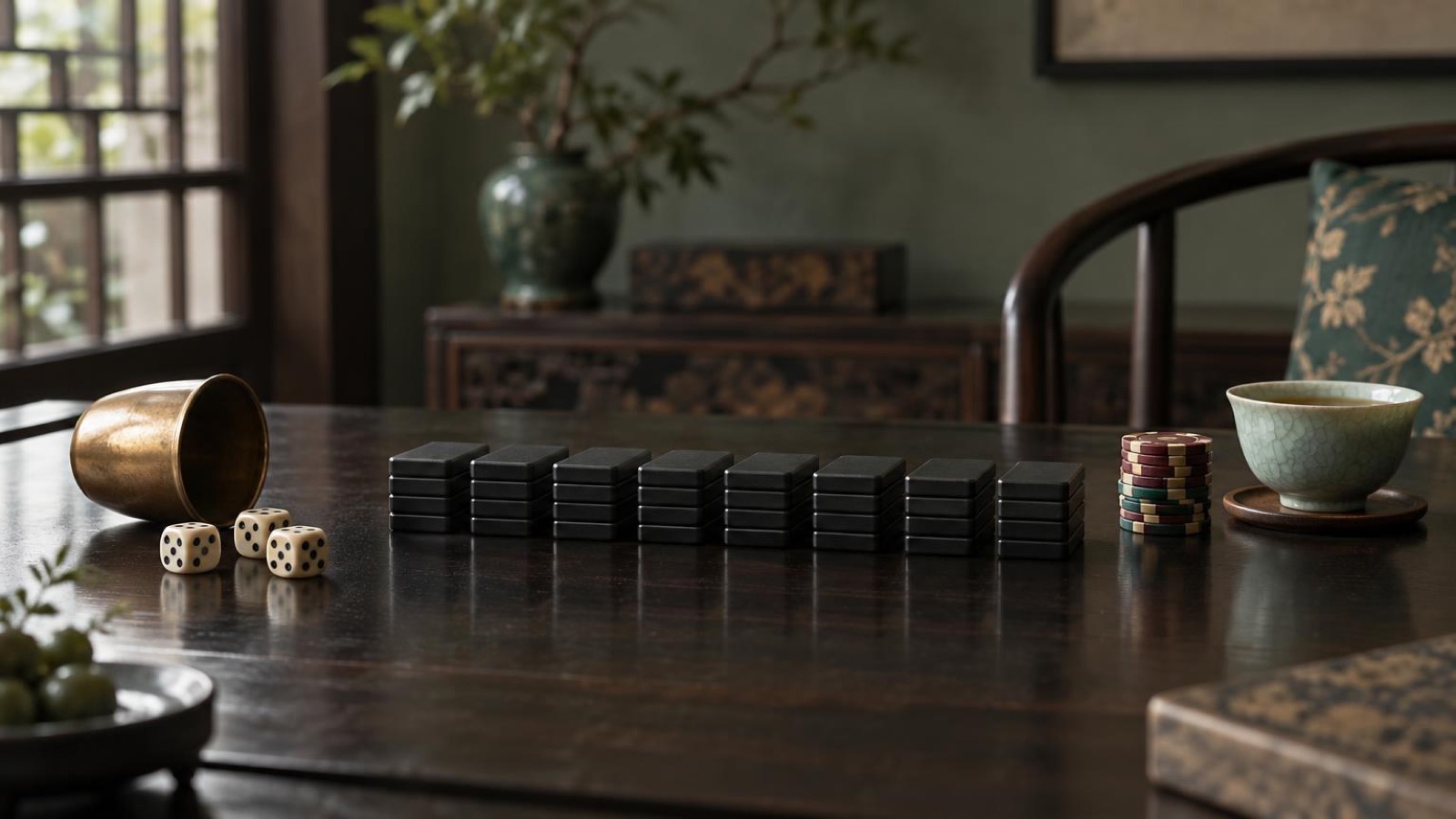
Pai Gow is one of the oldest games still dealt in casinos, and it is the ancestor of the American table game Pai Gow Poker. It is played with tiles rather than cards, the rankings are traditional rather than obvious, and the pace is slow and sociable. If you have seen it in a Macau casino or a Chinatown parlor and wondered what was happening, this page explains the whole game: the tiles, the rankings, the round, and the money.
The 32 tiles and the pairs they form
The game is played with a "deck" of 32 tiles, similar to dominoes. Each tile is twice as long as it is wide and has between 2 and 12 pips2. The 32 tiles include 21 number combinations and 11 duplicates3.
Eleven of the pairs are identical pairs: two tiles with exactly the same number of pips and the same pip pattern, totaling 22 tiles. These include the familiar names you will hear at the table: Teen (double six), Day, Yun, Gor, Mooy, Chong, Bon, Foo, Ping, Tit and Look4.
There are also five non-identical pairs, each with a two-word name. Four of these are the "chop" pairs: Chop Gow, Chop Bot, Chop Chit and Chop Ng. The fifth is special. The Gee Joon, or "supreme pair," is made up of the [4-2] and [2-1] tiles, and it is still considered a pair even though the two tiles look nothing alike1.
A hand in Pai Gow is always two tiles4. Your job is to arrange each pair so it scores as close as possible to nine, which is the perfect score. That is where the name comes from: "Pai Gow" means "to make nine"1.
How a round is played
The game is played by precisely 2 to 8 players, including the house dealer1. Everyone plays against a banker. Each player receives four tiles and forms them into two pairs, as does the banker2. You divide your four tiles into two hands of two tiles each: a high hand and a low hand1.
A round runs like this:
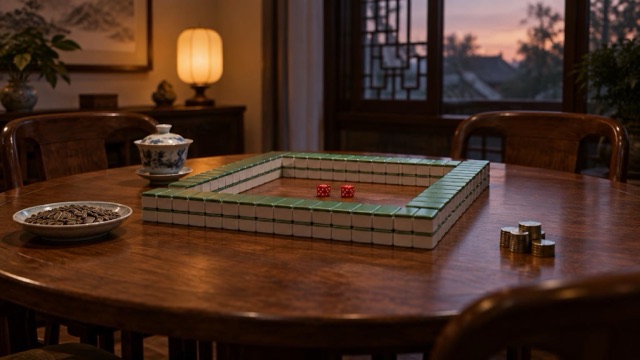
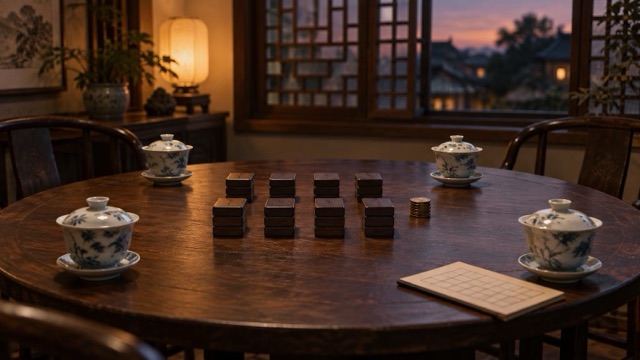
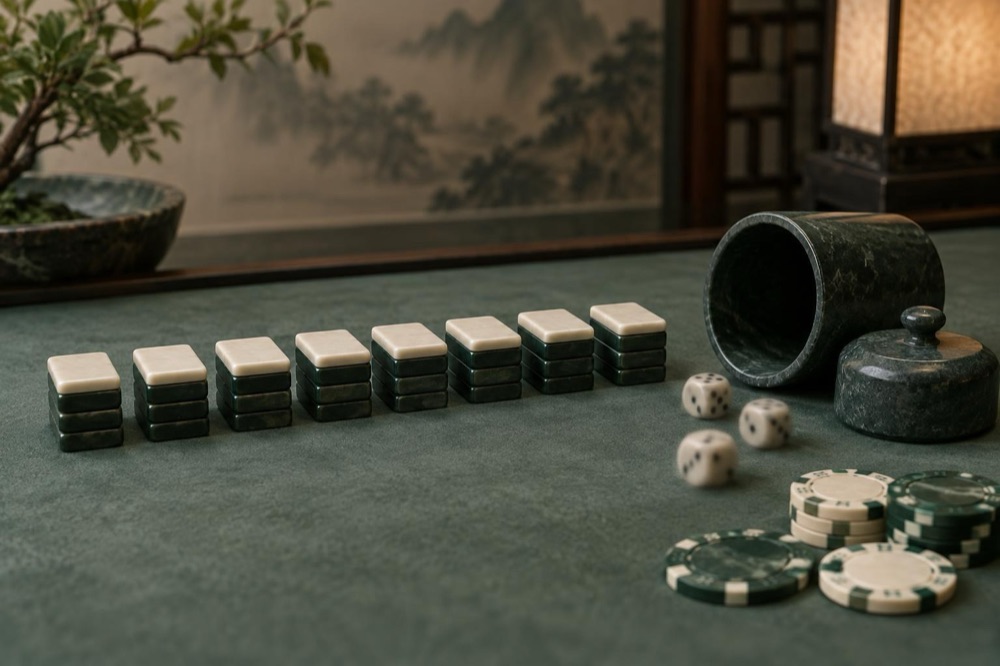
- The house dealer shuffles the 32 tiles and places them in eight stacks of four tiles in a line running from the dealer's right1.
- The banker rolls three dice in a cup. The total, between 3 and 18 inclusive, determines who receives the first set of four tiles, counting from the banker1.
- Each player splits their four tiles into a high hand and a low hand.
- The hands are compared. If both of your pairs outrank the banker's matching pairs, you win. If neither does, the banker wins. If just one does, the round is a draw2.
In Pai Gow there are four outcomes to each round: win, lose, push, or, for the banker, winning ties3.
The only decision: how to split your four tiles
Here is the remarkable thing about Pai Gow: the only decision made in the game is how to split your original four tiles5. There is no hitting, no drawing, no folding. You look at four tiles, decide which two go together, and the rest is comparison.
This makes the game closer to a puzzle than to poker. Two tiles can often be combined in more than one way, and the right split depends on the rankings, not on simple arithmetic. A weak-looking split that gives you two medium hands is often better than a greedy split that gives you one strong hand and one hopeless one, because you need both hands to win.
When you have no pair, no Wong, no Gong and no high 9, the best play is usually to make your two standard hands as close together in value as possible4.
Hand rankings: 16 pairs, lowest number wins
The pairs are ranked in order from 1 to 16, and here is the counterintuitive part: the lowest rank number is the strongest1. So the pair ranked 1 beats the pair ranked 16.
| Rank | Pair | What it is |
|---|---|---|
| 1 | Gee Joon | The supreme pair: [4-2] with [2-1] |
| 2 | Teen | Identical pair (double six) |
| 3 | Day | Identical pair |
| 4 | Yun | Identical pair |
| 5 | Gor | Identical pair |
| 6 | Mooy | Identical pair |
| 7 | Chong | Identical pair |
| 8 | Bon | Identical pair |
| 9 | Foo | Identical pair |
| 10 | Ping | Identical pair |
| 11 | Tit | Identical pair |
| 12 | Look | Identical pair |
| 13 | Chop Gow | Non-identical pair |
| 14 | Chop Bot | Non-identical pair |
| 15 | Chop Chit | Non-identical pair |
| 16 | Chop Ng | Non-identical pair |
The identical pairs run from the Teen down to the Look, and the four chop pairs sit at the bottom of the pair rankings4.
Below the pairs come the special combinations:
| Rank | Hand | What it is |
|---|---|---|
| 17 | Wong | A 12 tile (the Teen) with any 9 |
| 18 | Wong | A 2 tile (the Day) with any 9 |
| 19 | Gong | A 12 with any 8 |
| 20 | Gong | A 2 with any 8 |
So there are three groups of hands in Pai Gow: pairs, then Wongs, Gongs and high 9s, then standard hands4.
For standard hands, you add the pips of the two tiles and take only the ones digit, so a hand totaling 15 counts as 5, and a hand totaling 9 is perfect. The ranking is traditional and not obvious, which is why even experienced players keep a ranking chart nearby at first. The best pair is the Gee Joon, [4-2] with [2-1]1.
Ties, pushes and the tiebreaker rules
If only one of your hands beats only one of the dealer's, it is a tie and your bet pushes1. You keep your original bet: no win, no loss.
When two hands have the same total value, the tiebreaker is the rank of the highest single tile in the hand, not the number of pips4. So you take the highest tile in each hand and judge the hand on the rank of that tile. The hand with the highest ranked single tile wins; if both hands contain the same highest tile, the banker wins1.
This is where the [4-2] and [2-1] tiles get strange. On their own they are the lowest ranking single tiles2, yet together they form the Gee Joon, the supreme pair, which nothing beats1. So the same tile that is worthless in a tiebreak is half of the best hand in the game.
The banker and the 5% commission
The banker covers the wagers of the other players on each round, wins on all ties, and has special betting privileges1. In a casino, the dealer offers the banker role around the table before rounds, and a player who takes it can bet up to 10% more than the other players at the table2.
Each player who wins receives even money less a 5% commission, just like the banker bet in baccarat1. So if you win a $100 bet you will be paid $95 in winnings1. Some games collect the commission up front as part of your stake, which effectively reduces it from 1/20th of your bet (5%) to 1/21st (about 4.8%)1.
The banker's advantage comes from winning all ties, which is why the role is worth paying for. In player-banked games, the house never participates as a player/dealer and never takes a percentage of the game6.
Letting the house set your tiles
You have the option to ask for your tiles to be set the "house way," meaning the dealer sets the tiles exactly as the house would1. This is worth knowing on your first visit, because the rankings take a while to absorb and a mis-set hand can cost you the round.
Dealers are generally happy to help. Feel free to ask about the rules around hands, playing as the banker, or general gameplay7. Table etiquette is simple:
- Keep wallets and bags tucked away, and keep drinks in the holders7.
- Place your cash on the table rather than handing it to anyone when buying chips7.
Where Pai Gow fits among Chinese tile games: Tien Gow
Pai Gow belongs to a family of Chinese tile games, and its closest relative is Tien Gow (Tian Jiu). The two games share the same 32-tile set and much of the same vocabulary, including the Gee Joon, the supreme pair of [2-1] and [4-2] tiles, which in Tien Gow can beat nothing and is beaten by nothing8.
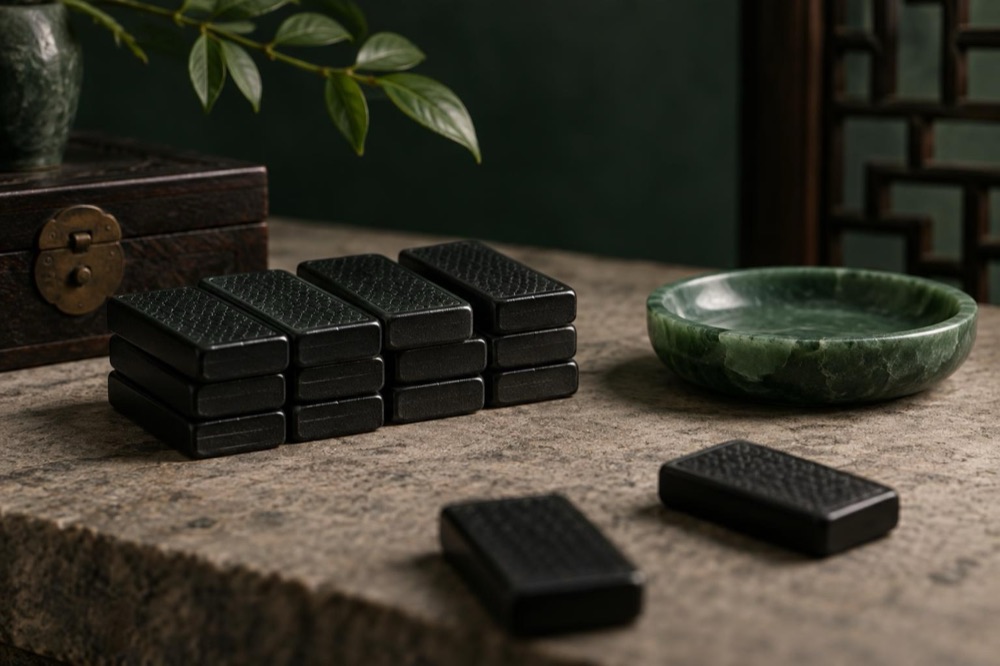
The difference is in the play. Tien Gow uses the same civil and military suit rankings, from Heaven [6-6] and Earth [1-1] down through the military tiles such as the Gow Nines [6-3] and [5-4], and it is a trick-taking game rather than a banking game8. Pai Gow, by contrast, is a comparing game: you never play tiles against other players' tiles in tricks, you only compare finished hands against the banker.
If you learn one, the tiles will look familiar in the other, but the strategy is entirely different. Pai Gow is the one you will find dealt in casinos, including in Macau, alongside other Chinese games.
Pai Gow tiles versus Pai Gow Poker
Do not confuse the two. Pai Gow tiles is the original Chinese game described on this page. Pai Gow Poker is an American table game that mixes elements of Pai Gow with seven-card poker5. It was created so that players familiar with poker hands could enjoy the same split-into-two structure without learning the traditional tile rankings.
The poker version is played with a 53-card deck that includes one joker6. Each player and the dealer is dealt seven cards that must be arranged into two poker hands: one with five cards and one with two6. The joker can be used as an ace or as any card that completes a straight or flush6.
The win conditions are the same shape as the tile game. You win your bet if your front and rear hands beat both of the dealer's hands, you lose if both tie or lose, and your bet pushes if only one hand wins6.
Pai Gow Poker is a sociable game with a relaxed pace of play5, and its house advantage is around three percent with a smart strategy as a player, but less than one percent if you are the banker9. The tile game is rarer in casinos outside Asia, but it is the deeper and older of the two, and in casinos in China's gambling hub of Macau it is the version dealt at the Pai Gow tables.
The tile game is very much its own thing: everyone plays against a banker, each player is dealt four dominoes and makes two pairs, and the 32-tile set includes 21 number combinations and 11 duplicates10.
Common Questions
How many players can play Pai Gow?
The game is played by 2 to 8 players including the house dealer. Everyone plays against a banker, and each player receives four tiles to form two hands. In casinos the dealer offers the banker role around the table before rounds.
What is the best pair in Pai Gow?
The Gee Joon, or supreme pair, made up of the [4-2] and [2-1] tiles. It adds up to 9 and wins every time. After it come the eleven identical pairs, then the four chop non-identical pairs.
Why are the [4-2] and [2-1] tiles both the lowest and part of the supreme pair?
On their own, [4-2] and [2-1] are the lowest ranking single tiles, which matters when hands tie and are judged on their highest tile. But together they form the Gee Joon, the supreme pair, which nothing beats.
What happens if I win one hand and lose the other?
The round is a push. You keep your original bet, with no win and no loss. You only win if both of your hands beat the banker's matching hands, and you only lose if both lose or tie.
How much does the banker's commission cost on a $100 bet?
Winning players are paid even money less a 5% commission, so a $100 bet pays $95 in winnings. If the commission is collected up front as part of your stake, the effective rate drops to about 4.8%.
What are the three dice used for?
After the tiles are shuffled and stacked, the banker rolls three dice in a cup. The total, between 3 and 18 inclusive, determines which seat receives the first set of four tiles.
Can I ask the dealer to set my tiles for me?
Yes. You can ask for your tiles to be set the house way, meaning the dealer sets them exactly as the house would. Dealers are also happy to answer questions about hands, banking, and general play.
Sources10 sources
- Pai Gow Poker: How to Play, Details, PlaySmart, 2026
- Pai Gow Poker: How to Play, PlaySmart, 2026
- Pai Gow, BoardGameGeek, BoardGameGeek, 2026
- Pai Gow Part B: Pairs and Standard Hands, WGM, 2012
- Pai Gow, Pagat, Pagat.com, 2023
- Hustler Casino Game Rules, California Department of Justice, 2021
- Pai Gow Poker Etiquette, PlaySmart, 2026
- Tien Gow, Pagat, Pagat.com, 2023
- How to Play Fortune Pai Gow Poker, GameSense, 2026
- Premium Rush: The Greatest Pai Gow Movie of All Time, Hollywood.com, 2022