Tien Gow, written 天九 in Chinese and sometimes romanized as tian jiu, is one of the old trick-taking games of the Chinese domino family. It is played by four people with a single set of 32 tiles, and its name refers to the highest pieces of the game's two suits. It is a cousin of Pai Gow (Chinese dominoes), which uses the same tiles but asks you to split your hand into two standing combinations rather than play tricks. Tien Gow is faster, more direct, and built around a simple question on every turn: can you beat what was led?
Players, equipment and hand size
The standard game seats exactly four players, and each player is dealt eight tiles from the 32-tile set1. That accounts for the whole set, so every tile is in someone's hand from the start. There is no draw pile and no discards. You play out your eight tiles over the course of the hand, mostly one at a time, and the hand ends when the last tile has been played.
The equipment is the ordinary Chinese domino set: 32 tiles, of which eleven are duplicated pairs of tiles, specifically 6-6, 6-5, 6-4, 6-1, 5-5, 5-1, 4-4, 3-3, 3-1, 2-2 and 1-1, with the remaining ten tiles appearing once each1. The tiles are divided into two suits, Civil and Military, and the suit a tile belongs to decides how it ranks. A 19th-century study of Chinese games recorded the same four-person, 32-piece setup under the name tá t'in kau, confirming that the shape of the game has hardly changed in well over a century2.
If you have played the casino version of Pai Gow, you will recognize the tiles at once. There, all players and the dealer receive four tiles each that they must split into two pairs3, and the same 32-tile set is used3. Tien Gow simply deals you twice as many tiles and makes you play them against the other players trick by trick.
The two suits: Civil and Military tiles
Every tile in the set belongs to one of two suits, and each suit has its own fixed ranking from highest to lowest1.
The Civil suit, in order:
| Rank | Tile | Name |
|---|---|---|
| 1 | [6-6] | Heaven |
| 2 | [1-1] | Earth |
| 3 | [4-4] | Man |
| 4 | [3-1] | Goose |
| 5 | [5-5] | Plum Flower |
| 6 | [3-3] | Double Three |
| 7 | [2-2] | Board |
| 8 | [6-5] | Hatchet |
| 9 | [6-4] | Partition |
| 10 | [6-1] | Long leg Seven |
| 11 | [5-1] | Big Head Six |
The Military suit, in order:
| Rank | Tiles | Name |
|---|---|---|
| 1 | [6-3], [5-4] | Gow, Nines (the two tiles are ranked equally) |
| 2 | [6-2], [5-3] | Bart, Eights (ranked equally) |
| 3 | [5-2], [4-3] | Chut, Sevens (ranked equally) |
| 4 | [4-2] | Lok, Six |
| 5 | [4-1], [3-2] | Ng, Fives (ranked equally) |
| 6 | [2-1] | Sam, Three |
Within a suit, a higher tile beats a lower one, and where two tiles are ranked equally, the one led first has priority1. The two suits do not fight each other directly: a Civil tile only ever competes against Civil tiles, and a Military tile against Military tiles. That is the heart of the game's strategy, because a lead forces everyone to answer in kind, and only tiles of the matching suit can win.
The Supreme pair: what it beats and what beats it
There is one special pair that stands outside both suit rankings: the Gee Joon, or Supreme pair, made up of the [2-1] and [4-2] tiles1. The [2-1] is the lowest Military tile, the Sam Three, and the [4-2] is the Lok Six, one step above it. Together they form the most famous combination in Chinese dominoes.
The Supreme pair has a strange double character. Nothing beats it, and it can beat nothing1. It only ever wins as a pair against another pair, and since no pair outranks it, a led Supreme pair always wins its trick. But if you split the pair and play the tiles singly, they are just weak Military tiles, and if someone leads a triplet or a quartet, your pair cannot answer at all.
In the casino Pai Gow game the same pair is the top-ranked combination, a perfect combo that adds up to 9 and wins every time3. In Tien Gow it is even more valuable in one way: any trick won by playing the Gee Joon immediately collects two points from each other player, on the spot, before the hand is even over1. Under the banker double rule, that becomes four points from or to the banker1. So the Supreme pair is not just a trick-winner, it is a payment event.
Setup and the wood piles
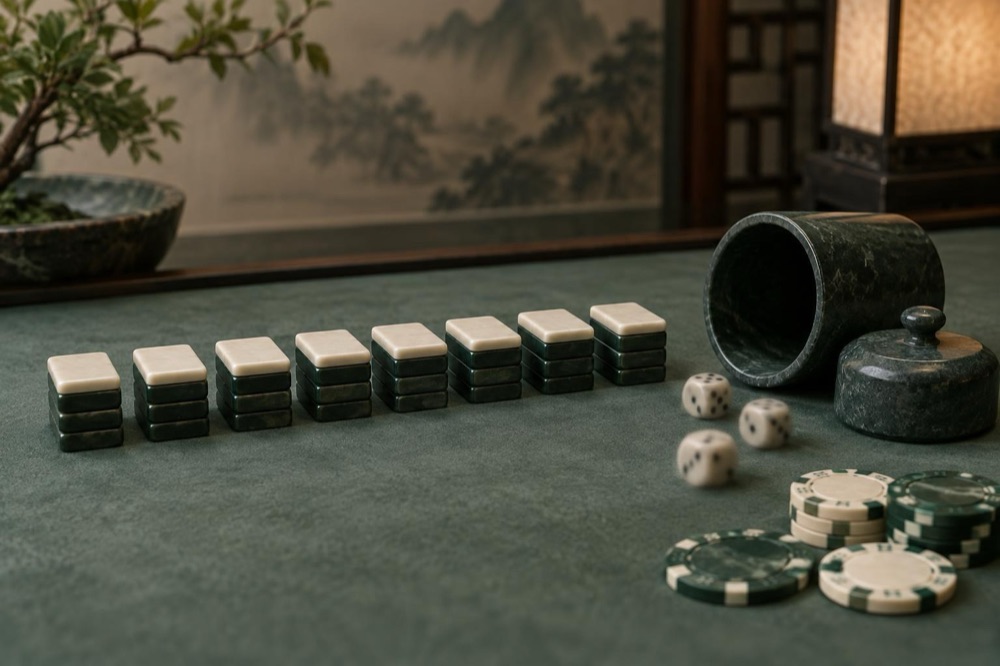
At the start of a hand, the 32 tiles are stacked face down in eight columns of four tiles each, called wood piles1. Each player takes two wood piles, giving the eight tiles of a hand1. The exact method of taking the piles varies from place to place, but the result is the same: four players, eight tiles each, all 32 tiles dealt.
The wood piles matter at the end of the hand as well as the beginning. As tricks are won, the captured tiles are stacked in columns in front of the winner, and at the end every non-winner counts the number of columns in front of him and compares it to a par value of four1. The columns you build during play are literally your score at the end.
How a turn works: singletons, pairs, triplets and quartets
The player holding the Heaven tile [6-6] leads the first trick1. On your turn to lead, you have four options1:
- one tile (a singleton)
- a pair of tiles (a bo, or pair)
- a set of three tiles (a triplet)
- a set of four tiles (a quartet)
The rule that makes the game work is that each subsequent player must follow with the same number of tiles of the same suit or suits as the lead1. If a singleton Civil tile is led, everyone must play a single Civil tile if they can. If a pair of Military tiles is led, everyone must answer with a pair of Military tiles. The highest tile of the matching suit wins the trick, and the winner leads the next one.
Pairs do not have to be natural pairs of identical tiles. Any two tiles of the same suit played together form a pair, and the pair is ranked by its higher tile1. Triplets and quartets work the same way: three or four tiles of one suit, ranked by the highest tile in the set. This is where the strategy lives. A hand full of high Civil tiles wants to lead Civil singletons and pairs, where it is strong. A hand with a run of Military tiles may prefer to lead triplets, forcing opponents to find three Military tiles of the same suit or surrender the trick.
Some special leads carry immediate payments. A player who wins a quartet trick immediately collects four points from each other player, with the banker double rule applying1. And there is a colorful bonus called Big Six Captures Little Three: if the last singleton trick is led with the Little Three [1-2] and won with the Big Six [2-4], the payments the other two players owe the Big Six player are paid by the Little Three player instead1. Leading your lowest tile into the final trick is therefore a genuine gamble.
Winning the hand and how points are paid
The hand ends when all tiles have been played. The winner of the hand is the player who has captured the most columns of tiles, and the settlement works against the par value of four1. Each non-winner counts the columns in front of him and settles with the winner according to where he stands against par. A player who captured six columns is two over par and is paid two points by the winner; a player who captured two columns is two under par and pays two.
There is a floor on the damage. Any non-winner with no columns at all, meaning no tricks won, pays five points instead of the four you would expect from simple arithmetic1. Winning nothing costs extra.
The 1893 account of the closely related tá t'in kau records the same idea in a plainer form: a trick counts one point, the holder of four or more tricks pays nothing, the holder of two tricks pays two points, the holder of one trick pays three points, and a player who takes no trick at all pays five2. The modern game's column-counting is a refinement of that same par-of-four settlement.
Payments also flow during the hand, not only at the end. The Gee Joon trick collects two points from each other player immediately, and a quartet trick collects four, as described above1. These per-trick payments are separate from the end-of-hand settlement.
Multipliers and penalties that change the score
Several rules can double or multiply what everyone owes.
The last trick bonus doubles the end-of-hand payments, though not the per-trick payments, for everyone if the last trick is won by any quartet, by the Gee Joon, or by the singleton Little Three1. So the final trick of the hand is worth watching even when the outcome seems settled.
The complete game bonus doubles the end-of-hand payments if any player wins all eight tiles, whether through clever use of the early death rule or by sheer strength1. If that all-winning hand also takes the last trick with a bonus combination, the payments are quadrupled, and if the banker is the one who wins everything, they are multiplied by eight1.
The early death rule is a forfeit that speeds up hopeless hands. If seven tiles have been played and the last trick is a singleton, any players who have not won a single trick during the first seven tiles immediately forfeit the last trick as well, and pay five points to its winner1. If you have won nothing by the seventh tile, you are out of the last trick and pay for it.
Several special situations change the score in Tien Gow. If a set of 4 tiles is played, the score is multiplied by 4, and a player who wins eight columns also gets the score multiplied by 4, a situation the French sources call "à huit heures et suite"1. A non-winner who ends the game with no columns pays five points instead of the usual four, and when a complete series of four tiles is played, a score of four points is deducted, adjusted according to the dealer rule.
Variants: Hong Kong dealer rule and two-player play
A local variation in Hong Kong changes how the banker's streaks are paid: when the banker wins, the payments are multiplied by his number of consecutive wins, so doubled on his second straight win, tripled on the third, quadrupled on the fourth1. A banker who keeps winning becomes progressively more expensive to lose to, which makes breaking a banker's run a shared project for the whole table.
Those older games also carried their own payment customs. In tá t'in kau, the first player, or tsò chong, always pays twice the amount when he loses and is paid double when he wins, and if he holds the position the ratio rises to 3 to 1 in the second game and 4 to 1 in the third2. A round won with the chí tsün pair, the 2-4 and 1-2 tiles, paid the winner four times if taken by another player and twice from the others, with four corresponding pairs paying eight times and four times respectively2. In gambling houses, the winner of a round with the chí tsün had to put the value of one point, and the winner with two corresponding pairs two points, into a box for the house2, an early form of table rake.
Playing for money
Tien Gow is a points game, and the points are usually worth money. Before a hand, the players agree what a point is worth, and all the payments described above, the per-trick payments, the end-of-hand settlement against par, and the various doublings, are settled in cash or chips at the end1. The banker double rule, under which the banker pays and is paid double, including four points on a Gee Joon trick, is the main reason the banker's seat matters1.
The old gambling-house practice of skimming a point from certain bonus wins into a box for the house2 has its modern echo in the casino rake taken on tile and card games today. If you sit down to play in a club or private game, the practical questions to settle first are what a point is worth, who is banker and for how long, and which of the optional rules, early death, One Red Dot, the Hong Kong banker streak multiplier, are in effect. None of them are universal, and they change the money substantially.
For a sense of scale, the casino descendants of the same tiles give a useful comparison. In casino Pai Gow each player gets just four tiles split into two pairs3, and a casino Pai Gow Poker table seats six players plus a dealer's area5, a much faster, house-banked format. Tien Gow, by contrast, is a player-against-player game where the whole set is dealt out and every tile you hold will eventually hit the table. That is its appeal: no standing hands, no pushes, just eight tiles and eight decisions.
Common Questions
How many tiles does each player get in Tien Gow?
Each of the four players is dealt eight tiles from a single set of 32 Chinese dominoes. Over the hand you play those eight tiles in tricks, usually one at a time, until they are gone.
What is the Supreme pair in Tien Gow?
The Gee Joon, or Supreme pair, is made of the [2-1] and [4-2] tiles. Nothing beats it, and it beats nothing. It only wins as a pair against another pair, and winning a trick with it collects two points from each other player on the spot.
Can you play Tien Gow with two players?
The standard game is for four players, but older two-player domino games from the same family exist, such as Naú t'in kau, played by two people with one set of dominoes. Some related games accept anywhere from two to twenty players.
What are the Civil and Military tiles?
The 32 tiles divide into two suits. The Civil suit runs from Heaven [6-6] down to Big Head Six [5-1], and the Military suit runs from the Gow Nines down to the Sam Three [2-1]. Within each suit, higher-ranked tiles beat lower ones.
How do you win a hand of Tien Gow?
You win tricks by playing the highest tile or set of the same type and size as what was led. At the end, each non-winner compares the number of tile columns won against a par of four, paying the winner if short of par and collecting from the winner if over it.
What happens if the Supreme is played before the last trick?
Winning any trick with the Gee Joon collects two points from each other player immediately, no matter when it is played. If it wins the last trick, end-of-hand payments are also doubled for everyone.
Can you split a pair in Tien Gow?
Yes. You are never forced to keep a pair together. You can play one tile of a pair as a singleton and save the other, though the two tiles of most pairs only reach full strength when played together.
Sources5 sources
- Tien Gow, Pagat.com, 2020-09-16
- Chinese Games with Dice and Dominoes (Culin 1893), Smithsonian Repository, 1893
- How to Play Pai Gow Poker: Details, PlaySmart, 2026-09-25
- Hustler Casino Pai Gow rules, California Department of Justice, 2021
- How to Play Pai Gow Poker, PlaySmart, 2026-09-25