Poker in China: what is legal and what is not
Gambling in mainland China is illegal, and that includes cash poker rooms and casino-style poker tournaments. Macau, the special administrative region an hour by ferry from Hong Kong, is the one exception on Chinese soil, with full casino resorts4. For poker specifically, the mainland offers a narrow legal path: clubs licensed as mind sports venues, where you pay membership fees and compete for points and non-monetary prizes rather than cash1.
The line the authorities draw is about money. Recreational card play is tolerated when there is no profit motive: mahjong games among friends, or chess and card rooms that charge only fixed venue and service fees, are not treated as gambling6. The moment cash changes hands based on who wins, the activity crosses into illegal gambling. Organizing or taking part in cash poker is a criminal offense under Article 303 of the Penal Law1.
For Chinese citizens, the restriction follows you abroad too. Cross-border gambling has been formally criminalized, so a Chinese citizen playing poker for money in a legally licensed casino outside China can still face liability at home7. Foreign visitors and residents in China face a different set of risks: those caught gambling online can be blacklisted and banned from re-entry for 10 years5.
If you want the wider picture of what is and is not allowed, see gambling in China.
Legal poker clubs: who can play and how
Legal poker in the mainland lives inside sports poker clubs, and there are only a few of them. The best known is the Mo Li Poker Sport Club in Beijing, established in 2012, which is the longest running and the only legal poker room in mainland China. Others have operated in Sanya on Hainan island, and clubs such as the Xian Baoyulin Poker Sporting Club in Xian carry the same sports club format1.
How a visit works:
- Entry. Both Chinese nationals and foreigners can enter. Foreigners must register with a passport1.
- Money. You pay a membership fee or entry fee for the venue, not a buy-in that becomes a cash prize pool1.
- Prizes. Winnings are paid in points, tickets or physical prizes, never cash, because a cash payout would make the game illegal gambling1.
- Games. Texas Hold'em is the standard format, run as tournament-style play rather than cash tables1.
Hong Kong, which many visitors treat as the nearby alternative, is actually stricter for poker. Only the Hong Kong Jockey Club may legally run gambling there, and poker is not among its games. Poker does exist in Hong Kong inside private members-only clubs, where games are restricted to paying members who complete a formal membership application before playing8.
Playing poker online from China
Online poker for money is effectively dead in mainland China. Online gambling is illegal, there are no Chinese-owned or licensed poker sites, and operating one is a crime. Enforcement energy goes mainly after operators rather than individual players, but players are not immune: authorities warn that even small online bets are illegal, and individuals caught gambling online risk fines and imprisonment1.
Practical barriers reinforce the legal ones. The Great Firewall blocks direct access to most global poker platforms, and ordinary Chinese payment methods generally cannot be used on the offshore sites that remain reachable, so players who try anyway end up on VPNs and crypto workarounds9.
Money lost online is gone for good. Chinese authorities state plainly that funds lost in online gambling are not protected by law and cannot be recovered, so there is no complaint channel if an offshore site refuses to pay out10.
For Chinese citizens, the same rules reach beyond the border: gambling abroad, gambling online, and providing funds or technical support for gambling all violate Chinese law regardless of where the site or casino is licensed11. Our full page on online poker in China covers the platforms, access methods and risks in detail.
Competitive Er Da Yi Poker National Championship
The most striking example of legal competitive poker in China is the National Competitive Er Da Yi Poker Championship, a state-sanctioned tournament for Er Da Yi, a competitive two-against-one card game in the dou di zhu family. The first championship was announced with a total prize pool of CNY 5,000,000, and the inaugural national champion took home CNY 1,000,0002.
The format had two stages. An online stage ran across five partner platforms, with strategic cooperation agreements signed with Lianzhong, Migu, Sina, 360 and Tencent, and players could compete by computer or mobile phone13. All participants registered under their real names and earned master points in a unified national ranking, with rank titles attached13. Selection ran nationwide as an open audition, roughly a year long, after which the top 2,000 players by master points advanced to the land-based stage, played in internet cafe service venues, followed by semifinals and a grand final2.
What makes the championship interesting is the model: poker-style card play, treated as a competitive mind sport, with real prize money, run in cooperation with the country's biggest internet companies. It is the clearest sign of how China separates competitive card gaming from gambling. The partner network eventually grew to include Tuyou, Sina, Tencent, Migu, Ourgame, JJ, Boyaa and Daren15.
Chinese Poker (Shisan Zhang): rules and scoring
Chinese Poker, called Shisan Zhang or 13-card, is the poker variant that actually belongs to Chinese home culture, and it works nothing like Texas Hold'em. There is no betting round by round and no bluffing. Instead, each player is dealt 13 cards from a standard 52-card deck with no jokers, and arranges them into three separate poker hands3:
| Row | Cards | Requirement |
|---|---|---|
| Bottom | 5 | Must be your strongest hand |
| Middle | 5 | Weaker than bottom, stronger than top |
| Top | 3 | Your weakest hand |
The game seats two to four players. Once everyone has set their rows, the hands are revealed and each row is compared directly against the same row of every opponent, using standard poker hand rankings3.
A popular modern offshoot is Open Face Chinese (OFC), where the cards arrive gradually: you get the first 5 cards face up and place them, then receive one card at a time until you hold 13. Because you commit cards before seeing the rest, OFC is as much a puzzle as a card game17.
Our dedicated page on Chinese Poker (Shisan Zhang) walks through the full rules, royalties and variants.
How the points and scoops work
Chinese Poker is scored in points, and each point carries an agreed value set by the players before the game starts. Each row is worth one point, so in a heads-up match you can win or lose up to three points per deal before bonuses3.
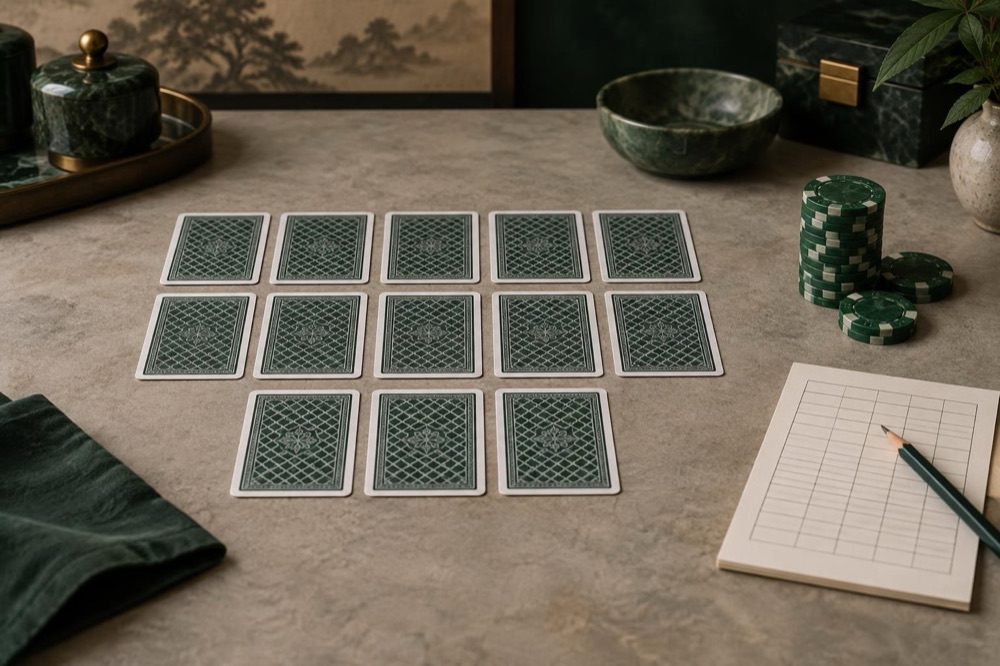
The big swing is the scoop. If you win all three rows against an opponent, you collect a three-point scoop bonus on top of the three row points. You also scoop automatically if your opponent fouls3.
A foul is what happens when you set your hand wrong. The rule is strict: the bottom row must be stronger than the middle row, and the middle row stronger than the top row. If you break that order, your hand is declared foul and your opponent scoops the entire hand, all rows at once. In Open Face Chinese the same principle applies mid-hand: if your top hand ends up stronger than your middle, or your middle stronger than your bottom, the hand is fouled3.
Because a foul costs you everything, the real skill in Chinese Poker is not making the strongest possible hands but making three hands that respect the order while staying strong enough to win rows. A player who puts a flush on top and a pair on the bottom has fouled and lost the deal no matter how good those individual hands look.
What to read next
Two pages go deeper on the subjects introduced here:
- Online poker in China: the full picture of what platforms are reachable, how the Great Firewall and payment blocks work in practice, and what the risks are for players and operators.
- Chinese Poker (Shisan Zhang): complete rules for 13-card and Open Face Chinese, including royalties, scoring examples and variants.
If you are curious about the wider card culture that surrounds poker in China, see chess and card rooms (qipai shi), the venues where most legal card play actually happens, or traditional Chinese card games for games like dou dizhu, the closest local cousin of the Er Da Yi championship game. For the rules on everything else, start with gambling in China.
Common Questions
Can foreigners play poker in China?
Yes, foreigners can play at the licensed sports poker clubs, such as those in Beijing or Sanya, but you must register with your passport. Payouts at these clubs are in points or tickets rather than cash.
Do poker clubs in China pay out in cash?
No. Legal clubs operate as mind sports venues with membership fees and non-monetary prizes. Playing poker for cash, or organizing cash games, is treated as a criminal offense in mainland China.
Is playing online poker a crime in China?
Online gambling is illegal in China and there are no licensed Chinese poker sites. Enforcement focuses mainly on operators, but individual players caught gambling online can face fines or worse.
How many cards are dealt in Chinese Poker?
Each player gets 13 cards from a standard 52-card deck with no jokers, and arranges them into three hands: a three-card hand on top and two five-card hands below it.
What happens if you set your hand wrong in Chinese Poker?
Your hand is fouled. The bottom row must beat the middle row, and the middle row must beat the top row. A fouled hand loses automatically and your opponent scoops all three rows.
Which platforms hosted the Er Da Yi championship online stage?
The championship signed cooperation agreements with five platforms: Lianzhong, Migu, Sina, 360 and Tencent. Players competed by computer or mobile phone under real-name registration.
Can I recover money lost gambling online in China?
No. Money lost in online gambling is not protected by Chinese law and cannot be recovered, which is one reason authorities urge people not to take part at all.
Sources17 sources
- Poker in China, SoMuchPoker, 2026-08-20
- 竞技二打一扑克全国锦标赛, General Administration of Sport of China, 2016-09-05
- Chinese Poker, 888poker, 2018-12-06
- Adelson looks to Macau, The New York Times (Chinese edition), 2012-08-15
- Best online casinos for players from China, Wizard of Odds, 2026-05-05
- 麻将娱乐不以赌博论处, China Peace, 2023-05-23
- China expands its strategy to curb cross-border gambling, GambleSector, 2026-02-20
- Poker in Hong Kong, SoMuchPoker, 2026-02-23
- China-friendly poker sites, SoMuchPoker, 2026-01-01
- 网络赌球资金不受法律保护, National Anti-Gambling Platform, 2026-08-18
- 出境参赌与网上赌博均违法, National Immigration Administration, 2021-02-05
- 竞技二打一扑克锦标赛即将举行, General Administration of Sport of China, 2016-04-05
- 与五家棋牌游戏运营平台签订战略合作协议, General Administration of Sport of China, 2016-04-05
- 竞技二打一扑克全国海选, National Business Daily, 2016-09-03
- 竞技趣味棋牌赛事战略合作伙伴, General Administration of Sport of China, 2016-09-05
- Hustler Casino 13-Card rules, California Department of Justice, 2021
- Open Face Chinese Poker, CoinPoker, 2023-04-13