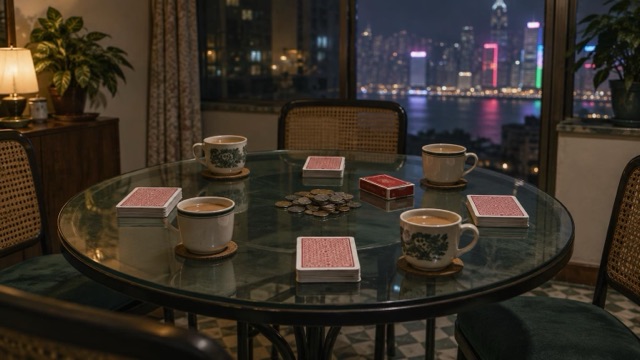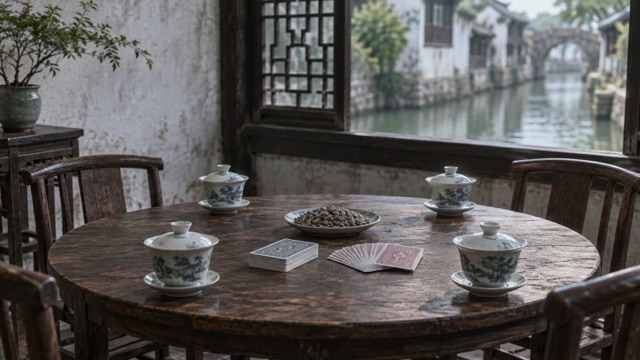
The game itself: San Da Yi and Er Da Yi
San Da Yi literally means "three hit one." It is a trick-taking card game for four players, in which three players form a temporary alliance against a single opponent, usually after a bidding round decides which player is on their own. The lone player wins the hand only by taking enough tricks against the combined force of the other three, which makes every hand a lopsided contest rather than a free-for-all. The game is a favorite in Shanghai and across eastern and northern China, played at kitchen tables, in neighborhood card rooms and, increasingly, on phone screens.
Er Da Yi, "two hit one," is the same idea squeezed down to three players: two against one. If you know Dou Dizhu, the most famous member of this family, you already understand the shape of the game, because Dou Dizhu is itself a two-against-one contest with a landlord on one side and two peasants on the other. Er Da Yi is an older, plainer relative of that game, and it is the version that caught the attention of China's competitive card game organizers.
What makes these games durable is the shifting alliance. You are never playing three opponents and never playing three friends. On one hand you defend together; on the next you are the one everybody is trying to bury. That constant flip, plus hands that play quickly, is why the format translated so naturally into organized online competition.
The national championship at a glance
Er Da Yi in China is not just a living room game. The National Competitive Er Da Yi Poker Championship was launched with a total prize pool of CNY 5,000,000, making it one of the richest card game events in the country1. The championship is run in two stages: a long online stage open to players nationwide, followed by a land-based stage for those who survive the online grind1.

The organizers took the format seriously from the start. The tournament borrowed the duplicate format used in international bridge competition, and the whole event is played without physical cards, which removes the luck of the draw from comparing results across tables3. In a duplicate format, the same deals are played at multiple tables, so what is being measured is how well you handle a fixed set of cards compared with everyone else who held them. That is a very different test from an ordinary evening of cards, and it is the reason the championship can credibly crown a national champion.
Every registered participant plays under real-name registration and is tracked in a unified national Master Points ranking, with rank titles awarded for achievement2. The Master Points system means your results accumulate over the whole competition rather than living and dying with a single session, closer to how bridge and chess rank their players than to how a one-night card game sorts winners from losers.
Prize money: CNY 5,000,000 total and a CNY 1,000,000 champion's purse
The headline numbers are simple. The total prize pool for the national championship is CNY 5,000,0001, and the first national champion takes home CNY 1,000,000 of it4. That champion's purse is a serious figure by the standards of any card game anywhere, and it puts the top prize in the same league as major tournament payouts in much larger and more international games.
The remaining CNY 4,000,000 is spread across the rest of the field, which at a championship drawing players from five national platforms is a wide field indeed. Because the event uses a Master Points ranking rather than a single knockout day, the prize structure rewards sustained performance over the full competition rather than one lucky run.
For context on what online card competition in China typically pays, some Chinese card game platforms run daily guaranteed tournaments with prize pools of CNY 500,000 or more per day, and special event tournaments with guaranteed pools of CNY 1,888,8885. The national championship's CNY 5,000,000 sits well above those regular platform events, which is exactly the point: it is the flagship, not the weekly grind.
How players enter and qualify
Entry to the national championship begins online, and it begins early. The competition runs through the following stages:
| Stage | What happens |
|---|---|
| Selection stage | Lasts about one year, after which the players ranked in the top 2,000 nationally by Master Points advance to the next round4 |
| Semifinals | The field narrows through the semifinals4 |
| Grand final | The surviving players compete in the grand final4 |
A year-long selection stage changes the character of the event. There is no single qualifying day you can circle on the calendar, no one session that makes or breaks you. Your ranking is built from accumulated results across the whole window, so consistency matters as much as any single hot streak. If you join late, you have fewer chances to gather Master Points; if you join early, you have the longest runway but also the longest commitment.
The practical path for an ordinary player looks like this:
- Register on one of the partner platforms under your real name, since all registered participants use real-name registration and are entered into the unified national ranking2.
- Play in ranked competition on that platform over the selection year, accumulating Master Points.
- Finish the selection stage inside the national top 2,000 to advance4.
- Survive the semifinals to reach the grand final, where the CNY 1,000,000 champion's purse is decided4.
Because ranking is national and unified across the participating platforms, you are not just competing against the regulars on your own app. You are competing against everyone in the country playing the same game under the same system.
Playing online: platforms, computer and mobile entry
The online stage is genuinely open in terms of hardware. Players nationwide can compete by computer or mobile phone, across multiple platforms4. The championship organizers signed strategic cooperation agreements with five game platforms to host the competition: Lianzhong, Migu, Sina, 360 and Tencent1. Between them, those five cover a large share of China's online card game audience, so most players can join on a platform they already know.

The five-platform setup also means you are not locked into one operator's software. Lianzhong is one of the oldest names in Chinese online card games; Tencent and 360 bring enormous existing user bases; Migu and Sina round out the field. All of them feed results into the same national Master Points ranking2, so the platform is a doorway, not a separate silo.
On devices, Chinese card game platforms broadly support iOS (iPhone and iPad) and Android smartphones and tablets6, so phone entry is normal rather than an afterthought. This mirrors the wider world of online card and casino play, where social card games are freely available on social networks, websites, apps, smartphones and tablets7, and where major online tournament series are routinely playable on both PC and smartphone8. If you can install an app and hold a stable connection, you can play.
A practical note for anyone playing ranked competition on a phone: a year-long selection stage means a lot of sessions, and connection stability matters more in duplicate-format play than in a casual game, because a dropped hand is a lost opportunity to gather ranking points. A stable Wi-Fi connection beats a marginal mobile signal for anything that counts.
The land-based stage in internet cafe venues
After the online stage ends, the championship moves offline. The top 2,000 players in the national ranking advance to the land-based stage, and that stage is played in internet cafe service venues across China1. The online stage of the first championship ran until June of the following year before handing over to the land-based rounds1.
Internet cafes (wangba) may sound like an odd venue for the business end of a CNY 5,000,000 championship, but the choice is practical. They are licensed commercial venues with rows of connected computers, they exist in every city in China, and they give organizers a controlled, supervised environment for competitive play. For players who qualified on a phone at home, the land-based stage moves everyone onto identical hardware in a watched room, which fits the duplicate spirit of the event: same conditions, same deals, skill decides.
If you picture a smoke-filled basement, update the picture. Modern internet cafes in Chinese cities are often bright, carded, membership-style businesses with gaming-grade machines, and hosting a national championship stage is exactly the kind of event they are set up to run. Advancing players should expect to travel to a participating venue, play scheduled sessions against other qualifiers, and work down toward the semifinals and grand final4.
Who can take part
The championship is open to Er Da Yi players across China who register under their real name on one of the five partner platforms2. There is no anonymous entry: real-name registration is the entry ticket, and it is what makes the unified national Master Points ranking possible. The same real-name system applies whether you are a local resident or a foreigner living in China with platform access and the language to play.
One thing to keep straight: the championship is a competitive, ranked card event, not a gambling product, and playing cards for money with strangers sits in a different category under Chinese law. If you are unsure where the line falls, our page on gambling laws in China covers it plainly.
San Da Yi at home and in card rooms
Away from the championship, San Da Yi and Er Da Yi live where Chinese card games have always lived: at home with family, and in the neighborhood chess and card rooms (qipai shi) that exist in practically every Chinese town. Card rooms typically rent tables by the hour, sell tea and snacks, and host regulars who treat an afternoon of cards as a social institution. San Da Yi fits that setting perfectly, because four players make a full table and hands resolve quickly enough to keep the room lively.
The other modern home for the game is the app store. Card and mahjong apps have carried San Da Yi, Er Da Yi and their many regional cousins onto phones, with iOS and Android both supported across the major Chinese platforms6. Casual play on these apps is free or nearly free, and it is how most of the hundreds of thousands of ranked players in a national championship field first learned the game.
If you are a visitor or new expat in China and want to watch rather than play, a neighborhood card room in the evening is the easiest place to see San Da Yi in the wild. Ask before sitting down, buy a drink, and let the regulars know you are learning; the "gang up on one" structure is easy to follow even before you understand the card rankings, because the table talk makes it obvious who is alone and who is allied.
Related games and pages
San Da Yi belongs to a large family of Chinese partnership-and-attack card games. The closest relatives worth knowing:
- Dou Dizhu: the famous two-against-one game, and the closest national cousin of Er Da Yi
- Big Two: the shedding game that shares much of the hand ranking logic
- Guandan and Zheng Shangyou: the partnership game that has become a competitive favorite in eastern China
- Traditional Chinese card games: the wider family, including Shanghainese favorites
- Poker in China and online poker in China: how western-style poker fits alongside games like Er Da Yi
For the broader picture of what you can and cannot play in the country, see gambling in China.
Common Questions
What is the top prize for the national champion?
The champion of the National Competitive Er Da Yi Poker Championship takes home CNY 1,000,000, out of a total prize pool of CNY 5,000,000 spread across the field.
How many players advance past the selection stage?
The top 2,000 players in the national Master Points ranking at the end of the selection stage advance to the next round of the championship.
How long does the selection stage last?
The national online selection stage runs for about one year, after which the top 2,000 ranked players move on to the later rounds.
Can I play on my phone?
Yes. The championship can be played by computer or mobile phone across several partner platforms, and card game apps in general support both iOS and Android devices.
Is registration anonymous?
No. All championship participants register under their real name, and every registered player is tracked in a unified national Master Points ranking with rank titles.
Where is the land-based stage played?
The land-based stage of the national championship is held in internet cafe service venues across China, after the online stage wraps up.
Sources8 sources
- 竞技二打一扑克全国锦标赛即将举行 (Competitive Er Da Yi Poker National Championship announcement), General Administration of Sport of China (archived), April 5, 2016
- 竞技二打一扑克全国锦标赛 (Competitive Er Da Yi Poker National Championship), General Administration of Sport of China, April 5, 2016
- 全国竞技二打一扑克锦标赛 (archived copy), General Administration of Sport of China (archived), September 5, 2016
- 全国竞技二打一扑克锦标赛 (National Competitive Er Da Yi Poker Championship), General Administration of Sport of China, September 5, 2016
- GXJM888 platform page, GXJM888, accessed September 26, 2026
- 微扑克 (WPK) official page, WPK, accessed September 26, 2026
- Gaming and Gambling (Safer Play), Responsible Gambling Council, accessed September 25, 2026
- Tournament Guide (トーナメントガイド), CoinPoker, accessed September 26, 2026