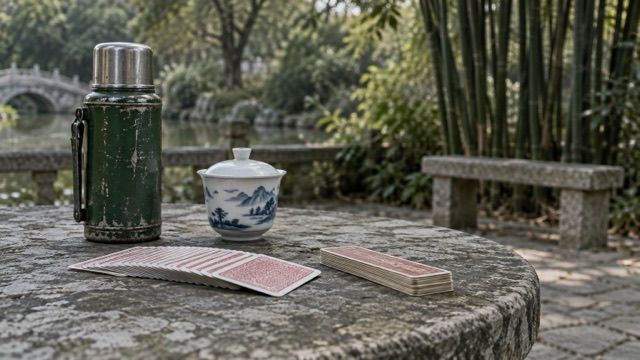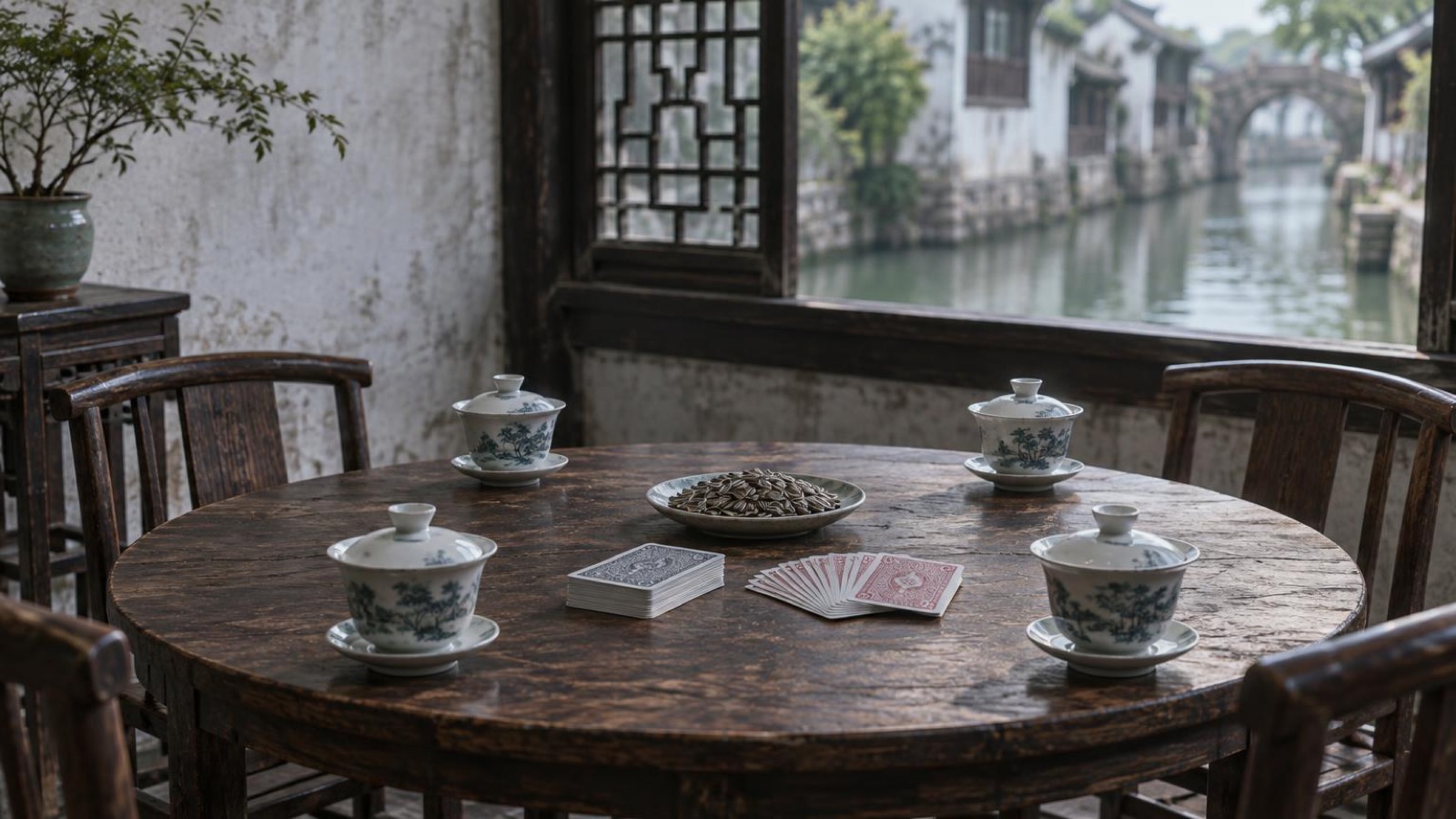
What Guandan is
Guandan, written 掼蛋 in Chinese, is a card game for four players in two fixed partnerships. The name is colloquial and memorable, and the game itself is exactly that: a fast, talky, social contest in which you and the player sitting opposite you try to run out of cards before the opposing pair does.
It belongs to a family of games that card players call climbing games. In a climbing game, someone leads a card or group of cards, and each following player must either beat that play with something stronger or pass. The round continues until nobody can or wants to beat the last play, and then the winner of that round leads the next one. The goal is simple: get rid of everything in your hand. If you have ever seen Dou Dizhu (Fight the Landlord) or Big Two (Choh Dai Di), you already understand the basic engine, because both of those run on the same principle.
What sets Guandan apart from its relatives is the partnership structure and the way a match unfolds. You are not playing for yourself; you are playing with a partner, protecting them, setting them up, and sometimes sacrificing your own position so they can finish first. And a match is not a single hand. Teams carry a level forward from hand to hand, climbing upward through the ranks, which gives a full game of Guandan the shape of a long contest rather than a quick deal. That is a big part of why it has become such a popular sitting game: there is always a story to the match, a comeback to attempt, a level to defend.
Guandan's rise has been remarkable. From its roots in Jiangsu province it spread through eastern China and then nationwide, picked up by business people, officials, students and retirees alike. It is now common at dinners, train journeys, office lunch breaks and dedicated card rooms, and it has a real tournament scene, with organized events that treat it as a mind sport rather than a pastime. For many players it fills the same social slot that mahjong in China fills for others, with the difference that no money needs to change hands.
How the game is played
The heart of Guandan is the climbing exchange. Here is the shape of a hand:
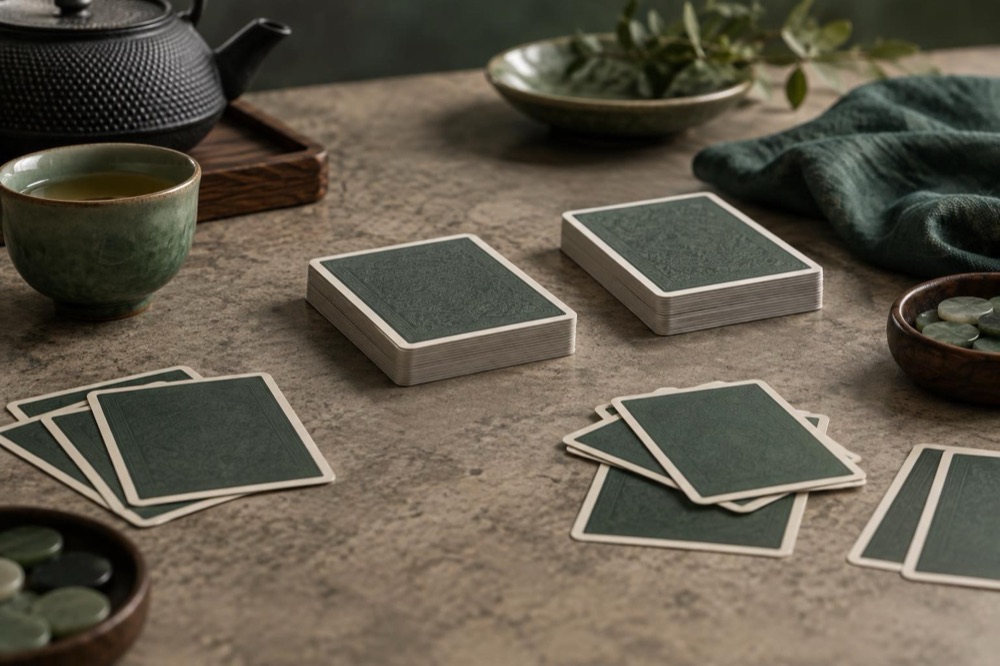
- The deal. Cards are dealt around the table so that every player holds a large hand. In its ancestor Zheng Shangyou, the cards are dealt to the players singly, counterclockwise, starting with the dealer1, and that dealing habit carries through the family.
- The lead. A player starts by putting down a card or a combination: a single, a pair, a triple, a run of consecutive cards, or one of the larger set plays.
- The climb. Each other player, in turn, either beats the play with a stronger combination of the same type or passes. You cannot beat a pair with a triple; you have to answer like with like.
- The reset. When everyone else has passed, the player who made the last unbeaten play wins the trick and leads whatever they like next.
- The finish. Play continues until players run out of cards. The first team to get both its members out ahead of the opposition wins the hand, and the result is converted into points and level progress for the match.
Combinations follow a hierarchy that will feel familiar to anyone who knows poker hands or Chinese shedding games: singles are beaten by bigger singles, pairs by bigger pairs, and so on up through triples, full-house style combinations, straight sequences and the big bomb-type plays that can beat almost anything. One rule from the family's older branch is worth knowing because it shows the logic: in Zheng Shangyou, any single suited sequence is better than any mixed suited sequence of the same length1. Clean runs outrank messy ones, and that kind of thinking about what beats what is the whole grammar of the game.
Because a match moves through levels, the rank that matters changes as the game goes on, and a card that was ordinary last hand becomes powerful this hand. This is the part that most surprises people coming from poker: the value of a card is not fixed, it depends on where the match stands.
Strategy, at its simplest, is about three things. First, shape your hand early: work out whether you are trying to finish first or trying to help your partner finish. Second, control the tempo: leading small to draw out the opposition's big cards, or holding back a bomb for the moment it wins the hand. Third, read your partner: because you can see what they play and what they pass on, a good partnership communicates through the cards themselves. Passing is a message. Leading low is a message. Half the skill of Guandan is sending and reading those messages without saying a word.
A hand is quick. Individual plays take seconds, and a complete deal resolves in minutes, in the way of other fast Asian card games; a hand of Pok Deng, for comparison, runs about 2 to 3 minutes4, and the Vietnamese dice game Bầu Cua Tôm Cá, a different beast entirely, finishes a round in 10 to 20 minutes5. What makes Guandan a long game is not the speed of any hand but the number of hands in a match, since teams keep playing until one of them climbs through the final level.
Zheng Shangyou: the game behind it
Every game has a lineage, and Guandan's is Zheng Shangyou (争上游), whose name means something like "striving to be first upstream." It is described as a skilful and light-hearted card game for four or more players, probably best with 5 or 61. It uses the same climbing engine: play a combination, beat it or pass, run out of cards to win.
Where Guandan locks the table into two pairs, Zheng Shangyou is looser. It can be played as an individual scramble, everyone for themselves, or in partnerships, and the scoring shows how that works. In the six-player partnership version, with the players who finish first and second sitting on opposite teams, the scoring works as follows1:
| Result | Points added to the team's score |
|---|---|
| The team of the player who finishes first | 3 points |
| The team of the player who finishes second | 2 points |
| The team which does not contain the player who finished last | 2 extra points |
So finishing last is its own small disaster, and dragging the table's slowest player onto the other side is worth real points.
The family resemblance is everywhere. The counterclockwise deal starting with the dealer1, the like-beats-like climbing, the suited-sequence rule noted above, the race to empty your hand: Guandan took all of this and tightened it. What Guandan added is the fixed two-against-two structure, the level system that carries a match across many hands, and the joker-driven ranking that makes the top of the deck matter so much.
If you learn one, you are most of the way to the other. Many Chinese players know several branches of this family tree, moving between Zheng Shangyou, Guandan and Dou Dizhu depending on how many people are at the table and how long they have. You can read more about the wider tradition on the traditional Chinese card games page.
Cost to play: free, unlike Texas Hold'em or mahjong
Here is the pleasant part: Guandan costs nothing but the cards. There is no buy-in, no rake, no table minimum and no house. Compare that with the games it is often mentioned alongside.
Online Texas Hold'em runs on real money. Cash games start as low as $0.01/$0.02 blinds2, and the same rooms spread high roller games at stakes of $2,500/$5,000 and above6. Even the cheapest table expects a deposit. Poker rooms soften the entry with free sign-up8 and free-to-enter tournaments that let you start without depositing9, and some casino sites offer demo modes in which no currency is spent and none can be won10, but the underlying product is a staked game.
Online mahjong works the same way. A typical platform, such as the GodGame mahjong service, is free to use at the base level but sells virtual game coins and items as paid services inside the game11. The game is free; the playing experience is metered.
Even friendly club games often carry a fee structure. A mahjong club's annual tournament can be an exception, with registration that is 100% free12, but that is a special event, not the everyday case.
Guandan sits outside all of this. The traditional setting is a table, four chairs and a deck of cards, and the score is kept on paper or in the head. Nothing is purchased, nothing is wagered, nothing is raked. When people play Guandan on card and mahjong apps, the free-to-play versions follow the same spirit: you are playing for levels and points, not for a balance that goes up and down. That is a genuine difference in kind, not just in degree, and it is a large part of why the game could spread so far and so fast through offices and family tables.
Who can play
Anyone who can hold cards can play. There is no age gate on a family card game, no entry requirement, no membership, and no distinction between citizens, foreign residents and visitors: a traveler who learns the combinations can sit down at a friendly table as easily as a local. The only line that matters is the one between playing for points and playing for money.
That line is real in China. Gambling is prohibited by Chinese laws and regulations3, and cross-border gambling is treated as a criminal offense that public security organs crack down on severely13. So the friendly, free game of Guandan that you see everywhere is entirely ordinary, but the same cards played for stakes would cross into prohibited territory. Keep the score on paper and the game stays what it is meant to be.
Where people play in Asia
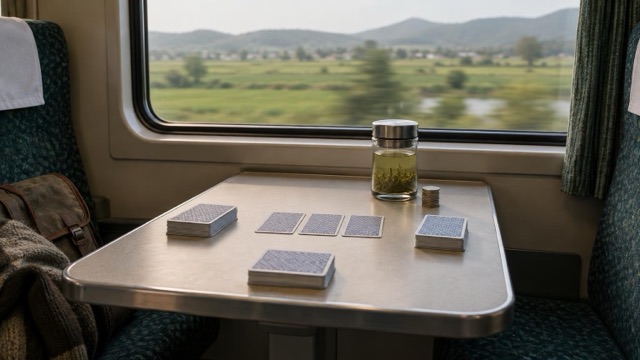
Guandan's home is mainland China, and it is everywhere there: kitchen tables, office pantries, high-speed train seats, and the dedicated venues described on the chess and card rooms (qipai shi) page, which exist precisely to give people a place to sit and play cards for hours. Card rooms typically rent the table, the cards and the tea by the hour, and Guandan is one of their staple games alongside mahjong and Dou Dizhu.
Beyond the physical table, the game lives on phones. The card and mahjong apps popular in China include Guandan titles that match you with players at your level, and these are played as free games for ranking and levels.
The wider region has its own equivalents in spirit. Street and park card culture is strong across Asia; in Thailand, the card game Pokdeng can be seen played in parks and open spaces across the country16, which is the same impulse that fills Chinese card rooms: a cheap, sociable, skill-based game that anyone can join. Visitors to China who want to watch or join a game will find chess and card rooms the easiest entry point, and a friendly table of Guandan is usually happy to teach a newcomer the combinations over a couple of hands.
Getting started as a beginner
Guandan is a genuinely approachable game. Among Asian games generally, difficulty varies widely; Bầu Cua Tôm Cá is rated at beginner level5, and Guandan belongs in that same beginner-friendly band for the basic rules, even though the partnership play runs deep. Here is a practical path in:
- Learn the combinations first. Singles, pairs, triples, sequences and bombs. Everything else in the game is built from these, and you can learn them from a cheat sheet in ten minutes.
- Watch a full hand before you play. The climbing rhythm, when to beat and when to pass, is much easier to absorb by watching than by reading. Any card room or app table will teach you this in one sitting.
- Play your first games on an app. The free Guandan apps let you practice against real opponents with nothing at stake, which is the modern equivalent of learning at a family table.
- Start with low, clean cards. The general card-game wisdom applies: keep your hand flexible and low rather than clinging to one big combination. In the climbing family, a hand that can answer many different plays beats a hand with one dramatic one.
- Expect a long first match. Because a match runs across levels rather than a single deal, plan for a sitting, not a quick game. For comparison, a single-table poker sit-and-go runs about 45 to 90 minutes17, and a Guandan match is in that territory or beyond, made of many fast hands.
- Talk to your partner between hands, not during. Table talk about the cards in play is off-limits, but post-hand review with your partner is half the fun and most of the learning.
The last piece of beginner advice is the simplest: keep it free. The whole culture of the game is built around points, levels and bragging rights, and that is exactly how it is played in homes, card rooms and apps across China. The moment money enters, the game changes into something that is both against the law in China and, as one guide for Chinese players puts it, exposed to real risks, with hefty fines and imprisonment among the consequences of gambling online15. Foreign casino sites are not an escape hatch either; they simply are not available in that jurisdiction, and attempts to reach them through a VPN are detected and blocked18. The free game is the good game, and it is the one everyone is actually playing.
Common Questions
How many players does Guandan need?
Guandan is built around four players in two fixed partnerships, sitting opposite each other. Its ancestor Zheng Shangyou is more flexible and works for four or more players, with five or six considered the sweet spot.
Is Guandan the same as Zheng Shangyou?
No, but they are close relatives. Zheng Shangyou is the older climbing game; Guandan refines it into a four-player partnership game with its own ranking system and level-progression scoring.
Do you need money to play Guandan?
No. A deck of cards is all it takes, and games are traditionally played for points or pride. That is a real contrast with poker or mahjong, where money is often part of the setup.
What cards are used in Guandan?
Ordinary international playing cards, the same kind used in games like Pok Deng, rather than mahjong tiles or dominoes. Guandan uses two decks including jokers so each player gets a large hand.
Is Guandan a gambling game?
Not as normally played. It is a shedding game scored in points. Gambling of any kind is prohibited in China, so playing Guandan for money would change its character entirely.
How long does a game of Guandan last?
A full match is a long sitting, since teams climb through levels rather than playing a single hand. Individual hands are quick, closer to a fast card game than a slow one.
Can Guandan be played online?
Yes, through card game apps. Playing it as a free game is one thing; gambling online from mainland China is another, and carries real risk of fines and imprisonment.
Sources18 sources
- Zheng Shangyou, Pagat.com, June 22, 2009
- Minimum Deposit, CoinPoker, 2026
- Legal Guidance on Gambling, Anyang Government, January 2025
- Pok Deng FAQ, Xoviet Pokers, September 26, 2026
- Bầu Cua Tôm Cá Rules, Xoviet Pokers, September 26, 2026
- RNG, CoinPoker, July 29, 2026
- Games, CoinPoker, September 16, 2026
- How to Play Poker, GGPoker, September 26, 2026
- Poker, Natural8, September 26, 2026
- Casino, Stake.com, September 26, 2026
- GodGame 13 Mahjong Rules, GodGame, archived April 1, 2016
- McGill Mahjong Club Blog, McGill Mahjong Club, March 1, 2016
- News Release on Cross-Border Gambling, Chifeng Public Security Bureau, February 6, 2026
- Public Security Guidance on Cross-Border Gambling, Ministry of Public Security, October 1, 2020
- Best Online Casinos for Players from China, Wizard of Odds, May 5, 2026
- Pokdeng: Traditional Thai Gambling and Online Gambling, TLC Texas, October 24, 2022
- Sit and Go, CoinPoker, March 6, 2026
- Gamdom FAQ, Gamdom, September 26, 2026