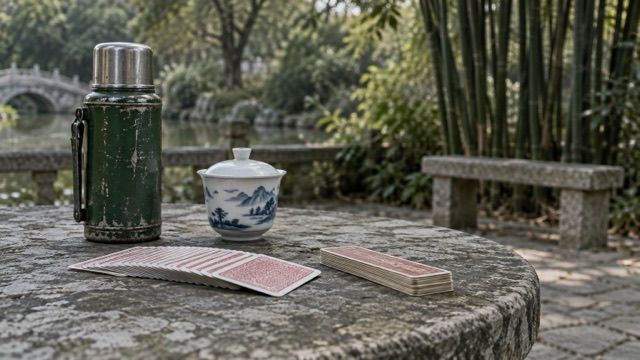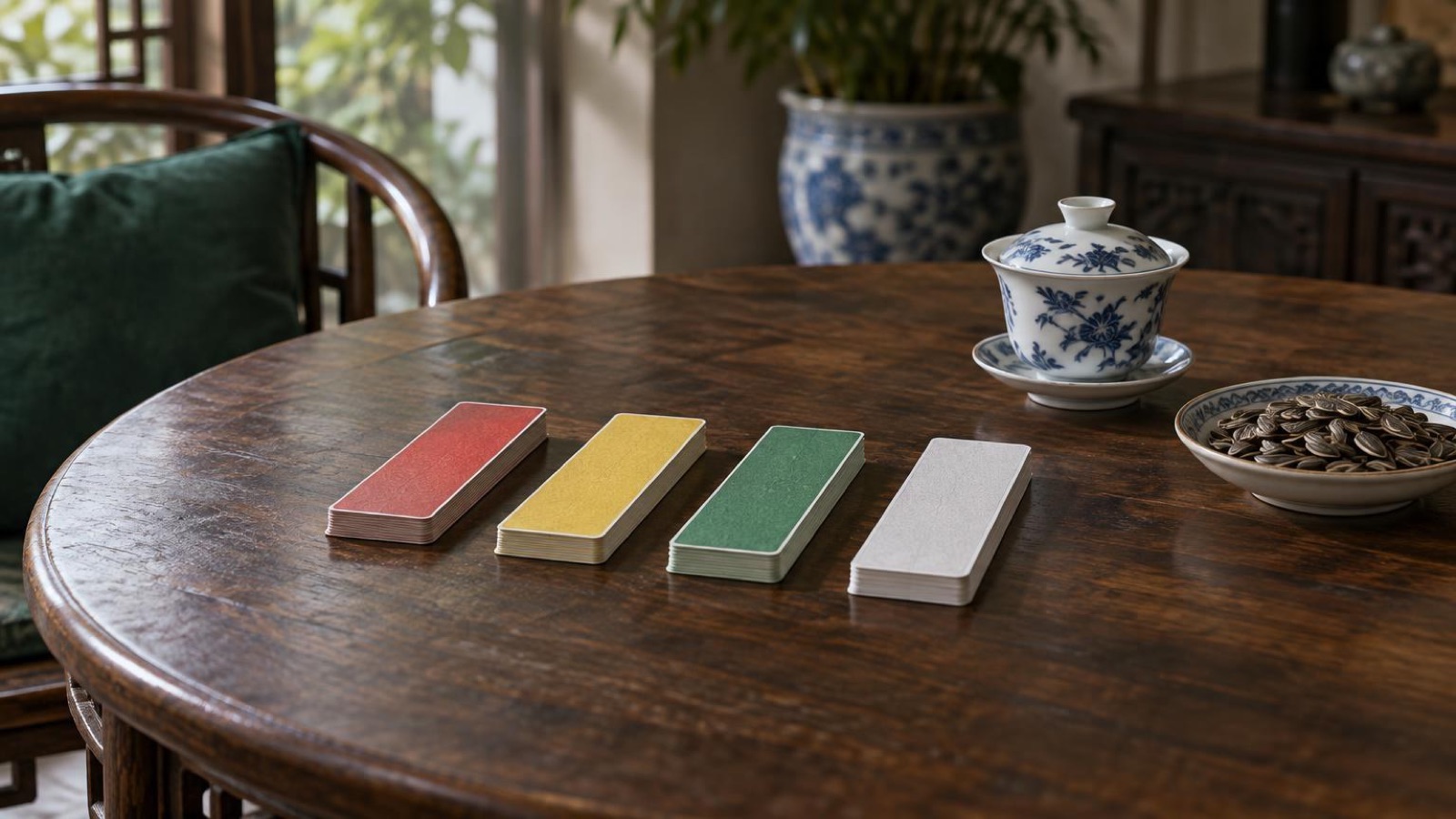
What four color cards are
Four color cards, called Si Se Pai (四色牌) in Mandarin, See Sek in some southern communities, and Tứ sắc in Vietnam, is a matching and collecting game in the same family as mahjong. Instead of tiles you use a slim deck of cards printed with Chinese Chess characters, and instead of building runs you build small groups of matching characters, stealing cards from other players to complete them1.
Four color cards is a game with deep roots in Chinese communities, played in various forms for generations. It remains a living game among older players in southern China, in overseas Chinese communities, and very widely in Vietnam, where Tứ sắc is a household game2. Like many card games in the region, it uses a deck divided into suits and values rather than the standard 52-card Western pack, and hands are ranked by combinations of matching cards, such as four cards of the same value3.
The core loop is simple. You draw a card, you discard a card, and you watch everyone else's discards. When a card you need appears, you steal it. The first player to complete a full hand of groups wins, and the sets you revealed along the way are counted up for score1.
The deck: four suits in four colors
The deck is nothing like a poker deck. Where most Western card games use a single 52-card deck with four equal suits4, four color cards uses its own deck built from Chinese Chess1.
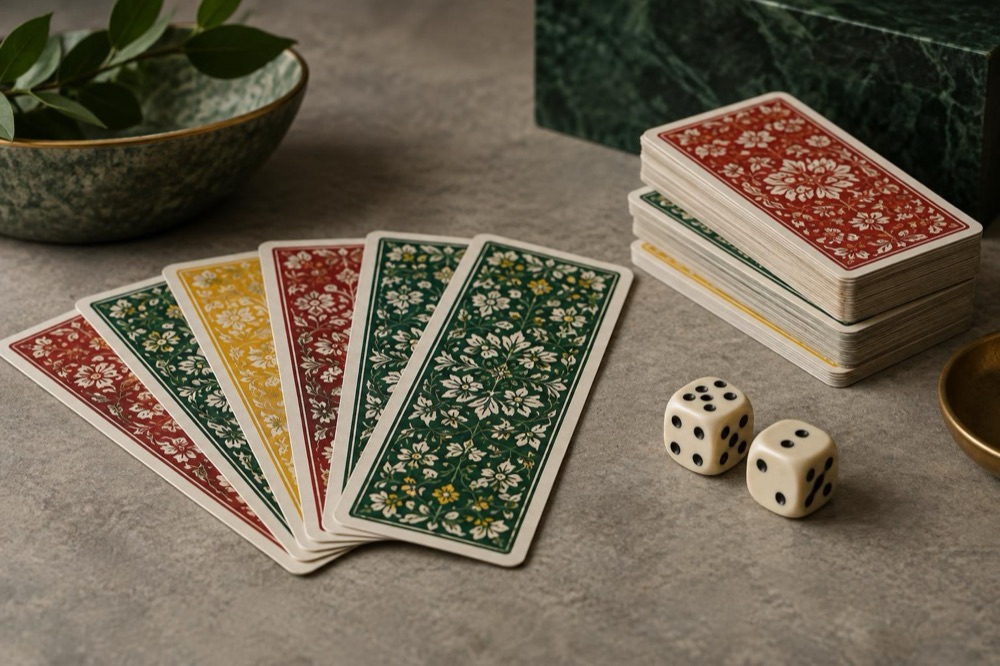
There are 7 types of card, and they carry the same characters as Chinese Chess: the General (King), the Advisor, the Elephant, the Chariot, the Horse, the Cannon, and the Soldier1. Each character appears in four different colors, which is where the game gets its name. Two cards of the same character in the same color are treated as identical, and the four colors let you hold several copies of the same character without them all being the same card.
The way cards combine is unusual if you come from poker. Groups can be anywhere from 1 to 4 cards1. A single card is almost never a group on its own: only a King counts as a group by itself1. Everything else has to be collected into sets. A typical set is three or four cards of one character across different colors, or a run of related characters such as Chariot, Horse and Cannon. The Chốt (Soldier) cards have their own special combinations, including a valued set of four Soldiers in four different colors2.
Because the deck is small and the characters repeat across four colors, the game rewards memory. Once you know which copies have been discarded, you know exactly what is left to steal.
How a hand runs
A hand begins with the deal. Each player receives 20 cards, dealt 5 at a time until everyone has their full hand, and the player holding the dealer position receives 6 cards for the first turn, giving them the first choice of what to keep and what to throw2.
From there the hand alternates between drawing and discarding. On your turn you take the top card of the stock or the current discard, add it to your hand, and throw one card away. The strategy lives in the discard pile: every card thrown is a card someone else may be waiting to steal1.
Stealing is the heart of the game. You can steal a card that someone has drawn or discarded in 3 situations1:
- To win the hand outright
- To make a Quad, which you are forced to take
- To make a Triplet, unless the card is a King
In other words, if a discard completes a four-of-a-kind group for you, you must take it; if it completes a three-card group, you may take it; and if it finishes your whole hand, you take it and the hand is over.
The target is exact. You are dealt 20 cards, but a winning hand has 211. That final card, the one that completes your last group, is the card everyone at the table is silently waiting for, and the tension of the last few turns is what players come back for.
Scoring and payouts
Winning the hand is only part of it. Four color cards is scored, and the score is counted in units called lệnh in the Vietnamese tradition2.
The sets you have revealed during the hand each carry a value:
| Set revealed | Score |
|---|---|
| 3 revealed cards (Chariot, Cannon and Horse; General, Advisor and Elephant; three same-color cards; or three different-color Soldiers) | 1 lệnh2 |
| Four Soldiers of different colors | 2 lệnh2 |
| 4 revealed cards | 6 lệnh2 |
The biggest single score comes from a full set of 4 revealed cards, worth 6 lệnh, which is why players will hold back a near-complete set rather than reveal a smaller one early2. The Vietnamese rules also score any 3-card group at 1 point, and note that even if the group contains a King, you still only get one point for it1.
When money is on the table, and in social play it often is in small amounts, the winner collects from each losing player according to the lệnh count, with extra payments for hands won by stealing the winning card. In casual home play, many groups just track lệnh across an evening and settle up at the end. Stakes are typically small, friendly sums rather than serious money.
Where to find players and tables
Four color cards is a game of specific places, and if you know where to look, finding a table is not hard.
In China itself, the natural home for the game is the chess and card room, the qipai shi found in most neighborhoods. These rooms exist precisely for games like this one, along with mahjong and the traditional Chinese card games, and an afternoon visit will usually turn up a table of regulars, especially among older players. Tea houses in southern China and in Chinatowns abroad serve the same role.
Online, the game lives on Chinese gaming platforms. Tencent's QQ Games platform, for example, hosts traditional multi-player card games, including a six-player game played with 3 decks totaling 162 cards, 27 per player, showing how these classic formats have been adapted for online play5. For playing on your phone, see our page on card and mahjong apps.
In Vietnam, Tứ sắc is easy to find almost anywhere: family homes, tea shops, and game clubs, and it is one of the first games many Vietnamese players learn2. If you are traveling between the two countries, the game is your bridge, since the rules are essentially the same.
Who can play
Anyone can learn four color cards, and there is no age or status barrier to sitting at a social table. The one practical line to know: in mainland China, playing for money outside licensed channels is not permitted, and games in card rooms are played as entertainment. Keep the stakes at friendly, symbolic levels and you are in the same position as the regulars at every table. For the full picture, see gambling laws in China.
How it compares with other Chinese games
If you know other Chinese table games, four color cards will feel familiar in some ways and strange in others.
Compared with mahjong, the structure is nearly identical: draw, discard, steal, complete a hand. The difference is the deck. Mahjong tiles carry suits and honors; four color cards compress everything into seven Chinese Chess characters in four colors, which makes the memory work more about counting copies than reading a wall of tiles.
Compared with card games played against the house, it is a completely different animal. Pai Gow Poker deals seven cards to each player and the dealer, which must be arranged into two poker hands6, and casino poker variants use a standard 52-card deck4. Four color cards has no dealer-opponent and no house edge; it is player against player, and the skill is in what you throw away.
Among the Chinese card games covered on this site, it sits closest to Pai Gow and Chinese Poker in spirit, games of building structured sets from a dealt hand. Player counts elsewhere vary widely for comparison: Seven Card Stud runs from as few as two to as many as eight players7, 5-card draw poker seats two to six8, and short deck poker tables set a minimum of 2 and a maximum of 6 players9. Omaha-style games deal four hole cards instead of two10, which is a different use of the number four than the four colors of this deck.
Regionally, four color cards overlaps with the great trick-shedding games. Tiến Lên in its southern form seats 4 players with 13 cards each12, and Dou Dizhu and Guandan dominate the mainland. Four color cards is quieter than all of them, closer to Badugi in pace, a draw game where each player receives 4 private cards13, though the mechanics are unrelated. Even the classic baccarat table of chemin de fer, which may only start if at least four players are seated14, shares the four-seat social shape, though nothing else.
Darts, Diamonds, Bars and other names you may see
The names around this game can confuse a first-time searcher, so here is a short map.
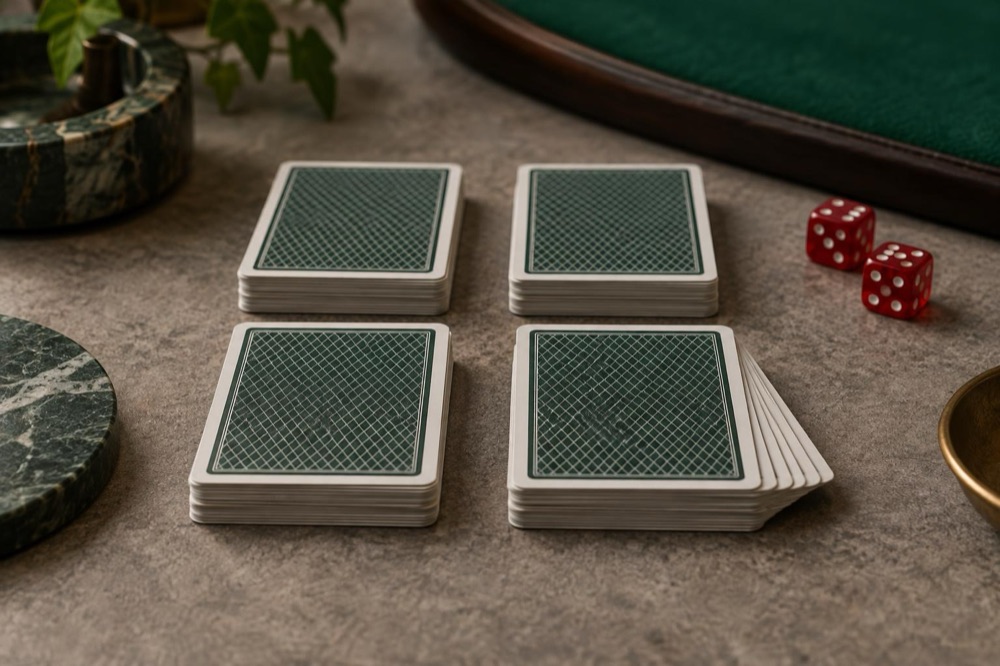
In Vietnam, ask for Tứ sắc and everyone knows the game2. In Cantonese-speaking communities, See Sek is the common name. In Mandarin, Si Se Pai. All three are the same game.
You may also run into variant names on gaming sites and in app listings, particularly English names like Diamonds, Cases, Drill, Bars, Darts and Packs. These appear as separate table listings on at least one major crypto casino site, where live counters showed Diamonds with 43 players, Cases with 15, Drill with 16, Bars with 2, Darts with 7, and Packs with 20 playing at the time of checking15. A similarly named slot-style title, 4 Supershiny Diamonds by Playson, showed 264 playing16. Treat these as names borrowed from the four-color tradition for marketing, not as the classic game itself: Bars, for instance, is listed as strictly 2 players15, while the classic game is a three or four player affair. If you want the real thing, look for the Chinese or Vietnamese name.
First-timer questions
Do I need to read Chinese? You need to recognize seven characters, and most decks print them clearly enough that you learn them in a hand or two. The characters are the same ones on a Chinese Chess set, so any chess player at the table already knows them.
What should I do on my first turn? Sort your hand by character, count how many copies of each you hold, and discard your loneliest card, one you have only a single copy of and no near-set for. Ask the player next to you to check your discards for the first few turns; stealing rules are the part newcomers miss.
How long does a hand take? A hand is short, usually ten to fifteen minutes, and a session runs many hands in a row, which is part of why the game suits an afternoon in a card room.
Can I practice alone? The online versions on Chinese gaming platforms are the easiest way to practice, since the software enforces the stealing rules for you5. Card game apps on our apps page cover what is available.
What does it cost? A deck of four color cards is cheap, sold wherever Chinese playing cards are sold, and a table in a chess and card room charges by the hour for the seat, typically a few yuan. The game itself costs nothing beyond that.
Is it like gambling? It is a skill game played between players, in the same social category as mahjong. Small-stakes play is normal in home games, and the gambling in China page covers where the line sits for visitors and residents.
Common Questions
How many players does Diamonds need?
On the gaming site where the name appears, Diamonds is listed as a table for a small fixed group, with live counts showing dozens of players active at once. It is not one of the classic four color cards variants, so treat the player count as whatever the specific table states.
What is the smallest number of players for a four color cards game?
The classic game is built around a dealer and opponents taking turns drawing and discarding, so two players is the practical floor. Most tables you will actually find seat three or four, which is the traditional size.
Which four color cards game suits the biggest group?
The classic game itself seats three or four, and that is the largest of the traditional sizes. Names like Cases that you see on casino listings are marketing labels rather than variants of the game, and the listings give no seat count for them, so for bigger groups the usual answer is to split into separate tables rather than stretch one game further.
Can Bars be played with more than two players?
Bars is listed as a two-player game, and the tables showing it run heads-up. If you have three or four people, the standard four color cards game or the four-player variant fits better.
What is Si Se Pai in English?
Si Se Pai translates simply as "four color cards," named for the deck's four colored suits. In Vietnam the same game is called Tứ sắc, and in some communities you will hear it called See Sek.
Is a special deck required?
Yes. Four color cards uses its own deck of cards printed with Chinese Chess characters in four colors, not a standard 52-card poker deck. The decks are inexpensive and sold wherever Chinese playing cards are sold.
Which game is best for beginners?
Start with the basic matching game at a three or four player table. The rules are mostly about forming groups and stealing, and experienced players will happily talk you through your first few hands.
Sources16 sources
- Si Se Pai rules, CMU School of Computer Science, accessed 2026
- Tứ sắc, Wikipedia, accessed 2026
- Chinese Games with Dice and Dominoes, Smithsonian Institution, 1893
- How to play poker, PlaySmart, 2026
- QQ Game rules, Tencent QQ Games, 2025
- How to play Pai Gow Poker, PlaySmart, 2026
- Stud poker, partypoker, 2026
- 5-card draw poker guide for beginners, CoinPoker, 2026
- Short Deck poker, Natural8, 2026
- Omaha poker, Natural8, 2026
- Provably fair casino games, Stake, 2026
- Online card games: basic rules, V9Bet, 2026
- Badugi guide, CoinPoker, 2023
- Arrêté ministériel 88-384, Journal de Monaco, 1988
- Natural8 poker, Natural8, 2026
- Stake.us, Stake.us, 2026