What Chinese poker is
Chinese poker is a variant of poker in which cards are arranged into three rows and compared against your opponents' rows to see who wins points5. Unlike Texas Hold'em or Omaha, there is no betting round by round and no community cards. You receive your cards, you set them, and then the hands are compared and scored. That makes it a game of arrangement rather than bluffing: the skill is in reading your 13 cards and deciding which row each one belongs in.
The game is often called 13-card poker in English, and shisan zhang in Chinese, which simply means "thirteen cards"1. It sits in the same family of Chinese gambling games as pai gow, where tiles or cards are split into groups and compared, rather than bet over street by street. It shares that split-and-compare spirit with pai gow and other traditional Chinese card games, but the scoring system and the three-row structure are its own.
Two main versions are played today. In the standard game, sometimes called closed Chinese poker, you receive all 13 cards at once and set them in secret before the showdown1. In open-face Chinese poker, usually shortened to OFC, the cards arrive gradually and are placed face up one at a time, which changes the feel of the game completely. Both are covered below.
Players, cards and the three rows
Chinese poker is played with two, three, or four players2. Four is the ceiling because the deck must supply 13 cards to each player, and 52 cards divided by 13 gives exactly four hands with nothing left over6. With two or three players there are cards to spare.
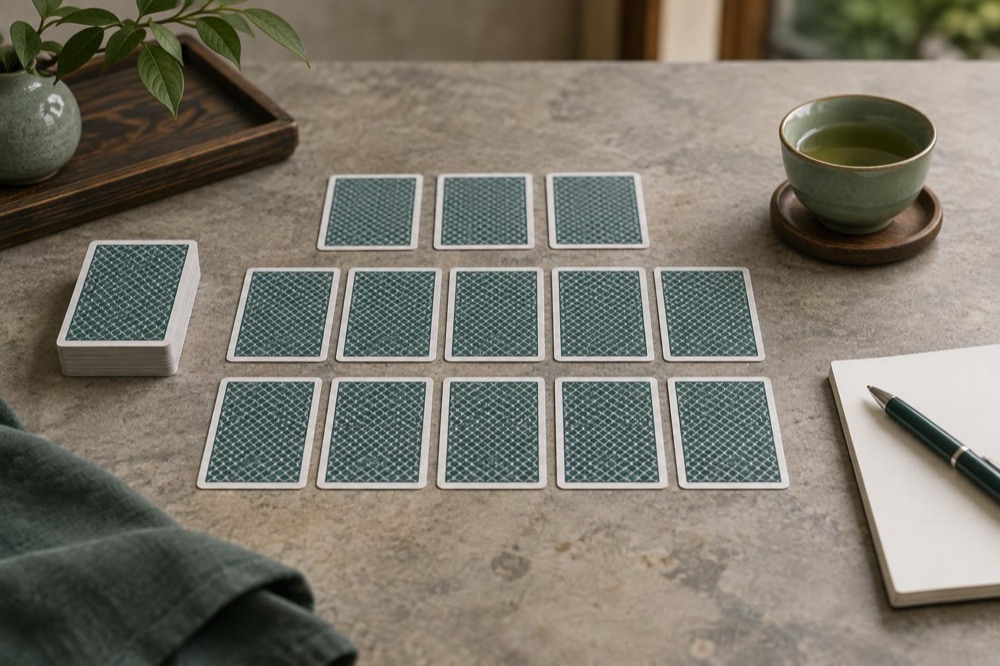
The game uses one standard 52-card deck with no jokers or wild cards2. Each player is dealt 13 cards, which are arranged into three separate poker hands: one three-card hand in front and two five-card hands behind it2.
The three rows, from front to back, are:
| Row | Cards | Role |
|---|---|---|
| Top row | 3 cards | The weakest hand, at the front |
| Middle row | 5 cards | Must be stronger than the top row |
| Bottom row | 5 cards | Must be the strongest of the three |
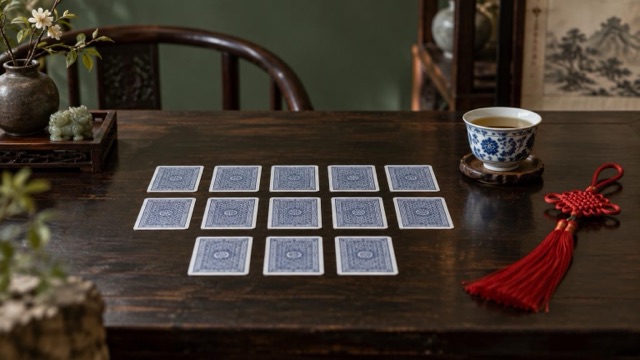
The top row holds three cards, the middle row five, and the bottom row five1. The three-card top row can only make very small hands: a three-of-a-kind is the best possible, and most tops are a single pair or just three high cards. The two five-card rows use the standard poker hand rankings you would know from any poker game: a hand in poker consists of five cards, ranked from a royal flush, A-K-Q-J-10 in the same suit, on down through straight flush, four of a kind, full house, flush, straight, three of a kind, two pair, one pair and high card7.
Because the rows are compared one against one, the same 13 cards can be set strong, safe, or greedy depending on how you split them, and two players holding equally good cards overall can still score very differently.
How the hands are set: the qualifying rule
The heart of the game is the qualifying rule: the bottom row must be stronger than the middle row, which in turn must be stronger than the top row1. Every set you make has to obey this descending order, and the whole strategy of the game flows from it.
Say you are dealt a full house, a flush, and a pair among your 13 cards. The full house must go in the bottom row, the flush in the middle, and the pair on top. If you put the flush on the bottom and the full house in the middle, your hand does not qualify and you lose everything, which is explained in the fouls section below.
The tension comes from hands that are not so clean. If your 13 cards contain two strong five-card hands and nothing for the top row, you may have to break one of them, for example pulling a pair out of your middle hand to place on top, so that all three rows stay legal and competitive. Choosing where to weaken your set is the real decision in the game, and it is a decision you make once, with all your cards in front of you, rather than across multiple betting rounds.
In the standard closed game, players set their hands out of each other's sight, then reveal simultaneously. There is no drawing and no discarding: the 13 cards you are dealt are the 13 cards you must place1.
Scoring: points, row values and the scoop bonus
Scoring is done row against row, player against player. Each row is worth one point1. You compare your top row with each opponent's top row, your middle with their middle, and your bottom with their bottom, and you win or lose one point per row per opponent. With three players, you score separately against each of the other two, so a single deal produces two sets of comparisons for you.
On top of the row points sits the scoop bonus: three points are awarded to a player who wins all three rows against an opponent1. Scooping someone, taking every row at once, is the big swing in the game, and protecting yourself from being scooped matters as much as winning individual rows.
Strong hands in the right places also earn royalty bonuses, paid in extra units on top of the row points. The classic schedule is:
| Bonus hand | Placement | Extra units |
|---|---|---|
| Straight flush | Back row | 5 |
| Four of a kind | Back row | 4 |
| Full house | Middle row | 2 |
These bonuses are paid regardless of whether you win the row, which is why players sometimes build a set around landing a royalty in a specific position2. The exact royalty schedule varies from game to game and is one of the things players agree on before starting.
In open-face Chinese poker the scoop is scored more heavily: if you win all three hands you get a scoop worth six points in total, which includes a three-point bonus for the clean sweep6.
Fouls and what happens when a hand is set wrong
A foul is a hand set in the wrong order. The rule is simple: if your top hand is stronger than your middle hand, your hand is fouled, and the same applies if your middle hand is stronger than your bottom6. A hand with the wrong number of cards in a row is also dead.
The penalty is total. A fouled hand is considered dead and the opponent scoops the entire hand, taking the scoop bonus and all three row points as if they had beaten you everywhere1. You cannot win any row with a fouled hand, no matter how strong your cards are. A player who arranges a monster set in the wrong order loses to an opponent holding almost nothing.
Fouls are the reason the qualifying rule dominates strategy. When you are placing your last few cards and realize your middle row has grown stronger than your bottom, you must weaken one of them immediately, even if it costs you a row, because the alternative is losing the whole deal.
In open-face Chinese poker fouls are more common and more painful, because you commit cards face up as they arrive and cannot rearrange rows afterward. A misplaced card in the first few turns can lock you into a foul by the end of the hand, which is part of what makes OFC a swingy, mistake-punishing game6.
Playing for money: how stakes are agreed
Chinese poker is played for points, with each point having an agreed monetary value1. Before the game starts, the players fix two things: how much a point is worth, and which royalty schedule applies. A game might be set at one unit per point with the standard royalties above, or at any other figure the table agrees on. Settlement is simple arithmetic at the end of each deal:
- Add up row points, scoop bonuses and royalties against each opponent.
- Multiply by the point value.
- Pay or collect.
In a card room setting, the structure is more formalized. To receive a hand, you must have at least three betting units for the particular game you are playing, and a buy-in is equivalent to 25 times the game's limit condition, with no short buy-ins allowed2. So at a table with a limit of one unit, you would need three units in front of you to be dealt in and 25 units to sit down properly.
The mechanics of wagering are the same as in any poker game: you decide how much to wager and place the corresponding value of chips on the table, whether that is one larger chip or several smaller ones adding up to the same amount9. Side bets are common in home games; in one example format, players agree to each put a fixed amount into a side pot before the cards are dealt, with the pot going to the player who hits the qualifying hand10.
If you are used to cash games like pot-limit Omaha, where a $5/$10 table carries a default buy-in around $100, Chinese poker's point-based settlement will feel different: there is no pot to win mid-hand, only points to score at the end11. Position matters less too. In games with a dealer button, the button is usually determined by dealing a single card to each player, with the highest card receiving it12, but in Chinese poker the deal order matters little because everyone receives the same number of cards and there is no betting order.
Online, where the game is dealt by software, house rules apply on top of the game rules. Players must act within a reasonable time limit that varies by table, game and stage; if you fail to act in time, your hand is automatically folded and you forfeit any amounts wagered in that hand, though many games give you a time bank for extra thinking13.
Where the game sits in China
Shisan zhang is one of the card games with the deepest roots in Chinese play culture, alongside mahjong, dou dizhu and big two. Games of comparing divided hands, where a player's pieces or cards are split into groups and scored against opponents, go back well over a century in Chinese gambling life; nineteenth-century accounts of Chinese card play describe games settled by points and sweeps in exactly this spirit14. Thirteen-card play in particular is a staple of family tables and chess and card rooms, and the open-face version has become popular among younger players through card game apps.
For money, the practical picture in mainland China is this: home games among friends are one thing, but playing through online or cross-border gambling channels is another. Chinese law treats cross-border gambling as a criminal offense and strictly prohibits it3, and online betting operations are likewise treated as illegal4. On top of that, direct access to most global poker platforms from within China is blocked by the Great Firewall, and traditional payment methods are often unavailable, so the online route is closed in practice as well as in law15. The result is that the game lives mainly in private, in-person settings. If you want to play poker for stakes in a fully open way, the realistic options are trips to legal venues elsewhere, covered on our gambling trips abroad page, or the licensed environment in Macau, described in our casinos in China guide.
Common Questions
How many players can play Chinese poker?
Two to four players. Four is the practical maximum because a standard 52-card deck must supply 13 cards to every player at the table.
How many cards does each player get?
Each player receives 13 cards from a standard 52-card deck with no jokers or wild cards, and arranges them into three rows of three, five and five cards.
What is a foul in Chinese poker?
A foul happens when a row is set in the wrong order, for example a top row stronger than the middle row. A fouled hand loses automatically and the opponent scoops all three rows.
How many points is a scoop worth?
In the standard game a scoop is worth three bonus points on top of the one point per row. In open-face Chinese poker a scoop is worth six points in total, including a three-point bonus.
How is open-face Chinese poker different from the standard game?
In open-face you start with five cards placed face up, then receive one card at a time until you have 13. In the standard game you get all 13 cards at once and set them in secret.
What is the top row in Chinese poker?
The top row is the three-card hand at the front. It must be the weakest of your three rows, since the bottom row must beat the middle row and the middle row must beat the top.
How do players agree on the stakes?
The game is played for points, and before starting the players agree on a monetary value for each point. In card rooms the buy-in is typically set at 25 times the game's limit.
Sources15 sources
- Chinese Poker, 888poker, 2018
- Hustler Casino 13-Card Chinese Poker rules, California Attorney General, 2021
- Cross-border gambling news release, Chifeng Public Security Bureau, 2026
- Online football betting notice, Wuxi Internet Information Office, 2026
- Poker Terms, 888poker, 2026
- Open Face Chinese Poker guide, CoinPoker, 2023
- Hand rankings, partypoker, 2026
- How to play poker, PlaySmart, 2026
- How to bet in poker, PlaySmart, 2026
- Acepots, Americas Cardroom, 2026
- Omaha, GGPoker, 2026
- Sit and Go, CoinPoker, 2026
- House rules, Natural8, 2026
- Chinese games with dice and dominoes, Smithsonian Institution, 1893
- China-friendly poker sites, Somuchpoker, 2026