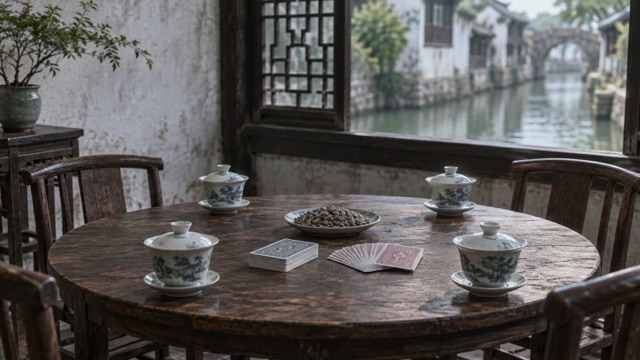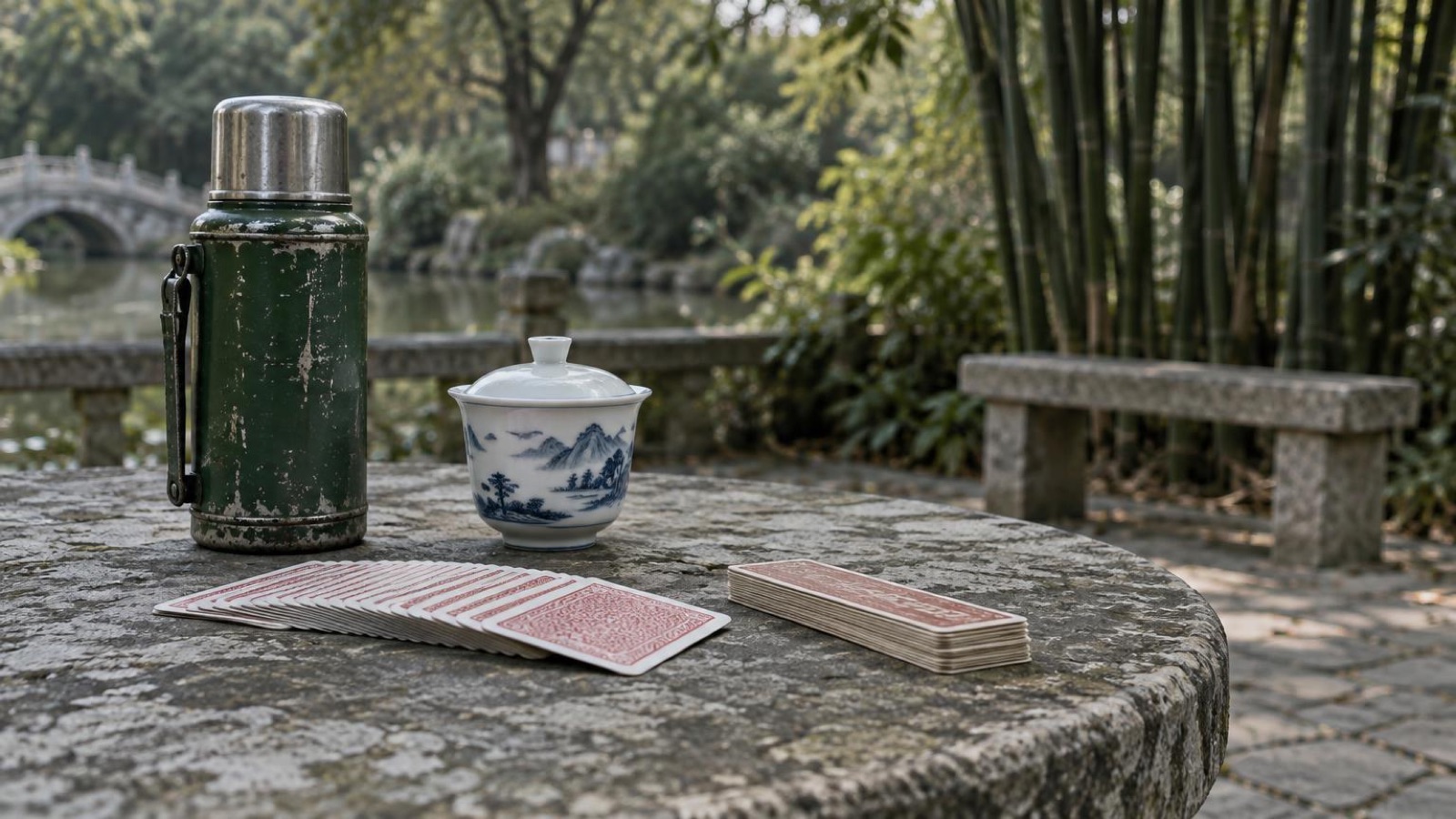
What counts as a traditional Chinese card game
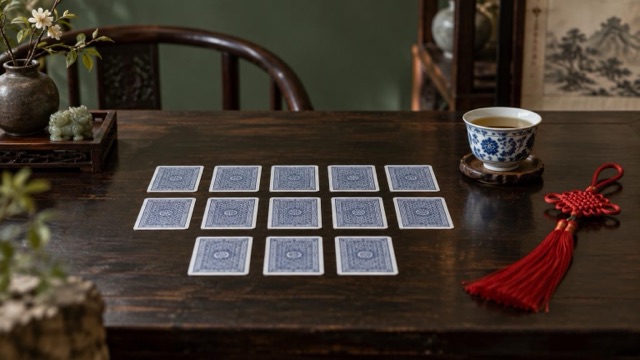
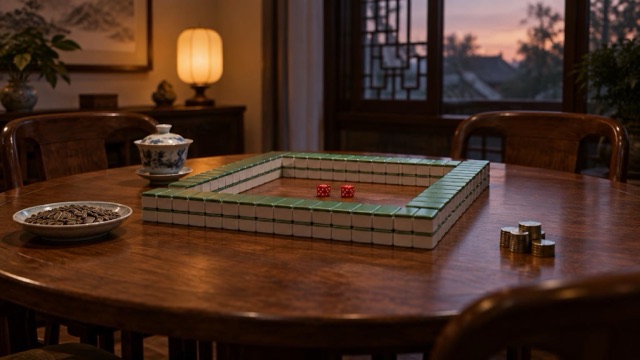
The phrase covers two different things. The first is the family of games played with Chinese money cards or character tiles: narrow cards with suits and denominations, dealt and drawn much like mahjong tiles. One example is Bopi (剥皮), a regional game where the first player to reach 100 hu points and change dealer triggers settlement, and the player with the fewest hu points is "skinned"; a self-drawn win adds 10 hu points5. Another is 八一字牌, played mainly in and around Guilin and Liuzhou in Guangxi with 80 cards and three players, each dealt 20 cards while the dealer draws 21.
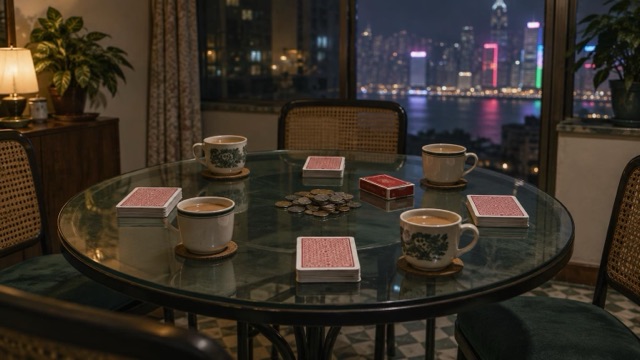
The second, and what most people mean now, is the cluster of games played with standard Western 52-card (or 54-card) decks that grew up in Chinese communities over the past century: Dou Dizhu, Big Two, Guandan, San Da Yi and their relatives. These are climbing and shedding games, where players try to empty their hands by beating each previous play with a stronger combination.
Both branches are alive. Money-card games like Si Se Pai are still played in southern China and Vietnam, while the Western-deck games are the everyday card play of the mainland, Hong Kong and the diaspora. You can read about the wider scene in gambling in China, and about where people actually gather to play in chess and card rooms (qipai shi).
Here is the quick map of the games this page covers:
| Game | Deck | Players | Type |
|---|---|---|---|
| Dou Dizhu | 54 cards, both jokers | 3 (or 4 with two decks) | Climbing, 1 vs 2 |
| Big Two | 52 cards | 4 (variants for 2 to 3) | Climbing, shedding |
| Guandan and Zheng Shangyou | Two decks | 4 in fixed pairs | Climbing, partnership |
| San Da Yi | Standard deck | 3 or more | Climbing |
| Si Se Pai | 117 money cards | 4 | Draw and discard, like mahjong |
| Khanhoo, Bopi, Digging Flowers | Chinese money cards | Varies | Draw and discard |
Dou Dizhu (Fight the Landlord): the deck and how a hand is dealt
Dou Dizhu is the most played card game in China. It uses all 54 cards of the deck including both jokers, and is usually played by 3 people1. Each player is dealt 17 cards, and the remaining 3 cards form a kitty. Players look at their hands and bid or compete to take the landlord role based on how good their cards are; the other two players become the peasants, a team of two against the one. The landlord then takes the 3 kitty cards, giving them 20 cards against the peasants' 17 each6.
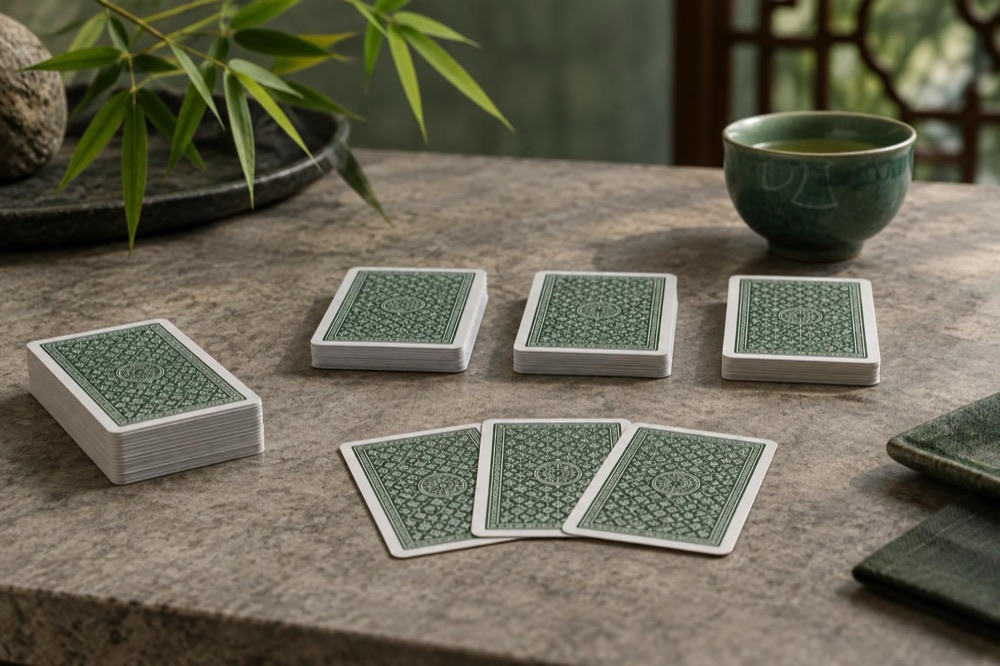
The name describes the structure exactly: three fight one, with the landlord playing alone but holding more cards7. The stakes follow the same logic. If each round is set at CNY 100:
| Outcome | Who pays | Who collects |
|---|---|---|
| Landlord wins | Each peasant pays 100 | Landlord collects 200 |
| Peasants win | Landlord pays 100 to each | Each peasant collects 100 |
| A bomb is played | Stake doubles | Applies per bomb thrown |
A bomb, meaning four cards of the same rank played together, doubles the stake each time one is thrown6.
A four-player variant spread through the Jiangsu-Zhejiang area: it uses two decks at once, with 4 people playing, 3 fighting 18. For the full rules, combinations and strategy, see Dou Dizhu (Fight the Landlord).
Big Two (Choh Dai Di): card ranking and playable combinations
Big Two, also called Choh Dai Di, is a shedding game for four players where everyone gets a hand of 13 cards2. The twist is in the name: the cards rank from high to low as 2, A, K, Q, J, 10, 9, 8, 7, 6, 5, 4, 3, so the deuce is the single most powerful card in the deck2.
Play is a climbing game. The player who holds the three of diamonds begins and must play that card2. After that, each play must beat the previous one in the same category: a single card beats a single, a pair beats a pair, a five-card combination beats a five-card combination. Among the five-card combinations, in ascending order:
- Straight
- Flush
- Full house
- Four of a kind
- Straight flush
Flushes are compared according to the rank of the highest card2. If you cannot or do not want to beat the current play, you pass, and the last player to play leads the next round with anything they like.
The game ends when one player runs out of cards. Full rules, variations and worked examples are on the Big Two (Choh Dai Di) page.
Big Two scoring: from 1 point per card to the 39-point penalty
When played for points, Big Two charges you for the cards you are caught holding:
| Cards left in hand | Penalty per card | Total if caught at that count |
|---|---|---|
| 9 or fewer | 1 point | Up to 9 points |
| 10, 11 or 12 | 2 points | 20 to 24 points |
| All 13 | 3 points | 39 points |
That last row is the worst case: a player who never played a single card pays the maximum2.
There is also a social penalty for carelessness. If you ignore a chance to block a player who is down to their last card, and the person after you wins by playing that single card, you have to pay the losses of all three players2. In other words, letting someone sail out on a single card can cost you everyone's points, not just your own.
Regional scoring differs. In Indonesia, each card from 3 to ace remaining scores 1 point, but each two remaining scores 5 points, with doubled or tripled totals for players caught with 11, 12 or all 13 cards2. In a version played until only one player has cards, the first to run out wins 5 points, the second 3, the third 1, and the last player nothing2.
Regional Big Two: Hong Kong's 17-card version and the Philippines' Pusoy Dos
Big Two is not one game but a family. In the three-player Hong Kong version, 17 cards are dealt to each player and the last card is placed face up in the center of the table; the holder of the three of diamonds adds this extra card to their hand2.
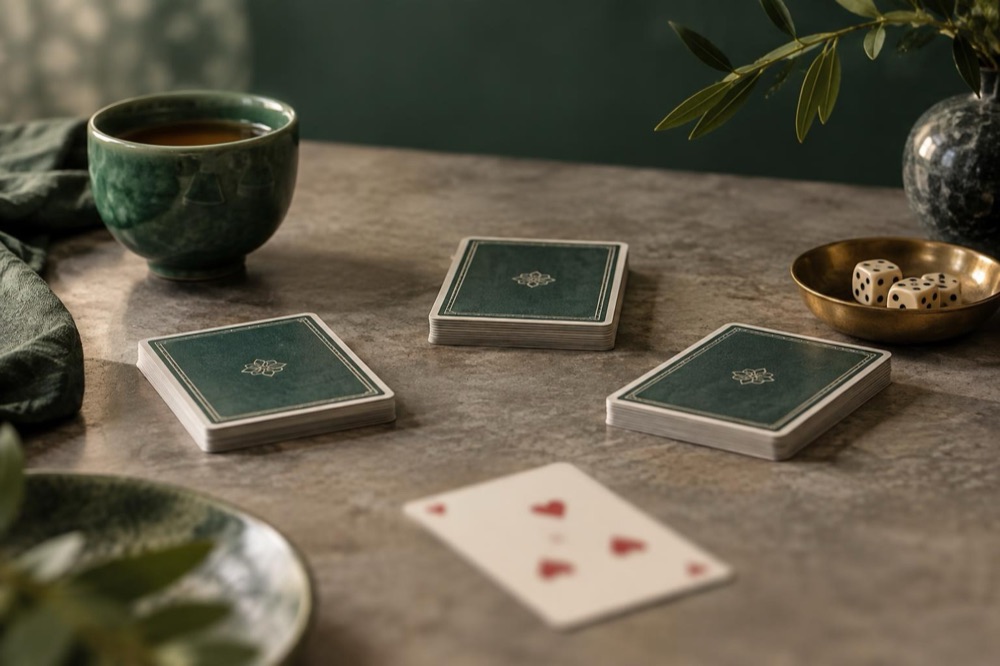
In the Philippines, the game is called Pusoy Dos, and scoring there rewards a stylish finish: the winner, the first player to run out of cards, normally scores 1 point and the others score nothing, but if the winning play includes one deuce the score doubles to 2, then 4 for two deuces, 8 for three and 16 if the final play contains all four deuces2.
The same climbing-shedding idea travels under other names across Southeast Asia. The Vietnamese version, Tiến lên, gives the twos their own point values when they are caught in hand: the two of spades is worth 1 point, the two of clubs 2, the two of diamonds 3 and the two of hearts 4, with special combinations like three consecutive pairs or four of a kind also worth 4 points9.
Si Se Pai (Four Color Cards): four suits, four of each denomination
Si Se Pai, Four Color Cards, is the clearest surviving example of the Chinese money-card tradition. The deck consists of four suits of 28 cards each and 5 jokers3. Like a mahjong set, there are four identical cards of each denomination3. There are 7 types of card, and they carry the same characters as in Chinese Chess10:
| Card type | Chinese Chess equivalent |
|---|---|
| General | General |
| Advisor | Advisor |
| Elephant | Elephant |
| Chariot | Chariot |
| Horse | Horse |
| Cannon | Cannon |
| Soldier | Soldier |
You are dealt 20 cards, but a winning hand has 2110. Groups can be anywhere from 1 to 4 cards, and only a King counts as a group by itself10. You can steal a card that someone has drawn or discarded in 3 situations:
- To win
- To make a Quad (which is forced)
- To make a Triplet, unless it is a King
The game is closely related to Tứ sắc in Vietnam, where scoring is counted in lệnh: a set of 3 revealed cards, such as chariot-cannon-horse or general-advisor-elephant, scores 1 lệnh, and four Soldier (Chốt) cards of different colors score 2 lệnh11. The full rules, card list and scoring table are on the Four Color Cards (Si Se Pai) page.
Partnership climbing games: Guandan, San Da Yi and the four-player favorites
Beyond Dou Dizhu, the Western-deck tradition in China leans heavily on fixed-partnership games. Guandan, hugely popular in Jiangsu and Anhui, and its older relative Zheng Shangyou, seat four players in two teams, with partners sitting opposite each other and working together to shed their hands through escalating combinations. San Da Yi, a Shanghai favorite, is another of this family: a climbing game where the lead and the combinations matter more than the bidding.
These games share a common shape with Dou Dizhu's four-player cousins. The press describes the pattern well: Da Bai Fen (Da Bai Fen), for example, is played with two decks by 4 people, and can be scaled up to three decks and 6 players8. Dou Dizhu itself made the same journey, with the Jiangsu-Zhejiang version using two decks for 4 players, 3 fighting 18. If you want the partnership games in depth, see Guandan and Zheng Shangyou and San Da Yi (Shanghai card game).
Character-card games: 八一字牌, Bopi and the money-card survivors
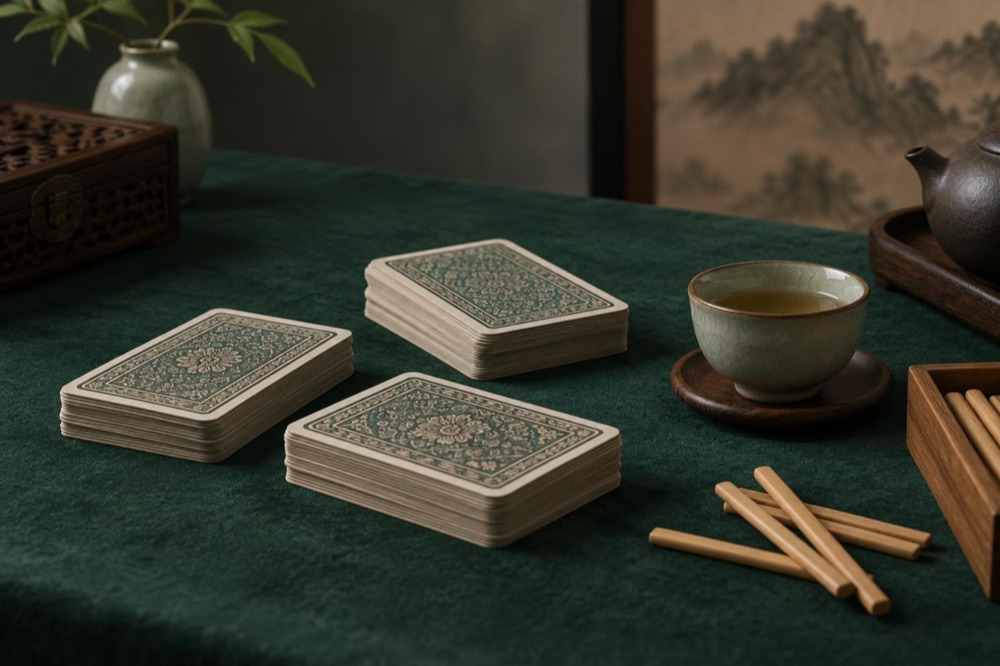
These games are increasingly a living-room and festival tradition rather than a gambling-house one, but they are the direct ancestors of Si Se Pai and, through it, of the card cultures of Vietnam and beyond. For the modern venues where card games of all kinds are played, see chess and card rooms (qipai shi) and card and mahjong apps.
Playing online: Viwawa, QQGame and Tiantian Doudizhu
The traditional games have moved wholesale online, and the numbers show how big they are. In April 2015, Huan Le Dou Di Zhu, a Happy Dou Dizhu title, ranked No. 6 among the top 10 free iOS game apps in China4, a sign of how mainstream the game had become.
Tencent's QQGame platform carries its own versions with house rules that differ from the kitchen-table game. One QQGame card game is a 6-player game using 3 decks of playing cards, 162 cards in total, dealt at 27 cards per player12. Its card ranking runs from high to low as big joker, small joker, 2, A, K, Q, J, 10, 9, 8, 7, 6, 5, 4, 3, with no ranking between suits12. The platform also runs a level system, where reaching level 4, for example, takes 520 points of accumulated play12.
On the developer side, Chanyou Technology built its business on exactly these titles: its main products are Dou Dizhu, Kuaiyu Bushou and Sichuan Mahjong, with Tiantian Doudizhu (Real Person Version), a live-opponent Dou Dizhu game, its most representative product13. The appetite extends to casino floors too: at least one electronic table product has been themed on the game, built around a popular Chinese card game that translates as "Beat the Landlord"14.
For the wider world of playing cards for money online, see poker in China, online poker in China and online gambling in China.
Common Questions
How many cards do you get in Dou Dizhu?
Each of the three players is dealt 17 cards from the full 54-card deck including both jokers. The remaining 3 cards form a kitty that goes to the player who takes the landlord role, giving the landlord 20 cards in total.
Why is the two the highest card in Big Two?
It simply is, by the game's ranking. In Big Two the cards rank from high to low as 2, A, K, Q, J, 10, 9, 8, 7, 6, 5, 4, 3, so the deuce sits above the ace instead of below the three as in most Western games.
What is a dragon win in Big Two?
A dragon is a hand containing exactly one card of each rank, from ace down to two. In some Hong Kong play, a player dealt a dragon wins immediately, and every other player at the table scores the full 39 penalty points.
How many cards are in a Si Se Pai deck?
The deck consists of four suits of 28 cards each plus 5 jokers, 117 cards in all. Like a mahjong set, there are four identical cards of each denomination across the suits.
What does 'Fight the Landlord' mean?
The name describes the structure: one player takes the landlord role and the other two play as peasants against them. The landlord fights alone with a bigger hand, while the two peasants win or lose together as a team.
How many decks does the QQGame version use?
The QQGame version is a six-player game that uses 3 decks of playing cards, 162 cards in total, dealt out at 27 cards per player.
Sources14 sources
- China Times news article, China Times, 2016-09-09
- Big Two, Pagat, 2026-03-14
- Si Se Pai rules, archived personal page, 2026-09-27
- China Daily business article (archived), China Daily, 2015-04-08
- Chinese Games with Dice and Dominoes (Culin 1893), Smithsonian Institution, 1893
- China Times news article (archived), China Times, 2016-09-09
- China Times news article, China Times, 2016-09-09
- China Times news article (archived), China Times, 2016-09-09
- Bài Tiến Lên, Vietnamese Wikipedia, 2026
- Si Se Pai rules, Carnegie Mellon University, 2026-09-27
- Tứ sắc, Vietnamese Wikipedia, 2026
- QQGame game rules, QQGame, 2025
- Chanyou Technology news article, National Business Daily, 2019-04-05
- Weike Gaming looks for growth in Asia, GGRAsia, 2014-09-16