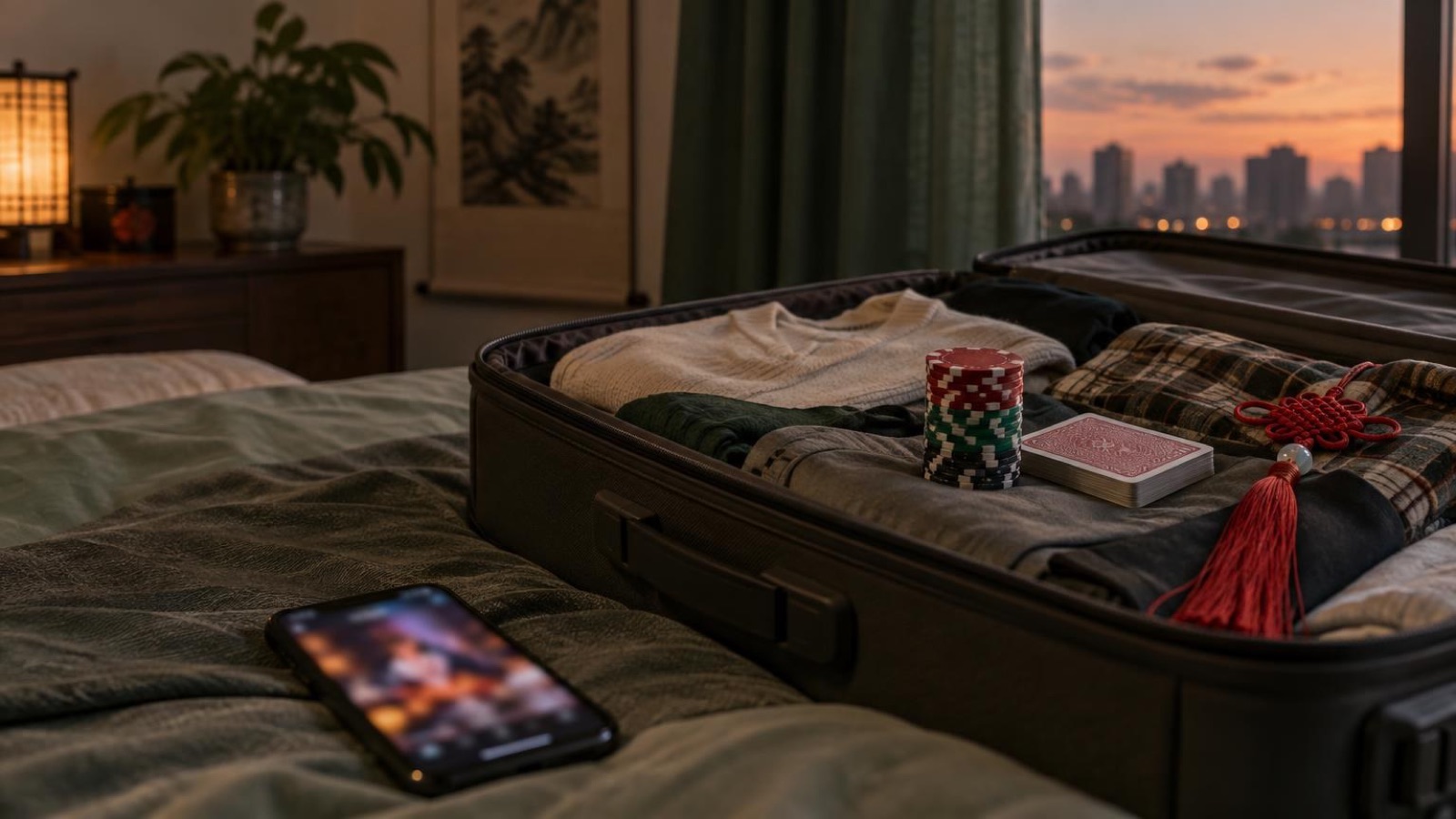
Why Chinese gamblers travel: where they go and why
The destinations cluster within a few hours of the mainland:
| Destination | Who goes | How they get in |
|---|---|---|
| Macau | Mainland visitors, especially from Guangdong and the Pearl River Delta | Individual Visit Scheme for residents of eligible mainland cities1 |
| Poipet and Bavet, Cambodia | Foreigners only; Thais cross at weekends from the Bangkok area | Overland border crossing2 |
| South Korea | Foreigners-only casinos in Seoul, Incheon and Jeju | Designated package tours entering visa-free under a temporary program6 |
There is a wrinkle worth knowing before you plan anything. While gambling has been outlawed in mainland China for decades, no rule in Chinese law explicitly forbids a Chinese national from gambling in a foreign country7. But Chinese authorities take a broader view: gambling abroad, online gambling, and providing funds or technical support for gambling all violate the Criminal Law and the Public Security Administration Punishment Law, and Chinese embassies have stated plainly that any form of gambling by Chinese citizens, including gambling overseas and opening casinos abroad to attract Chinese customers, is illegal under Chinese law4. In practice, that means the venue may be fully licensed where it stands, while the trip itself is still something Chinese law treats as an offense. Foreign visitors and expats in China are not covered by these rules in the same way; see gambling in China as a visitor for that side of it.
If you are curious what you can do legally inside the country, the state lotteries are the one outlet: the China lottery runs games like Double Color Ball and Super Lotto, and sports betting in China exists through the official Jingcai products.
Casino hubs within easy reach: Poipet and Bavet in Cambodia
Cambodia has built one of Asia's most accessible casino industries, and its geography is no accident. The casinos are located mostly in the border towns of Poipet, near Thailand, and Bavet, bordering Vietnam, with others in the coastal destinations of Koh Kong and Sihanoukville2. Each town faces a neighboring country where gambling is restricted, so the casinos sit right on the line where a short walk or a five-minute drive puts you in a jurisdiction where the tables are legal.

Poipet is the clearest example. Star Vegas Club and Casino sits on the border between Cambodia and Thailand and is the closest legal gaming destination to the Bangkok area, which is why the town's casinos cater to Thais, thousands of whom cross the border at weekends to gamble2. The casinos there are allowed to operate legally, and alongside the Thai weekend crowd you will find visitors from China, South Korea and Malaysia9. Golden Gate Casino in the area has historically operated as a foreigner-exclusive casino, which reflects the industry's basic rule10.
That rule matters: while casinos are legal in Cambodia, Cambodians themselves are not allowed to gamble in them, only foreigners5. Regulated gaming venues in the country allow foreigners and tourists to gamble, so a Chinese visitor, an expat resident or any other foreign passport holder can walk in and play11. If you are used to Macau's mega-resorts, expect something rougher in the border towns: hotel-casino complexes aimed at bus groups, long opening hours, and table games geared to regional tastes.
The games reflect who crosses the border. Alongside baccarat, which dominates every casino in the region, you will find regional card games. Pok Deng, a Thai card game where you bet on your own hand against the dealer, is offered at some Asian casinos and is far more common in Cambodia, Laos, Vietnam and some Chinese territories than anywhere else12. If you know baccarat you will recognize the rhythm of Pok Deng within a few hands: bet, cards, payout, repeat.
Recruitment on Kuaishou and Douyin: what casinos offer
The newest chapter in this story is not a new casino but a new sales channel. Kuaishou and Douyin have become the everyday channels through which mainland Chinese users get information and entertainment, and overseas casinos have moved in, using attractive come-ons like "free hotel stays" and "private car pickup" to lure mainland users to foreign casinos to open membership cards and exchange chips3.
The recruitment posts work like lifestyle content: a streamer shows a suite, a pile of chips, a border crossing, a buffet. The pitch is that the trip is cheap or free. What the posts do not spell out is that the streamer is usually an agent with a financial stake in your losses, and that the "free" parts are conditional on you putting real money on the tables.
This is not the first time Chinese players have been targeted where they live. Gambling websites have long recruited inside the mainland:
- The Ledu gambling website was built specifically to develop mainland citizens as website members to participate in gambling13
- The Dafa 888 (大发888) site ran entirely in Simplified Chinese and required gamblers to remit funds from bank cards inside China14
- One Phnom Penh Post investigation found the Shanghai Resort and Casino in Bavet ran online betting sites tailored for gamblers in Vietnam, China, Singapore, Indonesia and Hong Kong, so the physical border casino and the online recruitment operation were two doors into the same business15
- Some international online casinos also accept players signing up from China, though playing on them from the mainland runs into the same Chinese legal problem as the physical trips16
Free hotels, car pickups and gifts: what the packages include
So what is actually in the package? According to the reporting on the Kuaishou and Douyin recruitment, the offers include a free hotel stay, private car pickup, suite upgrades, flight booking and high-end gifts, all in exchange for opening a membership card at the casino and exchanging chips3.
| What they offer | What you must do |
|---|---|
| Free hotel stay | Open a membership card at the recruiter's designated venue3 |
| Private car pickup and suite upgrades | Exchange 30,000 to 50,000 in chips and gamble with them3 |
| Flight booking and high-end gifts | Same chip-exchange condition3 |
The membership card is the hinge of the whole deal. New members are told they only need to open a casino membership card at the recruiter's designated venue and exchange 30,000 to 50,000 in chips to gamble with, and then they enjoy the "perk" of a free hotel room3. Read that condition carefully: the room is not a gift, it is a rebate on a stake. If you exchange 30,000 in chips, you are expected to put that money into play, and the house edge does the rest. The gifts, the car, the suite upgrade all sit on top of that same requirement.
Casino membership cards themselves are usually free or near-free at the door; the cost is not the card but the chip exchange attached to it17. A first-time visitor comparing this to a normal casino trip should notice the difference: at a casino you walk into off the street, you decide your own stake. In a recruited package, the stake is the price of the perks.
Profit-split deals: the 70:30 arrangement explained
The most aggressive recruitment offers go beyond free rooms into structured staking deals. The recruiters proactively offer to help exchange currency, and even provide what they call 配码 (chip staking) and 代打 (playing on your behalf) services3.
Here is how the arrangement works, as described in the reporting:
- The gambler and the streamer each contribute funds at a 70:30 ratio, with the streamer putting up the larger share3
- The streamer then plays on the gambler's behalf3
- When the pair wins, the winnings are split 50:503
Notice the arithmetic. The streamer stakes 70 percent of the money but takes 50 percent of the winnings, so on the page's own figures the player, who stakes only 30 percent, takes half of anything won. The split favors the player's share of the winnings rather than charging a premium for borrowed stake. And the structure only splits winnings; the reporting does not describe any arrangement where the streamer shares your losses. If the combined stake loses, the player's own 30 percent is gone, and the player may still owe the recruiter for the "services" rendered along the way, from the hotel room to the currency exchange.
How the money comes back to you
The last link in the chain is 走资, moving the winnings back to the mainland, which the recruiters also offer to arrange, usually bundled with the currency exchange from the start of the trip3. In practice this means informal transfer channels rather than a bank wire, because a Chinese bank account receiving large unexplained sums from a casino town invites questions.

Two things follow from that. First, once your money is in the agent's hands for the move home, you are relying entirely on their honesty; there is no receipt, no regulator and no recourse. Second, the tax side is not suspended just because the money was won abroad. China's tax rules on gambling winnings tax a single sports lottery prize over 10,000 yuan in full under the individual income tax rules, and the same principle of declaring large gambling income applies to money brought home, whatever its source18. A player who cannot document how the funds arrived has both a tax problem and an evidence problem.
Legal options closer to home
If the point of the trip is simply to play, be aware that overseas casinos now recruit mainland players through short-video platforms, offering to help exchange currency, stake chips on the player's behalf, play on the player's behalf, and move winnings back to the mainland3. These arrangements are presented as convenience, but they put your money in someone else's hands from start to finish, and the resorts on the Cotai Strip are covered in our pages on Galaxy Macau, City of Dreams Macau and MGM Cotai.
South Korea is the other option that has recently gotten easier: local casinos there have regained momentum as Chinese group tourists return, with designated package tours entering visa-free under a temporary program6. Foreigners-only casinos in Seoul, Incheon and Jeju have long relied on Chinese and Japanese visitors, and the group-tour route is the standard way in.
For everyone else, the picture is simpler. Foreign visitors in China can read gambling in China as a visitor for what applies to them, and anyone weighing an overseas trip against the recruitment deals described above can compare the two directly: a licensed casino you walk into yourself, with your own stake in your own hands, versus a package whose every perk is priced against your chips. If gambling has stopped being fun, gambling help in China lists where to start.
Common Questions
Which overseas casinos are recruiting Chinese players on short-video apps?
Casinos and their agents post on Kuaishou and Douyin offering free hotel stays, private car pickups and gifts to people who open a membership card and exchange chips. The posts rarely name a licensed operator clearly, and the people behind them are usually recruitment agents rather than the casino itself.
What is 配码 (chip staking) and how does it work?
The recruiter stakes chips for you, meaning they put up part of the money you gamble with, often in a 70:30 split where the streamer or agent contributes 70 percent. You play with the combined stake, and any winnings are divided between you according to the deal.
What does 代打 (playing on a player's behalf) mean?
It means the streamer or agent plays the games for you instead of you playing yourself. You contribute funds, they sit at the table or place the bets, and winnings are typically split 50:50. You never control the chips yourself.
How do winnings get moved back to the player?
Recruiters offer 走资, moving money back to the mainland, usually through informal channels and currency exchange arranged by the agent. This is exactly the part of the arrangement that carries the most legal and financial risk for the player.
Where are Cambodia's casinos located?
Most are in the border towns of Poipet, near Thailand, and Bavet, on the border with Vietnam. Others sit in coastal areas such as Koh Kong and Sihanoukville. They are licensed for foreigners only, not Cambodians.
What do you get for opening a membership card at a recruited casino?
The advertised perk is usually a free hotel room, but it comes with a condition: you must exchange roughly 30,000 to 50,000 in chips and gamble with them. The room is only free if you put real money on the table.
Sources18 sources
- Macau: China's only casino gambling enclave, NBC News, 2006
- Cambodia gaming industry report, G3 Newswire, 2023
- Overseas casinos recruiting mainland gamblers via short-video platforms, Xinhua, 2026
- Cross-border gambling notice, National Immigration Administration of China, 2021
- Chinese punters flock to Poipet, Bangkok Post, 2019
- Local casinos regain momentum as Chinese group tourists return, The Korea Times, 2026
- China gambling overseas casino warning illegal Asia embassy Macao, Channel News Asia, 2024
- Chinese law on gambling by citizens abroad, Embassy of the People's Republic of China in the Philippines, 2019
- Games without frontiers, South China Morning Post, 2013
- Socio-economic origins of Korean and Singaporean casinos, APEBH conference paper, 2013
- Best online casinos for players from Cambodia, Wizard of Odds, 2026
- Pok Deng FAQ, Pokers, 2026
- Ledu gambling website case, China Peace, 2023
- Dafa 888 gambling website case, Cyberspace Administration of China, 2015
- Gambling law: Phnom Penh Post investigation, Phnom Penh Post, 2017
- Best online casinos for players from China, Wizard of Odds, 2026
- Self-exclusion and relinquishing casino membership, Gambling Therapy forum, 2010
- Individual income tax on sports lottery winnings, Shanghai Tax Bureau, 1998