Chinese dice games at a glance
Dice have been part of Chinese gambling life for a very long time, and the family of games they produced is wider than most visitors expect. Sic Bo, originally pronounced "SEE-BO," is an ancient Chinese dice game that survives today as one of the most recognizable tables in Macau1. Cee-lo, a gambling game of Chinese origin played with three dice, traveled the other way and became a street game known well beyond Asia6. Fan-Tan, which looks like a dice game to a passer-by, is actually a counting game built around a pile of tokens7.
Alongside these sit games where dice are only one part of the equipment. Hua ma que, an early ancestor of mahjong, used special king pieces as well as suits5. And Bo Bing, the Mid-Autumn Festival dice game, brings dice into homes and community halls once a year. If you are trying to place all of these in context, our page on gambling in China covers the wider picture, and casinos in China covers where you can actually sit down and play.
Sic Bo and Cee-lo: the three-dice games
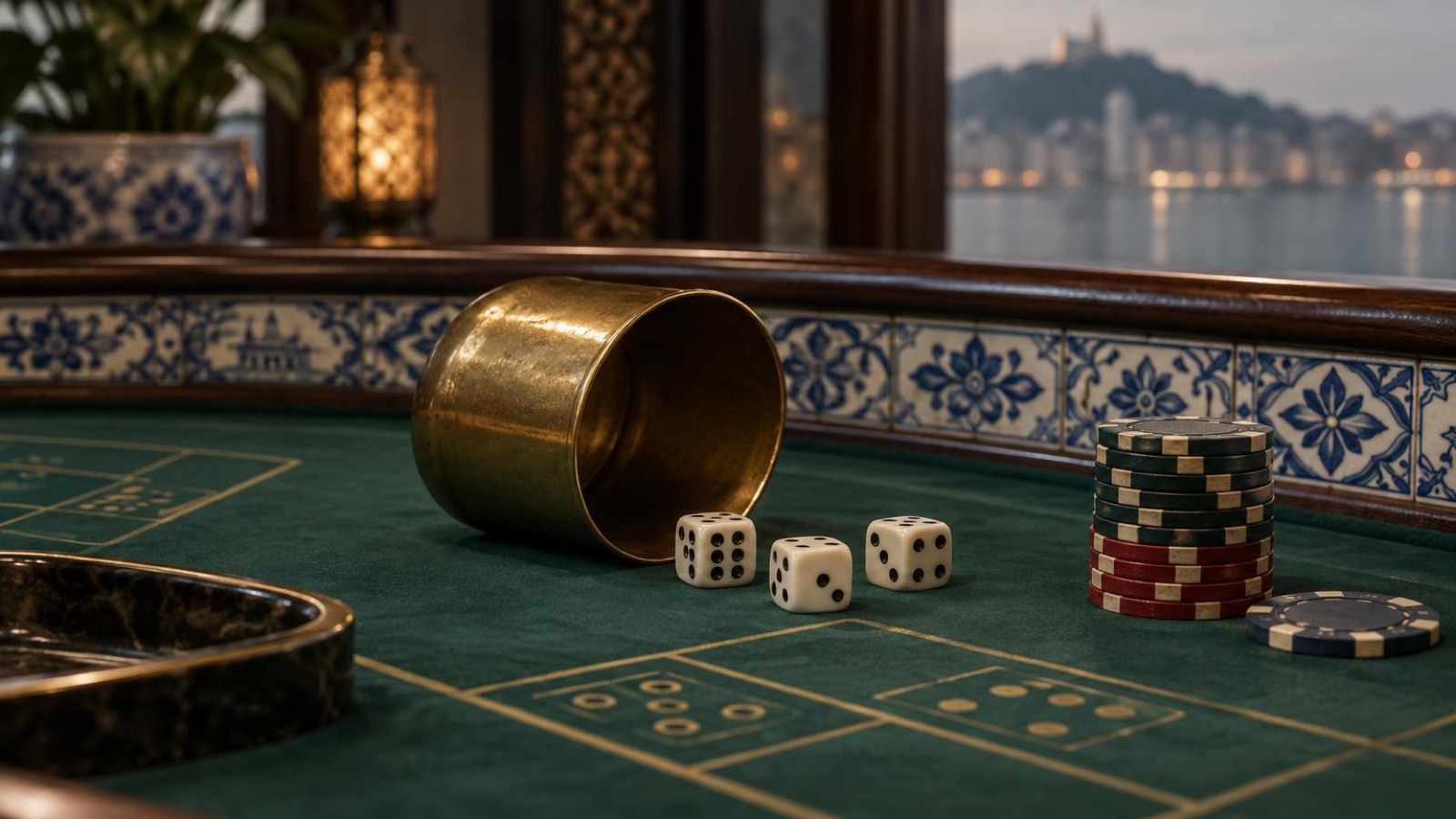
Sic Bo is a unique game of chance played with three dice, wildly popular in Macau casinos, where it is also known as Dai Siu, Tai Sai, Hi-Lo, or the Big and Small game2. The game is played with three dice and players bet on the outcome of each roll1. You are not rolling the dice yourself; the dealer does that, usually under a glass dome or an electronic shaker, and you bet on a layout that offers everything from a single number to totals, doubles and triples.
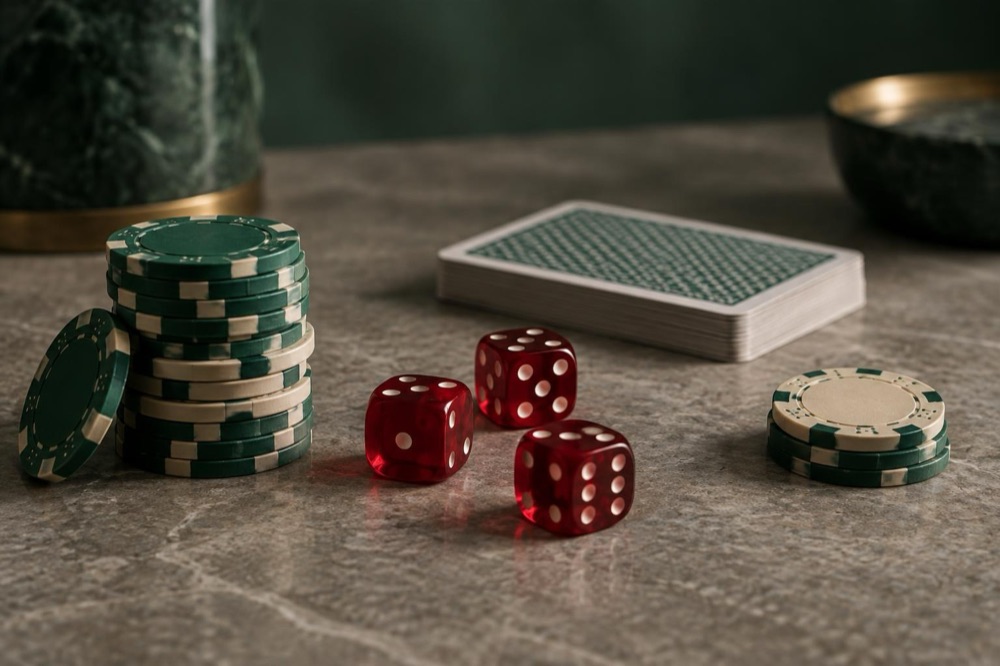
The "Big and Small" nickname comes from the two most popular bets: Small wins when the three dice total between 4 and 10, Big when they total 11 to 17, with triples usually excluded from both. Other bets cover specific totals, any given single number appearing on one, two or all three dice, and specific doubles or triples. The layout looks crowded at first, but every bet is simply a different way of predicting what three dice will show.
Cee-lo uses the same three dice but a different structure. It is a gambling game of Chinese origin played with three dice6, and it works for two or more players8, which makes it as much a street and home game as a casino one. Players take turns as the shooter and roll all three dice at once, with the roll resolving into a ranked result: three of a kind (the highest, with 4-5-6 also a special winning roll), a pair plus a third die (where the third die's value is your score), or 1-2-3 (a losing roll). If nothing scores, the shooter rolls again.
The practical difference between the two is where you will find them. Sic Bo is a casino table game with a felt layout and a dealer; Cee-lo is a game you can play with three dice in a cup anywhere, and its rules have traveled with Chinese communities around the world. Both are pure games of chance: no strategy changes what three dice will show, so the interest is in the betting choices and the pace.
Fan-Tan and its bet types: Fan, Hong, Kwok, Nim
Fan-Tan is the game that looks like a dice game but is not one. The croupier takes a pile of small tokens, such as beads, and removes them four at a time until one, two, three or four remain; gamblers bet on the remainder of the total number of tokens divided by four7. A single die or a pointer on the table shows which of the four numbers won.
The four classic bets, described as far back as 1891, are Fan, Hong, Kwok and Nim3:
- Fan is a straight bet on one number. If the remainder matches your number, you win at 3:1; any other result loses4.
- Hong covers three of the four numbers. It pays 1:4 in its classic form, or 1:2 in a modern three-number variant3.
- Kwok covers two numbers and pays 1:23.
- Nim splits your stake across two choices, with the payout depending on which half wins3.
The house edge on Fan-Tan is thin by table-game standards: the house receives 1.25% of each Tan bet, a modern three-number bet that has largely replaced Hong3. That makes Fan-Tan one of the fairest-looking games on a casino floor, though the slow, ritualized counting is as much of the appeal as the odds. Fan-Tan tables have largely disappeared from modern Macau floors in favor of faster games, but the game remains a piece of living casino history, and you can still find it in some older halls and in live-dealer versions online.
Hua ma que: the four king pieces
Hua ma que is an early form of mahjong from North China, around Beijing and Tianjin, and it shows how dice-adjacent pieces evolved into the tile games China is famous for. Each player holds sixteen tiles, unlike the thirteen of later mahjong variants9. The game-play of its southern cousin, wang ma que from Changsha in Hunan, is based on thirteen tiles5.
What makes hua ma que distinctive is its set of king pieces. The Inner Flowers are four pieces: the Cash King (tong wang), the Strings' King (suo wang), the Myriads' King (wan wang) and the General King (zong wang)5. The first three are the "kings" of the three suits, Cash, Strings and Myriads, which are the same suits you see today in Pai Gow (Chinese dominoes). The General King is the wild one: zong wang can act as any of the Cash, Strings, Myriads, or East, South, West, North5, meaning it can substitute for any suit tile or any wind.
The southern variant, wang ma que, expanded this: it has eight Inner Flowers rather than four9, and its wild piece can act as any of the Cash, Strings, Myriads, or Center, Fortune, Blank, or East, South, West, North9. The Outer Flowers, the bonus sets, should be five sets in principle, but can be added to, to make nine sets, or even eleven sets according to the players9; the conventional five are Heaven, East, Spring, Rain and Orchid5.
This history matters if you play mahjong today, because the flower tiles and wild-card conventions in modern mahjong in China descend directly from these king pieces. It also connects to the dominoes family: a related game, Tá t'in kau, is played by four persons with one set of dominoes, thirty-two pieces10, the same count as Pai Gow tiles.
Dice appear in this world too, not just tiles. Hong Kong Shengguan Tu, a promotion-ladder game, uses four dice11, and its rolls have names:
| Dice shown | Roll name |
|---|---|
| Two fours | de |
| Two sixes | cai |
| Two fives | gong |
| Two threes | liang |
| Two twos | rou |
| Two ones | zang |
Four dice rather than three, and named rolls rather than totals, show how flexible the Chinese dice tradition is.
Bo Bing, the Mid-Autumn dice game
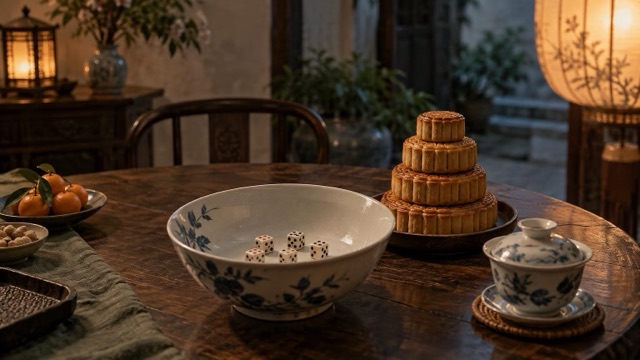
Bo Bing is the one Chinese dice game almost everyone in a Chinese community encounters, because it is played at Mid-Autumn Festival gatherings rather than in casinos. Players roll six dice and match the result against a ladder of prizes named after imperial examination ranks, from the top prize down through the scholar ranks to the lowest. It is a group game, played in families, workplaces and community halls, with everyone taking turns until the prizes are claimed.
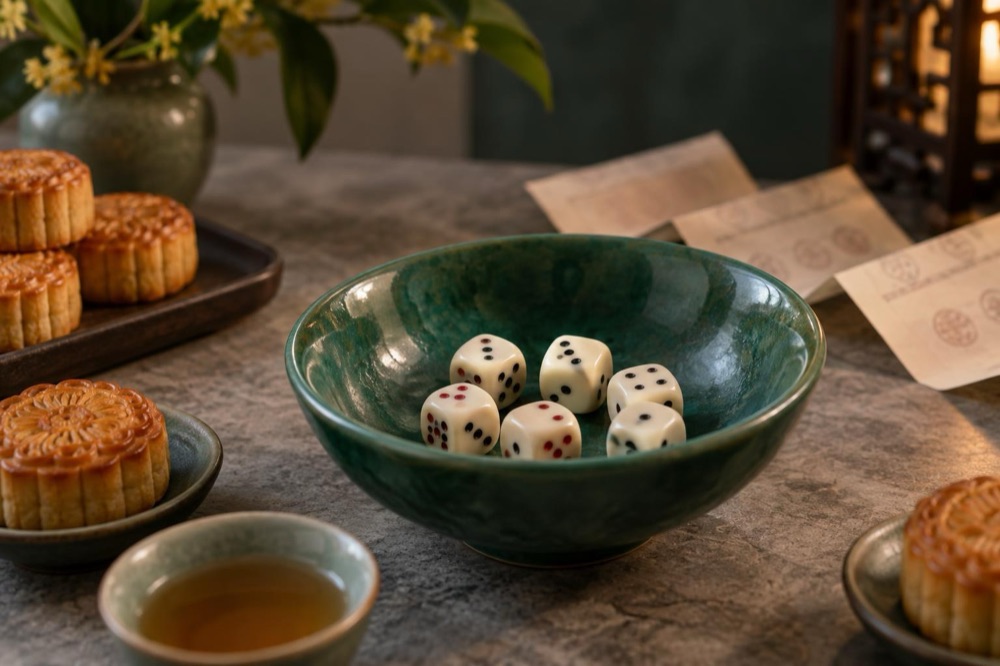
Because Bo Bing is a festival game with its own rules, prize ladder and traditions, we cover it in full on its own page: Bo Bing (Mid-Autumn Dice Game).
Where these games fit in casino play
Of everything on this page, Sic Bo is the game you will actually meet in a casino. It is a standard table in Macau, and live-dealer versions of it and other Chinese games are offered online2. Fan-Tan survives in live-dealer form too, with the Fan bet paying 3:14. If you are heading to Macau specifically, our pages on individual properties, such as Galaxy Macau and the Grand Lisboa, list what is on the floor.
Online, the dice tradition has taken a new turn. Provably fair casino games, a category that includes dice alongside mines, plinko, limbo, keno, crash, hilo and roulette, use cryptographic verification so players can check each roll12. These are simple high-low dice games rather than Sic Bo, but they are the direct digital descendants of the three-dice tradition. Mainland China does not license online casinos, so these products sit outside what residents can legally play at home; our page on online gambling in China covers that side of things.
The wider family of Chinese games also crosses over. Poker rooms and casino platforms serving Asian players list dice games alongside blackjack, baccarat, craps and crash games13, and Chinese poker, where players arrange thirteen cards into three rows, carries the same thirteen-piece structure you saw in wang ma que13. For the full picture of where each of these games sits, see gambling in China and our page on gambling in China as a visitor.
Common Questions
How many dice are used in Cee-lo?
Three. Cee-lo is a gambling game of Chinese origin played with three dice, and it works for two or more players, which makes it as much a street and home game as a casino one.
What does zong wang mean in hua ma que?
Zong wang is the General King, one of the four king pieces. It is a wild piece that can act as any of the Cash, Strings or Myriads suits, or as any of the four winds, East, South, West or North.
What are the four kings in hua ma que?
The four kings are the Cash King (tong wang), the Strings' King (suo wang), the Myriads' King (wan wang) and the General King (zong wang). They sit alongside the suits as the game's special pieces.
What bets can you place in Fan-Tan?
The four classic bets are Fan, Hong, Kwok and Nim. Fan pays 3:1 on a single number, Hong covers three numbers, Kwok covers two, and Nim is a stake split across two choices.
When is Bo Bing played?
Bo Bing is the Mid-Autumn Festival dice game, played when families and friends gather for the festival. Our full Bo Bing page covers the rules, prizes and traditions in detail.
Is Fan-Tan a dice game or a counting game?
It is a counting game. The croupier removes tokens four at a time from a pile, and players bet on how many will be left at the end: one, two, three or four. Dice are not the mechanism.
Sources13 sources
- How to play Sic Bo, PlaySmart, 2026-09-25
- Live dealer casino games, Natural8, 2026-09-26
- Fan-Tan, Wikipedia, 2026
- Live game rules, FB88, 2026-09-26
- Flowers and Kings: an hypothesis of their function in early ma que, The Mahjong Tile Set, 2026-09-27
- Cee-lo, Porg.es Games, 2025-02-16
- Gambling games research, PMC, 2024-05-31
- Plastic dice in bulk, Cool Tools, 2020-05-28
- Flowers and Kings: an hypothesis of their function in early ma que (archived), The Mahjong Tile Set, 1941
- Chinese games with dice and dominoes, Culin, 1893
- Hong Kong Shengguan Tu research, NTNU, 2005-06
- Provably fair casino games, Stake.com, 2026-09-26
- MPC 24: Ying Lin Chua wins the biggest ever Red Dragon, Somuchpoker, 2026-09-27