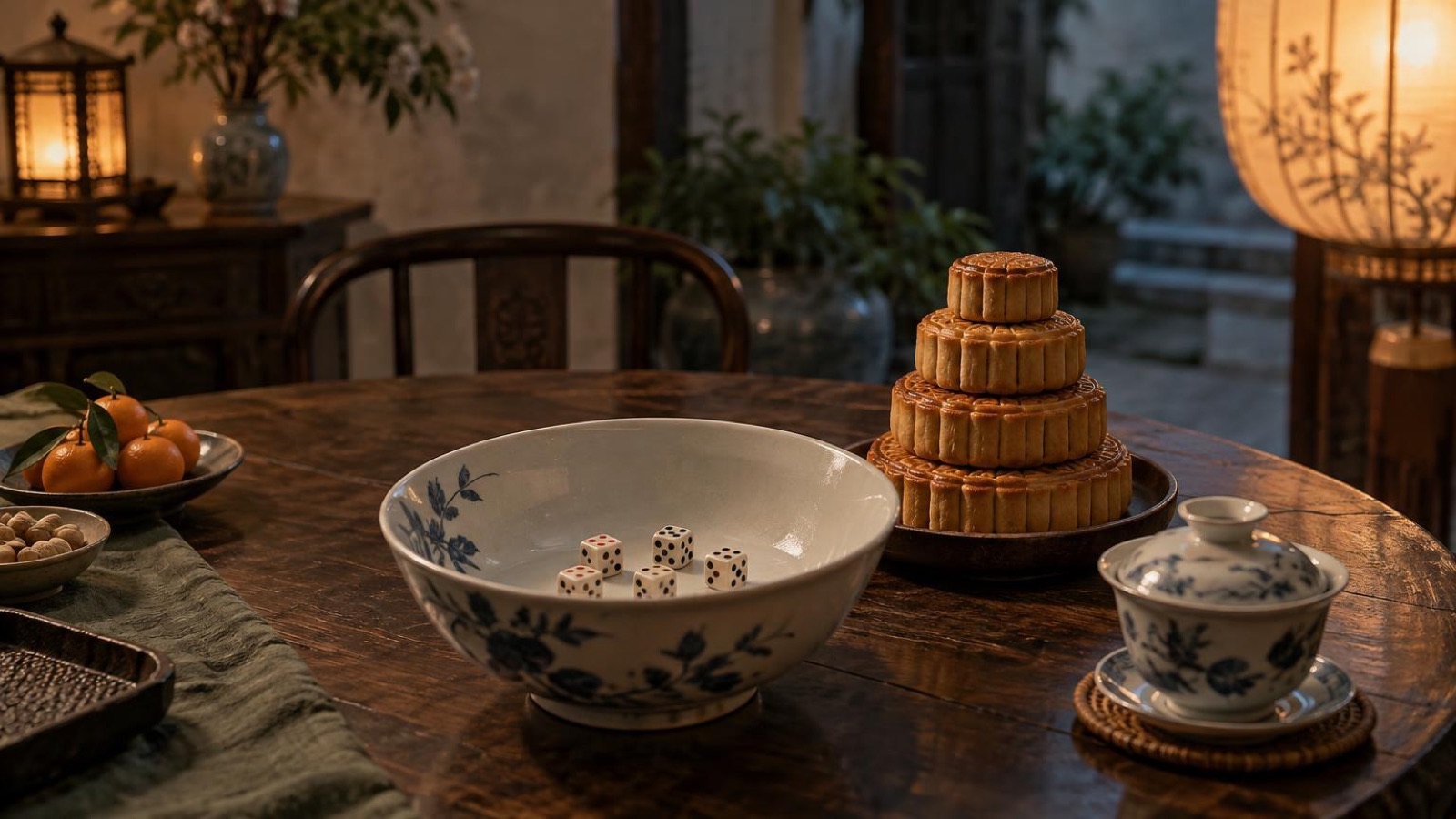
Bo Bing (博饼, "competing for cakes") is the dice game of the Mid-Autumn Festival. Players take turns throwing six dice into a bowl, and the pattern that lands face up decides which of six ranks the throw earns, named after the old imperial examination titles: Zhuangyuan (状元), Bangyan (榜眼), Tanhua (探花), Jinshi (进士), Juren (举人) and Xiucai (秀才). Each rank wins a mooncake, and the better the rank, the bigger the cake1.
Where and when it is played
Bo Bing belongs to the Mid-Autumn Festival season, and it is played in the Minnan region of southern Fujian province and in Taiwan1. Xiamen is the heartland of the game, and it spreads through the wider Hokkien-speaking world, including communities in Southeast Asia. The game peaks on the festival night itself, when the moon is at its fullest, but it is common through the days around it at family gatherings, workplace parties, school events and community celebrations.
The setting is usually a dinner table or a courtyard. A box of mooncakes is opened, the cakes are laid out where everyone can see them, and the dice and bowl go in the middle. It is a social game, closer in spirit to a raffle than to a casino table: everyone throws, everyone has a chance at the top prize, and the fun is in the shouting when a big hand lands.
That said, dice games with a bowl are a long tradition across Asia, and Bo Bing sits inside it. In Japan, Chinchirorin is played with three dice and a bowl or teacup2. In Vietnam, Bầu Cua Tôm Cá uses three standard six-sided dice, a betting mat and a dice cup or bowl3. In Thailand, Pok Deng can be seen played in parks and open spaces across the country4. And in Macau casinos, Sic Bo is a three-dice game known as Dai Siu, Tai Sai, Hi-Lo or Big and Small5. Bo Bing is the Mid-Autumn member of this family, distinguished by its six dice, its examination-title ranks and its mooncake prizes.
If you are in China over Mid-Autumn and want the wider picture of what gambling is and is not available, see gambling in China; Bo Bing itself is a festival game played for cakes, not a betting product.
What you need: dice and bowl
The equipment is simple, which is part of why the game has survived so long. You need six standard six-sided dice, one bowl, and a set of prizes1. The bowl should be deep enough that the dice tumble inside it rather than bouncing out, and wide enough that all six dice land flat and readable. A porcelain bowl is traditional, and the sound of the dice rattling in it is part of the atmosphere.
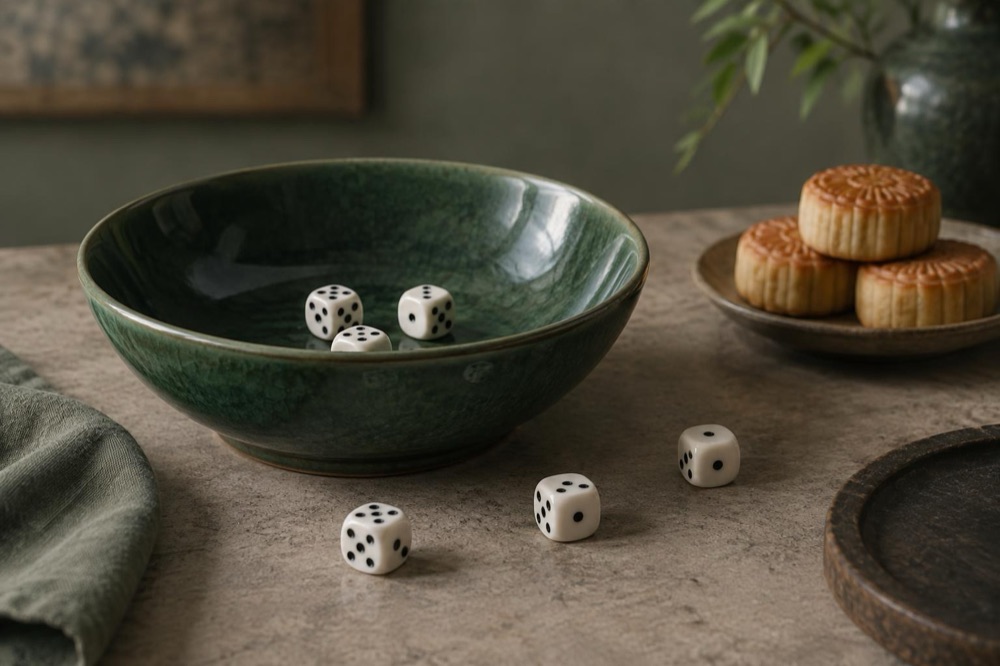
Six dice is unusual. Most bowl and dice games in Asia use three. Chinchirorin uses three dice and a bowl2. Bầu Cua Tôm Cá uses three six-sided dice numbered 1 to 63. Sic Bo is played with three dice, with bets placed on the outcome of each roll6, and one crypto dice page describes it the same way, as a fast-paced game played with three dice7. Even the strictest casino regulation of the game, in the United Kingdom, fixes it at "three dice, and no more, shall be thrown at every throw"8. Craps, the Western dice game, uses a pair of six-sided dice plus an ON/OFF puck9. Bo Bing doubles the count to six, which is what makes its hand rankings possible: with six dice you can get four of a kind, five of a kind or even six of a kind, patterns that three dice can never produce.
The dice should be fair ones. In any dice game the assumption is that each die is independent and unbiased; one Taiwanese analysis of three-dice games notes that the 216 ordered permutations assume the dice are fair and independent10. With six fair dice, every throw is a fresh random event, and no pattern of previous throws tells you anything about the next one, in the same way a bingo ball blower ensures no single number has a greater chance of appearing than any other11.
How each winning throw works
Play moves around the table, one player at a time. On your turn you pick up all six dice and throw them into the bowl. The pips that land face up decide your rank for that throw, and the rank decides your prize1.
The six ranks, from bottom to top, are:
| Rank | Meaning | Prize |
|---|---|---|
| Xiucai (秀才) | lowest examination degree | smallest mooncake |
| Juren (举人) | provincial graduate | small mooncake |
| Jinshi (进士) | palace graduate | medium mooncake |
| Tanhua (探花) | third place in the palace exam | larger mooncake |
| Bangyan (榜眼) | second place | larger still |
| Zhuangyuan (状元) | first place, the top honor | the largest mooncake |
The ranks borrow the ladder of the imperial examination system, which for centuries was the path to official position in China. Throwing dice for these titles turns the whole table into a mock examination, and the joke of a five-year-old winning Zhuangyuan while a professor draws Xiucai is half the fun.
Because the outcome of each throw is pure chance, there is no strategy. You cannot throw more skillfully, and you cannot bet on another player's throw. This puts Bo Bing in the same category as bingo, where the first player to match all their numbers to those called wins a prize12, or a lottery draw, where prize tiers are fixed in advance and the winning bet counts and per-bet prize amounts are published after each draw13. The Chinese lottery Pailie 3, for example, publishes its prize tiers with winning bet counts and per-bet amounts in yuan after every draw13, and Kuaile 8 pays a fixed 52 yuan for a pick-seven match-three14. Bo Bing works the same way, except the prize pool is a box of mooncakes and the draw is your own wrist.
The prize structure: 63 cakes per set
The traditional prize set is built around mooncakes in different sizes, matched to the six ranks1. The smallest cakes go to the lowest ranks and the largest to the Zhuangyuan, so a full game needs a box with a real spread of sizes, not a box of identical cakes.
The classic set runs to 63 cakes in total, arranged so that the low ranks are won often and the top ranks rarely. That structure matters for how the evening feels: because most throws win something small, nearly everyone at the table collects a cake or two, and because the Zhuangyuan hands are rare, the moment one lands is the moment the table erupts. It is the same design logic as instant scratch tickets, where some tickets feature smaller top prizes but many more prizes overall15, spreading the wins around instead of concentrating them.
Before you start, open the box and lay the cakes out in the middle of the table, sorted by size, so everyone can see exactly what each rank is worth. Decide in advance what happens to unclaimed cakes at the end of the night, since with 63 cakes and a modest table, some will always be left over. Many families carry them over to a final round, or simply share them out with tea.
If you are buying the set yourself, a mooncake box with a large cake plus many small ones fits the game better than a box of equal-sized cakes. Prices vary widely by bakery and city, and the game works just as well with an inexpensive box, since the prizes are symbolic.
Special Zhuangyuan hands: Wuhong, Liubeihong, Chajinhua
The Zhuangyuan rank has its own internal hierarchy of special hands, and these are the throws people remember. The celebrated ones are:
- Wuhong (五红): five dice showing four pips, the red-blessed pattern.
- Liubeihong (六杯红): all six dice showing four pips, the perfect throw.
- Chajinhua (插金花): four pips appearing with the other dice forming a pair, the "golden flower" hand.
These hands outrank an ordinary Zhuangyuan, and in many house rules a later special hand can take the Zhuangyuan cake away from a player who won it earlier with a plain one. That possibility keeps the table loud until the very last throw.
Named special hands with big payouts are a recurring feature of Chinese games. In Pai Gow tiles, the strongest named hands are Gong and Bo combinations, such as a 2 paired with any 816. In Vietnamese Mahjong, there is a huge bonus payable to a hand that wins without any Jokers, bonus tiles or honor tiles, called the "No Flowers, No Leaves" hand17. In the old Chinese domino games documented by Stewart Culin in the 1890s, special throws like sing luk ("four, five, six") or three alike won the full stakes from every player at once18. Bo Bing's Wuhong and Liubeihong belong to this same tradition of giving the rarest patterns names, ranks and stories.
Table rules: fouls, repeats and table size
Bo Bing is a household game, so the fine rules are set by the table, and it is worth agreeing on them before the first throw. The questions that come up most often:
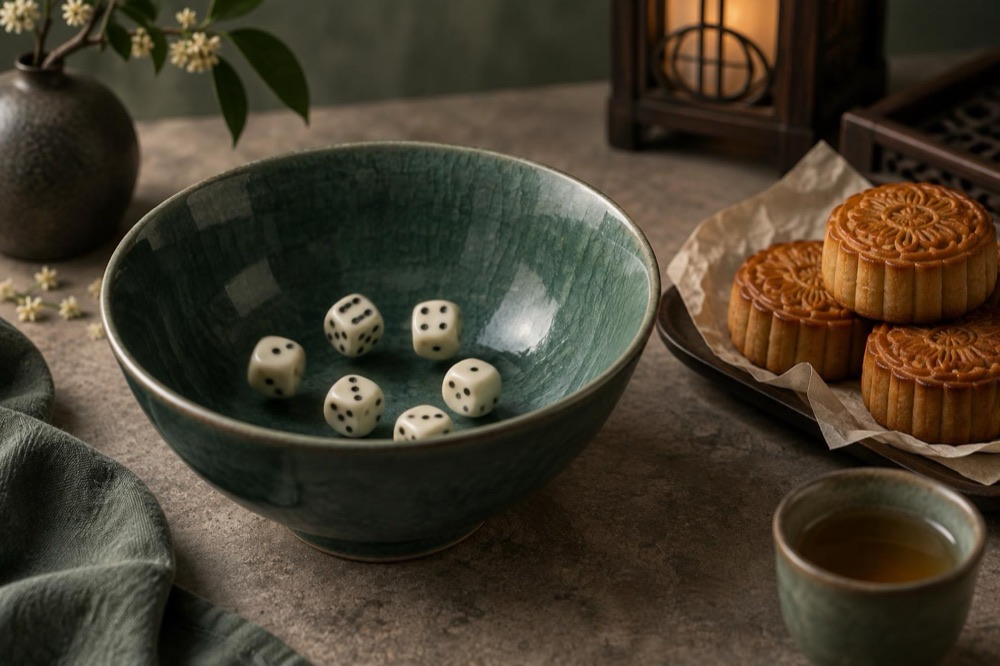
How many people can play? There is no fixed limit in the traditional rules. For a sense of scale, a Texas Hold'em poker table seats 2 to 10 players19, a Pai Gow Poker table has positions for six players and a dealer's area20, and the Thai card game Pok Deng allows anywhere from 2 to 17 players21. A Bo Bing circle of around eight to twelve works well: everyone throws often enough to stay interested, and 63 cakes go a reasonable distance.
What if the dice fall out of the bowl? Most tables treat it as a foul and let the player throw again, but some stricter households count it as a lost turn. Compare craps, where a throw only counts when both dice hit the back wall of the table, and where bets lose or win strictly according to the numbers that legally land22. Agree on your version up front, especially if children are playing, because a bouncing die is guaranteed to happen at least once.
Can a player throw twice in a row or win Zhuangyuan twice? House rules differ. Some tables let a repeat Zhuangyuan stand and simply hand over a second large cake; others rule that one top prize per player is the limit. The Chinese Sports Lottery's 4 Goals game allows a bet range of 2 to 99 on a single slip23, a reminder that even official games set their own generous limits; your Bo Bing table can set its own too.
Who throws first? Traditions vary, and some families have the eldest or the guest of honor start. The simplest approach is to let everyone throw once to decide, with the highest rank going first, which is itself a mini round of the game.
One practical note on the law: Bo Bing is a festival game played for mooncakes among family and friends, not a commercial gambling product, and it is not something a visitor needs to worry about joining. If you want the general picture of what is and is not permitted in China, see gambling laws in China.
Dice games in the same family
If Bo Bing catches your interest, the wider world of Chinese dice games and fan-tan is worth exploring. Sic Bo, the three-dice casino game, is the closest commercial relative, and it is very popular in Macau casinos under the names Dai Siu and Tai Sai5. Chinchirorin in Japan and Bầu Cua Tôm Cá in Vietnam use the same bowl-and-dice setup with three dice2. For the tile-based cousins, see Pai Gow (Chinese dominoes) and mahjong in China, both of which share Bo Bing's love of named hands and ranked patterns.
Common Questions
How many dice are used in Bo Bing?
Six. Each player in turn throws all six dice into a bowl, and the pattern of pips that lands face up decides which of the six ranks the throw earns, from Xiucai at the bottom to Zhuangyuan at the top.
What is the highest roll in Bo Bing?
The best throw earns the rank of Zhuangyuan, the top of the six ranks named after imperial examination titles. A player who throws a Zhuangyuan hand takes the largest mooncake in the set, and special Zhuangyuan hands such as Wuhong and Liubeihong are celebrated most.
How many people can play Bo Bing at one table?
There is no fixed number in the traditional rules, and households set their own. For comparison, poker tables seat 2 to 10 players and Pai Gow Poker tables have positions for six players and a dealer, so a Bo Bing circle of around ten is typical and workable.
What happens if the dice fall out of the bowl?
Traditions vary from family to family, and most treat it as a foul that cancels the throw, with the player rolling again. Agree on the rule before starting, the same way craps players agree that a roll counts only when both dice hit the back wall.
When does the Bo Bing season start and end?
Bo Bing belongs to the Mid-Autumn Festival, so the season centers on the festival night itself, with games often played in the days around it among families, friends, workplaces and community groups in Minnan and Taiwan.
What prizes do players win in Bo Bing?
Mooncakes, in different sizes matched to the six ranks. The lowest rank wins the smallest cake and the Zhuangyuan wins the largest, so a full set of prizes is a box of mooncakes laid out on the table before play begins.
Can the same player win Zhuangyuan twice?
House rules differ. In many families a player who has already taken the Zhuangyuan cake can still throw again and win a second one, while others cap it at one top prize per person so the cakes spread further around the table.
Sources23 sources
- Bo Bing project page, ihchina.cn, 2026
- Chinchirorin, Wikipedia, 2026
- Bầu Cua Tôm Cá rules, Xoviet Pokers, 2026
- Pokdeng: traditional Thai gambling and online gambling, TLCCTX, 2022
- Live dealer casino, Natural8, 2026
- Sic Bo: how to play, PlaySmart, 2026
- Crypto casino dice, CoinPoker, 2026
- The Gaming Clubs (Bingo) Regulations 2002, OPSI, 2002
- Craps guide, CoinPoker, 2025
- Sic Bo odds analysis, fk57dcard, 2026
- Bingo odds, PlaySmart, 2026
- Break open tickets: how to play, PlaySmart, 2026
- Pailie 3 draw results, zhcw.com, 2026
- Kuaile 8, zhcw.com, 2026
- Instant games: how to play, PlaySmart, 2026
- Pai Gow Poker: how to play, PlaySmart, 2026
- A quick look at mahjong around the world, McGill Mahjong, 2015
- Chinese games with dice and dominoes, Stewart Culin, 1893
- Texas Hold'em guide, CoinPoker, 2024
- Pai Gow Poker table layout, PlaySmart, 2026
- Pok Deng FAQ, Xoviet Pokers, 2026
- How to play craps, PlaySmart, 2026
- 4 Goals game help, Sporttery, 2026