What Pok Deng is
Pok Deng (ป๊อกเด้ง) is a traditional Thai card game, a point-comparison game in the same family as baccarat. The aim is simple: get a higher hand total than the dealer. The scoring term is "taem," and a taem of 8 or 9 is a high score4. The name of the game comes from its two key ideas: "Pok" is a two-card hand totaling exactly 8 or 9, and "deng" is a multiplier that pays you extra when your winning hand has a special shape, such as two cards of the same suit1.
The game is played with a standard 52-card deck, and each player holds a minimum of two and a maximum of three cards1. One person acts as dealer, and everyone else plays against that dealer, not against each other. A single table can seat one dealer and up to sixteen players, though four to eight is the comfortable range1. Hands are quick: about two to three minutes each, with a typical round of play lasting around five minutes1.
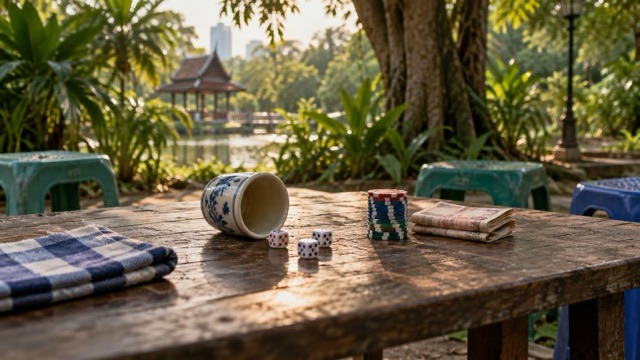
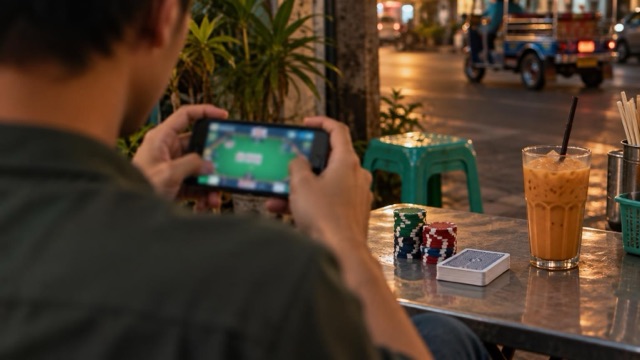
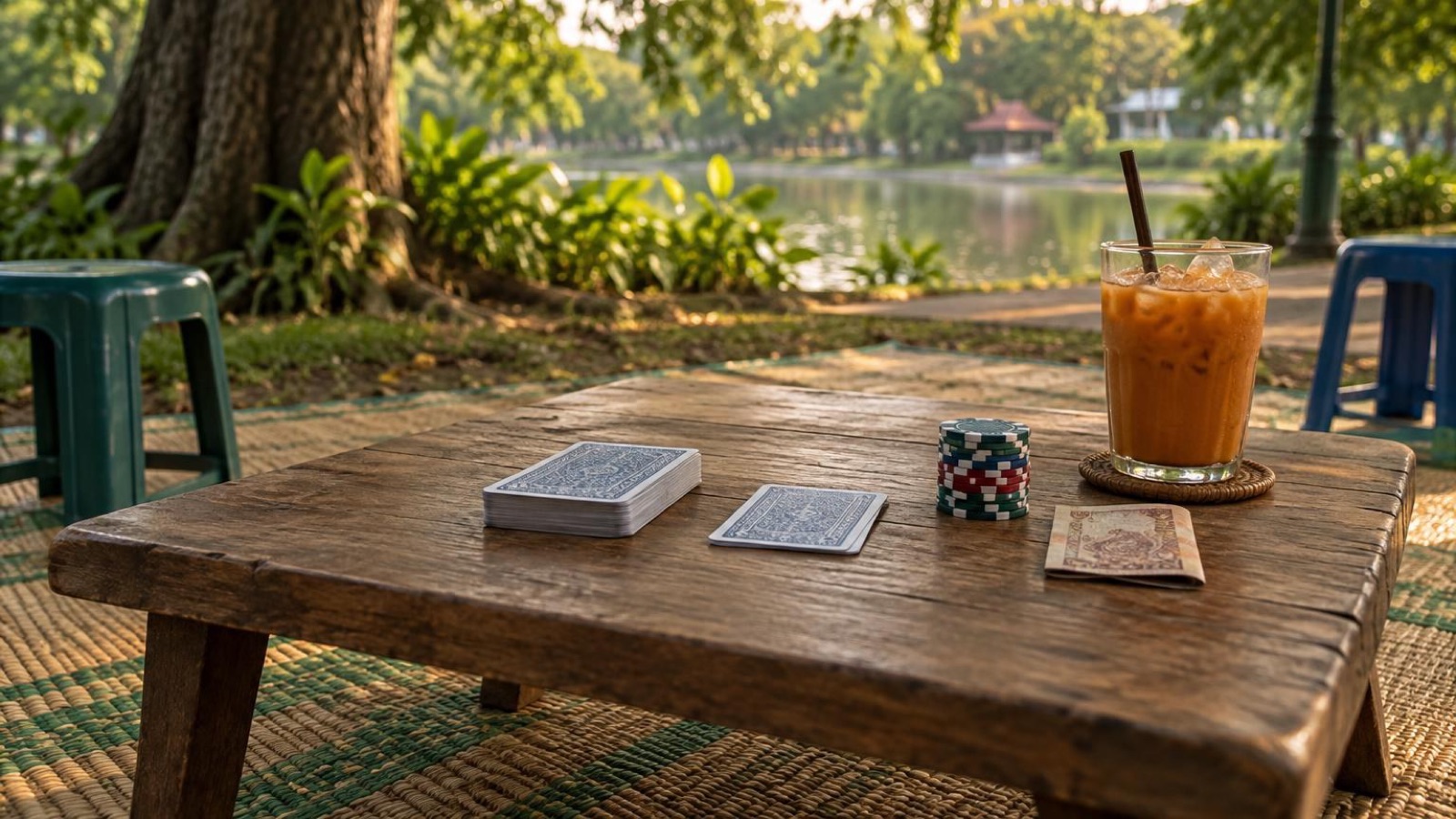
Pok Deng is woven into everyday Thai life. It can be seen played in parks and open spaces across the country, and it is one of the best-known of the traditional Thai gambling games. It has also spread beyond Thailand, and it now appears in casinos elsewhere in Asia2.
Other names: Pok Kao, Pok Eight Pok Nine
The game also goes by Pok Kao, or Pok Eight Pok Nine1. Both alternative names point at the heart of the game: the two-card hand worth exactly eight or nine points. If the cards in your hand total eight or nine, you turn them face up immediately, and this is called getting Pok Eight or Pok Nine, depending on the total. Pok Nine beats Pok Eight1.
So the names are not just labels. They describe the moment every player is waiting for: the instant deal of two cards that ends the hand before it has really begun.
Card values and scoring (taem)
Card values are straightforward1:
- Number cards count their face value.
- J, Q and K count as 10.
- A counts as 1.
After adding your cards, only the units digit of the total counts. This is the taem, your hand's score. A hand of 7 and 8 totals 15, so the taem is 5. A hand of 9 and 10 totals 19, so the taem is 9. A hand of 10 and 10 totals 20, so the taem is 01.
This units-digit scoring is why the game tops out at nine. There is no such thing as a score above 9, and a score of 0 is the weakest result you can hold. The comparison with baccarat is exact: in baccarat, the player's hand stands on totals of 6 or 7 and draws on 0 to 5, and hands are likewise scored by the units digit5.
How a hand plays out
A hand runs in a fixed order1:
- The dealer shuffles and deals two cards to each player, ending with the dealer. The dealer may choose to deal clockwise or counterclockwise4.
- Anyone whose two cards total 8 or 9 reveals them at once: that is Pok Eight or Pok Nine, and Pok Nine is the stronger of the two1.
- If the dealer does not have Pok, every player has the right to call for one more card, one card each, but is not required to take it1.
- Each player may stay or draw one card, and the dealer may also draw a card4.
- Hands are compared with the dealer's. To win, your hand's point total must be higher than the dealer's1.
The whole thing takes two to three minutes, and online it can be even faster, sometimes a matter of seconds2. Because everyone plays the dealer separately, several players can win, several can lose, and some can tie, all in the same hand.
The third card rule
The third card is where the small decisions live. If the dealer does not have Pok, every player may call for one additional card, one each, but nobody has to1. Staying on a 7 or 8 is usually fine; drawing on a 0, 1 or 2 is usually automatic. The in-between totals are where players differ.
One wrinkle is unique to the dealer. Before the dealer calls for a third card, the dealer may "capture": using the dealer's two cards to play against the players who hold the same number of cards as the captured ones1. In other words, the dealer can choose to stay on two cards and take on only the players who also stayed, rather than drawing and facing the three-card hands too.
Note that the third card can change your hand's shape as well as its score. Three cards of the same suit, three cards in sequence, or three court cards all create special hands with higher payouts, which is covered below under deng.
Hand rankings from Pok down to normal hands
Pok Deng hands rank in a clear order, from strongest to weakest1:
| Hand | Cards | Score | Deng |
|---|---|---|---|
| Three of a kind (tong) | 3 | variable | 5 |
| Straight flush | 3 | variable | 5 |
| Straight (riang) | 3 | variable | 3 |
| Sam Lueang (three court cards) | 3 | 0 | 3 |
| Pok | 2 | 8-9 | 1-2 |
| Normal hand | 2-3 | 0-9 | 1-3 |
The details behind the table1:
- Tong means all three cards in your hand are the same rank. It counts as stronger than a nine that is not Pok Nine, and stronger than Sam Lueang. If it wins, it pays five times the bet.
- A straight (riang) is three cards in sequence, such as 2-3-4, 5-6-7 or Q-K-A. K-A-2 and A-2-3 do not count as a run, because 2 is the lowest card and A is the highest. A winning run pays three times the bet.
- Sam Lueang, also called kra bueng, is three court cards, J Q or K, in any mix. It scores 0 as a taem but ranks above a non-Pok nine. If it wins, it pays three times the bet.
- Pok is the two-card 8 or 9 hand described above.
- A normal hand is everything else: two or three cards scoring 0 to 9, with deng of 1 to 3 depending on the cards' shape.
Like poker, the game also looks at flushes, pairs and trios, and straights and straight flushes are treated as distinct ranked hands4. This is where the comparison with Three Card Poker comes in: since each hand there consists of only three cards, Three Card Poker rankings also differ from standard poker, running straight flush, three of a kind, straight, flush, pair, high card6. Pok Deng has been described as an Eastern version of Brag, a fast-played form of three-card poker4.
Deng: payouts and multipliers
Deng is the multiplier that makes Pok Deng more than a flat even-money game. If your hand wins, the deng determines how many times your bet you are paid1:
- Two deng: your hand has two cards, and those two cards are the same suit or the same rank. A win pays double the bet.
- Three deng: your hand has three cards, all of the same suit. A win pays triple the bet.
- Tong (three of a kind): a win pays five times the bet.
- Straight: a win pays triple the bet.
- Sam Lueang: a win pays triple the bet.
- Straight flush: deng of 5, the top multiplier alongside tong.
A worked example: you bet 100 baht and draw 5 and 4 of hearts. That is a taem of 9, a Pok Nine, and two cards of the same suit, so two deng. If the dealer cannot match it, you collect 200 baht on top of your stake. Change those cards to 5, 4 and 3 of hearts and you have a straight flush worth deng 5: a win pays 500 baht on a 100 baht bet.
The tie rule matters here too. A player whose Pok equals the dealer's Pok ties, and neither wins nor loses1. In dealer games generally, a tie is sometimes a push where you keep your bet, and sometimes a loss, so it is worth knowing which rule your table uses before you sit down7.
Special positions: legs, cut leg and buey leg
Pok Deng has three special betting positions that have no equivalent in Western card games, and they are part of what gives the game its character1:
- Multiple legs (lai thua): a single player may place bets in several separate parts of the table. Each part is called a leg, and each leg receives its own cards. It is a way of spreading risk across several hands at once.
- Cut leg (tat thua) or cut luck (tat duang): placing a leg inserted among other players' positions, in order to take that player's luck for yourself. It is a superstition as much as a strategy, but it is a recognized move at the table.
- Buey leg (thua buay) or buey hand (mue buay): a leg placed behind the dealer. This leg receives the last set of cards, dealt after the dealer's own. Its purpose is to cut the dealer's luck.
If you join a casual game in a park, you will see these positions used constantly. They change the texture of play: one person can be in three hands at once, and where you sit relative to the dealer is itself a choice with meaning.
One more dealer-side rule belongs here: the dealer may cap the maximum bet the dealer accepts, a practice called an-ing1. If you want to bet big, check the cap first.
Playing against the dealer, not each other
The single most important structural fact about Pok Deng: each player is playing against the dealer, and not the other players4. Even with up to seventeen people involved, there is no player-versus-player competition at all. Your hand is compared with the dealer's hand, and that comparison settles your bet, regardless of what anyone else holds.
This puts Pok Deng in the same family as other dealer games. In Caribbean Stud Poker, players compete against the dealer, not one another8, and novelty poker games in general pit you against the dealer or a pay table rather than the other players at the table9. The difference is that in Pok Deng the dealer is often a player too, rotating or banking the game, rather than a casino employee.
Because you are not playing the table, reading other players matters less than in poker. In Pokdeng, each player plays against the dealer and not the other players, so the other hands at the table do not affect your result10. The dealer is the one making the visible choices, such as whether to deal clockwise or anti-clockwise, and the dealer's hand is what your bet is settled against.
Where Pok Deng is played in Asia
In Thailand itself, Pok Deng is a street and home game. It can be seen played in parks and open spaces across the country4. There are no legal casino tables for it in Thailand, since the country has no casinos; for the wider picture, see gambling in Thailand. Research on Thai gambling dens has noted national-level dens in Bangkok at four locations, King Petch, Pratunam, Sukhumvit and Si Yak Kow Kao, and dens abroad with only Thai players in Macau, Singapore and Malaysia8.
At international casinos, Pok Deng is offered at some Asian venues, and it is more common in Cambodia, Laos, Vietnam and some Chinese territories2. So if you are traveling from Thailand for a casino trip, those are the neighboring countries where you are most likely to find a live table. Our pages on casinos in Thailand and gambling trips abroad from Thailand cover the practical side of that.
Pok Deng online
Online, Pok Deng lives inside casino sites. Some online casinos serving Thai players feature Pokdeng alongside roulette, poker, blackjack and virtual slot machines4. The mechanics are the same, but the economics change: with the online casino version, the stake is as the house has determined4. You cannot negotiate the bet or the cap; you pick from the table limits on offer.
Speed is the other difference. A hand online can take only a couple of minutes, and sometimes a mere few seconds4. The dealer's capture option and the special leg positions generally do not exist online; you are playing a streamlined version against the house. For the broader picture of playing online from Thailand, including payments, see online gambling in Thailand and gambling payments in Thailand.
Common Questions
How many players can play Pok Deng?
One dealer and one to sixteen players, so up to seventeen people in all. Four to eight players is the comfortable range, and online versions support the same spread.
How long does a hand of Pok Deng take?
Around two to three minutes per hand at a table, and about five minutes is a typical round in casual play. Online, a hand can take a couple of minutes or just a few seconds.
What is the house edge in Pok Deng?
Around 3.5 percent, comparable to poker games played well, which sit at roughly 2 to 3.5 percent. The exact figure depends on the house rules and payout table.
What is the best hand in Pok Deng?
A three of a kind, called tong, ranks above everything except a Pok Nine and pays five times your bet if it wins. A straight flush also pays at the top multiplier of five deng.
What happens if my Pok ties the dealer's Pok?
A player whose Pok equals the dealer's Pok ties, and neither wins nor loses. Your bet simply stays where it is for the next hand.
Can the dealer limit how much I bet?
Yes. The dealer may cap the maximum bet they will accept, a practice called an-ing. Online, the stake is whatever the house has set.
Is Pok Deng similar to three-card poker?
It is close. Pok Deng has been described as an Eastern version of Brag, a fast form of three-card poker, and like Three Card Poker it is a point-comparison game against the dealer.
What deck is used in Pok Deng?
A standard 52-card deck, with no jokers. Number cards count face value, J Q K count ten, and an ace counts one.
Sources10 sources
- ป๊อกเด้ง, Thai Wikipedia, 2026
- Pok Deng FAQ, Pokers, 2026
- Online card games: basic rules and how to choose, V9Bet, 2026
- Pokdeng: traditional Thai gambling and online gambling, TLC88, 2022
- Baccarat: how to play, PlaySmart, 2026
- Three Card Poker, PlaySmart, 2026
- Poker essentials, GameSense, 2026
- Caribbean Stud Poker, PlaySmart, 2026
- Ultimate Texas Hold'em, PlaySmart, 2026
- How to read opponents' psychology in online card games, V9Bet, 2026