
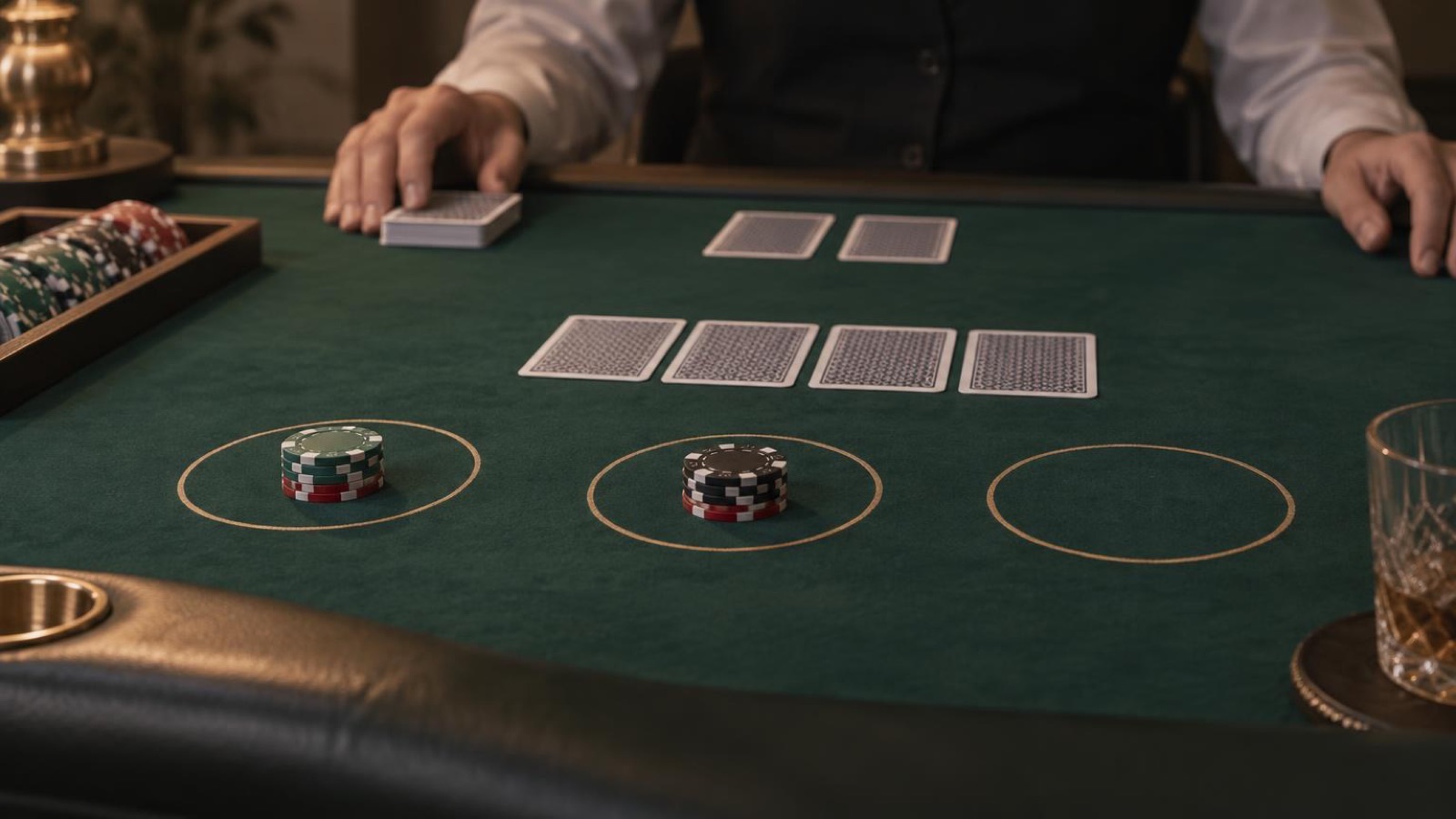
Poker against the dealer instead of against the table
Most poker, the kind you see in tournaments and card rooms, is player against player. The casino takes a fee from each pot and does not care who wins. The games on this page work the other way around. You sit at a table, the dealer represents the house, and every bet you make is matched against the casino's own money6.
Game rules call these "novelty poker" games. Rather than compete with the other players at the table, they pit you against the dealer or a pay table6. The family includes Three Card Poker, Caribbean Stud, Mississippi Stud, Ultimate Texas Hold'em, Four Card Poker, Let It Ride, Hold'em Bonus and several others7. Some rules and pay tables may vary slightly by casino, so always check the signage at the table before you play8.
The big practical difference is that bluffing is gone. There is no one to read and no one to push off a hand. You either hold cards that beat the dealer's, or you fold. Decisions are simple and the pace is fast: a hand of Three Card Poker takes seconds, not minutes. That makes these games a good entry point if you know the poker hand rankings but have never sat at a live table.
Some venues in Asia run their own versions. Deltin, which operates casinos in India, spreads Texas House Poker, a variation of traditional Texas Hold'em played only against the dealer instead of the other players9. Hoiana in Vietnam has its own Hoiana Stud Poker.
Three Card Poker: rules, dealer qualification and hand rankings
Three Card Poker was invented in the 1990s by Derek Webb and is now one of the most common poker table games in the world5. It is based on one easy-to-follow concept: whoever has the higher three-card hand, dealer or player, wins1.

Each round starts with the player making an Ante bet, and optionally a Pair Plus wager. The dealer then gives three cards to each player and to themselves, all dealt face down1. A single pack of fifty-two cards is used, shuffled before each hand10.
After looking at your cards, you have two choices. To keep playing against the dealer, place a "play" bet equal to your ante11. Or fold and lose the Ante. If you have the higher poker hand, both your Ante and Play bets pay even money: a winning bet of $1 returns $21. If you and the dealer tie, your Ante and Play bets push into the next round1.
The dealer qualification rule is what makes the game interesting. The dealer must turn over a Queen or higher in order to qualify for the round1. The layout itself usually carries the inscription "Dealer Plays with Queen High or Better"12. If the dealer's hand is weaker than Queen-high, the dealer does not qualify: your Ante is paid at even money and your Play bet is returned5. If the dealer qualifies and your hand beats the dealer's, Ante and Play bets are paid even money, plus any Ante Bonus and Pair Plus payouts at the odds posted on the table signage13.
Hand rankings differ from standard poker because each hand has only three cards1:
| Three Card Poker hand | Rank |
|---|---|
| Straight flush | Best |
| Three of a kind | 2nd |
| Straight | 3rd |
| Flush | 4th |
| Pair | 5th |
| High card | Worst |
Note that a straight beats a flush here, the reverse of five-card poker. A three-card straight is harder to make than a three-card flush, so the rankings flip. If you are used to Texas Hold'em, this is the first thing to relearn.
The game also offers a 44.91% chance of winning on the Ante1, which is why it feels friendlier than many table games: you win nearly half the time before any strategy is applied.
Three Card Poker side bets: Pair Plus, Ante Bonus and the Six Card Bonus
Three Card Poker carries four bets: the Ante, the Play bet, the Pair Plus wager and the Six Card Bonus side wager1. The Ante and Pair Plus are the base bets; the Six Card Bonus and the progressive jackpot are side bets14.
Pair Plus pays purely on your own three cards, regardless of what the dealer holds1:
| Pair Plus hand | Payout |
|---|---|
| Straight flush | 40 to 1 |
| Three of a kind | 30 to 1 |
| Straight | 6 to 1 |
| Flush | 3 to 1 |
| Pair | 1 to 1 |
The odds on the Pair Plus bet are less favorable than they look: while it pays out 40 to 1 when it wins, it is more likely to lose than win, so it is not a strategy for chasing losses1.
Ante Bonus is paid on the Ante bet when you end with a straight or higher, no matter what hand the dealer has1. In the Macau rules for Fortune 3 Card Poker, the Ante bonus is paid regardless of whether play continues: a straight flush pays 5 to 1, three of a kind pays 4 to 1, and a straight pays 1 to 115.
Six Card Bonus pays based on the best five-card poker hand that can be made by combining your three cards with the dealer's three-card hand1. The dealer takes five of the six cards and forms the highest possible hand under the Six Card Bonus rankings, then pays the corresponding odds14. A player holding three of a kind or better wins regardless of the dealer's hand15. The pay table starts at 5 to 1 for the low end and climbs to 1,000 to 1 for a royal flush, with 200 to 1, 25 to 1 for four of a kind, 20 to 1 for a full house and 10 to 1 in between1.
The betting layout has three areas per player position: Pair Plus nearest the dealer, the Ante in the middle and the raise farthest away, with a fourth area for side bets when they are offered15.
Caribbean Stud Poker: five-card play against the dealer
Caribbean Stud Poker is based on the rules of 5-Card Stud and pits the player against the house, with a possible 100 to 1 top payout2. Players compete against the dealer, not one another2.
Once bets have been made, the player and the dealer each receive five cards. All cards are distributed face down, with the exception of one dealer card, which is dealt face up2. That single exposed card is your only information when deciding whether to continue.
The flow is simple. You make an Ante bet, look at your five cards, then either fold and surrender the ante, or make a double bet to continue16. If the dealer qualifies with a lower hand than the player, the player wins even money on the Ante and wins according to a pay table for any raise bets2. The pay table is where the 100 to 1 payout lives, on the rarest hands.
Caribbean Stud has a house edge of 5.2%2, higher than Three Card Poker, which is the price of the big pay table and the simple decision structure. Japanese-language references put the figure at about 5%17.
At online casinos the stakes can be very wide. CoinPoker Casino, for example, lists bets from a minimum of USD 0.10 up to a maximum of USD 10,00018, so the game is available at almost any budget online even where live tables start higher.
Texas Hold'em Bonus Poker: the flop bet and the bonus jackpot wager
Texas Hold'em Bonus Poker is a variation of poker where players compete against the house3. It borrows the look of Texas Hold'em, with your own two cards and community cards in the middle, but there is no opponent except the dealer.
The betting sequence runs like this. After the deal, players may choose to fold, forfeiting the Ante wager and any Bonus wager, or continue by placing a "Flop" wager that is exactly twice the Ante3. After the dealer reveals the flop, which is three community cards dealt face up in the center of the table19, the player may either place a "Turn" wager equal to the Ante or check and continue3. A river bet follows the same pattern. The Flop bet pays 1 to 13.
The Bonus wager is a side bet on your first cards, with a pay table that rewards big starting hands. The top line pays 1,000 to 1 when A-A appears in both the player's hand and the dealer's hand3. The Japanese regulation pay table for the bonus bet reads: pair of Aces 30 to 1; suited A-K 25 to 1; suited A-J or A-Q 20 to 1; unsuited A-K 15 to 1; pair of J, Q or K 10 to 1; unsuited A-J or A-Q 5 to 1; and a pair of 2s through 10s 3 to 14. The operator version lists low pairs, 10-10 through 2-2, at 3 to 13.
The Jackpot wager is a separate progressive side bet. A full house on the jackpot pay table pays 80 to 13.
Deltin's Texas House Poker works on the same skeleton, with Ante, Flop, Turn, River, Bonus and Jackpot bets. There, the flop, turn and river bets each get paid 1x of the betting amount if the player's hand beats the dealer's hand9.
Hoiana Stud Poker: ante, bet and the progressive jackpot
Hoiana Stud Poker is the house-banked stud game spread at Hoiana Resort & Golf in Vietnam. It uses a standard 52-card deck without jokers20. The player places an Ante wager and receives five cards face down20. The dealer also receives five cards, with one card turned face up21.
After looking at your cards, you either fold or continue by placing a "Bet" wager that is exactly twice the Ante20. The dealer must qualify with an Ace-King or higher21. If the dealer does not qualify, the Ante is paid even money and the Bet is returned21. If the dealer qualifies and the player's hand ranks higher, both Ante and Bet are paid4. If the dealer qualifies and the dealer's hand is higher, both Ante and Bet lose4.
The ante pay table rewards strong hands even when the dealer fails to qualify:
| Hoiana Stud hand | Ante payout |
|---|---|
| Royal flush | 100 to 1 |
| Straight flush | 50 to 1 |
| Full house | 7 to 1 |
| Flush | 5 to 1 |
| Straight | 4 to 1 |
| Two pair | 2 to 1 |
| Pair or high card | 1 to 1 |
The bet wager pays 20 to 1 on four of a kind, 7 to 1 on a full house and 3 to 1 on three of a kind20.
Players may also place an optional Progressive Jackpot wager for the chance to win jackpot payouts based on qualified hand combinations4. The top qualifying hand wins 100% of the Major Progressive Jackpot22, with a lower qualifying hand taking 10%4. The progressive side bet pay table also lists a 400 to 1 payout for the top hand23. The game's multilink progressive version carries the same ante pay table, with a royal flush at 100 times the ante24.
Side bets and progressive jackpots across the table versions
Nearly every house-banked poker game carries a progressive or fixed-prize side bet, and the mechanics are broadly the same across all of them. You place a small wager alongside your ante, and a qualifying hand triggers a payout from a shared jackpot meter or a fixed prize list.
Macau's rules for linked jackpot poker describe the classic layout: each table has eight positions including the dealer's, and each player position has three betting boxes, with the progressive jackpot box nearest the dealer, the original bet in the middle and the raise outermost25. The rules for progressive jackpot poker spell out the same arrangement: the innermost box is for the progressive jackpot, the middle for the ante and the outermost for the raise26.
The betting rules are strict. One position only per player, with the original bet required first. The progressive jackpot may be bet before the first card is dealt. The raise must be exactly double the original bet, no more and no less. If the player chooses not to raise, the position is treated as a loss and the dealer takes the cards and the original bet25.
The money side is worth knowing. In the Casino Stud Poker rules, an amount not less than 70% of the total value of the Progressive Jackpot wagers placed at all tables is added to the Progressive Jackpot Meter10. So the jackpot you are chasing is funded by the side bets of every player at every linked table.
Fixed prizes are listed on the gaming table itself26. In Casino Stud Poker, a full house on the raise wager pays 8 to 117, and a straight flush on the raise pays 50 to 1, capped at the house's pre-set maximum per round26. A full house on the progressive jackpot bet carries a fixed prize26.
The practical takeaway: side bets are where the headline numbers live, but they are also where the house takes its biggest slice. Treat them as the price of a lottery ticket attached to your main game, not as the reason you sat down.
House edge and RTP: how the versions compare
House edge is the built-in slice that stays with the casino over time. If a game shows 96% return to player, the remaining 4% is the house edge27. The same idea applies to table games, where the edge is usually stated directly.
Here is how the house-banked poker games stack up:
| Game or bet | House edge |
|---|---|
| Three Card Poker, Ante and Play | 3.37%5 |
| Poker table games generally, optimal play | 2 to 3.5%28 |
| Caribbean Stud Poker | 5.2%2 |
| Fortune pai gow poker, smart strategy | around 3%29 |
For context, other casino staples sit in these ranges: baccarat at 1.06 to 1.24%, blackjack at 0.5 to 2% and roulette at 2.7 to 5.3%18. Japanese references list blackjack at roughly 1% with basic strategy and video poker from 0% up depending on the machine and pay table17.
What the numbers tell you: the main bets in Three Card Poker are among the better value in the poker room, Caribbean Stud costs you more per unit wagered, and every side bet sits on top of these figures, usually well above them. Slot machines are less favorable than table games such as fortune pai gow poker, blackjack and roulette in terms of return to player30, so the poker tables compare well against the slots floor.
Where you can play these games in Asia
House-banked poker tables are spread across the region's casinos, and a few venues have made them a signature.
- Vietnam. Hoiana Resort & Golf spreads Hoiana Stud Poker and Texas Hold'em Bonus Poker, with rules published in English, Vietnamese, Korean and Chinese4. Vietnam's casinos are open to foreigners, and to Vietnamese citizens who meet the entry conditions.
- South Korea. Paradise Casinos list Three Card Poker and Caribbean Stud in their game guides, with Caribbean Stud described as five cards dealt to each dealer and player, the higher rank hand winning16. Foreigner-only casinos in Incheon and elsewhere carry these tables; casino poker remains barred for South Korean residents except at Kangwon Land.
- Macau. Fortune 3 Card Poker and progressive jackpot stud are regulated games with published rules, so you will find them on the main floors15.
- Philippines. The PAGCOR license register lists dozens of licensed poker rooms, including Metro Card Club in Ortigas, Kings Card Club, 9D Poker Club, Metro Card Club Davao, Texas Holdem Café, Poker Brothers, Masters Poker Club, Gensan Poker Club, Red Dragon Poker Room and Voyager Poker Club31. These are mostly player-vs-player rooms, but casino floors also run house-banked tables.
- India. Deltin's casinos in Goa and Sikkim spread Texas House Poker against the dealer9.
- Cambodia, Laos and some Chinese territories. Regional games like Pok Deng, a Vietnamese card game, appear at some Asian casinos, more commonly in Cambodia, Laos, Vietnam and some Chinese territories32.
- Online. Live dealer studios stream house-banked poker to players across Asia. Sites serving Japanese players offer live versions of blackjack, baccarat, roulette, Dragon Tiger and Sic Bo, and game shows, alongside table poker games33, with stakes from USD 0.10 to USD 10,000 at CoinPoker Casino18.
If you are traveling, check the entry rules for the country and the specific casino before you go: some Asian casinos admit foreign passport holders only, and playing poker as a visitor has its own ID and currency practicalities.
Basic strategy thresholds: when to play and when to fold
Because there is no opponent to outplay, strategy in these games reduces to a simple threshold: which hands are worth continuing with, and which should be folded immediately.
Three Card Poker. The commonly cited threshold is Q-6-4 or better: hands at that level or above are played, and anything weaker is folded, losing only the Ante5. This single rule captures almost all the value in the game. The dealer's Queen-high qualification rule means marginal hands have awkward outcomes, and the threshold keeps weak hands out of them.
Caribbean Stud and Hoiana Stud. The fold rule is mechanical: if you choose not to raise, the position is treated as a loss and the dealer takes the cards and the ante25. With a raise costing exactly double the ante, the question is whether your five cards justify tripling your total exposure. Strong pairs and better are the usual continue zone; the ace-king dealer qualification in Hoiana Stud21 means that if the dealer does not qualify, the Ante is paid even money and the Bet is returned.
Texas Hold'em Bonus. The fold decision comes first: fold and forfeit the Ante and any Bonus wager, or commit a Flop bet of exactly twice the Ante3. Because the later turn and river bets are optional checks or ante-sized wagers, you can control your exposure as the community cards appear.
For contrast, in player-vs-player seven card stud, some players believe that a hand should be folded unless it contains three of a kind34, a far tighter threshold, because there you are fighting skilled opponents rather than a fixed qualification rule.
Two habits carry over from all poker. Push your chips over the line toward the center of the table when you bet35. And set your budget before you sit down: consider using cash only and leaving credit cards at home7. If you want the full betting mechanics, the poker betting actions page covers check, bet, call, raise and fold in detail.
Common Questions
Who invented Three Card Poker?
Derek Webb, a British poker player, invented Three Card Poker in the 1990s. He designed it as a fast casino table game played against the dealer, and it has since become one of the most widespread house-banked poker games in the world.
What is the minimum and maximum bet for Caribbean Stud Poker at CoinPoker?
CoinPoker Casino lists bets from a minimum of USD 0.10 up to a maximum of USD 10,000. The range applies to its casino games, so you can start small or play at high stakes depending on your budget.
What does the dealer need to qualify in Three Card Poker?
The dealer must turn over a Queen-high hand or better to qualify. If the dealer does not qualify, your Ante is paid at even money and your Play bet is returned. If the dealer qualifies, the higher hand wins.
How much does a royal flush pay in Hoiana Stud Poker?
A royal flush pays 100 to 1 on the ante bet in Hoiana Stud Poker. A straight flush pays 50 to 1, four of a kind 20 to 1 and a full house 7 to 1 on the bet wager.
What is the house edge on Three Card Poker's Pair Plus bet?
The Pair Plus bet is less favorable than the main game. It pays up to 40 to 1 for a straight flush, but it is more likely to lose than win, so treat it as an occasional extra rather than a way to chase losses.
Can I play Three Card Poker on my phone?
Yes. Online casinos offer Three Card Poker as a table game on mobile apps and browsers, including live dealer versions. The rules and payouts mirror the table game, with the same dealer qualification rule.
What is the Six Card Bonus bet based on?
It pays based on the best five-card poker hand that can be made by combining your three cards with the dealer's three cards. A hand of three of a kind or better wins regardless of what the dealer holds.
Sources35 sources
- Three Card Poker, PlaySmart, 2026-09-25
- Caribbean Stud Poker, PlaySmart, 2026-09-25
- Texas Hold'em Bonus Poker, Hoiana, 2026
- Hoiana Stud Poker, Hoiana, 2026
- 3 Card Poker guide, CoinPoker, 2025-11-03
- Ultimate Texas Hold'em, PlaySmart, 2026-09-25
- How to play poker, PlaySmart, 2026-09-25
- Mississippi Stud, PlaySmart, 2026-09-25
- Texas House Poker, Deltin, 2026-09-26
- Statutory Instruments 2002 No. 1130, OPSI, 2002-05-13
- How to play Three Card Poker, GameSense, 2020
- Chapter 69E regulations, New Jersey Division of Gaming Enforcement, 2016
- Three Card Poker, Newport World Resorts, 2026
- Fortune 3 Card Poker rules, DICJ Macau, 2025-10-30
- Fortune 3 Card Poker rules, Boletim Oficial 45/2025, Imprensa Oficial de Macau, 2025-10-30
- Casino game manual, Paradise Casino, 2026-09-26
- 控除率, Wikipedia, 2026
- Crash games at CoinPoker Casino, CoinPoker, 2026-04-30
- Texas Hold'em community poker, PlaySmart, 2026-09-25
- Hoiana Stud Poker (Vietnamese), Hoiana, 2026
- Hoiana Stud Poker (Korean), Hoiana, 2026
- Hoiana Stud Poker (Traditional Chinese), Hoiana, 2026
- Hoiana Stud Poker (Simplified Chinese), Hoiana, 2026
- Linked Jackpot Poker rules, Boletim Oficial 36/2003, Imprensa Oficial de Macau, 2003-09-01
- Statutory Rules for Progressive Jackpot Poker, DICJ Macau, 2004-05-12
- Casino Stud Poker regulations, SI 1994/2899, OPSI, 1994-11-13
- How do slot machines work, GameSense, 2021
- Baccarat, GameSense, 2025
- How to play Fortune Pai Gow Poker, GameSense, 2020
- Best payout slots, Hong Kong, Wizard of Odds, 2026-09-26
- List of poker operators with issued gaming license, PAGCOR, 2026-05-07
- Pok Deng FAQ, Pokers, 2026-09-26
- Best online casinos for players from Japan, Wizard of Odds, 2026-05-06
- 7 Card Stud, PlaySmart, 2026-09-25
- How to bet in poker, PlaySmart, 2026-09-25















