What Short Deck (Six Plus) Hold'em is
Short Deck Hold'em, often written as 6+ Hold'em, is a fast, high-action version of Texas Hold'em. The name comes from the deck: only cards ranked six and above are used, which strips the standard 52 cards down to 361. Everything else feels familiar. You receive two hole cards, five community cards come down in the middle, and you make the best five-card hand you can from the seven2.
The game has been rapidly gaining popularity, particularly in Asian countries, where it became the game of choice for high-stakes specialists in Macau1. That pedigree matters. Short Deck earned its reputation in some of the biggest cash games in the world, and it has since spread to online poker rooms and tournament series, where operators run it alongside regular Hold'em3.
Why did the big-game players adopt it? Because removing 16 cards from the deck compresses everything. Strong hands come around far more often, draws get there more often, and the pots grow faster. If you already know Texas Hold'em rules, you know 90 percent of Short Deck already. The differences are the deck, the hand rankings and the betting setup, and each of those is covered below.
The 36-card deck: what is removed and why it matters
A Short Deck game uses one deck of 36 cards, and the deck is shuffled after each hand3. All of the 2s, 3s, 4s and 5s are removed4. What remains, in rank order, is A, K, Q, J, 10, 9, 8, 7 and 6 in each of the four suits5.
That single change ripples through the whole game:
- Fewer ranks, more collisions. With only nine ranks instead of thirteen, pairs, trips and quads land far more often.
- Flushes get harder, sets get easier. Each suit has only nine cards instead of thirteen, so completing a flush is tougher, while flopping a set with a pocket pair is easier. This is why the hand rankings get rearranged, as explained in the next section.
- Straights come in shorter steps. With the low cards gone, the ace has to bend to fill the bottom of the straight ladder, which produces the unusual A-6-7-8-9 straight.
- Faster action. More premium hands and more completed draws mean bigger pots and more aggressive betting, which is exactly what the high-stakes crowd wanted.
If you are coming from a full-deck game, the shuffle-after-every-hand rule is worth noting too. Online, the 36-card deck is reshuffled for each hand, so card tracking does not carry over from one hand to the next3.
Hand rankings in Short Deck: flush beats full house
Here is the change that trips up the most new players: in Short Deck, a flush beats a full house6. The reason is pure math. With only nine cards per suit, five cards of one suit are harder to assemble than three of a kind plus a pair, so the rankings swap to reflect the true difficulty2.
The full order, from strongest to weakest, in the most common format6:
- Royal flush (an ace-high straight flush, for example A-K-Q-J-10 all of hearts)
- Straight flush (a five-card straight all in the same suit, for example 10-9-8-7-6 all of hearts)
- Four of a kind (four cards of equal value, for example four aces)
- Flush (any five cards of the same suit, for example K-Q-10-8-7 all of spades)
- Full house (three of a kind plus a pair, for example A-A-A-K-K)
- Straight (five cards of sequential value in different suits, for example 6-7-8-9-10)
- Three of a kind (three cards of the same value, for example three aces)
- Two pair (two cards of one value plus two of another, for example two aces and two kings)
- One pair (two cards of the same value, for example two aces)
- High card (the highest card wins; kickers break ties)
Compare that with the standard poker hand rankings, where a full house beats a flush, and you can see the only structural change: flush and full house trade places. Everything else sits where you expect it.
One detail that does not change: there is no ranking of suits in Short Deck. If two players hold the same type of hand, the highest card decides it, so a king-high flush beats a queen-high flush regardless of which suit each player holds5. When the paired cards also tie, a kicker, meaning the highest unpaired card, settles it6.
The ace and the lowest straight: A-6-7-8-9
Aces play as both high and low in Short Deck, just as they do in full-deck Hold'em. What changes is what the ace connects to at the bottom. Since there are no twos, threes, fours or fives, the traditional wheel straight, A-2-3-4-5, is simply not available4. In its place, the ace drops down to sit below the six, and A-6-7-8-9 becomes the lowest straight7.
So the full set of straights in Short Deck runs:
- A-6-7-8-9 (the lowest, a nine-high straight)
- 6-7-8-9-10
- 7-8-9-10-J
- 8-9-10-J-Q
- 9-10-J-Q-K
- 10-J-Q-K-A (the highest, the Broadway straight)
The same logic applies to straight flushes. Ah-6h-7h-8h-9h is the low straight flush, and the royal flush, A-K-Q-J-10 suited, still tops the chart6. A nine-high straight of 9-8-7-6-A takes some getting used to the first time you see it win a pot2, but after a session or two it becomes second nature. Just remember when you hold an ace: it can complete the bottom straight as easily as the top one, which changes how you read boards that pair the six and the nine.
Antes instead of blinds: how the betting works
This is the second big structural difference. Most Short Deck games are played as no-limit, but there is no small blind and no big blind. Instead, everyone at the table pays an ante before each hand1.
An ante is a small forced bet each player must post before a hand begins, put there to create an initial pot worth fighting for8. In a regular $1/$2 Hold'em game, for example, an ante might be $0.25 per player on top of the blinds8. In Short Deck, the ante replaces the blinds entirely: the game uses an ante-based system with no blinds at all5.
The most common setup is the button-blind method. Every player posts the standard ante, and whoever has the dealer button in front of them also posts a mandatory second ante2. That button ante is typically about 2 to 4 times the normal ante5. The button's extra money seeds the pot the way the blinds would in Hold'em, and it gives the button extra incentive to get involved, since it already has chips committed.
A few practical points follow from this setup:
- The minimum raise preflop is equal to double the value of the ante2. This is smaller than a typical Hold'em min-raise relative to the pot, which encourages looser opening ranges.
- There is no straddle option in Short Deck3. If you like to straddle in Hold'em games, that tool is off the table here.
- The ante does not change the betting structure of the hand itself. It is a separate forced bet, and once the cards are dealt the action proceeds with normal no-limit betting8.
If you want the full background on forced bets, see blinds, antes and straddles.
Betting rounds and table setup
Once the antes are in, a hand of Short Deck plays out exactly like Texas Hold'em. There are four betting rounds: the preflop, the flop, the turn and the river, followed by the showdown2. Short Deck uses the same betting structure as Hold'em throughout5.
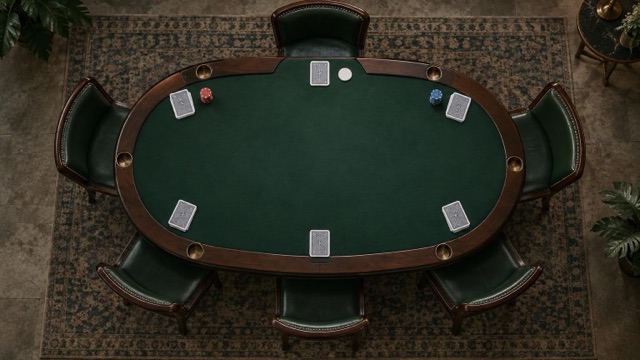
Table sizes are where operators differ. Some run all Short Deck tables as 5-max, meaning a maximum of five players per table, with a minimum of two players to get a game going3. Others seat up to six, with the same two-player minimum9. One operator spreads 6-max tables with stakes running from $0.01 blinds up to $50 blinds10. Live Short Deck games are typically short-handed too, which fits the game's aggressive character: fewer players, more hands per hour, more pots per session.
For online cash games, the entry cost is low. Buy-ins start from $13. On tables that use a button blind, chips exceeding 40 times the button blind can be removed from the table, a rule that keeps deep stacks from growing without limit3.
Rake, the fee the operator takes from each pot, runs at 5 percent on Short Deck tables, with caps that scale with the stakes9.
| Stakes | Rake cap |
|---|---|
| $0.02 blinds | $0.03 with two players to $0.06 with five or more |
| $0.10 blinds | $0.08 to $0.30 |
| $1 blinds | $0.50 to $1.50 |
| $10 tables (high stakes) | 0.38 big blinds to 1.5 big blinds depending on player count |
If you want to dig into how these fees work, see poker rake explained.
Where the rules vary: three-of-a-kind vs straight and other variants
Short Deck is young enough that not every room plays it the same way, and the differences are not cosmetic. Before you sit down, check which ranking system the venue uses.
Three of a kind vs straight. In some Six Plus Hold'em variants, three of a kind beats a straight2. Some live venues consider three of a kind stronger than a straight, while others, including at least one major online operator, rank the straight higher1. The logic behind the variant ranking: with only nine ranks, trips are rarer relative to the number of straight combinations, so some rooms promote trips above straights.
Straight vs flush. The mainstream order puts the flush above the full house and the straight below the trips-or-straight debate, but at least one operator ranks a straight above a flush11. Again, this reflects a different reading of how often each hand can be made with 36 cards.
Flush vs full house. Even the headline change is qualified. In most formats a flush beats a full house12, but "most" is doing some work in that sentence. Confirm the ranking before you call down with a full house facing heavy flush-card action.
The practical takeaway: ask, or check the rules page, for two specific questions. Does a flush beat a full house here, and does three of a kind beat a straight? Those two answers tell you which Short Deck you are playing.
How the changed odds affect play
The smaller deck reshapes the math of every decision, and knowing a few headline numbers will save you money in your first sessions.
Premium hands are relative. The only pocket pairs that can be considered premium hands in Short Deck Hold'em are pocket aces and kings, along with A-K suited2. Queens and jacks, monsters in Hold'em, run into bigger pairs and overcards far more often here.
Sets and draws move in opposite directions. With a pocket pair, you flop a set 17 percent of the time, versus 12 percent in traditional no-limit Hold'em2. Flush draws go the other way: with a flush draw on the flop, you have just a 30 percent chance of completing it by the river, and with a flush draw on the turn, the probability of making it by the river drops to 16.6 percent. In Hold'em, those same situations offer 35 percent and 19.5 percent2.
Straight draws get stronger. An open-ended straight draw in Short Deck completes a little over 45 percent of the time by the river, specifically 45.5 percent, versus 31.5 percent in Hold'em2. Holding J-10 or T-9, you pick up that straight draw on the flop 19 percent of the time2.
Starting-hand equity compresses. A suited J-10 against a suited A-K has around 47 percent equity in Short Deck, compared to 40 percent in standard Hold'em. If the A-K is unsuited, the suited J-10 is almost exactly 50 percent to win2. The gap between premium and speculative hands narrows, which is why the game plays so loose and aggressive.
A quick counting shortcut. To approximate your equity with a draw, multiply your outs by 3 with one card to come and by 6 with two cards remaining2. That rule of thumb reflects the denser deck, where each out is a larger fraction of the remaining cards. For the underlying concepts, see poker odds and probabilities.
Sizing follows the game's character. Because draws hit more often and players commit more readily, overbets of 1.5x to 2x the pot are a common tool in advanced Short Deck play5. If you come from a Hold'em background where pot-sized bets are the ceiling, expect to see and face bigger numbers.
Put together, the picture is consistent: Short Deck rewards hands that make sets and straights, punishes chasing flushes at Hold'em prices, and moves faster at every decision point. Play a few low-stakes tables, buy in for as little as $13, and let the new rankings settle in before you take the game seriously at higher stakes.
Common Questions
How many cards are in a Short Deck?
A Short Deck, also called Six Plus Hold'em, uses 36 cards. All the twos, threes, fours and fives are removed, leaving only sixes through aces. The deck is shuffled after every hand.
What is the lowest straight in Short Deck poker?
The lowest straight is A-6-7-8-9, a nine-high straight. Because the twos through fives are gone, the classic ace-to-five wheel does not exist. Ten-J-Q-K-A remains the highest straight.
Does a flush beat a full house in Short Deck?
Yes, in most formats. With fewer cards in the deck, flushes are harder to make than full houses, so the rankings swap: a flush sits above a full house. Some operators rank them differently, so check the house rules.
Why does the dealer post a bigger ante?
Short Deck has no small or big blind. Everyone posts an ante and the player on the button posts a second, larger ante, typically two to four times the standard ante, to seed the pot and drive action.
How many players can sit at a Short Deck table?
It depends on the operator. Some run five-max tables, others six-max, and the minimum to start a hand is two players. Live Short Deck games are usually short-handed by design.
What is the wheel straight and why is it missing?
The wheel is the ace-to-five straight, A-2-3-4-5, the lowest straight in regular poker. Short Deck removes the twos through fives, so the wheel cannot be made. A-6-7-8-9 takes its place as the bottom straight.
Sources12 sources
- Short Deck Hold'em, partyPoker, partyPoker, 2026
- How to Play Short Deck Poker, Natural8, Natural8, 2026
- Short Deck Poker, Natural8, Natural8, 2026
- Short Deck Poker Rules, CoinPoker, CoinPoker, July 24, 2026
- วิธีเล่นสำรับสั้น, WPT Global, WPT Global, 2026
- Short Deck Hand Rankings, partyPoker, partyPoker, 2026
- 6+ Short Deck, GGPoker, GGPoker, 2026
- Ante and Straddle, Americas Cardroom, Americas Cardroom, 2026
- Short Deck Poker, Natural8, Natural8, 2026
- Short Deck Poker on CoinPoker, CoinPoker, CoinPoker, August 26, 2026
- ショートデッキ, CoinPoker, CoinPoker, July 27, 2026
- Texas Hold'em, partyPoker, partyPoker, 2026