What Texas Hold'em is and the aim of the game
Texas Hold'em is a community card game and the world's most popular and most commonly played poker variant8. The aim is simple: either win at showdown with the best five-card poker hand, or force every opponent to fold before you get there7. Those are the only two ways a hand ends, which is why betting matters as much as the cards.
It is a winner-takes-all game. There is only one winning hand each round, and all the money bet during the hand goes to that player5. What happened in the previous hand has no effect on the next one: the deck is shuffled fresh, and every hand stands on its own3.
Hold'em is often played as a no-limit game, meaning there is no maximum bet3. That single rule is what made the game famous: on any hand, a player can push their entire stack into the middle. We cover the other betting structures, pot-limit and fixed-limit, further down.
The deck, players and cards dealt
Texas Hold'em uses one standard 52-card deck, and the deck is shuffled after each hand2. Aces can count high or low: in a five-high straight the ace plays as the low card, A-2-3-4-59.
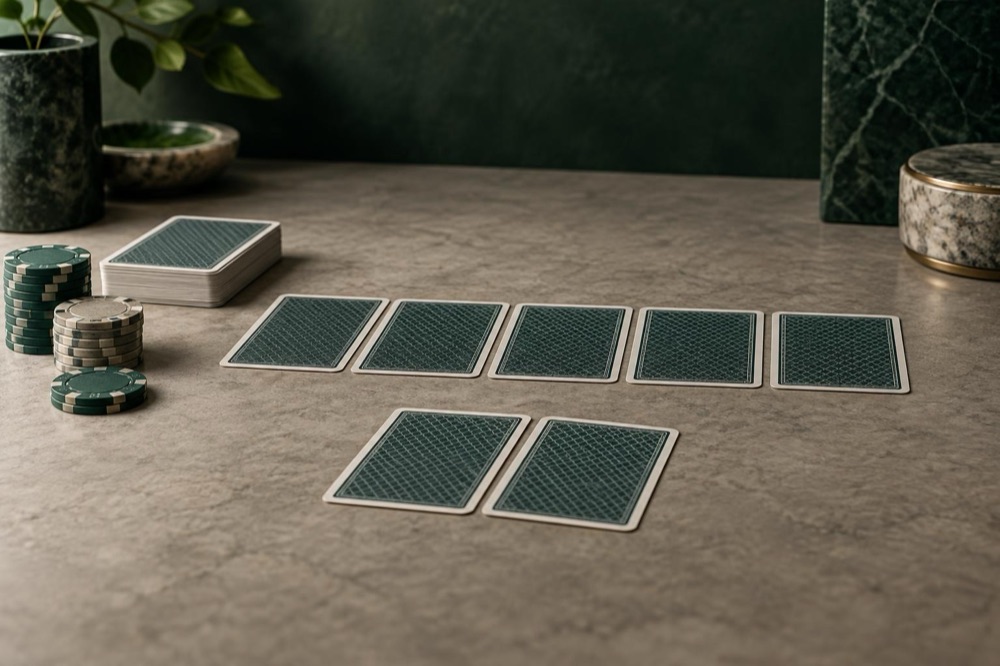
The game seats 2 to 10 players9. A licensed table in Macau, for example, is set up with 10 seats for players plus one for the dealer, with the option of more than 10 player seats, and carries a dealer button, a discard holder and a cutting card or shuffling machine2. Online tables are often smaller, capping at 9 players10.
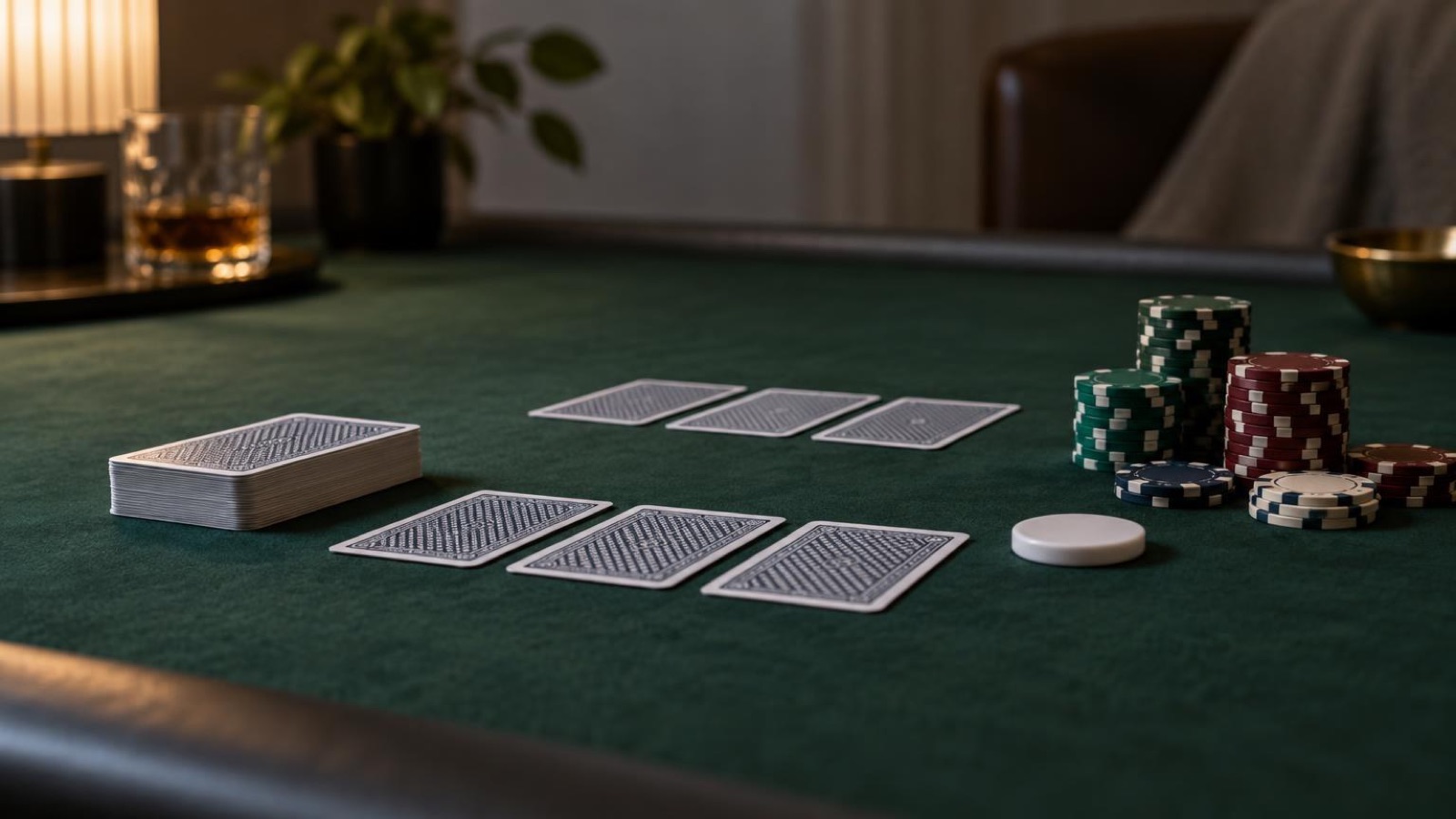
Each player is dealt two cards face down, called hole cards, which belong to that player alone3. Then, over the course of the hand, five community cards are dealt face up in the middle of the table in a 3-1-1 pattern: three at once, then one, then one10. Every player shares those five cards.
To make your final hand, you may use both hole cards, just one, or even none: your best five-card hand is what counts1. That flexibility is the key difference from Omaha, where you must always use exactly two of your four hole cards11.
Blinds and antes: the forced bets
Before any cards are dealt, the two players to the left of the dealer button post forced bets called blinds1. The first player posts the small blind, equal to half the minimum bet, and the second posts the big blind, the full minimum3. The big blind is usually twice the small blind9.
Blinds exist to guarantee money in the pot and give players a reason to play. Without them, you could simply wait for the perfect hand and never risk a chip. The button moves one seat clockwise after every hand, so everyone takes their turn paying the blinds.
Depending on the game, each player may also post an ante, another forced bet that is usually smaller than either blind4. Antes are more common in tournaments and in some cash formats. If you want the full picture of forced bets, including straddles, see blinds, antes and straddles.
The four betting rounds: pre-flop, flop, turn and river
A standard hand of Texas Hold'em has four betting rounds: pre-flop, flop, turn and river5. Here is how each one runs.
| Round | Cards dealt | Betting |
|---|---|---|
| Pre-flop | Two hole cards dealt to each player | The first betting round begins with the player to the left of the big blind; it happens before any community card is shown1 |
| Flop | One card burned face down, then three community cards dealt face up in the center of the table3 | A second betting round follows |
| Turn | Another card burned, then a fourth community card dealt face up8 | A third betting round follows |
| River | One more burn card, then the fifth and final community card8 | The last betting round takes place, and any players still in the hand go to a showdown |
Those face-down burns are what people mean by burn cards: up to three in a hand, one before each community card deal4. Burning exists so the next card to come can never be marked or spotted in advance.
If everyone but one player folds at any point, the hand ends immediately and the last player takes the pot without showing anything. That is the "force your opponents to fold" half of the game's aim.
Betting actions and minimum bets
During each betting round, players can check, bet, call, raise, or fold, depending on the action before them6. In plain terms:
- Fold: give up your hand and any money you have already put in the pot9.
- Check: pass the action without betting, only possible when no one has bet yet.
- Call: match the current bet to stay in the hand.
- Raise: increase the current bet. A raise must be at least equal to the previous bet or raise in the round8.
- All-in: bet everything you have9.
The minimum bet in no-limit Hold'em equals the big blind, and there is no upper limit, which is what makes the all-in option possible4. In fixed-limit games, raises are capped: a maximum of three raises per betting round8.
Stakes vary enormously from table to table, but whatever the level, the mechanics of the betting stay the same. For a deeper look at each action, see poker betting actions.
Hand rankings: all ten, from high card to royal flush
Texas Hold'em uses the standard poker hand rankings, from high card to royal flush1. The full order, from best to worst3:
- Royal flush: A-K-Q-J-10, all in the same suit12
- Straight flush: five consecutive cards of the same suit
- Four of a kind: four cards of the same rank
- Full house: three of a kind plus a pair
- Flush: five cards of the same suit
- Straight: five consecutive cards of any suit
- Three of a kind
- Two pair
- One pair
- High card: no combination; the highest card plays
So yes, a full house beats a flush9. The best hand overall is the royal flush: an ace, king, queen, jack and 10 in the same suit4.
Two things trip up new players. First, suits have no ranking: if two players hold the same type of hand, the higher cards decide it, never the suits3. Second, these rankings are not universal. In Short Deck poker, a flush beats a full house, because the stripped-down 36-card deck makes full houses easier to make13. The rankings above are also shared with Pot Limit Omaha and 5-Card Pot Limit Omaha1. See our full poker hand rankings page for more detail.
Showdown: who wins the pot and what happens in a tie
If the hand reaches the river with two or more players still in, there is a showdown: players reveal their hands to decide who wins5. The best five-card hand takes the pot1.
If two players share an identical hand, for example both using the same community cards to make a straight, the pot is split equally between them6. Before splitting, the winner is determined by the kicker: the highest card that is not part of the combination. If two players each hold a pair of kings, the player with the higher next card wins. If the hands are still tied after kickers, the pot is split evenly4. If two players have the same ranking five-card combination, the higher value high card wins the round5.
One thing that does not carry over from other poker games: in Hold'em you are playing against the other players, not the house. That is different from casino table versions like Ultimate Texas Hold'em, where you bet against the dealer and a mathematical house edge is built into the game, similar to slots3. Those house-banked versions have their own rules and payouts; see casino poker games against the house.
No-Limit, Pot-Limit and Fixed-Limit: which structure you're playing
Hold'em comes in three betting structures, and the structure changes the game more than almost anything else.
- No-Limit: players can bet any amount up to their total chips at any time1. This is the most common form, the one you see on television, and the version most online sites spread by default8.
- Pot-Limit: bets are limited to the current size of the pot1. The largest bet you can make is governed by the pot size in front of you7.
- Fixed-Limit: betting is restricted to a set amount each round, with bet sizes dictated by the blinds7. Fixed-limit is more commonly found in live poker rooms in the United States and is rarely played online7.
Before you sit down, check which structure the table is using. A no-limit game and a fixed-limit game with the same blinds play completely differently. We compare the three in detail on no-limit vs pot-limit vs fixed-limit.
Starting hands and pot odds
Not all starting hands are equal. There are 169 possible starting hands in Hold'em, and only 5 are considered premium: A-A, K-K, Q-Q, A-K suited and J-J3. The best starting hole cards are pocket aces, known as pocket rockets4, and the general best list runs A-A, K-K, Q-Q, J-J, A-K, 10-10, A-Q, A-J, K-Q6. At the other end, 2-7 offsuit is considered the worst starting hand6.
The numbers explain why patience matters. If a hand is one card short of a flush on the turn, it will be completed about 19.6% of the time; a flush draw from the flop to the river completes about 35% of the time14. Pocket aces are strongest, but any hand can win depending on play14.
Pot odds are how you weigh those chances against the money on the table: they compare the size of the pot to the cost of a call. If the pot odds are better than your odds of hitting your hand, calling is the cheaper mistake to make; if not, folding is. For the full picture, see poker odds and probabilities.
Where Hold'em sits in Asia's legal picture
Whether you can sit down at a Hold'em table depends entirely on where you are. In mainland China, gambling is prohibited, and the prohibition follows Chinese citizens even when they play abroad or online. The practical risk for a Chinese citizen is real, so if that is you, the licensed rooms elsewhere in Asia are the places to look.
Elsewhere in Asia the picture is different. Macau licenses Texas Hold'em tables under official game rules published by the regulator2. In the Philippines, PAGCOR issues gaming licenses to poker operators; one licensed example is the Texas Holdem Café poker room in Panglao, Bohol15. Licensed casinos in India, South Korea, Vietnam, Cambodia and Singapore also spread poker rooms open to foreign visitors, and residents where local rules allow.
Online, Hold'em is the most popular poker type worldwide, with cash games and tournaments running around the clock5. Whether online play is available to you depends on the country you are in and, in some places, on your citizenship rather than your residence. For country-by-country detail, start with our poker in Asia overview or the guide for the country you are in.
Common Questions
How many hole cards do you get in Texas Hold'em?
Each player gets exactly two hole cards, dealt face down. Those two private cards combine with the five community cards dealt face up in the middle of the table to make your best five-card hand.
Do you have to use both of your hole cards?
No. You can use both hole cards, just one, or even none at all. If the five community cards already make the best hand on the table, everyone still in the hand shares it.
What is the best and worst starting hand?
A pair of aces, known as pocket rockets, is the best starting hand. A 2-7 offsuit, two low cards in different suits, is generally considered the worst.
What happens if two players have the same hand?
The higher kicker card breaks the tie. If the hands are still identical, the pot is split evenly between the tied players.
Does a full house beat a flush?
Yes. In Texas Hold'em the rankings run from high card up to royal flush, and a full house sits above a flush. In Short Deck poker the order is different and a flush beats a full house.
Do suits matter in Texas Hold'em?
No suit is ranked above another. If two players hold the same type of hand, the higher cards decide it, never the suits.
What are pot odds and how are they calculated?
Pot odds compare the size of the pot to the cost of calling. You weigh that cost against your chance of improving to decide whether calling is worth the money.
Is Texas Hold'em legal in China?
No. Gambling is prohibited in mainland China, and for Chinese citizens gambling abroad, gambling online and funding or supporting gambling all violate Chinese law. Poker rooms operate legally in places like Macau and the Philippines instead.
Sources15 sources
- How to Play Texas Hold'em Poker, CoinPoker, 2026
- Texas Hold'em Poker Rules, DICJ Macau, January 18, 2008
- Texas Hold'em Community Poker, PlaySmart, 2026
- How to Play Texas Hold'em Poker, GGPoker, 2026
- Texas Hold'em Poker, Deltin, 2026
- How to Play Texas Hold'em, partypoker, 2026
- How to Play Poker Games, partypoker, 2026
- Texas Hold'em, GGPoker, 2026
- Poker Terms and Definitions, Natural8, 2026
- How to Play Poker, PlaySmart, 2026
- Hold'em and Omaha Differences, CoinPoker, 2026
- Poker Hand Rankings, GGPoker, 2026
- How to Play Short Deck Poker, Natural8, 2026
- Texas Hold'em Guide, CoinPoker, 2024
- List of Poker Operators with Issued Gaming License, PAGCOR, May 7, 2026