Poker variants: what the family covers
When people say "poker" they usually mean Texas Hold'em, the community-card game that dominates television and online lobbies. But the family is much wider, and the older branches of it are still played in card rooms across Asia and beyond.
The basic structure is shared. Most forms of poker use a single 52-card deck in which all suits are considered equal in value, though some variations add jokers, treat aces as high or low, or use wild cards1. Depending on the variation, players will typically receive either two or five cards1. The object is always the same: win the pot, either by creating a winning hand or by making other players fold theirs1.
The main branches look like this:
- Community poker, where players combine private hole cards with shared board cards. Texas Hold'em is the flagship, and it sits in this category7.
- Stud poker, where each player receives their own cards, some face up and some face down, with betting between rounds. Seven Card Stud and its hi/lo split version belong here1.
- Draw poker, where you receive all your cards face down, discard some, and draw replacements. Five-card draw is the classic home game.
- Lowball and split games, where the lowest hand wins the pot, or the pot is split between the highest and lowest hands, as in Omaha Hi/Lo and Seven Card Stud Hi/Lo1.
- Chinese poker, where you arrange 13 cards into three rows and score against each opponent row by row3.
- House-banked casino versions, which take poker hand rankings and turn them into table games against the dealer or a pay table8.
- Video poker, a machine format where you hold and draw cards against a pay table, with no opponents at all9.
If you enjoy the idea of bluffing and playing against other players, the community and stud games are the natural home. If you would rather play against the house and are not keen on bluffing, the novelty versions are built for you1. For the hand rankings that run through all of these games, see our poker hand rankings page.
How casino poker differs from player-versus-player games
The split that matters most when you sit down is who you are trying to beat.
In player-versus-player poker, you compete with the people around you. The house takes a fee from the pot or the seat, but it does not play. Your winnings come out of your opponents' pockets, which is why skill matters so much over time.
Casino poker, by contrast, pits you against the dealer or a pay table rather than the other players at the table8. Caribbean Stud Poker is a clean example: players compete against the dealer, not one another10. Ultimate Texas Hold'em works the same way, using Hold'em's familiar cards but pitting players against the dealer, not one another11. Mississippi Stud goes one step further and removes the dealer contest too: it is a five-card poker variation that pits you against a pay table rather than against the dealer11.
Video Poker takes this to its logical end. While the house banks each game, a player's only opponent is themselves9. Since players are not facing a dealer or other players, the element of bluffing, faking your way through a bad hand, is removed entirely9. The play sequence is mechanical: insert your bet, press DEAL to show five face-up cards, press HOLD to keep the ones you want, press DRAW to replace the rest, and collect a payout according to the rank of the hand you make12. From game to game there may be scoring or hand-ranking variations, for example Deuces Wild, in which twos are wild9.
One practical note for the house-banked tables: some of the rules and pay tables may vary slightly by casino, so it is worth checking the felt or asking before you bet11. And asking is fine. At Pai Gow Poker, for instance, new players should feel free to ask the dealer about the rules around hands, playing as the Banker, or general gameplay13. We cover the house-baked versions in more detail on our casino poker games against the house page.
Thirteen cards, three rows: how Chinese poker works
Chinese poker is the variant you are most likely to meet in an Asian home game or a tournament side area, and it plays very differently from everything above.
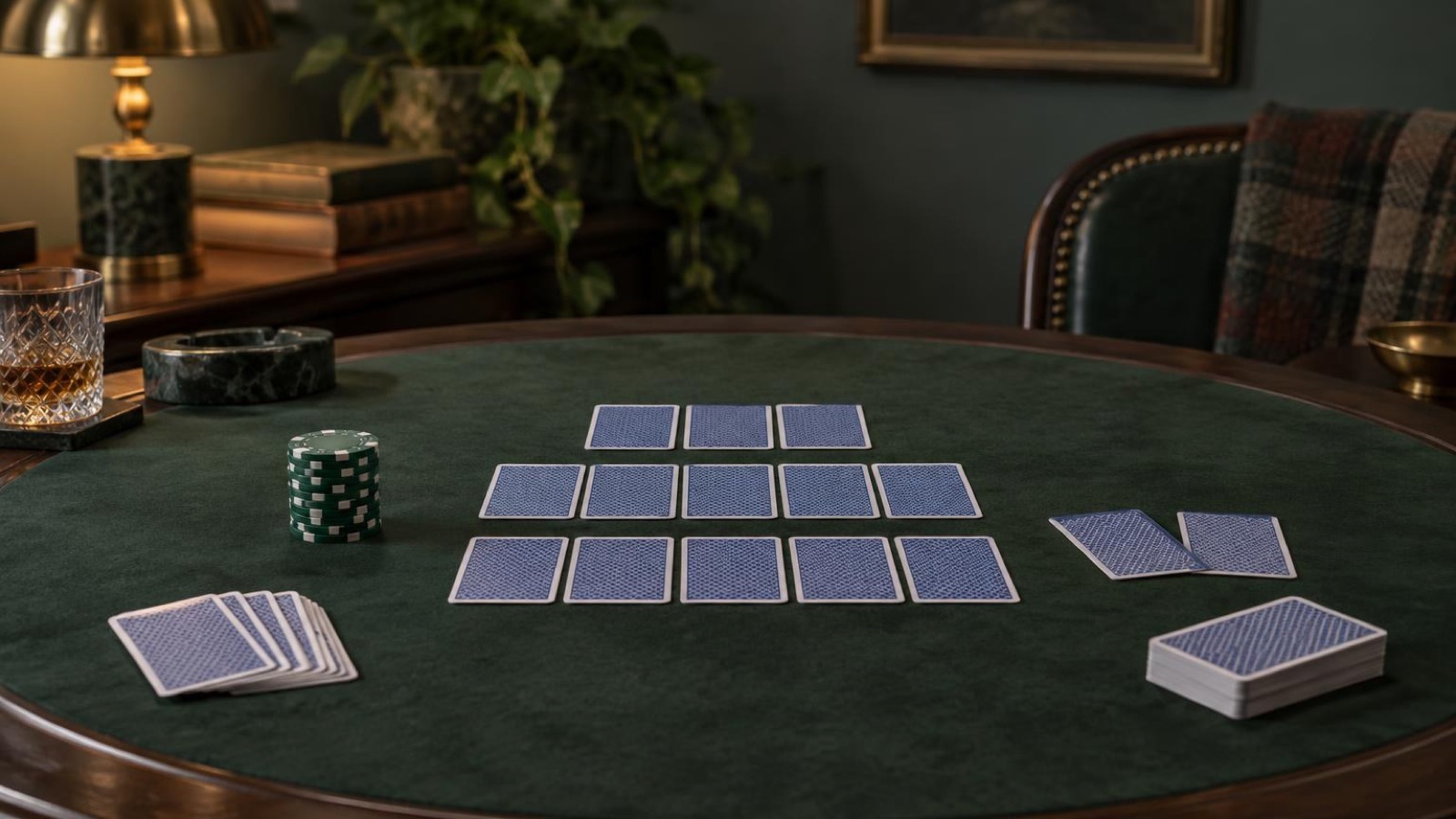
Each player is dealt 13 cards, which the player arranges into three separate poker hands: one three-card hand in front and two five-card hands behind it3. The game is played with two, three, or four players3, and it uses a standard 52-card deck with no jokers or wild cards3.
Scoring is row against row. Your three-card front hand is compared with each opponent's front hand, your middle five-card hand with their middle, and your back five-card hand with their back. You win a point for each row you take, and the totals settle in chips at the end. The one iron rule is that your hands must descend in strength from back to front: the back hand must beat your middle, and the middle must beat your front. Break that order and the whole hand is dead.
Beyond the row points, Chinese poker pays bonuses for premium hands placed in the right rows3:
| Hand | Where | Bonus |
|---|---|---|
| Three of a kind | front | 3 additional units |
| Full house | middle | 2 additional units |
| Four of a kind | back | 4 additional units |
| Four of a kind | middle | 8 additional units |
| Straight flush | back | 5 additional units |
| Straight flush | middle | 10 additional units |
The money side is simple. A buy-in is equivalent to 25 times the limit condition, and no short buy-ins are allowed3. So if you are playing at one unit per row, you need 25 units in front of you to sit down.
The game has deep roots in the region. Its ancestor, Si Se Pai, uses seven types of card bearing the same characters as in Chinese Chess14, and historical Chinese card games in Hong Kong settled penalties in chips paid into a common pool, three chips per grade for redemption, two for restoration, one for salary fines15. The 13-card version is the modern descendant of that tradition.
Open-Face Chinese: the Ultimate Rule and the scoop penalty
Open-Face Chinese (OFC) is the newer, faster cousin, and it has become a favorite in high-stakes cash games and tournament side events across Asia.
The twist is in the name: the cards are placed face up. You start with five cards set face up in your three rows, then receive the rest one at a time, placing each into a row as it comes, with every placement visible to the whole table. There is no redrawing and no hiding. The tension comes from watching your opponents' rows fill in while you gamble on completing your own.
A real-world example of the format in action: the Open-Face Chinese event at the Japan Open Poker Tour runs with a maximum of three players per table, played with one deck of 54 cards including two jokers, and the Ultimate Rule is adopted4. Players start with 500 chips4.
The Ultimate Rule is the scoring detail that makes OFC brutal. Under it, taking all three rows against an opponent, the scoop, carries an extra penalty payment from the scooped player. And the fouling penalty is what everyone fears: if you misplace your cards and your rows end up out of order, front stronger than middle, or middle stronger than back, your hand is fouled and you lose all three rows against every opponent, paying the full scoop penalty on top. A single careless placement in the middle of a hand can cost the equivalent of several clean hands.
Because tables are capped at three players4, OFC is slower to deal but faster to feel. Every card you place is information for your opponents, and every card they place tells you whether to play it safe in the middle row or gamble on a flush in the back.
House edge: 2 to 3.5% with optimal play
If you are comparing poker against the other games on the casino floor, the numbers are worth knowing.
Poker carries a house edge of 2 to 3.5% with optimal play2. That is not the cheapest game in the building, but it is far from the most expensive. For comparison16:
| Game | House edge with optimal play |
|---|---|
| Blackjack | 0.5% |
| Fortune Pai Gow Poker | 0.5 to 2.5% |
| Baccarat | 1.06% |
| Poker | 2 to 3.5% |
| Roulette | 5.3% |
| Lottery | 50% |
Two things to keep in mind when reading that table. First, "with optimal play" is doing real work: poker's 2 to 3.5% assumes you are making the right bet, call and fold decisions, and casual play will cost more. Second, in player-versus-player poker the house edge is really the rake, and your actual result depends on whether you play better than the people across the table. In live rooms, in-person games tend to be softer, with a weaker player pool and a less competitive atmosphere, which allows a much higher hourly win rate per table played19. The preferred approach in real-world poker is exploitative play, because live players make bigger mistakes and do not pay much attention to your hand ranges19.
Odds worth knowing: from the top starting hand to flopping two pair
A few numbers come up again and again, and they shape how every variant feels in practice.
The chance of getting a high starting hand, like a pair of aces or kings, is just 2.1%7. Out of all the possible starting hands in Hold'em, only five are considered premium: AA, KK, QQ, AK suited, and JJ7. So roughly one hand in fifty delivers the goods, and the rest of the game is played out of position with second-best cards. We break this down further on our poker odds and probabilities page.
Once you are past the start, the probability of flopping two sets of pairs, known as "two pair", from non-pair hole cards is about 2%2. So even when you connect, you usually connect modestly.
The betting structure rewards knowing these numbers. In Ultimate Texas Hold'em, for example, the odds on the 2x Play bet are more favorable on hands that contain two pair or better, or a flush draw, meaning one card short of a flush11. That is a concrete decision point: check in the first round, and if the flop gives you two pair or a four-flush, the math says to press.
And at the very top of the scale, the highest possible hand in many poker variants is the Royal Flush, A-K-Q-J-10 in the same suit1. You will see it rarely enough that it is worth remembering when you do.
Side bets and payouts: even money, pushes and ties
Most poker variants, house-banked or not, carry side wagers alongside the main game, and the payout language is worth decoding before you bet.
Even money means a winning bet of $1 returns $2, your stake plus your profit. In Three Card Poker, if the player has the higher poker hand, both the Ante and Play bets pay even money20. The same language applies at the baccarat table, where a winning Player's Hand bet also pays even money21.
Side bets pay more because they hit less often. Three Card Poker offers a Pair Plus wager and a Six Card Bonus side wager alongside the Ante and Play bets20. At baccarat, the Optional Pairs wager wins 11 to 1 if the first two cards for the Player or Banker are an identical pair21. At blackjack tables, the 21+3 side bet pays 50:1 for a flush, three cards of the same suit22. At craps, the Pass and Come bets pay 1 to 123.
The older stud games show where these pay tables come from. Under the classic Casino Stud Poker rules, the Raise wager pays 20 to 1 on four of a kind and 2 to 1 on two pairs, and when the banker's hand fails to qualify, the Ante wins at 1 to 1 while the Raise is returned as a "no bet"24. In Macau's progressive jackpot poker, the raise on a straight flush pays 1 to 50, capped at the house's pre-set maximum per round25. Four Card Poker's multi-game progressive pays 10% of the jackpot to its winners26.
Pushes and ties are the other half of the vocabulary. A push means your bet is returned, nobody wins. In Pai Gow Poker, the seven cards you and the dealer each receive are arranged into two poker hands, and if your front and back hands exactly copy the dealer's corresponding hands, the result is a push27. A Pai Gow Poker table has positions for six players and a dealer's area27, so ties are common enough to matter to your session.
Where poker is legal in Asia: Singapore, Thailand and India compared
What you can actually play depends heavily on where you are standing, and the picture across Asia is genuinely mixed.
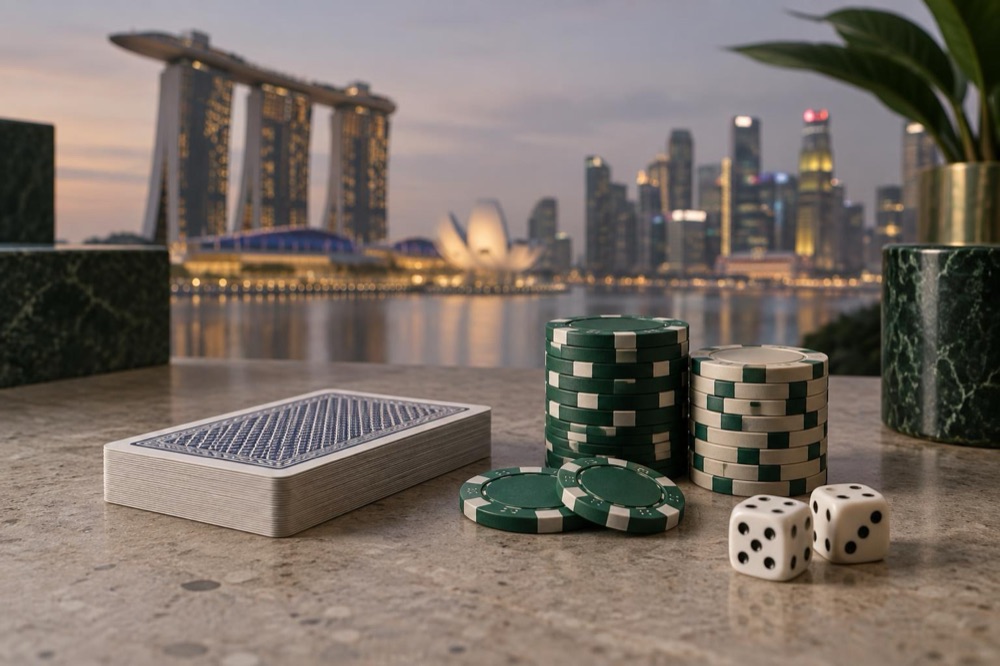
In Singapore, the legalized forms of gambling are social gambling, betting with Singapore Pools, casino gambling at Marina Bay Sands and Resorts World Sentosa, and jackpot gambling in private clubs28. Poker against other players is not on that list as a general offering, so the poker you find there is limited to what the licensed casinos and approved formats provide.
Thailand made a dramatic change recently. Tournament poker is now officially legal in Thailand, after the government overturned a long-standing ban in August 20255. This opens the door to organized tournament play in a country that was previously one of the strictest in the region for poker.
India went the other way. The Promotion and Regulation of Online Gaming Act, 2025 imposes a complete ban on all forms of online money games, and this applies to games of chance, games of skill, and any mix of the two, along with their advertising, promotion and facilitation6. Online poker, whatever its skill component, is caught by that ban.
Japan's approach is structural. Under the casino regulatory framework, poker is divided into eight classifications, of which two are played between customers and one is a tournament played between customers29. So player-versus-player poker exists within the licensed system, but only in the approved classifications.
The Philippines is the most open of the group: the gaming regulator maintains a published register of licensed poker operators, with dedicated poker rooms among the licensed offerings30. For the country-by-country picture, see our main poker in Asia page.
Variants you will find at Asian casinos and online operators
Putting it together, here is what the map actually looks like for a player in Asia.
In licensed card rooms, the spread is Hold'em first, with the house-banked novelty games alongside. The licensed Philippine operators run dedicated poker rooms30. The regional tournament circuit brings the wider variants with it: Open-Face Chinese appears on tour schedules with its three-player tables, 54-card deck with two jokers, and the Ultimate Rule4. Mixed-game lineups, rotating through several variants in one session, are increasingly part of regional series.
At the tables themselves, the regional flavor matters. Pai Gow Poker, the seven-card game split into two hands, seats six players plus the dealer27 and is a natural fit for Asian floors. Pok Deng, a Thai card game, is offered at some Asian casinos and is more common in Cambodia, Laos, Vietnam and some Chinese territories31. Video Poker machines offer instant gameplay, instant payouts and the option to pay by coin, bill or card, like a slot machine but with an element of skill9.
Online, the picture splits between licensed and offshore. Offshore casinos serving Vietnamese players offer slots, instant-win and scratchcard games, table games and live dealer games, with payment by credit cards, eWallets, bank transfers and cryptocurrency, including Payz, Help2Pay, and VISA and MasterCard debit cards32. Casinos accepting Japanese players list the Japanese Yen among supported currencies33. Whether those offshore sites are lawful to use from your country is a separate question, and the country guides cover it.
For a first visit to any of these games, the practical order is: check what the room actually spreads, ask the dealer or floor staff about the house rules, since pay tables and rules may vary slightly by casino11, and start at the lowest stakes on offer. The etiquette of getting a seat, acting in turn and tipping is covered on our card room rules and etiquette page.
Common Questions
Is poker a game of skill or chance?
Both. The cards you receive are random, so every hand has a chance element. But deciding when to bet, call, raise or fold is skill. In house-banked versions like Mississippi Stud, chance dominates and skill is limited to bet and fold decisions.
How many players can play Chinese poker?
Classic 13-card Chinese poker works with two, three or four players. Open-Face Chinese, the newer version, is usually capped at three players per table because everyone's cards are placed face up as the hand develops.
What happens if you set your hand wrong in Open-Face Chinese?
If your three rows do not run from strongest at the back to weakest in front, the hand is fouled. You lose every row and pay every opponent, often with an extra penalty under the Ultimate Rule, which is the harshest scoring version.
What is the best starting hand in poker and how often does it win?
A pair of aces is the best starting hand in Hold'em. But the chance of being dealt a top starting hand like aces or kings is only about 2.1%, so most of the game is played with far weaker cards.
Do you play against the dealer or other players in casino poker?
It depends on the format. In player-versus-player poker you compete with the other players for the pot. In novelty or house-banked versions like Caribbean Stud and Ultimate Texas Hold'em, you play against the dealer or a pay table instead.
Is online poker banned in India?
Yes. The Promotion and Regulation of Online Gaming Act, 2025 imposes a complete ban on all forms of online money games in India, covering games of chance, games of skill, and any mix of the two, along with their advertising and promotion.
Why is poker considered better for players than roulette?
Roulette carries a house edge of around 5 to 6% and no decision you make changes it. Poker's house edge is 2 to 3.5% with optimal play, and in player-versus-player games your decisions and your opponents' mistakes matter far more than luck.
Sources33 sources
- How to play Poker, PlaySmart, 2026
- Poker essentials, GameSense, 2020
- 13-Card Chinese Poker rules, California Department of Justice, 2021
- JOPT 2025 Tokyo Players Guide, Japan Open Poker Tour, 2025
- Tournament poker now legal in Thailand, Asia Gaming Brief, 2025
- Promotion and Regulation of Online Gaming Act, 2025 guidance, Press Information Bureau, India, 2026
- Texas Hold'em, PlaySmart, 2026
- Ultimate Texas Hold'em, PlaySmart, 2026
- How to play Video Poker, PlaySmart, 2026
- Caribbean Stud Poker, PlaySmart, 2026
- Mississippi Stud, PlaySmart, 2026
- Video Poker play sequence, Wikipedia, 2026
- Pai Gow Poker etiquette, PlaySmart, 2026
- Si Se Pai rules, independent game rules, 2026
- Hong Kong card game penalty chips, NTNU research paper, 2005
- How to play blackjack, PlaySmart, 2026
- How to play baccarat, PlaySmart, 2026
- How to play roulette, GameSense, 2026
- Live vs online poker, CoinPoker, 2025
- Three Card Poker, PlaySmart, 2026
- Baccarat how to play details, PlaySmart, 2026
- Blackjack how to play details, PlaySmart, 2026
- Craps odds, PlaySmart, 2026
- Casino Stud Poker rules, UK statutory instrument, 1994
- Stud Poker rules, Macau, DICJ Macau, 2004
- Four Card Poker, GameSense, 2020
- How to play Pai Gow Poker, PlaySmart, 2026
- About problem gambling, Singapore, MSF Singapore, 2026
- Casino regulatory policy, Japan, JCRC Japan, 2026
- List of poker operators with issued gaming license, PAGCOR, 2026
- Pok Deng FAQ, Poks Viet, 2026
- Best online casinos for players from Vietnam, Wizard of Odds, 2026
- Best online casinos for players from Japan, Wizard of Odds, 2026