
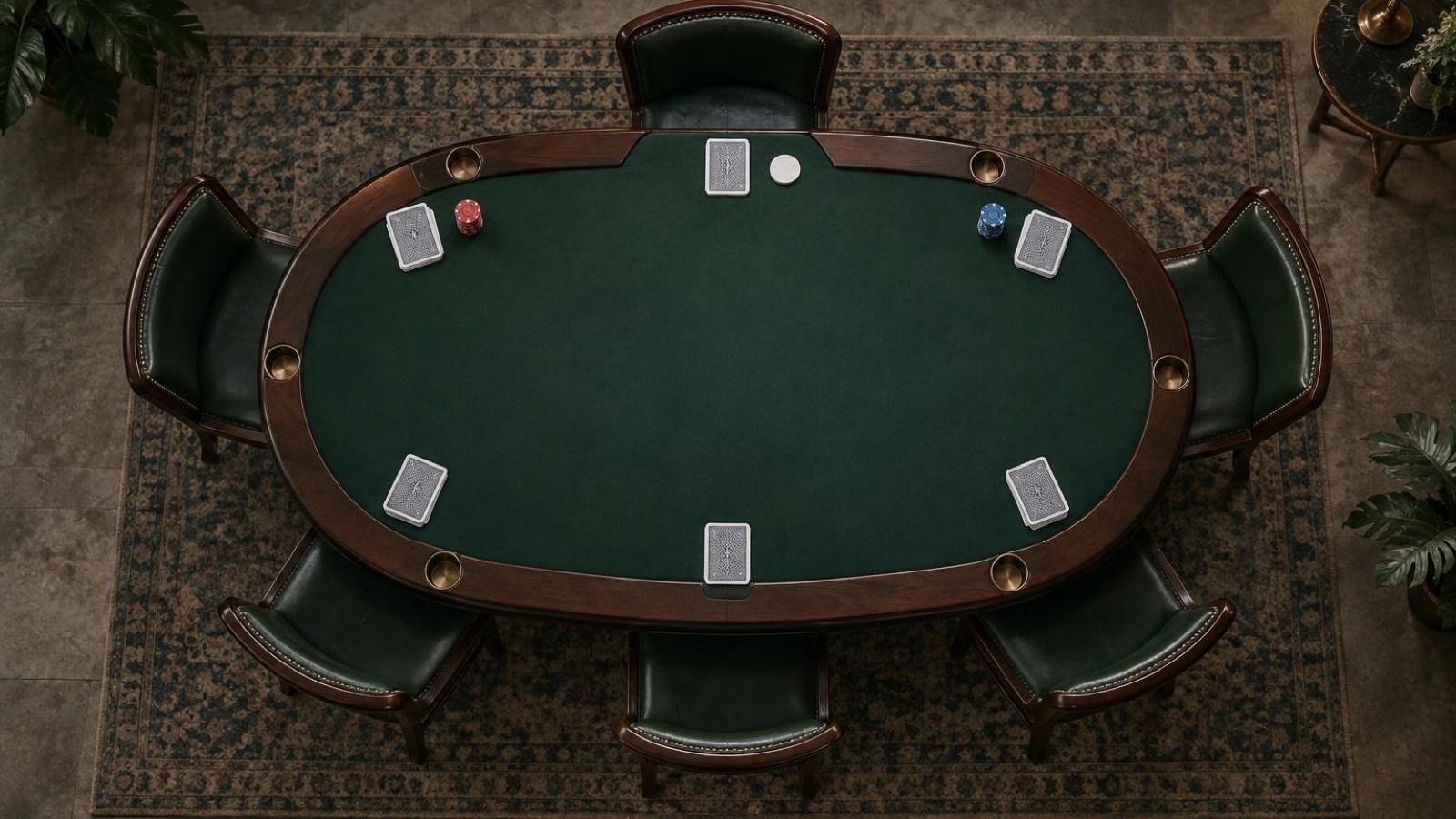
What the positions are at the poker table
Poker is dealt clockwise from a dealer position, and where you sit relative to that dealer decides when you act in every betting round. That is what players mean by "position": not where you are in the room, but how many opponents still have to act after you.
A live Texas Hold'em table in a licensed casino carries a table sign with 10 seats for players plus one seat for the dealer, and the casino can choose to use tables with more than 10 player seats1. Omaha tables follow the same layout, with 10 player seats and a dealer seat on the table sign6. Online, tables are smaller and clearly labeled: a 6-Max table holds at most six players and a 9-Max table at most nine, with a minimum of two players for a game to run4.
If you are playing in a live card room rather than online, you do not choose your seat when you walk in. You visit the poker podium and speak to the person the room calls "the brush," who controls seating. If a seat is open you are seated right away; if not, you go on a first-come, first-served waiting list, and some casinos take call-ahead reservations with a check-in window7. Wherever you land, the dealer button rotates one seat to the left after every hand, so everyone takes a turn in each position.
The positions group into three bands. Early position covers the first two or three seats at the table when at least six players are in the game8. Middle position sits between the early seats and the cutoff. Late position means the players who act last, or nearly last, in a betting round2. The names of the individual seats, from first to act to last, are:
- Under the gun (early position)
- Middle position seats
- The hijack
- The cutoff
- The button
- The small blind and big blind, which post forced bets but act in a different order before and after the flop
If you are new to the game itself, see Texas Hold'em rules for how the betting rounds work, and poker hand rankings for which hands beat which.
The button: dealer position and why it acts last
The button is a flat white disc that marks the dealer position for the current hand. In a casino game the house dealer physically deals the cards, but the button still tells everyone where the "dealer" sits for betting purposes, and it moves one seat clockwise after each hand2.
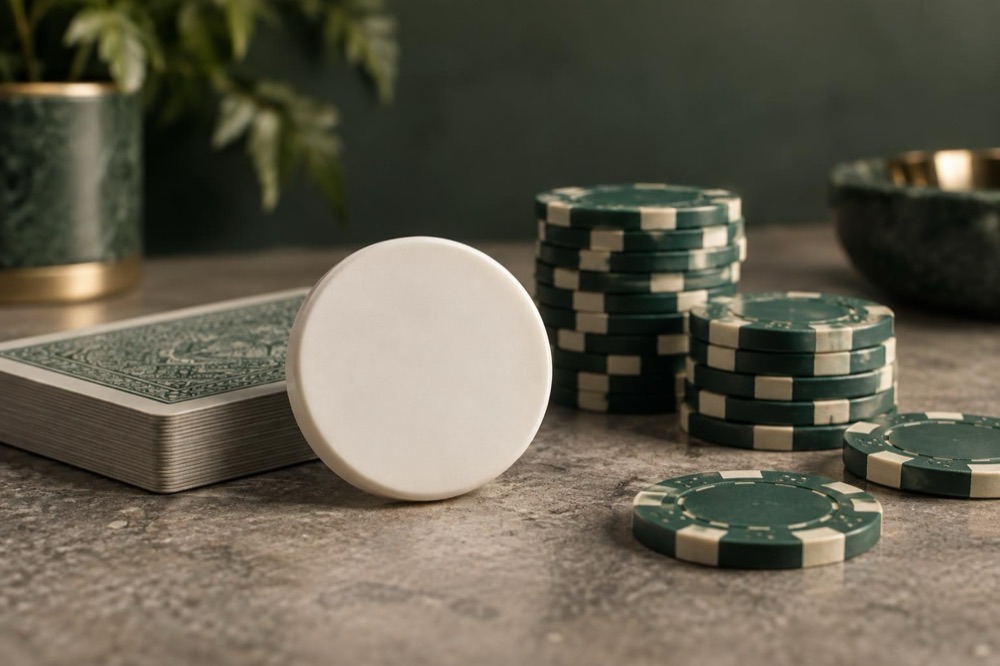
Being on the button is an advantage because that player ends the betting round. In poker terms, the button is "in position": the player who is the last to act in each betting round2. Acting last means you see what everyone else does before you have to decide. If everyone checks to you, you can bet with nothing and often take the pot. If someone bets big, you can fold a weak hand without having paid anything to find out. No other seat gives you that much information before you commit chips.
The button does have one small quirk: before the flop, the button is one of the last seats to act, but not the last, because the blinds are still waiting behind it. From the flop onward, the button is always last if it stays in the hand.
The blinds: small blind and big blind
Before any cards are dealt, the two players to the left of the dealer post forced bets called blinds. The first player posts the small blind, and the second posts the big blind9. The small blind is a bet equal to half the minimum bet, and the big blind is a bet equal to the minimum bet3. In a $1/$2 game, for example, the small blind posts $1 and the big blind posts $2.
The names describe the seats as well as the bets. The big blind is the position second to the dealer's left, and it requires a mandatory preflop payment at the start of the first betting round10. The small blind sits directly to the dealer's left and pays a smaller amount, usually half of the total bet, while the player next to the small blind is the big blind and pays the entire stake, precisely double the small blind11.
The blinds exist to guarantee there is money in the pot to fight over on every hand. Without them, players could simply fold everything except premium cards and the game would stall. If you want the full picture of forced bets, including antes and straddles, see blinds, antes and straddles.
One thing that surprises new players: the blinds are the worst positions after the flop. The small blind is the first seat to act in every betting round from the flop onward, and the big blind is second. You have already put money in blind, and then you have to act first with the least information. That is the trade-off for the discount you got before the flop.
Early position: first to act after the blinds
Early position is the first two or three seats at the table when at least six players are in the game8. The first of these seats has a famous name: under the gun, often shortened to UTG. In Texas Hold'em, under the gun is the player directly to the big blind's left, and they are the first to act in the first betting round8.
The official rules say the same thing in more formal language: after the hole cards are dealt, the player to the immediate left of the big blind, the third player after the button, acts first3. The first betting round begins with the player to the left of the big blind9.
Under the gun is the hardest seat to play before the flop. You are first to act, and every other player at the table gets to react to whatever you do. If you raise, everyone can fold, call or re-raise with full knowledge of your move. Because of that, players tighten up in early position and play only strong starting hands. A starting-hand chart reflects this: pocket aces and jacks are marked for a raise or re-raise from early position and the blinds, while a hand like ace-jack is marked check/fold from early position but worth playing from late position12.
The same logic applies to the other early seats. The more players who still have to act behind you, the stronger your hand needs to be to open the pot.
Middle position: between the early seats and the cutoff
Middle position covers the seats between the early positions and the cutoff. At a 9-Max table that is roughly the fourth, fifth and sixth seats after the button; at a 6-Max table the middle seats shrink to one or two players.
Middle position is a step up from early position. You have seen what the early players did, so you have some information, but there are still several opponents behind you, including the late-position seats that will act after you on every street. Hands that were too weak to open from under the gun become playable here. A suited king-jack, for instance, is marked as a play from middle position in starting-hand charts, where it would be a fold from the earliest seats12.
The seat at the top of middle position, two to the right of the button, has its own name: the hijack. It sits between the middle-position seats and the cutoff, and it is considered the last of the middle positions rather than a true late-position seat. A raise from the hijack still has the cutoff, the button and the blinds to get through.
One more thing worth knowing about middle position: it is where being "out of position" starts to bite. Playing out of position means you are forced to act before your opponent during the post-flop betting rounds13. If you open from an early or middle seat and a player on the button calls, you will be acting first on every street that follows, which is exactly the situation strong players try to avoid.
Late position: cutoff and button
Late position means the players who act last, or nearly last, during a betting round2. Two seats make up late position: the cutoff and the button.
The cutoff is the seat to the dealer's right8. The name comes from the idea that this seat "cuts off" the button's advantage: the cutoff acts just before the button in every round, so it is nearly, but not quite, the best seat at the table. Before the flop, the cutoff gets to see what everyone else has done and can open with a much wider range of hands than the early seats. After the flop, only the button acts after it.
The button, as covered above, is the best seat in the house. It acts last in every betting round after the flop, and it is one of the last seats to act before the flop as well.
Starting-hand charts show the difference clearly. From late position, hands like ace-king, ace-queen, pocket tens, queens and jacks are all marked for a re-raise, and even smaller pairs like twos, sixes, sevens and nines, along with jack-ten, are marked as playable12. The same chart that folds ace-jack in early position plays it in late position. The cards have not changed; the position has.
Between the two, the button is better than the cutoff. The cutoff acts late but still has the button behind it, while the button has nobody behind it after the flop. If you ever have a choice of seats at a table, take the one that will put the button on you more often, and expect the player on your immediate right, the cutoff, to act before you rather than after you.
Who acts first once the flop is out
The order of action flips after the flop, and this is the single most confusing thing for new players.
Before the flop, action starts to the left of the big blind: under the gun acts first, and the action moves clockwise, ending with the button and then the blinds3.
After the flop, everything changes. The flop is the first three community cards, dealt face up after the first betting round10. From this round onward, the player to the left of the dealer starts the betting. The official Omaha rules state it plainly: in the flop round and all following rounds of betting, the player to the left of the dealer starts the round14. Texas Hold'em works the same way.
That means the small blind acts first after the flop, then the big blind, then under the gun, and so on around to the button, which acts last. The blinds, which had the best view before the flop, now have the worst. The button, which waited near the end before the flop, now closes every street.
This flip is why position matters so much in flop games. If you are in the small blind, or if you opened from an early position and a player on the button calls, you are out of position: you must act before your opponent on every post-flop round, guessing at what they will do13. If you are on the button, you watch first and decide second, on the flop, the turn and the river alike.
How positions shift at 6-Max tables
A 6-Max table seats at most six players, with a minimum of two for a game to run4. Six-handed games are the most popular format online, and they compress the seat map considerably.
At a full 6-Max table, the positions are:
- Small blind
- Big blind
- Under the gun (the only true early-position seat)
- Middle position (sometimes called the hijack at 6-Max, since it is two off the button)
- Cutoff
- Button
Notice what disappears: the extra early and middle seats. At 9-Max there are three early positions and up to three middle positions; at 6-Max there is one of each. The hijack, which at a 9-Max table sits between middle position and the cutoff, effectively merges into the cutoff's neighbor at 6-Max, and many players just call the fourth seat "the hijack" and the fifth "the cutoff."
The practical effect is that the whole game shifts toward late position. With only five opponents, you are in the cutoff or button two hands out of every six, and even under the gun has only five players behind it rather than eight. Starting-hand ranges widen at every seat as a result, pots are contested more aggressively, and hands come to a showdown more often. If you sit at a 6-Max table playing the tight ranges you would use from early position at a 9-Max table, you will simply bleed blinds.
How positions shift at 9-Max tables
A 9-Max table seats up to nine players4. This is the closest online format to a full live table, and the seat map stretches back out:
- Small blind
- Big blind
- Under the gun (UTG)
- UTG+1
- UTG+2 (these three make up early position when at least six players are seated8)
- Middle position 1 (the lojack)
- The hijack
- The cutoff
- The button
At nine seats, early position is a genuinely dangerous place. Under the gun has eight players still to act, and even the third early seat has six. Starting-hand charts respond accordingly: only the strongest hands are marked for a raise from early position and the blinds12. Middle position loosens up a little, and the hijack, cutoff and button play the widest ranges.
Live casino tables can be larger still. The Macau table rules for Texas Hold'em provide for 10 player seats plus the dealer, with the option of tables carrying more than 10 player seats1, and Omaha tables use the same 10-plus-1 layout6. At a 10-handed live table, add one more early-position seat to the 9-Max map and push everything else one seat further from the button.
The broader lesson: the more players at the table, the more early positions there are, the tighter those seats must play, and the more valuable the button and cutoff become. The fewer the players, the more the whole table behaves like late position.
6-Max tables on Natural8: buy-ins, blinds and rake
Natural8 runs 6-Max No Limit Hold'em cash tables across three stake bands, and the numbers give you a concrete picture of what a 6-Max game costs.
| Stakes | Blinds | Default buy-in | Rake cap (by players in pot) |
|---|---|---|---|
| Low Stakes | $0.01/$0.02 | $0.50 | $0.05 (2) / $0.10 (3) / $0.15 (4) / $0.20 (5+) |
| Low Stakes | $0.02/$0.05 | $1 | $0.13 (2) / $0.25 (3) / $0.38 (4) / $0.50 (5+) |
| Middle Stakes | $0.25/$0.50 | listed by table | varies by table |
| Middle Stakes | $0.50/$1 | $20 | varies by table |
| Middle Stakes | $1/$2 | listed by table | $4.50 (2) / $6 (3) |
| High Stakes | $2/$5 | $100 | 0.4BB (2) / 0.8BB (3) / 1.2BB (4) / 1.6BB (5+) |
| High Stakes | $5/$10 | $200 | 0.25BB (2) / 0.5BB (3) / 0.75BB (4) / 1BB (5+) |
| High Stakes | $10/$20 | $500 | 0.188BB (2) / 0.375BB (3) / 0.563BB (4) |
The lowest 6-max tables start at $0.01/$0.02 blinds with a $0.50 default buy-in, and the site confirms a minimum of two players per table4. Buy-ins on the 6-max tables start as low as $0.5016, and at the top of the range the $10/$20 table carries a $500 default buy-in4. Low-stakes tables take 5% of each pot, with the caps listed above depending on how many players were dealt in15.
At the very top end, Natural8's VIP 6-max games run at blinds from $100/$200 up to $500/$1,000, with minimum buy-ins of $4,000, $8,000 and $100,000 respectively, and the $200/$400 table's rake is capped at 0.038BB with two players, 0.113BB with three and 0.15BB with four17. The VIP tables also feature unlimited buy-ins18.
If you prefer Omaha, the same site's Pot Limit Omaha tables also seat a maximum of six players with a minimum of two, and PLO buy-ins start from as low as $0.2019. For how rake works in general, see poker rake explained.
Common Questions
Who acts first after the flop?
The first active player to the left of the dealer button. The blinds act first after the flop because they sit closest to the button's left, and action then moves clockwise around the table.
What is the hijack seat?
The hijack is the seat two to the right of the button, between middle position and the cutoff. It gets its name because a raise from there can "hijack" the position of the players still to act.
Is the cutoff or the button better?
The button is better. The cutoff acts late but still has the button behind it before the flop, while the button acts last in every betting round after the flop, which is the strongest position at the table.
How many players can sit at a 6-Max table?
Six at most, with a minimum of two for a game to run. A 9-Max table seats up to nine players. Online card rooms label tables 6-MAX or 9-MAX so you know the size before you sit.
What is the minimum buy-in on Natural8 6-Max tables?
Buy-ins on Natural8's 6-max tables start at $0.50 for the lowest-stakes games at $0.01/$0.02 blinds, and rise with the stakes up to a $500 default buy-in at $10/$20.
How much rake do Natural8 6-Max tables take?
Low-stakes 6-max tables take 5% of each pot, with caps that depend on how many players are dealt in. At $0.01/$0.02 the cap runs from $0.05 with two players to $0.20 with five or more.
Sources19 sources
- Texas Hold'em Poker rules, DICJ Macau, January 18, 2008
- Poker terms and definitions, Natural8, 2026
- Texas Hold'em community poker, PlaySmart, 2026
- Texas Hold'em, Natural8, 2026
- Texas Hold'em, Natural8, 2026
- Omaha Poker rules, DICJ Macau, July 29, 2010
- How to play poker, PlaySmart, 2026
- Poker terms and definitions, Natural8, 2026
- How to play Texas Hold'em poker, CoinPoker, 2026
- Poker terms and definitions, Natural8, 2026
- Poker 5-card draw guide for beginners, CoinPoker, 2026
- Starting hands, partypoker, 2026
- How to play out of position in poker, Natural8, 2026
- Omaha community poker, PlaySmart, 2026
- Texas Hold'em, Natural8, 2026
- Texas Hold'em, Natural8, 2026
- VIP tables, Natural8, 2026
- VIP tables, Natural8, 2026
- Omaha, Natural8, 2026















