
What a card room's house rules cover
A live poker room is not a free-for-all. It runs on a set of house rules that sit on top of the game rules you already know. Those house rules cover the practical stuff: how you get a seat, how much you must buy in for, what counts as a legal bet, when you are allowed to act, how the pot is split, and how the room handles mistakes.
The game rules themselves are standard. Texas Hold'em deals two cards face down to each player, one at a time, clockwise from the first player left of the button4. Omaha deals four cards face down to each player, one at a time5. Depending on the variation, players typically receive either two or five cards1. The community cards come out the same way in both: the flop of three, then the turn, then the river, each preceded by burning a card6.
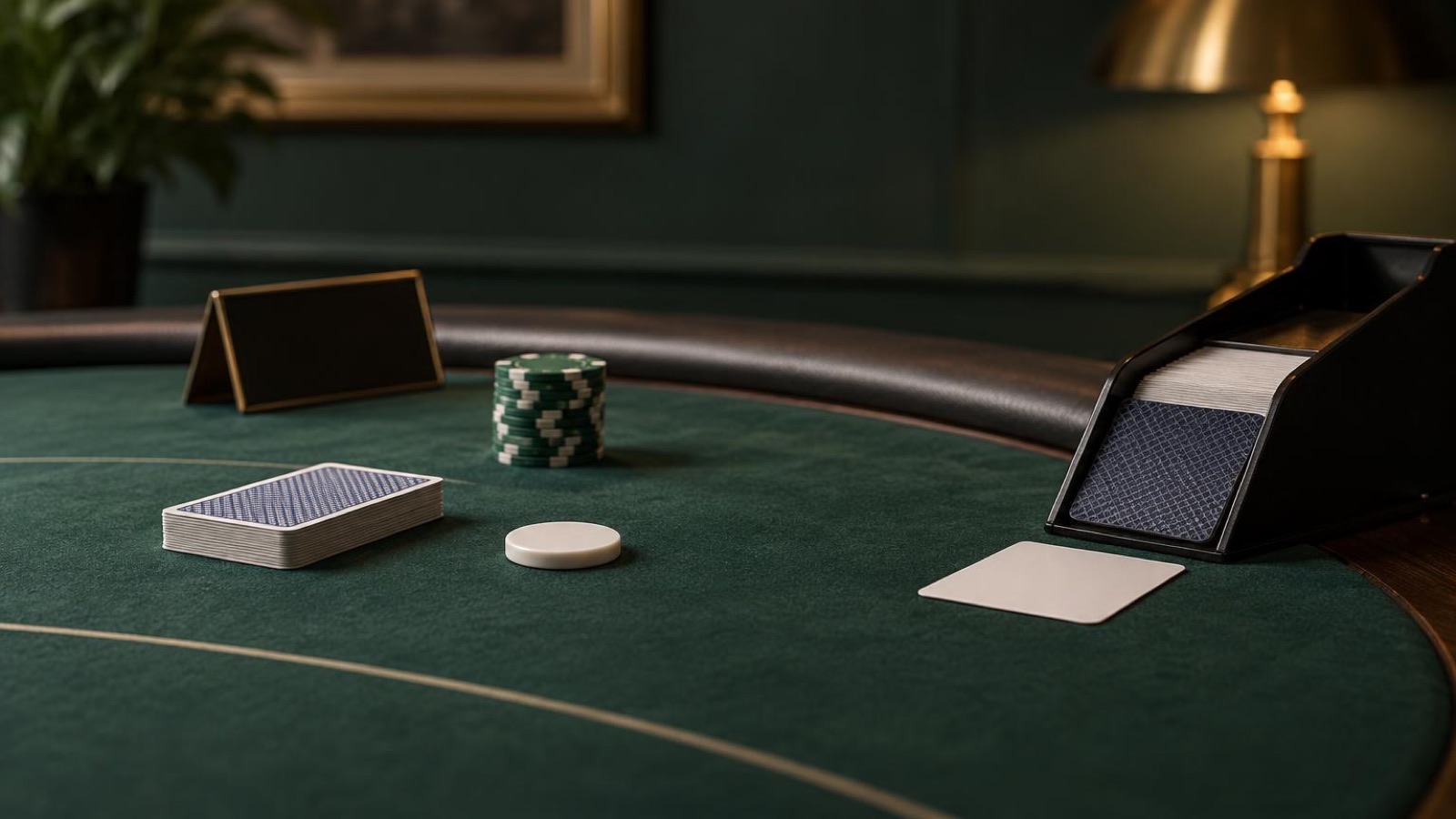
What changes from room to room is the house layer. A regulated poker room in Kahnawà:ke, for example, may offer Hold'Em, Omaha, Omaha High-Low, Seven Card Stud, Razz, Seven Card Stud High-Low, Lowball, Draw High and Chinese Poker7. The equipment is standardized too: one gaming table with a table sign, a dealer button, one deck of 52 cards, a dealing shoe and a white cutting card, or a card shuffling machine4.
If you are new to live poker, the useful thing to understand is that the dealer and the floorperson enforce these rules, not the players. If something feels wrong, you ask the dealer. If the dealer cannot resolve it, the floor is called. That is normal and not a big deal.
Getting a seat: lists, waiting and table changes
The first thing you do in a live poker room is not sit down. You go to the poker podium and speak to the person who controls seating, known as the brush1. You tell them what game and what stakes you want. If there is space, you are seated right away. If not, you go on a waiting list, first come, first served1.
Some casinos take call-ahead reservations, with a check-in window. If you miss the window, you lose your spot1. This is worth knowing if you are traveling and want to play at a specific time.
Table sizes vary by game. A Texas Hold'em table has 10 seats for players plus one for the dealer, and the room can choose tables with more than 10 player seats4. Omaha uses the same 10 plus 1 layout5. Stud games and house-banked variants often run smaller: a Fortune 3 Card Poker table has six to eight positions, one of which is the dealer's8, and a Pai Gow Poker table has positions for six players and a dealer's area9.
If you want to change tables, you tell the brush. In a cash game you can usually move when a seat opens at your desired table, but you may have to post a blind or wait for the big blind when you arrive. Ask before you move so you know what you are agreeing to.
Buying in: minimums, chips and table stakes
Once you have a seat, you buy chips. The cleanest way is to put your cash on the table and let the dealer know you want chips, ideally after the current hand finishes10. Do not hand cash to another player, and do not buy chips from someone leaving the table.
Table stakes means you can only play the chips you have on the table at the start of a hand. You cannot reach into your pocket mid-hand to add more. If you want to add chips, you do it between hands.
Buy-in rules vary by game and room.
| Room or game | Buy-in rule |
|---|---|
| Table with a $1/$2 bet limit | $50 minimum and $300 maximum3 |
| 13-Card Chinese Poker | Buy-in equivalent to 25 times the limit condition; short buy-ins are not allowed11 |
| High-limit room | A seated player may be required to bet six times per round11 |
The house takes its cut from each pot. In Macau, the venue takes 3% to 5% of each pot as commission, capped at five times the big blind4. Elsewhere the rake is often 10% of the pot for each hand1. Depending on the type of poker, there may also be a session fee, and in some games an ante bet contributed by each player before the hand starts1.
You need to be old enough and show ID. In a regulated room, a person participating in approved games must provide official identification that includes a photograph, showing their name, address and date of birth12. Bring your passport if you are traveling.
Verbal bets: what you say and when it binds you
This is the rule that catches out more new players than any other. In poker, verbal betting statements are binding2. If the amount you verbalize does not match the amount of chips you put down, the dealer goes with the amount you said2. When playing poker in casinos, verbal statements are binding, and if a spoken statement does not match a hand gesture, the spoken action must proceed1.
So the safe habit is: say the number first, then move the chips. "I bet $5" is a bet of $5, no matter what you push forward2. If you say "raise" and then put out an amount that does not match, the words govern.
A call is a wager equal to the amount of the last bet placed around the table2. A call keeps play moving and lets you see the next card, and in some variations it can trigger a showdown2.
A raise must be at least equal to the previous bet or raise in the round4. In fixed-limit games, the first two rounds bet the small blind amount and the last two rounds bet the big blind amount4. In no-limit games, players may bet all chips on the table at or above the minimum bet, which is an all-in4.
If you want the full breakdown of each action, see check, bet, call, raise, fold and all-in.
Acting in turn: checks, calls, raises and fold rules
You act only when it is your turn. That sounds obvious, but it is the source of most table disputes. You cannot fold out of turn, you cannot call before the player ahead of you has acted, and you cannot reach for chips early.

Folding ends your participation in the hand. You can fold on any round, including right off the deal, but you must wait until your turn to act2. When you fold, you forfeit all your bets and are prohibited from making any further bets on the round2.
In house-banked games the fold rule is even more final. In Progressive Jackpot Poker, if the player chooses not to raise, the spot is treated as a loss and the dealer takes the cards and the ante bet13. In Three Card Poker, a player who does not make a Play wager surrenders the Ante stake to the bank, and the Play wager must be equal to the Ante wager14.
Betting limits differ by game type. In limit games there is a maximum of three raises per betting round6. In no-limit games there is no limit on bet or raise amounts, and no limit on raises when only two players remain4. When two players remain head up in a limit game, the raise amount is unlimited6.
If a dealing error happens, it must be corrected immediately. If it cannot be corrected, the round is void and bets are returned to players4. In Progressive Jackpot Poker, if dealing is incorrect, the number of cards dealt differs, or two or more cards are wrongly exposed, the round is void and bets are canceled, except progressive jackpot bets which carry over to the next round13.
String bets and other betting mistakes
A string bet is when you put chips out in more than one motion to build a raise. You call with one handful, then reach back for more. It is not allowed, because it lets you watch the table react before you have committed the full amount.
The fix is simple. Decide how much you want to wager, then place the corresponding value of chips on the table in one motion, for example one $5 chip or five $1 chips for a $5 bet2. If you are raising, push your raise amount in chips across the line, into the middle of the table2.
Other common mistakes:
- Announcing one amount and pushing a different amount. The words win2.
- Betting at a seat you are not occupying. A player may bet only at the position they occupy and may not bet at more than one position through others15.
- Betting after the deal has started. In Fortune 3 Card Poker, no more bets are accepted once the dealer deals the first card of a round8.
- Recording results or using a device to predict outcomes. Players are prohibited from recording results, predicting or devising betting strategies8.
If you are unsure whether an action is legal, ask the dealer before you do it. That is always cheaper than a ruling against you.
Showdown and mucking: who shows and when
If everyone folds to you, you win the pot without showing your cards. That is the most common way a hand ends.
If the hand goes to showdown, the order matters. The last player to bet or raise shows first, then the remaining players in order. You can muck a losing hand without revealing it, but if your bet was called, the winner generally has to show.
Ties are handled by rule, not by negotiation. In Texas Hold'em, if two or more players hold identical combinations, they split the pot equally down to the lowest divisible amount, and the indivisible remainder goes to the first player still in the hand to the dealer's left4. In Omaha, players may not agree to split the pot, and two or more players with identical hands share the pot equally, with the indivisible remainder going to the first player still in the hand to the dealer's left5. In Omaha, if any players tie, they split the pot evenly3.
In Omaha, each player combines their first two hole cards with three of the community cards to make the best five-card hand, and the best five-card hand wins the pot5. In Pai Gow Poker, the player wins their bet if their front and rear hands beat both of the dealer's hands, and the bet pushes if only one of their hands beats only one of the dealer's hands9.
For the full ranking order, see poker hand rankings.
Tipping: how much and when
Tipping is a custom, not a house rule, and it varies by room and region. In the United States, dealers are often tipped from pots won. In Asia, the expectation is generally lower, and some rooms pool tips among staff.

A practical approach: tip a small amount from a pot you win, scaled to the stakes you are playing. If you are at a $1/$2 table, a dollar or two from a decent pot is normal in many rooms. If you are at higher stakes, the tip scales up. If you are unsure, watch what the regulars at your table do for the first hour.
You are not required to tip, and no dealer should ask you for one. If a room has a no-tipping policy, it will usually be posted or mentioned when you sit down.
The house's own cut is separate from tipping. The venue takes its commission from each pot, and that money does not go to the dealer4.
Common etiquette at the table: phones, stalling and etiquette disputes
Etiquette is not enforced the way rules are, but breaking it will get you a reputation fast.
- Keep your phone off the table while you are in a hand. Taking calls mid-hand slows the game and looks like stalling.
- Do not stall. Deliberately taking too long on every decision is bad for the game and the room may put you on a clock.
- Keep your personal items tucked away. Players should keep wallets, handbags and other personal items tucked away, and beverages should be kept in holders to avoid spills16.
- Do not reveal your cards to anyone still in the hand, and do not discuss a hand in progress.
- Do not comment on a hand you have folded. It gives information to players still in the pot.
- Do not ask the dealer for advice on how to play your hand. You can ask about the rules around hands, playing as the Banker, or general gameplay16, but not what to do.
- Do not hit and run repeatedly. Leaving immediately after a big win is allowed, but doing it every time at the same room is noticed. For more on this, see what hit and run means in poker.
If you have a dispute with another player, do not argue across the table. Call the dealer, and if needed the floor. That is what they are there for.
If you want to understand how the rake and fees work before you sit down, see poker rake explained. If you are new to live play and want the full picture of getting seated, see how to get a poker room seat.
Common Questions
What happens if you bet out of turn in poker?
Your action is usually stopped and you are told to wait. In most rooms the bet does not stand, though a floorperson can rule that it is binding if it clearly influenced another player. Dealers correct the order before the next card comes, and repeated out-of-turn action can get you a warning.
Is a verbal bet binding in poker?
Yes. In casino poker, what you say out loud is binding. If the amount you announce does not match the chips you push forward, the dealer goes with the amount you said. Say the number first, then move the chips, so there is no argument.
What is a string bet?
A string bet is when you put chips out in more than one motion to build a raise, such as calling with one handful and then reaching back for more. It is not allowed because it lets you read reactions before committing. Announce the full amount, then push it all out at once.
How much should you tip a poker dealer?
Tipping is a custom, not a rule, and it varies by room and region. A common approach is a small amount from a pot you win, scaled to the stakes you are playing. Dealers in Asia generally expect less than in the United States, and some rooms pool tips.
Can you leave a poker table whenever you want?
In a cash game, yes. You can get up between hands and take your chips to the cashier. You should not leave in the middle of a hand you are still in, and if you are on a waiting list for another table, tell the brush so your spot is handled properly.
Do you have to show your cards if you win?
If you are the last player with cards and everyone else has folded, you win without showing. If the hand goes to showdown, the last aggressor shows first, then players in order. You can muck a losing hand without revealing it, but a called bet usually means the winner must show.
Sources16 sources
- Poker, PlaySmart, 2026-09-25
- How to Bet, PlaySmart, 2026-09-25
- Omaha Community, PlaySmart, 2026-09-25
- Texas Hold'em Poker, DICJ, 2008-01-18
- Omaha Poker, DICJ, 2010-07-29
- Despacho, Boletim Oficial de Macau, 2010-08-09
- FAQs, Kahnawà:ke Gaming Commission, 2026-09-25
- Fortune 3 Card Poker, DICJ, 2025-10-30
- Pai Gow Poker, PlaySmart, 2026-09-25
- How to Play Craps, PlaySmart, 2026-09-25
- Hustler Casino, California Attorney General, 2021
- Regulations concerning Poker Rooms, Kahnawà:ke Gaming Commission, 2026-01-14
- Stud Poker, DICJ, 2004-05-12
- Statutory Instrument 2002 No. 1130, UK Government, 2002-05-13
- Despacho, Boletim Oficial de Macau, 2025-10-30
- Pai Gow Poker Etiquette, PlaySmart, 2026-09-25















