What sets Vietnamese Mahjong apart
If you already know Cantonese or Hong Kong Old Style mahjong, you can sit down at a Vietnamese Mahjong table and follow most of what happens. The core of the game is the same: four players, 13 tiles in hand, drawing and discarding until someone assembles a complete hand of four sets and a pair. The suits, the winds, the dragons, the flowers and the seasons are all where you expect them3.
What makes the Vietnamese game its own thing is the Joker system. Vietnamese Mahjong adds eight special Joker tiles that can stand in for other tiles. On top of that, the set carries four king tiles and four queen tiles as extra bonus tiles, which feed into the scoring through a doubling rule you will not find in Chinese Classical play1.
A few structural details also differ. There is no dead wall, so the wall is drawn down as play proceeds rather than a section being set aside. Discards are thrown randomly into the pile rather than arranged in tidy rows, which takes some getting used to if you learned the game elsewhere. And in most rules only the winner's hand is scored, rather than every player counting points2.
How many tiles are in a set
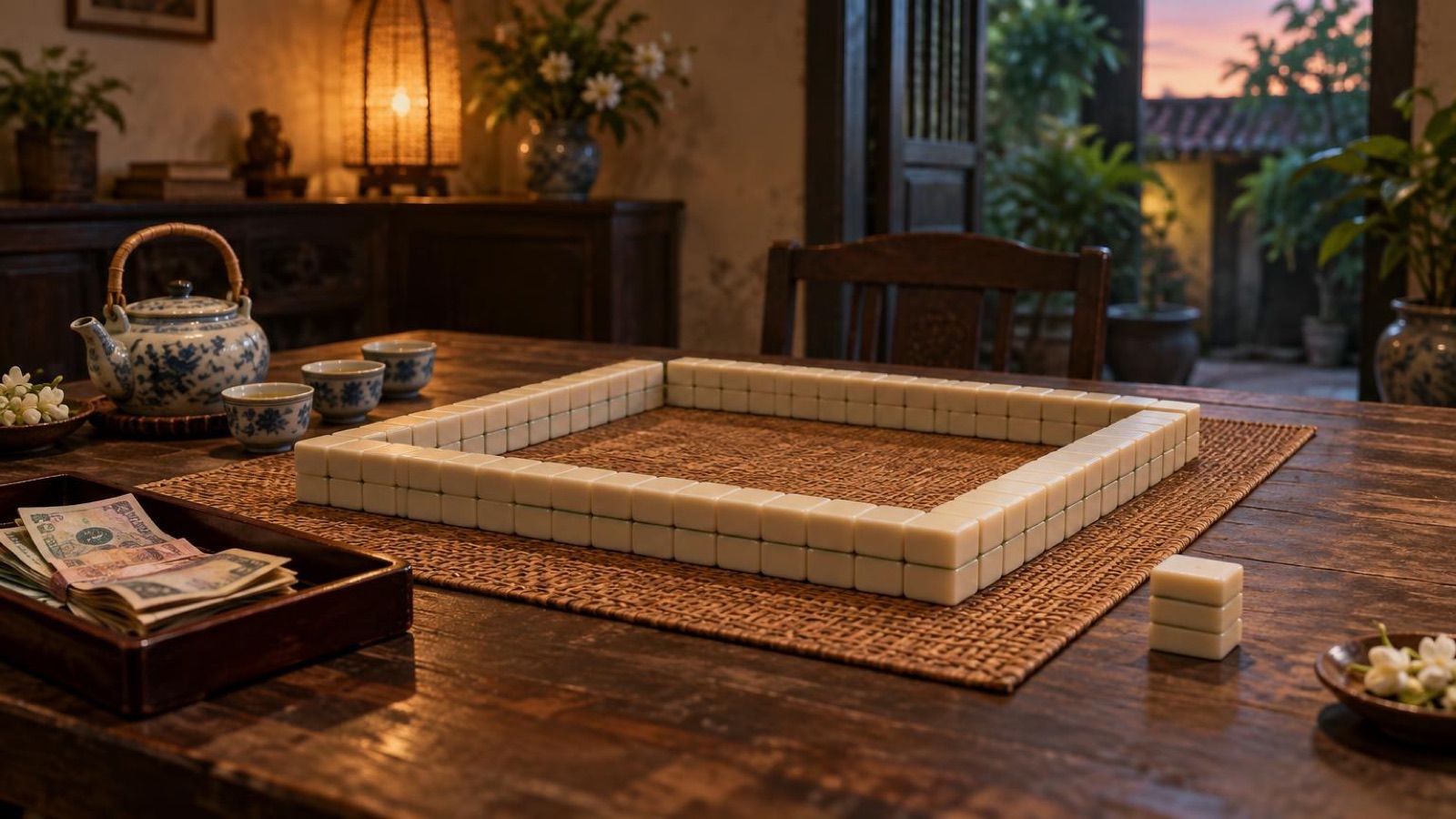
A modern Vietnamese Mahjong set contains 176 tiles. The breakdown is:
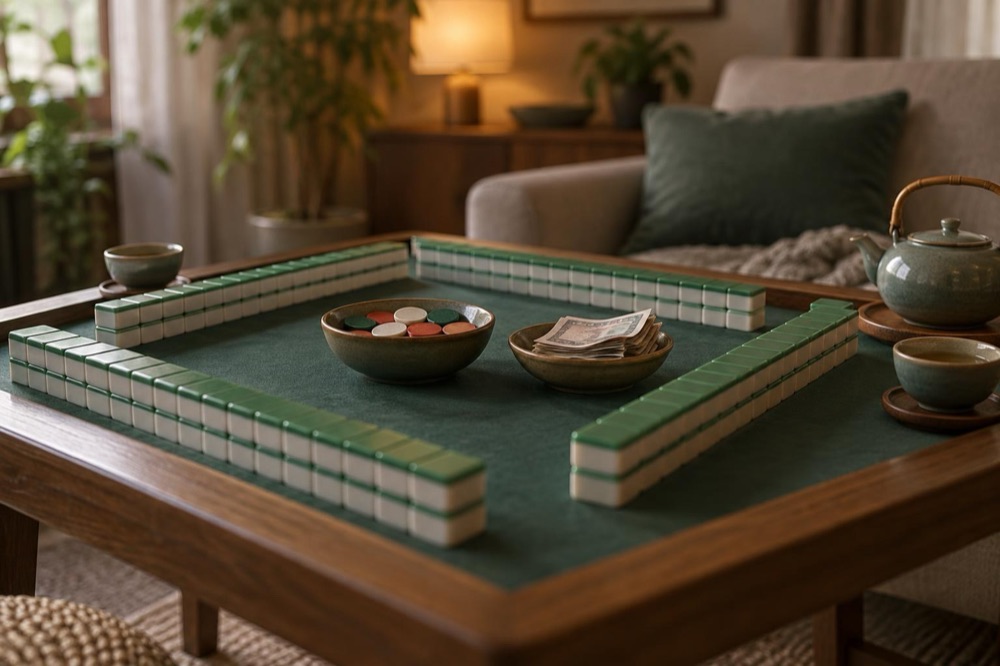
- 152 tiles before the Jokers: 108 suited tiles (dots, bamboo, characters), 28 honor tiles (winds and dragons), and 16 bonus tiles, the usual flowers and seasons plus four kings and four queens1
- 8 Joker tiles in a classical set, or 24 in a modern set, where each Joker appears in three copies, for a total of 160 tiles in a classical set or 176 in a modern set1
The bonus tiles deserve a closer look. Beyond the four flowers and four seasons you would find in any Chinese set, Vietnamese Mahjong adds eight special bonus tiles: four kings and four queens1. These are not Jokers. They sit alongside the flowers and seasons as tiles you reveal and replace, and they matter at scoring time, where a set built on a king tile and a queen tile with a matching number doubles your points2.
Each player still holds 13 tiles, exactly as in Cantonese mahjong, drawing a 14th on their turn and discarding back to 133.
Classical and modern Joker sets
Vietnamese Mahjong sets come in two generations, and the difference is purely how many Jokers you get.
In classical sets, one copy of each Joker is used, so eight Joker tiles in total1. In modern Vietnamese Mahjong sets, three copies of each Joker are used, giving 24 Jokers. The three copies of each Joker are told apart by a small mark around the character: one copy is drawn with a circle, one with a rectangle, and one with a diamond1.
The eight Joker tiles are separated into two groups of four: four Blue Jokers and four Red Jokers1. The color grouping does not change what each Joker substitutes for, but it helps players track which Jokers are still live in the game.
If you are buying or borrowing a set, check the Joker count first. A set with only eight Jokers is a classical set, and a game played with it will feel tighter, with fewer wild substitutions flying around. A modern set with 24 Jokers makes for a looser, faster game where big hands come together more often.
What each Joker does
Each of the eight Jokers substitutes for a specific family of tiles2:
| Joker | Substitutes for |
|---|---|
| Flower Joker | Any bonus tile |
| Dragon Joker | Any dragon tile |
| Wind Joker | Any wind tile |
| Suited Joker | Any dots, bamboo, or character tile (some rules also allow any bonus tile) |
| Characters Joker | Any characters tile |
| Bamboo Joker | Any bamboo tile |
| Dots Joker | Any dots tile |
| Emperor Joker | Any other tile at all, including a bonus tile |
The pattern is easy to remember. Six of the Jokers map onto the building blocks of the game: one for each suit, one for the winds, one for the dragons. The Flower Joker covers the bonus tiles. And the Emperor Joker sits above them all as a true wild card, usable in place of anything, bonus tiles included1.
A Hong Kong newspaper feature from 2003 listed the same eight Jokers by their Chinese characters, with the same substitutions: the tile written 花 for any tile, 元 for the three dragons, 喜 for the four winds, 合 for any suited tile, 總 for any honor tile, 索 for bamboo, 萬 for characters, and 筒 for dots3. The small differences from the list above, such as which Joker covers honors versus winds, reflect how much the details vary from set to set and club to club. Ask about the house rules before you play for anything meaningful.
How Jokers and bonus tiles behave during play
The bonus and Joker rules follow a clear rhythm across the hand.
In your opening hand, you must reveal and replace all bonus tiles dealt to you, just as in Hong Kong Old Style mahjong. When you replace bonus tiles during the opening hand, you may also reveal any Jokers you hold and treat them as bonus tiles, setting them aside and drawing replacements2.
During later turns, the rules tighten. Only the Emperor Joker and the Flower Joker may still be treated as bonus tiles and set aside for a replacement draw. The other six Jokers must stay in your hand and be used as substitutions within your sets2.
Flowers drawn during later turns are handled differently from the opening hand: you can keep a flower in your hand, and discard it later, or another player may claim it2. This is where the bonus-discard rule, covered below, comes into play.
Discards themselves are thrown randomly into the discard pile rather than lined up in order, again following Hong Kong Old Style practice2. This means reading the discard pile is harder than in Japanese or American play, and players rely more on memory of what has been thrown.
One more structural note: no dead wall is used2. In games that keep a dead wall, a block of tiles is reserved for replacement draws and the hand ends when the live wall runs out. In Vietnamese Mahjong the whole wall is in play, so hands tend to run longer before a draw is declared.
Winning off a bonus discard
Here is the rule that surprises most players new to the game: if you discard a bonus tile, including the Flower Joker, while any other player is waiting on a winning tile, that player may treat your bonus tile as her winning tile and win off your discard2.
This changes discard strategy considerably. In most mahjong variants, throwing a flower is a free and safe discard, since flowers are not part of anyone's winning hand. In Vietnamese Mahjong, a late-game flower discard can hand the win to a waiting opponent. The same applies to the Flower Joker, which counts as a bonus tile for this purpose.
Discarded Joker tiles carry their own risks. A discarded Joker can be used by another player to create an open meld, or to declare a win2. Between the bonus-discard rule and the live Joker discards, the endgame in Vietnamese Mahjong is more open than in many variants, and players hold safe tiles more carefully.
Scoring
Scoring in Vietnamese Mahjong appears to be identical to Chinese Classical scoring, with one main exception: in most rules, only the winner's hand is scored2. In Chinese Classical, all players score points and not just the winner, though that is an option there too4. In practice, the Vietnamese game usually settles into a simple winner-takes-the-pot arrangement, with the winner's hand valued against the classic point scale: a base score for going out, then points counted up from pungs, kongs and pairs, then doubles applied5.
The distinctly Vietnamese part is the king and queen doubling. You double the points your hand scores for every set you have on a king tile and a queen tile with a matching number, even if that number does not correspond to your seat position2. So a pung sitting on a king 3 and a queen 3 doubles once, and further matching king-queen pairs double again, which can push a modest hand into a serious payout.
There is also a special hand worth knowing about, even if you are unlikely to see one. A huge bonus is payable to a hand that wins without any Jokers, bonus tiles, or honor tiles, called the 'No Flowers, No Leaves' hand1. The exact rules for this hand are complicated and obscure, and descriptions of it vary between sources and players, so if it matters to your table, settle the payout before the game starts.
A first game: what to expect
If you are joining a Vietnamese Mahjong table for the first time, here is the shape of a session.
The deal begins with each player taking 13 tiles. You immediately reveal and replace any bonus tiles in your opening hand: flowers, seasons, kings and queens, and any Jokers you choose to treat as bonus tiles at this stage. Draws and discards then proceed clockwise, with players calling melds from discards as in any mahjong game.
Watch the discards. Because tiles are thrown randomly into the pile, you cannot read the history of the hand at a glance, so pay attention as each tile lands. Because discarded Jokers can be claimed for melds or wins, and discarded bonus tiles can be claimed as winning tiles, the late game rewards caution.
When someone goes out, only the winner's hand is scored in most rules. The winner counts up the classic points for the hand's sets, then applies doubles, including one for each matching king-queen pair in the hand. Payments settle between the players according to the table's agreed stakes.
A few practical notes for your first game:
- Ask which set is in use. A classical set with eight Jokers plays very differently from a modern set with 24.
- Confirm the house treatment of the Suited Joker, since some rules let it stand for bonus tiles as well as suited tiles1.
- Agree on the 'No Flowers, No Leaves' payout in advance, since the rules around it are obscure even among experienced players1.
- If you know Hong Kong Old Style, lean on that. The discard habits and opening-hand bonus rules carry over directly2.
Where it is played today
Vietnamese Mahjong is above all a home and club game in Vietnam, played socially among family and friends, and it remains part of the wider fabric of traditional games alongside card games like Tien Len and Xi Dach. It does not have a formal place in the country's licensed casinos, which run internationally familiar table games, but it circulates in the same social world as the games that do.
The game has also traveled. In the early 2000s, Vietnamese mahjong was reportedly a trending game in Yau Tsim Mong, the busy district on the Kowloon side of Hong Kong, where players were drawn to its 176-tile modern set and the extra Jokers3. That fashion moment says something about how the game reads to outsiders: familiar enough to learn in an evening, different enough to feel fresh.
For context on where gambling of any kind happens in Vietnam today: the country has nine operating casinos, including the one on Phu Quoc, the only one piloting entry for Vietnamese nationals6. Card clubs also exist, with at least one poker club in Hanoi, Ho Chi Minh City and various provinces7. Mahjong sits outside that commercial world. If you want to play, your route is a social invitation, a family table, or a mahjong club, not a casino floor. For the wider picture of what you can and cannot play in the country, see gambling in Vietnam.
Common Questions
How many tiles does Vietnamese Mahjong use?
A modern set has 176 tiles: 152 tiles before the Jokers, made up of 108 suited tiles, 28 honor tiles, and 16 bonus tiles, plus 24 Joker tiles. The 16 bonus tiles include the usual flowers and seasons plus four kings and four queens. A classical set has 160 tiles, with just eight Jokers.
What are the eight Joker tiles and what do they substitute?
The eight Jokers are Flower, Dragon, Wind, Suited, Characters, Bamboo, Dots, and the Emperor. Each substitutes for a family of tiles, such as any dragon or any wind, and the Emperor Joker can stand in for any tile at all, including bonus tiles.
How many Jokers are in a modern Vietnamese Mahjong set?
Modern sets carry three copies of each of the eight Jokers, so 24 Joker tiles in all. Each copy is marked with a circle, a rectangle, or a diamond around the character so the copies can be told apart. Classical sets had just one copy of each.
Is there a dead wall in Vietnamese Mahjong?
No. Vietnamese Mahjong plays without a dead wall, unlike Japanese riichi or Chinese Classical play. The wall is simply drawn down as the hand proceeds, which changes the rhythm of the game toward the end.
What happens if I discard a bonus tile?
If any other player is waiting on a winning tile, that player may treat your discarded bonus tile, including the Flower Joker, as her winning tile and win off your discard. Discarded Jokers can also be used to build open melds.
What is the 'No Flowers, No Leaves' hand?
It is a hand that wins without any Jokers, bonus tiles, or honor tiles, and it earns a huge bonus. The exact rules are complicated and obscure, and even experienced players describe them inconsistently, so agree on them before playing for stakes.
How is scoring different from Chinese Classical?
Scoring appears identical to Chinese Classical, except that in most rules only the winner's hand is scored. Points also double for every set built on a king tile and queen tile with a matching number, even if it does not match your seat.
Sources7 sources
- A Quick Look at Mahjong Around the World, McGill Mahjong Blog, August 6, 2015
- A Quick Look at Mahjong Around the World, McGill Mahjong Blog, August 6, 2015
- 油尖旺潮玩越南麻雀, Next Plus (Apple Daily HK), September 24, 2003
- Mahjong Rules, Gareth J M Saunders
- Mah Jongg Rules, Sloperama Mah Jongg FAQ
- Casino news on operating casinos in Vietnam, Tien Phong, February 28, 2022
- Trường hợp nào chơi poker bất hợp pháp và hợp pháp tại Việt Nam, Xay Dung Chinh Sach (Government of Vietnam), July 7, 2025