What Bầu Cua Tôm Cá is
Bầu Cua Tôm Cá, sometimes shortened to Bầu Cua, is a traditional Vietnamese dice game. The name lists the first four of its six symbols: gourd, crab, shrimp and fish. You bet on which symbols will come up when three dice are shaken in a cup and rolled onto the table, and the more dice that show your symbol, the more you win1.
The game is a close cousin of Sic Bo, the three-dice game you will find on casino floors in Vietnam and across Asia. Sic Bo is played with three dice and players bet on the outcome of each roll, including single-number bets on any of the numbers 1 through 62. Bầu Cua Tôm Cá takes the same idea and swaps the numbers for animals, which is what gives the game its charm and its name. Some casino versions of Sic Bo even use a mechanical shaker and dice tumbler rather than a hand-held cup3.
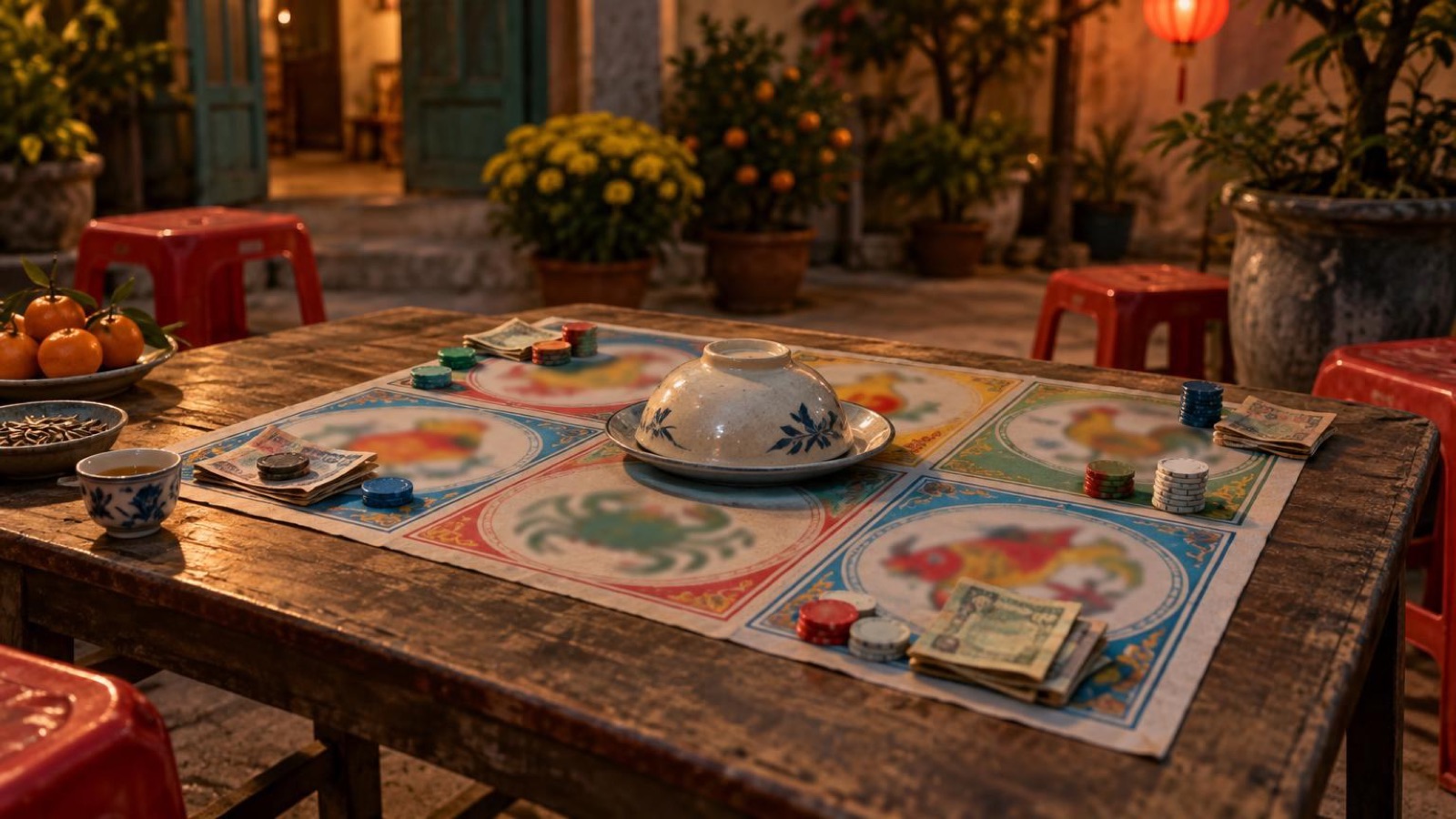
At its heart, though, Bầu Cua Tôm Cá is a home and street game. It needs almost nothing to run: three dice, something to shake them in, and a mat with six pictures on it. That simplicity is why it turns up at family gatherings, markets and especially at Tết, the lunar new year, when it is one of the games people most associate with the holiday. If you are curious about the wider picture of gambling in the country, see our page on gambling in Vietnam.
Equipment: dice, mat and cup
The equipment list is short, which is exactly the point1:
- 3 standard dice, six-sided and numbered 1 to 6, each face printed with one of the six animal symbols
- A betting table or mat with six marked betting positions, one for each symbol
- A dice cup or bowl for shaking and rolling
- Chips or money for betting
Each die face carries one symbol, and the same six symbols are marked on the mat as betting positions1. The standard mapping of die faces to symbols is1:
| Die face | Symbol |
|---|---|
| 1 | Bầu (Gourd) |
| 2 | Cua (Crab) |
| 3 | Tôm (Shrimp) |
| 4 | Cá (Fish) |
| 5 | Gà (Rooster) |
| 6 | Nai (Deer) |
So when a die lands, you read it by its picture, not its number. A roll of 1, 2 and 3 is a gourd, a crab and a shrimp. The mat is usually a cloth or board laid flat in the middle of the table so everyone can reach a betting position, and the banker sits with the dice cup at one end.
Compare this with Xóc Đĩa, another popular Vietnamese game, which needs nothing more than a plate, a bowl and some coins4. Both games share that do-it-anywhere quality, and you can read more about the coin version in our guide to Xoc Dia.
How a round works
A round of Bầu Cua Tôm Cá moves quickly, and the flow is always the same1:
- Betting opens. Players place their chips or money on any of the six symbols on the mat. You can bet on one symbol or spread your money across several. Betting typically lasts 30 to 60 seconds1.
- Betting closes. The banker calls time and accepts no more wagers.
- The shake. The banker puts the three dice in the cup or bowl and shakes them, then rolls them out onto the table where everyone can see.
- The read. The three upper faces are read. Each face shows one of the six symbols, so a roll always produces three symbols, sometimes with repeats.
- The payout. Every player whose symbol appears on at least one die wins. The more dice showing your symbol, the bigger the payout. Players whose symbol does not appear at all lose their bet1.
- Next round. Bets are cleared, and betting opens again.
Because three dice are rolled and each die shows one of six symbols, a single roll can produce anywhere from one to three different symbols. If all three dice land on the same picture, everyone who bet that symbol hits the top payout, and everyone else loses. If the dice show three different symbols, three betting positions get paid and three do not.
There are no decisions to make after you place your bet. Unlike a card game where you choose whether to draw, fold or raise, here the dice do all the talking once the cup goes down. That is what makes the game so fast and so easy for a first-timer to join.
Payouts: 1×, 2× and 3× your bet
The payout structure is the whole game, and it is beautifully simple. It depends only on how many of the three dice show the symbol you backed1:
| Your symbol appears on | You win |
|---|---|
| 1 die | 1× your bet |
| 2 dice | 2× your bet |
| 3 dice (triple) | 3× your bet |
| No dice | You lose your bet |
So if you put 50,000 VND on the shrimp and one die shows Tôm, you get your stake back plus an equal amount as winnings. If two dice show Tôm, you win double your stake, and if all three land on Tôm, you win triple1. The Vietnamese Wikipedia entry on Lắc Bầu Cua confirms the same ratios: the banker pays 1:1 if the symbol appears on one die, 2:1 on two dice, and 3:1 on all three5.
A worked example: you bet 20,000 VND on Cá (fish) and 20,000 VND on Gà (rooster). The dice come up fish, fish and deer. Your fish bet wins 2×, so it pays 40,000 VND in winnings, and your rooster bet loses. Net result: you come out 20,000 VND ahead on the round. If instead the dice had come up fish, deer and deer, your fish bet would pay 1× (20,000 VND winnings) and you would break even overall.
Note that the payout is per die, not per roll. A symbol appearing on two dice pays 2× even though two other symbols also appeared. Every winning position is paid independently, and every losing position is swept.
Some house rule variations change these numbers, and they are worth knowing about before you sit down. A two-symbol combination bet, such as Bầu + Cua, can pay 2 to 3× under local rules. And in some games a triple, all three dice showing the same symbol, pays 5 to 10× the bet instead of the standard 3×1. Always ask the banker what the house pays before the first shake.
The banker's role and rotation
One player acts as the banker, and that role matters more here than in most games. The banker is not just a dealer: the banker covers all bets, meaning every winning wager is paid out of the banker's own money, and every losing wager goes to the banker1.
That cuts both ways. If the dice come up three different symbols, the banker pays three positions and collects from the other three, which usually nets out fine. But if the dice land a triple on a heavily bet symbol, the banker can be paying 3× on a large pile of chips at once. This is why the banker has protections: the banker can refuse a bet if the amount is too high, can set a maximum bet per position, and can refuse bets mid-round if the pot grows too large1.
The banker role does not belong to one person all night. The banker usually changes after every 3 to 5 rounds, or sooner if the banker loses significantly. In casual play, players often simply rotate the banker role around the table so everyone takes a turn at covering the bets1. If you are joining a home game, expect to be offered the cup at some point.
If you take the banker role, keep your bankroll in mind. You need enough cash to cover the worst realistic outcome, which is a triple on the most popular symbol at the table. Setting a maximum bet per position before the first round is the standard way to protect yourself, and no one will think it unusual if you do.
House rules and side bets
Because Bầu Cua Tôm Cá is mostly played in homes and informal settings rather than under a casino rulebook, house rules vary, and it pays to ask about them before you bet. The common variations are1:
- A maximum bet per position, set by the banker, which caps how much anyone can put on a single symbol
- Refusal of bets mid-round if the pot grows too large for the banker to cover
- Higher triple payouts, 5 to 10× instead of 3×, when all three dice show the same symbol
- Combination bets on two symbols at once, such as Bầu + Cua, paying 2 to 3× under local rules
- Side bets on the total sum of the dice, or on odd versus even results, depending on local rules
The side bets deserve a word of caution. In casino table games generally, side bets tend to come with a reduced return to player and a higher house edge than the regular bets, as is the case with side bets in poker variants like Caribbean Stud6. In a home game of Bầu Cua there is no published edge at all; the terms are whatever the house says they are. If a side bet is offered, ask exactly what it pays and on what outcome before putting money down.
The core bets, by contrast, are transparent. You can see the six positions, you know the 1×, 2× and 3× payouts, and the dice are rolled in the open. Stick to those and you always know what you are being paid and why.
Player count, setup and game duration
Bầu Cua Tôm Cá suits 2 to 8 players1. With the minimum of two, one player banks and the other bets, which works but is a thin game; the sweet spot is five or six people betting across the mat while one banks. The mat has six betting positions, so with a full table everyone can reach at least one symbol comfortably.
Timing breaks down like this1:
| Stage | Time |
|---|---|
| Setup before the first round | 2 to 3 minutes |
| Betting per round | 30 to 60 seconds |
| Full game | 10 to 20 minutes |
The game is rated beginner difficulty, which tells you most of what you need to know: there is nothing to memorize beyond six symbols and three payouts, and a new player can join mid-game without slowing anything down1. A session at Tết often runs much longer than 20 minutes, of course, because when one game ends, the loser usually calls for another.
Is it all luck?
Yes, entirely. Bầu Cua Tôm Cá is rated 100 percent luck1. Once the cup goes down, nothing you did in earlier rounds, no pattern you think you have spotted, and no betting system changes how three dice land. Each roll is independent, and the symbols come up as they come up.
This puts the game at the far end of the spectrum from skill games. In poker variants, players win by using skill, strategy and bluffing to make other players fold7, and even in some table games a degree of skill can improve your results. Here there is no such lever. The only decisions you make are how much to bet and where to put it, and neither affects the odds of any given roll.
That is not a flaw; it is the design. A pure luck game with instant resolution is the perfect game for a holiday table, because the person who has played for twenty years and the person watching for the first time have exactly the same chance. If you enjoy games where decisions matter, traditional Vietnamese card games like Tien Len or Tu Sac are the ones to look at instead.
Where the game comes from
In Vietnam itself, the game is woven into everyday play. Simple gambling games that need only a plate, a bowl and some coins, like Xóc Đĩa, have long been part of street and family life4, and card games of the same spirit remain popular across Vietnam and Southeast Asia today8. Bầu Cua Tôm Cá sits in that tradition: minimal equipment, instant results, and a place in the calendar, since it is a game people particularly associate with Tết, the lunar new year, when families gather and the mat comes out.
Who can play
Anyone can learn Bầu Cua Tôm Cá, and as a game played at home among family and friends for small stakes, it is part of normal holiday life in Vietnam. The practical line is money. When the game is played for stakes in public or organized settings, Vietnamese law treats it as gambling, and playing Xóc Đĩa-style games for money, including online, can carry criminal liability in Vietnam4. The safe version is the one most people actually play: coins or small notes among friends, with the banker rotating around the table. For the wider picture of what is and is not allowed, see gambling in Vietnam, and for the casino version of three-dice play, see casino table games in Vietnam.
Quick reference for your first game
If you are about to sit down for the first time, here is everything you need on one card.
The six symbols and their die faces1:
| Die face | Symbol | Vietnamese |
|---|---|---|
| 1 | Gourd | Bầu |
| 2 | Crab | Cua |
| 3 | Shrimp | Tôm |
| 4 | Fish | Cá |
| 5 | Rooster | Gà |
| 6 | Deer | Nai |
The payouts1: your symbol on one die pays 1× your bet, on two dice 2×, on all three dice 3×, and on no dice you lose your stake. Ask first whether this house pays a bonus for triples, since some pay 5 to 10× instead1.
The flow1: betting opens for 30 to 60 seconds, the banker closes it, shakes the cup and rolls the three dice, then pays every winning position and sweeps the rest. A full game runs 10 to 20 minutes.
Before you bet, ask the banker1:
- Is there a maximum bet per position?
- What does a triple pay, 3× or more?
- Are there any side bets, and what do they pay?
- How often does the banker rotate?
Good to know1: the game takes 2 to 8 players, needs only dice, a cup and a mat, is pure luck, and is rated beginner difficulty. If you are asked to bank, set your maximum bet before the first shake, because the banker covers all bets out of pocket.
Common Questions
How many people can play Bầu Cua Tôm Cá?
The game works with 2 to 8 players. One person acts as the banker while everyone else bets on the six symbols, and in casual games the banker role rotates so everyone gets a turn on both sides of the table.
How long does a game of Bầu Cua Tôm Cá take?
A full game usually runs 10 to 20 minutes. Each round is quick: betting takes about 30 to 60 seconds, then the dice are shaken and paid out. Setup before the first round takes 2 to 3 minutes.
Is Bầu Cua Tôm Cá skill or luck?
It is 100 percent luck. The outcome depends entirely on how three dice land after the banker shakes them, so there is no strategy that changes your odds. It is rated as beginner difficulty because the rules take a minute to learn.
What do the six symbols on the dice mean?
Each die face shows one of six symbols: Bầu (gourd), Cua (crab), Tôm (shrimp), Cá (fish), Gà (rooster) and Nai (deer). The same six symbols are marked on the betting mat, and you bet on the one you think will come up.
How long do players have to place bets?
Betting typically lasts 30 to 60 seconds per round. Once the banker closes betting, the dice cup is shaken and revealed, and no more bets are accepted until the next round opens.
Can the banker refuse a bet?
Yes. The banker covers all bets and can refuse one if the amount is too high. A banker may also set a maximum bet per position, or refuse bets mid-round if the pot grows too large.
How often does the banker change?
Usually every 3 to 5 rounds, or sooner if the banker loses significantly. In casual home games players often simply rotate the banker role around the table so no one holds it too long.
Sources8 sources
- Bầu Cua Tôm Cá Rules, Xoviet Poker, 2026
- Sic Bo: How to Play, PlaySmart, 2026
- Sic Bo, Hoiana Resort & Golf, 2026
- Xóc đĩa là loại hình gì? Chơi xóc đĩa online có thể bị truy cứu trách nhiệm hình sự như thế nào?, Thư Viện Pháp Luật, 2023
- Lắc bầu cua, Wikipedia (Vietnamese), 2026
- Caribbean Stud Poker Guide, CoinPoker, 2025
- 7 Card Stud: How to Play, PlaySmart, 2026
- Bài Bửu, Ha Tien Vegas, 2025