
How fan-tan is played: the bowl, the beans and the count
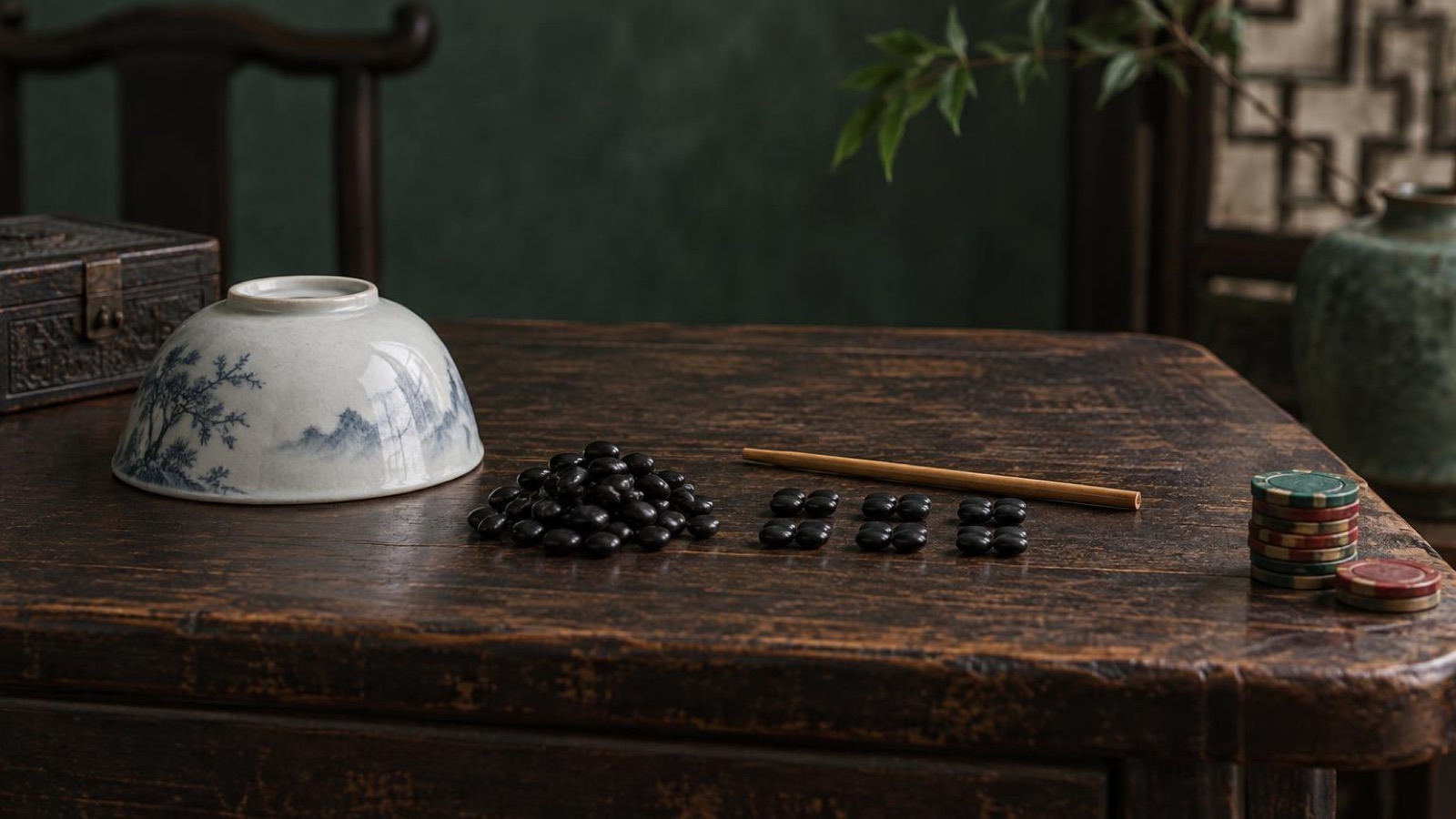
Fan-tan is one of the oldest gambling games still dealt in casinos. It traveled from southern China, where it was played in gambling houses with buttons, dried beans or beads, to the casino floors of Macau, where it sits today next to baccarat and sic bo. The modern casino version keeps the same simple equipment it has always used: a bowl, a cup and a pile of small white beads or buttons1.
The table itself is usually square or hexagonal, with the dealer standing at one side and the betting layout marked with the numbers 1, 2, 3 and 4, often in both Arabic and Chinese numerals. Around the layout are the four bets, fan, nim, kwok and nga, which we cover in the next section.
A round runs like this:
- The dealer sweeps a random handful of beads into the bowl and covers it with an upturned cup, so nobody, including the dealer, knows how many beads are underneath.
- Players place their bets on the layout while the cup sits on the bowl.
- The dealer lifts the cup and begins removing beads with a small bamboo stick or wand, four at a time, flicking each group of four off to the side.
- When fewer than four beads remain, the leftover pile is the result: one bead means 1 wins, two beads means 2, three beads means 3, and four beads means 4.
The count is done in the open, in full view of the players, and the pace is quick. A full round takes well under a minute, which is part of the game's appeal: in a busy Macau pit, fan-tan rounds come as fast as roulette spins. The dealer announces the result, losing chips are swept away, winners are paid, and the next handful of beads goes under the cup.
Because the starting number of beads is unknown and random, every one of the four results is equally likely in the long run. That is the whole mathematical heart of the game, and it is why the payouts are what they are.
The four bets: fan, nim, kwok and nga
The layout offers four bet types, and each is just a different way of covering some of the four numbers. Macau's gaming regulator publishes approved rules for the table games offered in its casinos, and fan-tan's bet structure is fixed across licensed tables, so what you see in one casino is what you see in another2.

Fan (single number). The simplest bet. You choose one number, 1, 2, 3 or 4, and it wins if that number is the final count. It pays 3 to 1. This is the bet most people picture when they think of fan-tan, and it is the one with the biggest payout on the layout.
Nim (two numbers, one main). Nim is a bet on your chosen number plus one adjacent number on the fan-tan cycle, where the numbers run in a circle: 1, 2, 3, 4 and back to 1. If your main number wins, you are paid 3 to 1. If the adjacent number wins, you get your stake back, a push. Nim is a way of softening a single-number bet: you give up nothing on your main number and get insurance against one neighbor.
Kwok (two numbers, equal). Kwok covers two numbers, and either one winning pays the same: 1 to 1. Unlike nim, there is no main number and no push. You simply have two of the four numbers working for you at even money.
Nga (three numbers). Nga covers three of the four numbers. If any of your three wins, you are paid 1 to 3, meaning one third of your stake in winnings. It is the closest thing fan-tan has to a low-risk bet: you win most rounds, but the payout is small.
A quick way to see the family resemblance between the bets: fan is one number at 3 to 1, kwok is two numbers at 1 to 1, and nga is three numbers at 1 to 3. Nim is the odd one out, a hybrid of a single-number bet and a push. The 5% commission on winnings gives the bets different edges: about 3.75% on fan, 2.5% on kwok and 1.25% on nga, which we come to below.
Settlement: piles of four and the result of 1, 2, 3 or 4
The settlement of a round is entirely mechanical, and this is what makes fan-tan easy to follow even if you do not speak the dealer's language. The dealer removes beads strictly in groups of four until the pile left is one, two, three or four beads. That remainder is the number. There is no judgment, no drawing, no decision by the dealer that affects the outcome.
The four numbers sit in a fixed cycle on the layout, 1, 2, 3, 4, and this cycle matters for nim bets, since your "adjacent" number is the next one around the circle. If you bet nim on 2, your adjacent numbers are 1 and 3, and you choose which side to take.
Once the result is announced, the dealer pays the layout in a set order, starting with fan bets on the winning number, then nim, kwok and nga. As at a roulette table, the layout is effectively frozen during settlement: you cannot touch your chips, place new bets or reach for your winnings until the dealer has finished paying everyone3. This is standard table-game practice, and it protects both you and the house from disputes over what was bet and what was won.
If you are playing at a live table, watch the dealer's wand work for a round or two before you bet. The four-at-a-time flick is fast, and once you can see it, the whole game becomes transparent: you can verify the result yourself every round, which is more than you can say for most casino games.
Commission: 5% deducted before payout
Like baccarat, fan-tan takes a commission on winnings rather than building its edge into the odds. The rate is 5%, and it is deducted from your winnings before you are paid. The practice of a house levy on winning bets has a long history in casino games; in the baccarat variant chemin de fer, for example, the rules specify a 5% levy on winnings placed in the cagnotte when the banker wins, and fan-tan's commission works the same way: a slice of the win, not of the stake4.
In practice, the dealer calculates your payout, subtracts 5% of the winnings, and pays you the rest, usually rounding to the nearest convenient chip. A 100 unit fan bet that wins at 3 to 1 earns 300 in winnings, less 15 in commission, so you receive 285 on top of your returned stake.
The commission applies to all four bet types, and it is the reason the true payouts are slightly worse than the headline odds suggest. It is deducted before payment, so the amount handed over at the table is already net of the 5%.
Odds and payouts for each bet type
Because each of the four numbers is equally likely, the odds of the bets follow directly from how many numbers you cover. Here is the full picture:

| Bet | Numbers covered | Wins if | Headline payout | True odds against |
|---|---|---|---|---|
| Fan | 1 | your number is the count | 3 to 1 | 3 to 1 |
| Nim | 2 (one main, one adjacent) | main wins: 3 to 1; adjacent wins: stake returned | 3 to 1 or push | varies |
| Kwok | 2 | either number is the count | 1 to 1 | 1 to 1 |
| Nga | 3 | any of the three is the count | 1 to 3 | 1 to 3 |
Notice that the headline payouts are exactly fair: fan at 3 to 1 against true odds of 3 to 1, kwok at 1 to 1 against true odds of 1 to 1, nga at 1 to 3 against true odds of 1 to 3. The house's entire edge comes from the 5% commission deducted from winnings before payout.
Nim is worth a worked example. Suppose you bet 100 on nim with 2 as your main number and 3 as your adjacent number:
- Result is 2: you win 300, less 15 commission, so you collect 285 plus your stake.
- Result is 3: your stake is returned, nothing won, nothing lost.
- Result is 1 or 4: you lose your 100.
The push on the adjacent number is what makes nim feel different from kwok, even though both cover two numbers. Kwok pays you on either number but never pushes; nim pays fully on one number, pushes on the other, and loses on the remaining two.
For comparison, the fixed odds you see on sports and racing bets are set in advance and locked when the bet is accepted, as Singapore's gambling law defines a fixed odds bet: one where you know, when you make it, the amount you will win5. Fan-tan is the same in spirit: the payout for each bet is printed on the layout and never moves. What changes from round to round is only which number comes up.
Fan-tan and sic bo are not the same game
Fan-tan is often confused with sic bo, because both are Chinese in origin and both sit in the same casino pits in Macau. They are different games. Sic bo is a dice game, an ancient Chinese dice game in which three dice are shaken and you bet on the totals and combinations they show6. Fan-tan uses no dice at all: its result comes from counting beads in groups of four.
The betting experience is similar, though. Sic bo tables have two dealers who exchange chips, monitor the bets and keep the game moving, and fan-tan pits are staffed the same way, with dealers handling the cup, the wand and the payouts6. The etiquette is shared, too: act in a timely fashion when betting, respect other players' time, and be aware of those around you so everyone can place their chips where they want7. If you have played sic bo, you will feel at home at a fan-tan table within a round or two.
The two games also differ in what you can influence, which in both cases is nothing. Every sic bo bet and every fan-tan bet is a pure chance wager. The difference that matters to a visitor is variety: sic bo offers dozens of bets across a crowded layout, while fan-tan offers just four bet types on four numbers, which is precisely why it is the easier game to learn. You can read more about both in our guide to Asian gambling games.
What happens on a network error or video freeze
When you play fan-tan through a live dealer stream or an electronic terminal, the game depends on a video feed and a network connection, and both can fail. Regulators set out what must happen when they do. Under the regulatory framework for gaming venue operations in the Philippines, an operator must declare a game void if there is any malfunction, fault or interruption in the operation of any electronic gaming machine or equipment that affects the outcome of that game, and all wagers on that game are refunded8. The same framework states flatly that any system or machine malfunction voids all plays and pays8.
In practice, this means:
- If the freeze happens before the result is determined and the outcome is affected, the round is void and your stake is refunded.
- If the round was already settled and paid before the error, the settlement stands; you do not get to replay a finished round.
- If you are disconnected but the game continued correctly in the studio, bets you had already placed are settled on the actual result, whether you saw it or not.
The distinction that matters is whether the malfunction affected the outcome. A frozen video stream that merely prevents you from watching a round that completed normally in the studio does not void anything. A fault in the terminal or the game equipment that changes or obscures the result does. If you believe an error affected your bet, note the round number and raise it with the operator immediately; refund rules like the ones above exist precisely for these situations.
Playing fan-tan online vs at a live table
Fan-tan online is almost always the live dealer version: a real dealer in a studio, a real bowl and real beads, streamed to your screen with a betting interface laid over it. Live dealer studios are a licensed, regulated product; Playtech's live dealer suite, for example, is registered as an approved live table game offering, with each game carrying its own identifier in the regulator's register9. The studio version of fan-tan is the same game as the floor version, dealt at the same pace, with the camera doing the traveling for you.
The differences between the two experiences are practical ones:
- Pace. Online rounds are set by the studio's timer, not by the crowd at the table. You get a fixed betting window, which helps if you find a live pit overwhelming.
- Stakes. Online tables often start lower than casino floors, and you can usually see the minimum and maximum before you sit down.
- Social side. The live table has it, the stream does not. Fan-tan pits are noisy, communal places, and part of the game's character is the crowd reacting to the count.
- Verification. At a live table you watch the beads being counted in front of you. Online, you watch the same thing through a camera, which is nearly as good, but the network error rules in the previous section only exist online.
If your interest is broader than fan-tan, our page on playing Asian games online covers how live dealer studios, apps and cash games work across the region.
What to expect on your first round
Fan-tan is one of the friendliest table games in an Asian casino for a first-timer, because there is nothing to learn beyond four bets and nothing to do wrong once you have placed your chips. A few things will make the first round smooth.
Buy your chips at the table, not from the dealer's hand. The convention across table games is that you place your money on the layout and the dealer exchanges it for chips; you never hand money directly to a dealer, and this applies at fan-tan just as it does at sic bo6. State or signal your bet size, put your money down, and take your chips.
Bet during the window when the cup is on the bowl. That is the betting phase of every round. Once the dealer lifts the cup and starts counting, the layout is closed, and once settlement begins, the table is frozen until all winners are paid3.
Start with a fan bet if you want the simplest possible round: one number, 3 to 1, and you will know within seconds whether you won. Start with nga if you would rather win small and often while you watch how the dealer counts. Both are fine first bets, and neither requires any skill.
Collect your winnings before the next round starts. This is a habit worth forming at any table game: pick up your payout as soon as the table unfreezes, or you may find yourself accidentally betting it on the next round6.
Finally, do not look for patterns. Because the number of beads under the cup is random every round, the result of the last round tells you nothing about the next one. Scoreboards in casinos and online studios display recent results, and players study them, but each round is independent. Fan-tan's charm is its simplicity: four numbers, four bets, one count, and a result you can verify with your own eyes every single time.
Common Questions
What is the last pile in fan-tan?
After the dealer removes beads from the bowl in groups of four, the beads left in the very last pile are counted. However many remain, one to four, is the winning number for that round.
How much is the commission in fan-tan?
The house takes a 5% commission, deducted from your winnings before payout. A winning fan bet at 3 to 1 on a 100 unit stake pays 285 rather than 300.
What are the four numbers you can bet on in fan-tan?
Only 1, 2, 3 and 4. Every round ends with one of these four counts, and every bet on the layout is some combination of these numbers.
What is a nim bet in fan-tan?
Nim is a two-number bet. You pick your main number and one adjacent to it. If your main number wins you are paid 3 to 1; if the adjacent number wins you get your stake back.
What is the difference between kwok and nga?
Kwok covers two numbers and pays 1 to 1 if either wins. Nga covers three numbers and pays 1 to 3, one third of even money, if any of the three wins.
What happens if the video freezes during a fan-tan game?
If a malfunction or interruption affects the outcome, the game is declared void and all wagers on that round are refunded. Bets already settled before the error stand.
Sources9 sources
- Chinese Games with Dice and Dominoes, Smithsonian Institution, 1893
- Craps game rules, Gaming Inspection and Coordination Bureau of Macao
- Roulette: how to play, PlaySmart, 2026
- Ministerial Order of July 26, 1988, Journal Officiel de Monaco, 2021
- Gambling and Control Act 2022, Singapore Statutes Online, 2023
- Sic bo: how to play, PlaySmart, 2026
- Sic bo etiquette, PlaySmart, 2026
- Regulatory Framework for Gaming Venue Operations, Philippine Amusement and Gaming Corporation, 2025
- Playtech Live approved game kit, Philippine Amusement and Gaming Corporation, 2026















