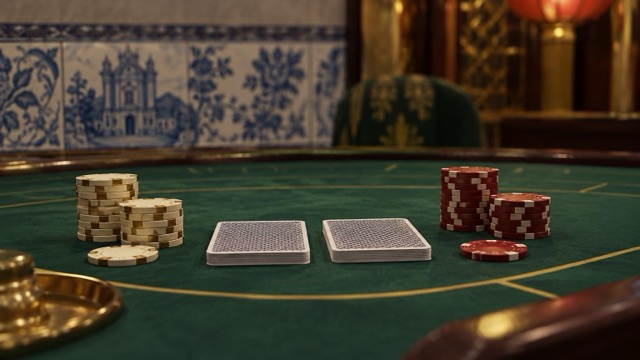
Walk through any large casino floor in Macau, Manila, Da Nang or Incheon and the biggest cluster of tables will almost always be baccarat. It is typically the only game offered in VIP rooms and the preferred game among Chinese players, and on the mass floor it comes in more flavors than any other table game5. This page explains the variants you will actually meet in Asia: how a round works, what the standard game pays, what changes in the no-commission versions, what the squeeze is, and what the side bets on the felt are for. For the full rules of the base game, see baccarat rules.
What baccarat is and how a round works
Baccarat, also known as punto banco, is one of the oldest and most widely played casino games in the world, and it is especially popular among high-rollers and Asian gamblers6. Despite the ceremony around it, the game itself is a simple guessing game: you bet on which of two hands will win, and the hand closest to a total of 9 points wins1.
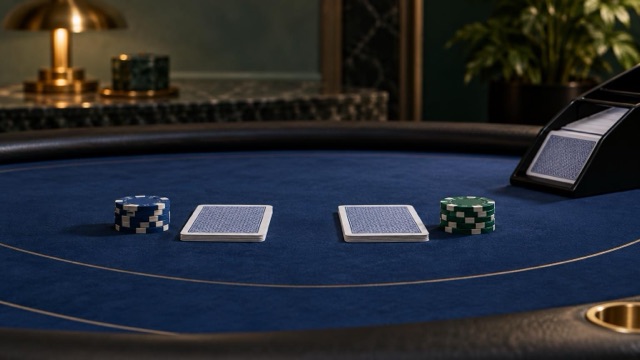
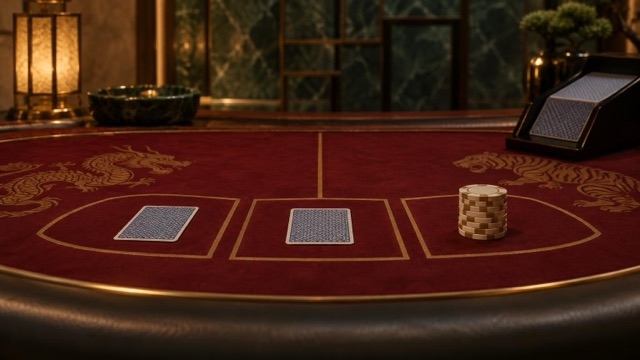
No matter how many players are at the table, only two hands are dealt: the Player's and the Banker's7. Once bets are placed, four cards come out: two for the Player box and two for the Banker box. Each hand then either stands or takes one more card according to fixed rules the dealer applies. Neither hand ever gets more than three cards1.
There are three possible outcomes: Player wins, Banker wins, or Tie7. In the event of a tie, neither hand wins or loses, and Player and Banker bets are typically returned. All bets must be placed before the cards are dealt; there is no betting once the round has started8.
You are not betting "against the house" in any meaningful sense, and you are not playing the Banker's hand yourself. The two names are just labels for the two hands. You pick one, and the dealer does everything else. That is why the game moves so fast and why it suits both a 10-unit minimum table and a private room with enormous stakes.
Card values and the nine-point limit
The point system is short enough to learn in a minute:
- Cards 2 through 9 count at face value9
- 10, jack, queen and king count as 09
- Aces count 110
- If a hand's total exceeds 9, only the rightmost digit counts: a total of 12 becomes 2, and 25 becomes 58
The highest possible point total for a hand is nine, and the maximum number of points in both hands is 99. A two-card 9 is the best hand you can start with, and a two-card 0 is the worst.
The drop-the-first-digit rule is what makes baccarat feel different from blackjack. There is no "busting." A hand of 7 and 8, worth 15 in any other context, is simply a 5 in baccarat. Every hand lands somewhere between 0 and 9, and the comparison is always clean.
The third card rules, in brief
You never decide whether a hand draws. The rules, called the tableau, are fixed and the dealer applies them automatically.
Player's hand: on any total from 0 to 5, the Player draws a third card, unless the Banker has 8 or 9. The Player always stands on 6 or 7, and on 8 or 9 the hand is a natural win with no additional cards drawn7.
Banker's hand: when the Player stands on 6 or 7, the Banker draws a third card on totals of 0 to 5 and stands on 6 or 711. When the Player draws, the Banker's action depends on the Player's third card:
| Banker total | Draws if Player's third card is | Stands if Player's third card is |
|---|---|---|
| 0, 1, 2 | any card | never |
| 4 | 2, 3, 4, 5, 6, 7 | 0, 1, 8, 9 |
| 5 | 4, 5, 6, 7 | 0, 1, 2, 3, 8, 9 |
| 6 | 6, 7 | 0, 1, 2, 3, 4, 5, 8, 9 |
| 7 | never | always |
A natural ends everything: if either hand totals 8 or 9 on the first two cards, the game is over, the bets are paid and no further cards are dealt1. If either the player or banker has a natural 8 or 9, both hands automatically stand, no exceptions12. You do not need to memorize any of this to play; the dealer runs the tableau. But knowing why a hand suddenly stopped at two cards saves a lot of head-scratching at the table.
Standard baccarat payouts and the 5% Banker commission
In standard baccarat, the payouts are simple:
- Player wins: paid 1 to 19
- Banker wins: paid 1 to 1, but the house charges a 5% commission on any winning Banker bets2
- Tie: paid 8 to 19
The commission exists because the Banker hand wins slightly more often than the Player hand. Without the fee, everyone would bet Banker and the house would have no edge on it. The 5% commission, taken from the amount won on Banker each coup, is the price of betting the better side2.
In practice the dealer tracks commission with markers next to your betting spot and settles up when you leave the table or cash out. At high stakes it is settled in chips on the spot: one Vietnamese casino's rules describe the dealer calling "Bet is $24,000, pay $23,000, and get $200"13. A 100-unit Banker bet that wins pays 95 in winnings, not 100.
The commission rate is not universal. One Las Vegas casino, the D, used to offer a 4% commission Banker bet, though it no longer does14. In Asia, 5% is the standard you will find on almost every commission table.
No-Commission Baccarat: the Banker-6 catch
No-commission baccarat does exactly what the name says: it drops the 5% fee on winning Banker bets. But the house does not give up its edge for free. The catch is a single rule: when the Banker wins with a total of 6, winning Banker bets are paid at 1 to 2, meaning half3. When the Banker wins with any other total, winning bets are paid even money and no commission is taken3.
So a Banker bet that wins on 7, 8, 9 or any total other than 6 pays full even money. A Banker win on exactly 6 pays half: a 100-unit bet returns 50 in winnings plus your stake. Every operator that publishes rules for this game states it the same way. Hoiana's rules say a winning Banker wager is paid 50% when the Banker wins on 615. Nustar Resort and Casino in Cebu describes its Non-Commission Baccarat as a game dealt and played like normal baccarat wherein banker bets are paid half when the banker wins on 6 points16. Paradise City near Incheon offers both options on the same floor: commission, where a banker win pays after 5% commission, and no commission, where a banker win with 6 pays only 50% of the banker bet and otherwise nothing is deducted17.
The variant travels under several names. EZ baccarat follows the same rules as mini-baccarat except there are no commissions on winning Banker wagers9. Some Asian casinos call it Super Six, because the Banker-6 rule is the heart of the change; one Vietnamese operator describes Super Six as no commission on the banker's hand, with the banker paying half when it wins on 6 points13. Whatever the sign on the table says, the mechanic is the same: no fee, but a half payout on one specific outcome.
House edge compared: standard vs no-commission
Here is the honest comparison. The figures below are the ones the operators themselves publish.
City of Dreams Manila lists its Non-Commission Baccarat house edge at 1.35%18, and its No Commission Baccarat rules list the Banker bet at 1.46%3. Either way, the no-commission Banker bet costs you more per unit wagered than the standard 5%-commission Banker bet at roughly 1.06%18. A University of Macau study of the territory's gaming industry puts the standard figure at about 1.06 percent on banker bets5.
The practical takeaway: no-commission baccarat is not a better deal, it is a more convenient one. You never wait for commission to be settled, and the game moves faster. But the half payout on Banker-6 wins more than replaces the 5% fee. If you are choosing a table purely on cost, the standard commission game has the lower edge on the Banker bet. For a broader comparison across games, see casino house edge.
The squeeze and Super Six tables
Two more things vary from table to table in Asia: who turns the cards over, and how the round is presented.
The squeeze. At a squeeze table, the cards are dealt face down and the players reveal them. The players with the highest wagers on each of the Player and Banker hands are given the cards to squeeze, touch or hold2. The ritual is a big part of baccarat's appeal in Asia: the highest bettor slowly bending, peeking at and finally flipping the card builds the drama the game is famous for. Paradise City in Incheon offers tables in combinations of commission/no commission and no squeeze/all card squeeze, so you can pick both settings at once17.
Squeeze tables have a seating rule attached. Hoiana's rules state that you must be seated at the table to view the cards, while standing players can still place wagers10. So if you want to watch the reveal up close at a squeeze table, you need a seat; if you just want to bet, you can stand.
Super Six. The name "Super Six" is used two ways in Asia. As noted above, some casinos use it for their no-commission baccarat, since the Banker-6 rule is what defines the game13. At other properties it appears as a side bet on the Banker winning with 6, paid at 11 to 113. Check the sign at the table or ask the dealer which version you are looking at.
Side bets: Pairs, Super Tie, Lucky 6 and Tigers
The marked circles around the main Player, Banker and Tie boxes are side bets. At casinos that publish their rules, players may place side wagers without having placed a wager on Player or Banker, and may place several wagers on the same hand3. They win or lose on their own conditions regardless of which main bet you made.
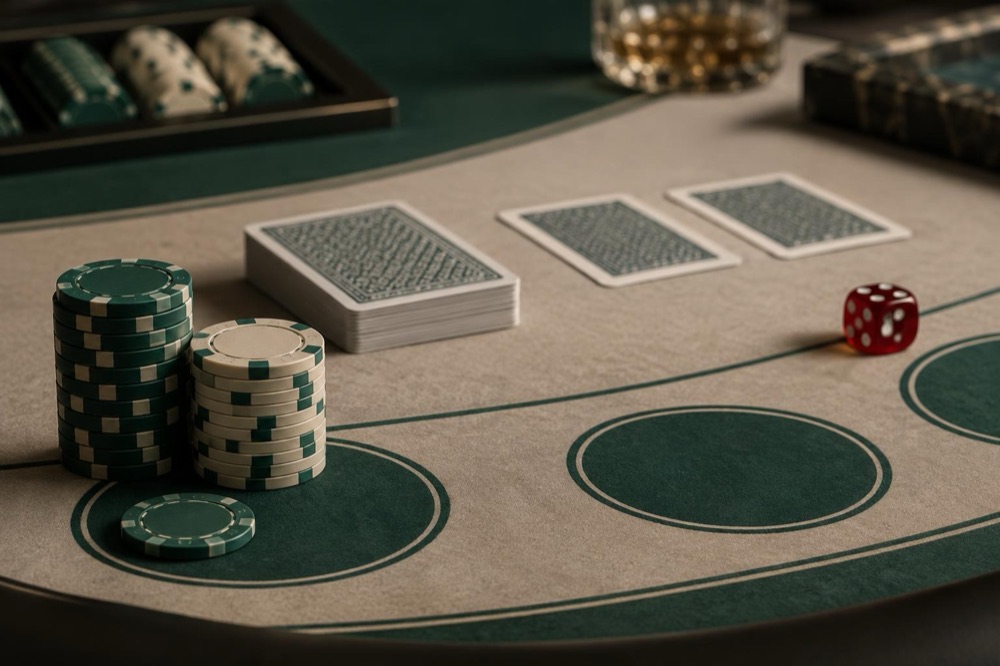
The menu at City of Dreams Manila's No Commission Baccarat gives a full picture of what one table can carry: Player, Banker, Player Pair, Banker Pair, Super Tie, Lucky 6, Small Tiger, Big Tiger, Lucky 7 and Super Lucky 73. The common ones:
Pairs. A Player Pair wager wins if the first two cards dealt to the Player constitute a pair, and Banker Pair works the same way for the Banker's first two cards10. Pairs typically pay 11 to 111, and City of Dreams lists the house edge on Player Pair and Banker Pair at 10.36% each3.
Lucky 6. This one wins if the Banker wins on a total of 6. Hoiana pays 2 to 1 if the Banker wins with a two-card 6 and 20 to 1 with a three-card 611; City of Dreams pays 12 to 1 with two cards and 20 to 1 with three cards3. Check the felt, because the two-card payout varies by property.
Super Tie. A boosted version of the Tie bet, listed at a 16.51% house edge at City of Dreams3. The plain Tie bet pays 8 to 19, with a house edge around 14.36%9, making it the worst of the three main bets.
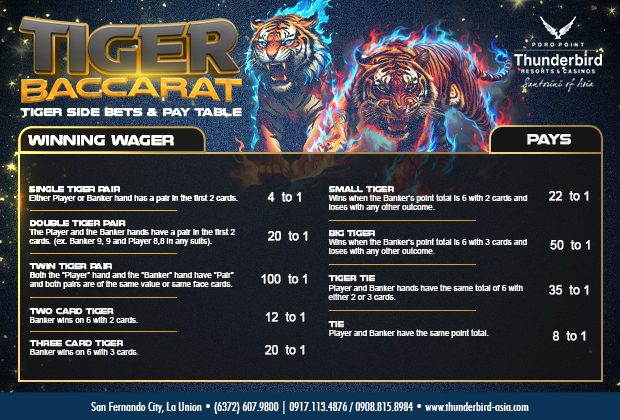
Tigers. Tiger Baccarat, dealt at Okada Manila as a non-commission variant, carries six side bets19, with odds running up to x10020. The published payouts: Tie pays 8 to 1, Tiger Tie pays 35 to 1, Single Tiger Pair pays 4 to 1, and Twin Tiger Pair pays 100 to 14. Big Tiger carries a 15.25% house edge at City of Dreams3.
Dragon Tiger baccarat. A related no-commission game at Hoiana pays the Banker 1 to 2 when it wins on 6 points, 1 to 1 on other points, and the Player 1 to 1, with a Tie side bet at 8 to 121. It plays like a stripped-down baccarat; see dragon tiger rules for that game in full.
Side bets share one trait: every one of them carries a house edge far above the roughly 1.06% you pay on a banker bet in the main game. The payouts are the draw: a tie pays 8 to 1, a Single Tiger Pair pays 4 to 1, a Tiger Tie pays 35 to 1, and a Twin Tiger Pair pays 100 to 13. They are there for the payout ceiling, not the value.
Where the variants are dealt in Asia
Baccarat dominates the region's floors, and the variants are spread across it.
Macau. Baccarat is typically the only game offered in VIP rooms and is the preferred game among Chinese players5. Commission baccarat remains the default in the VIP setting, with no-commission and side-bet-heavy versions on the mass floor.
The Philippines. City of Dreams Manila runs Traditional Baccarat22 alongside No Commission Baccarat with the full side-bet menu3, and publishes its house edges for both18. Nustar Resort and Casino in Cebu deals Non-Commission Baccarat16. Okada Manila offers Tiger Baccarat as a non-commission variant with its six side bets19.
Vietnam. Hoiana Resort & Golf near Hoi An deals both Traditional Baccarat and No Commission Baccarat, with betting limits displayed at each table23. Corona Casino in Phu Quoc publishes baccarat rules including the Super Six no-commission payout13.
Cambodia. Ha Tien Vegas, on the border near Ha Tien, runs baccarat tables with the standard 5% commission on Banker wins24 and publishes a full beginner's guide to the game for its guests25.
South Korea. Paradise Casino's game guide describes baccarat with Player, Banker and Tie wagers, all wagers within the table's posted limits26, and Paradise City offers tables in combinations of commission or no commission and squeeze or no squeeze17.
Wherever you play, the practical checklist is the same: read the sign at the table, which tells you the game type, the minimum and maximum bets, and whether it is a commission or no-commission table. If the sign says "no commission," look for the Banker-6 rule, because it is always there. And if the table is quiet and the cards are face down, you have found a squeeze table, and you will need a seat to watch.
One last thing worth knowing: baccarat is a straightforward game of pure chance27. There is no strategy that changes the outcome of a round, because every decision after you place your bet is made by fixed rules. The only choices that matter are which table you sit at and which bets you place, and now you know how those differ.
Common Questions
Why is there a commission on Banker bets at all?
The Banker hand wins slightly more often than the Player hand, so without a fee it would be the better bet every time. The 5% commission brings the payout back in line so the house keeps its small edge. No-commission versions restore the balance differently, by cutting the payout when Banker wins with a 6.
Is no-commission baccarat better than standard baccarat?
Not really. Standard baccarat with the 5% commission has a Banker house edge of about 1.06%, while typical no-commission versions run around 1.35% to 1.46% because of the half-payout on Banker-6 wins. No-commission is simpler to settle at the table, but it is not cheaper to play.
What happens if Banker wins with a 6 in no-commission baccarat?
You get half your money back. A winning Banker bet is paid at 1 to 2 instead of even money, so a 100 chip bet returns 50 in winnings plus your stake. On every other Banker win you are paid even money with no commission taken.
What is a natural in baccarat?
A natural is a two-card hand totaling 8 or 9. If either hand has one on the first two cards, the round ends immediately, no further cards are dealt, and the bets are settled. A natural 9 beats a natural 8.
How much does the Tie bet pay and what is its house edge?
The Tie bet pays 8 to 1 when both hands finish on the same total. That sounds generous, but ties are rare, and the house edge is around 14.36%, far higher than the roughly 1% on Player and Banker. It is the worst of the three main bets.
Can you place side bets without betting on Player or Banker?
Yes. At casinos that publish rules for these games, including City of Dreams Manila and Hoiana, players may place side wagers without a Player or Banker bet, and may place several side wagers on the same hand. Side bets stand or lose on their own conditions.
Do you have to be seated to see the cards?
At squeeze tables, yes. Hoiana's rules, for example, state that you must be seated at the table to view the cards, while standing players can still place wagers. At standard tables the cards are turned over by the dealer and everyone can see them.
Is baccarat a game of skill?
No. It is a game of pure chance. You choose where to put your money, but every card after that follows fixed drawing rules, and no decision you make changes the outcome. The only skill is picking the bets with the lowest house edge.
Sources27 sources
- How to play baccarat, PlaySmart, 2026
- Baccarat how to play details, PlaySmart, September 2026
- No Commission Baccarat, City of Dreams Manila, September 2026
- Tiger Baccarat, Thunderbird Asia, March 2026
- The Transformation of Macao's Gaming Industry, University of Macau Repository, February 2026
- Baccarat, Wizard of Odds, 2026
- Baccarat how to play, PlaySmart, 2026
- Baccarat, Natural8, September 2026
- Baccarat, GameSense, 2025
- Baccarat, Hoiana Resort & Golf, 2026
- Baccarat, Hoiana Resort & Golf, 2026
- House rules, GGPoker, March 2026
- Bài Cào, Corona Casino, September 2026
- Baccarat basics, Wizard of Odds, February 2017
- 百家乐, Hoiana Resort & Golf, 2026
- Baccarat, Nustar Resort and Casino, June 2026
- Casino game guide, Paradise City, September 2026
- House edge, City of Dreams Manila, September 2026
- バカラ, Okada Manila, January 2024
- 百家乐, Okada Manila, January 2024
- 龙虎百家乐, Hoiana Resort & Golf, 2026
- Traditional Baccarat, City of Dreams Manila, September 2026
- Baccarat, Hoiana Resort & Golf, 2026
- ការលេង Baccarat នៅ Ha Tien Vegas, Ha Tien Vegas, March 2026
- Mastering baccarat at Ha Tien Vegas, Ha Tien Vegas, September 2026
- Casino game manual, Paradise Casino, September 2026
- Table games, GameSense, 2020