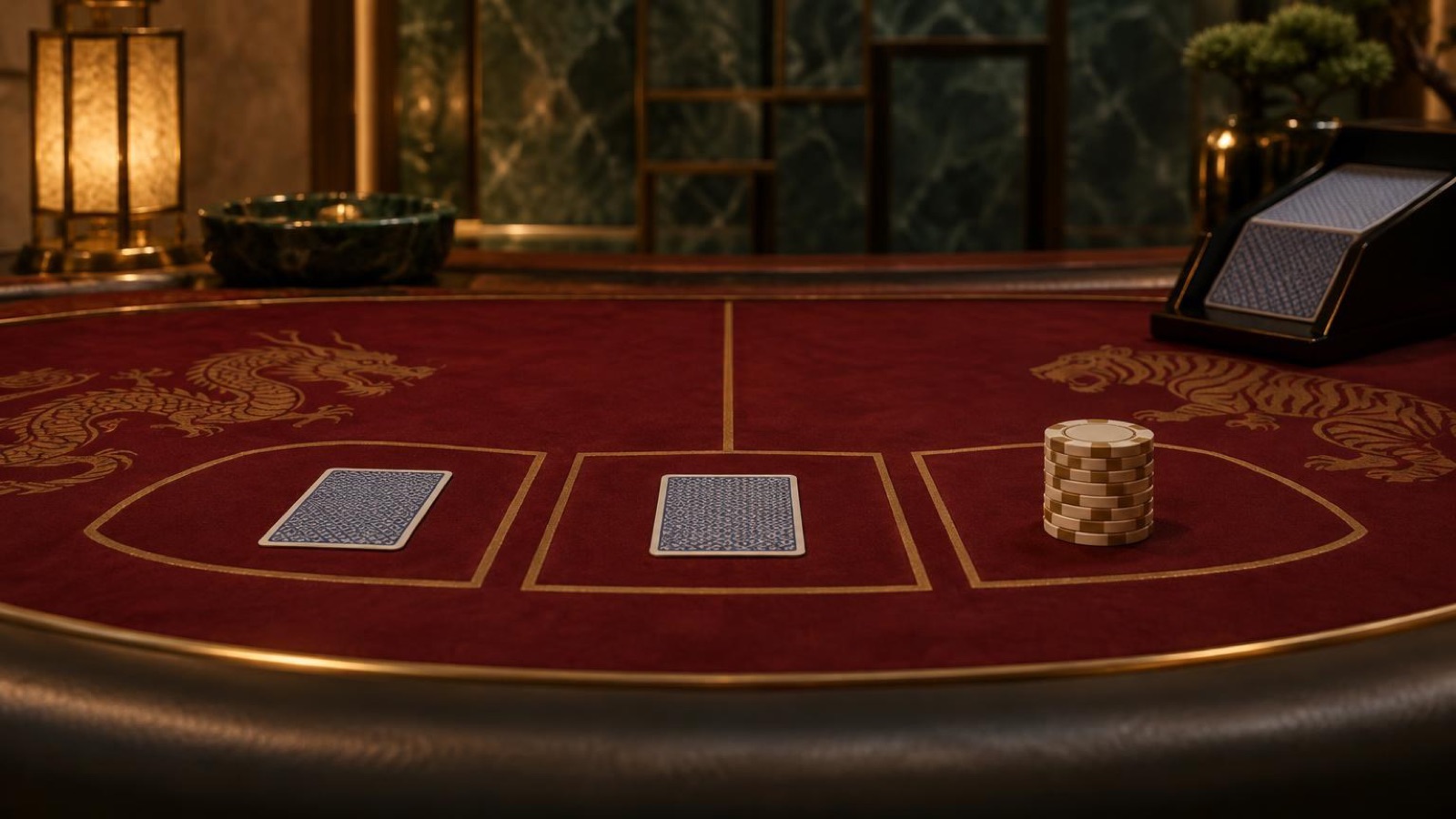
What Dragon Tiger is and how a round works
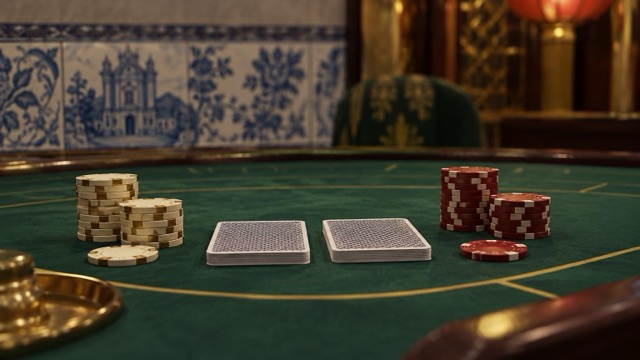
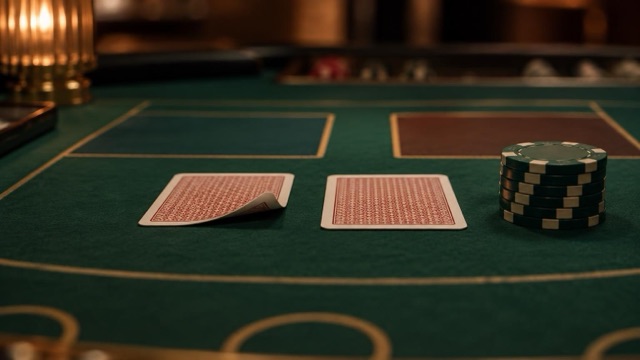
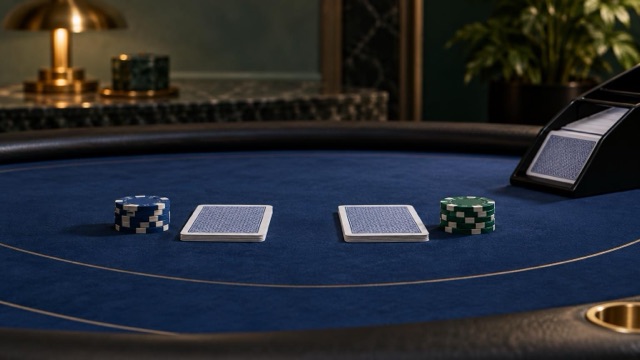
Dragon Tiger is one of the simplest card games in the casino. The table has two betting positions, Dragon and Tiger. The dealer takes one card from the shoe and places it face up in the Dragon box, then takes a second card and places it in the Tiger box. Whichever card is higher wins, and the bets on that side are paid. That is the whole game: no hits, no draws, no decisions for the player to make1.
If you have played Casino War, you already know the shape of it. In Casino War the player and the dealer each get one card and the higher card wins, with Aces ranking highest and suits not mattering; Dragon Tiger works the same way, except you are betting on two positions rather than playing a hand yourself1.
A round runs quickly. You place your chips on Dragon, Tiger or Tie while the betting area is open. Once the dealer announces that betting is closed, no further bets are accepted and the stakes on the table cannot be changed or removed; this closing call is a firm rule in Asian table games, and the result only counts once the procedure is complete2. The dealer then reveals the two cards, the higher side wins, losing bets are swept away and winning bets are paid at the posted odds. Because only two cards are involved, the whole thing is over in seconds, which is exactly why the game is popular with players who find baccarat's third-card rules too slow.
Card rankings: the two variants you will meet
In the classic game the ranking is simple: Ace is the highest card, then King, Queen, Jack, Ten down to Two, and the suit makes no difference at all. This ace-high, suits-irrelevant ranking is the same one used in Casino War, where Aces are the highest value cards and suits, whether hearts, diamonds, spades or clubs, do not matter1. Pai gow poker uses the same idea, scoring no-pair hands with Aces high3.
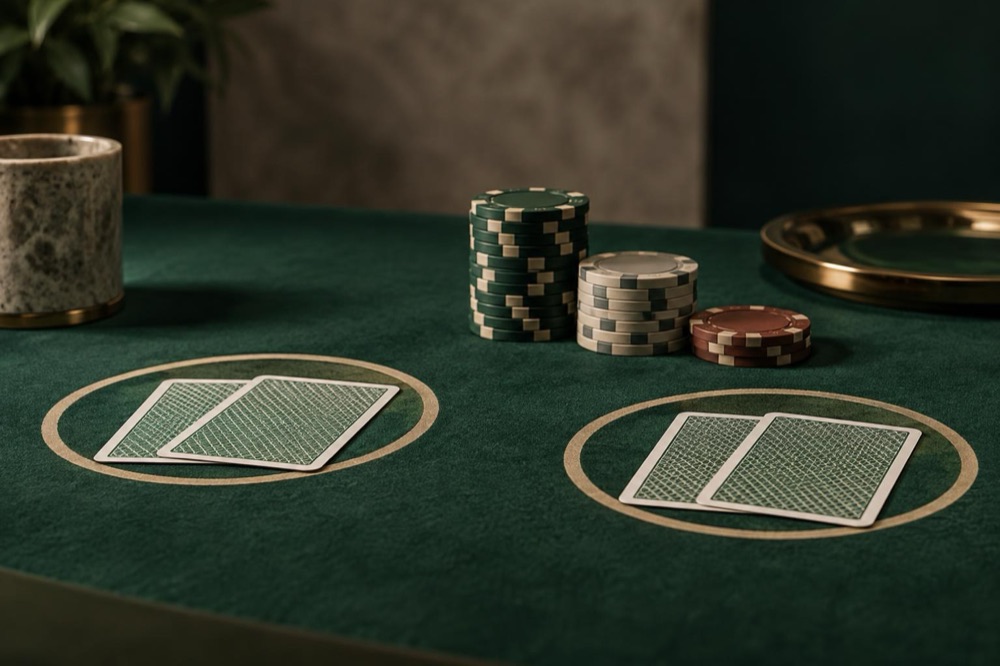
The second variant you may meet is not a different ranking of the cards but a different game wearing the same name. Dragon Tiger Baccarat, offered at Hoiana in Vietnam, deals four cards to each side and adds up their points, with picture cards and Tens worth zero, exactly as in baccarat. In that game the ranking question is not "which card is higher" but "which total is higher," and the Ace counts as one point rather than as the top card4. So before you sit down, check whether the table in front of you is the one-card game or the four-card game, because the strategy of just picking a side does not carry over.
A note on Aces elsewhere: in poker-style games an Ace can be part of a qualifying hand, as in Caribbean Stud Poker where the dealer must hold an Ace and a King or better to qualify, and in the older Casino Stud Poker where the banker needed the same Ace-King minimum5. That has no bearing on Dragon Tiger, but it explains why some players arrive at the table with the idea that Ace-King is a special combination. Here it is not. Ace simply beats King.
The three bets: Dragon, Tiger and Tie
There are only three bets in the classic game, and you will see all three marked on the felt.
- Dragon. You are betting that the card in the Dragon box will be higher. It pays even money.
- Tiger. You are betting that the card in the Tiger box will be higher. It also pays even money. The two sides are symmetrical: neither has an inherent advantage over the other, which is why both pay the same.
- Tie. You are betting that the two cards will be of equal rank. This is the long-shot bet, and it pays much more than even money: 8 to 1 in most casinos, though some tables pay 10 to 17.
The tie is where the casino makes its money on this game. In Casino War, a close cousin, the same structure appears: the player's card ties the dealer's card and the tie bet pays 10 to 1 in the Macau rules for that game1. In baccarat, the tie bet almost always pays 8 to 1, which casinos often express as the equivalent of 9 for 1, and the same convention has carried over to Dragon Tiger9.
Some tables add pair-style side bets. In baccarat, Player Pair and Banker Pair bets win at 10 to 1 when the first two cards on that side form a pair9, and Dragon Tiger Baccarat at Hoiana offers a similar pair bet decided by the first four cards dealt, where a pair means two cards of the same rank or same-suit court cards4. If your table offers these, treat them as separate wagers with their own odds, not as part of the main Dragon or Tiger bet.
Payouts: 1:1 on Dragon or Tiger, up to 8:1 or 10:1 on Tie
The headline payouts are easy to remember.
| Bet | What must happen | Typical payout |
|---|---|---|
| Dragon | Dragon card is higher | 1 to 1 |
| Tiger | Tiger card is higher | 1 to 1 |
| Tie | Both cards are equal rank | 8 to 1, sometimes 10 to 1 |
The 8 to 1 tie payout is the standard: playsmart's baccarat guide gives 8 to 1 for a winning tie bet, and Wizard of Odds notes that almost all casinos pay 8 to 1 on a tie, often expressed as 9 for 17. The 10 to 1 version exists too: Casino War's tie bet pays 10 to 1 when the player's and dealer's cards are equal under the Macau rules, and Casino War's standard rules pay winning Tie Bets at 10 to 1 as well1. Historically, tie payouts have ranged even wider: Macau's Makccarat rules once allowed either 14 to 1 or 9 to 1 on the tie depending on the alternative chosen, and some online casinos have paid 9 to 110. Because the tie payout varies from table to table, it is the one number printed on the felt or the screen that differs most between versions of the game.
The price of the attractive tie payout is a much higher house edge than on the main bets. The 6.385 percent figure that Wizard of Odds quotes for a 9 to 1 tie applies to baccarat dealt from a single deck, not to Dragon Tiger9. In Dragon Tiger each side receives just one card, so equal ranks turn up roughly once in every thirteen rounds, and a 9 to 1 payout on that frequency leaves a house edge near 23 percent, far worse than the baccarat number. Compare that with the roughly 2 to 3.5 percent house edge of poker played optimally, or the 5.3 percent of roulette, and you can see where the tie sits: it is a long-shot bet priced like one12.
A commission version also exists. At Hoiana, the Commission Dragon Tiger Baccarat table pays the Banker side at 0.95 to 1, that is, a 5 percent commission, while the Player side pays the full 1 to 14. This mirrors commission baccarat, where the Banker win carries a 5 percent charge. If you are playing a commission table, the payout you receive on a winning Banker or Dragon bet will be slightly less than your stake again.
Equipment and dealing: 6 to 8 decks, one card each
Dragon Tiger is a shoe game. The cards are standard 52-card decks without jokers, the same deck used by games like Pok Deng and Liêng13, and multiple decks are shuffled together and placed in a dealing shoe, with a cutting card marking the point at which the shoe is reshuffled.
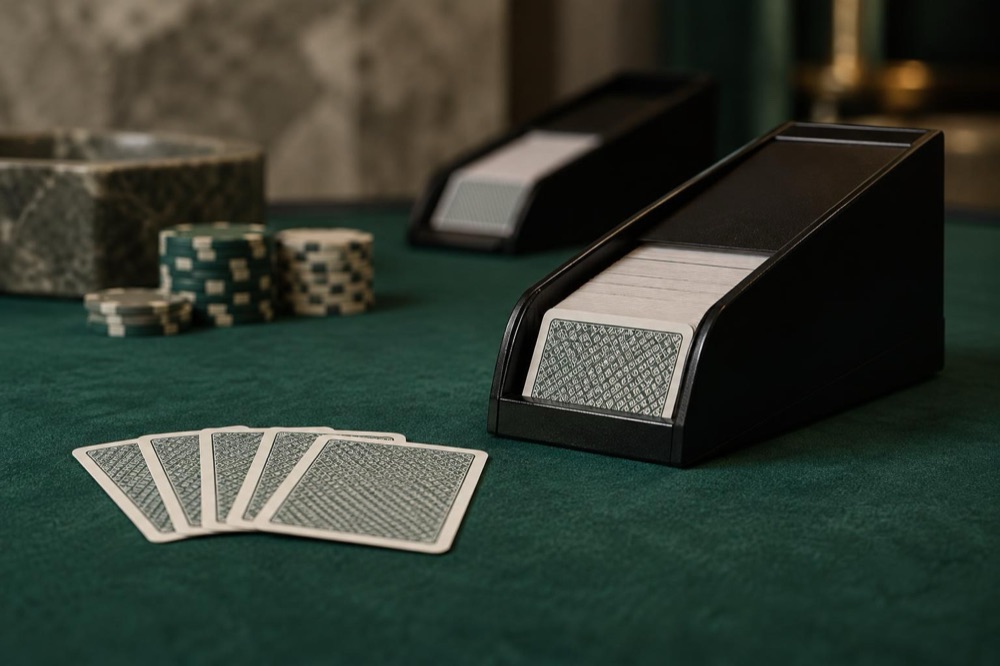
The number of decks follows the conventions of the shoe games around it. Baccarat is usually dealt from eight decks9. Macau's rules for card games such as Fortune 8 allow one to eight decks of 52 cards, together with a dealing shoe and cutting card, an automatic shuffling and dealing machine or a shuffling machine, and a table with seven or more seats15. Blackjack variants show the same flexibility: Super Fun 21 is dealt with one, two or six decks16. In practice you will meet Dragon Tiger dealt from a shoe in the same six-to-eight-deck range as baccarat, and the exact count is usually posted or available from the dealer on request.
The dealing itself could not be simpler: one card to Dragon, one card to Tiger, both face up. There is no burn-card ritual to learn, no squeeze, no third-card chart. In Dragon Tiger Baccarat at Hoiana, by contrast, four cards are dealt to each side and up to three additional cards may be drawn per side according to a supplement-card rule table, which makes it a much longer game4.
Dragon Tiger Baccarat: a different game with the same name
If you see "Dragon Tiger Baccarat" on a sign, you are looking at a different game from the one-card Dragon Tiger. Hoiana, the integrated resort near Hoi An in Vietnam, spreads it, and its rules make clear how far it has moved from the original4.
In Dragon Tiger Baccarat, four cards are dealt to each side, and the hands are scored by point totals with a supplement-card rule table that can add up to three more cards per side. If the first two cards of either side total 8 or 9, that is a Natural: the higher total wins and equal totals are a tie, just as in punto banco4. The first four cards dealt also decide the Player Pair and Banker Pair results, where a pair means two cards of the same rank or same-suit court cards4.
The game also carries a distinctive side bet called Dragon Tiger, which is where the name gets confusing. That side bet wins if the Player beats the Banker with 7 points against 6, and it pays according to how many cards were used in the round: 100 to 1 with six total cards, 40 to 1 with five, and 30 to 1 with four4. So inside the game named Dragon Tiger Baccarat there is a bet named Dragon Tiger, and neither is the classic one-card game. If you want the simple version, ask the floor staff whether the table is one-card Dragon Tiger before you buy in.
Is Dragon Tiger the same as baccarat?
No, and the differences matter for how you play.
Classic baccarat, or punto banco, deals two cards to a Player hand and two to a Banker hand, and then follows a third-card rule that determines whether either side draws. The Dragon 7 side bet in baccarat, for example, pays 40 to 1 when the Banker wins with a three-card total of 7, and when it hits, all bets on the Banker hand are pushed and returned17. The Dragon Bonus side bet pays on the margin of victory: 20 times the stake for a 9-point winning margin, down to 1 time for a 4-point margin, and it pushes on a winning natural17. None of that machinery exists in one-card Dragon Tiger. There are no point totals, no third-card rule, no naturals, no side bets on margins.
What the two games share is the even-money structure and the tie bet. Baccarat's Player and Banker bets pay 1 to 1 (with commission on Banker), and its tie pays 8 to 1, exactly the pattern Dragon Tiger uses9. Dragon Tiger is best understood as baccarat stripped down to a single card per side: same bets, same payouts, no drawing rules. That makes it faster and easier to learn, but it also removes every decision the player could make. In baccarat you at least choose Player or Banker with different odds structures; in Dragon Tiger the two main bets are identical, and the only real choice is whether to pay for the long shot on the tie.
Betting limits and round speed
Every table posts its own minimum and maximum bets, and the posted limits are binding: in Macau's Dragon-Phoenix rules, for instance, bets must respect the table's posted minimum and maximum, and once betting closes the stakes cannot be changed or removed2. For an idea of scale at the regulatory level, a 2010 Finance Ministry draft decree in Vietnam proposed a pilot betting scheme with stakes of no more than VND 1,000,000 per player per day, though this was only a proposal for sports betting rather than a limit in force on casino tables19.
Round speed is Dragon Tiger's selling point. With one card per side, a round takes seconds once betting closes. Compare the card games around it: Liêng runs 2 to 5 minutes per round14, Pok Deng about 5 minutes for a typical hand20, and even the Japanese Tehonbiki dice game settles a contest in around 2 minutes21. Dragon Tiger is faster than all of them, which means you will see many more decisions per hour, and your money will move faster too. That is worth planning for: set a daily budget and a time limit for your play and stick to it, which is the standard advice from responsible-play programs, and it applies doubly at a fast table22.
Where to play Dragon Tiger
In Asia, the game appears in two main settings.
Casino floors. Integrated resorts across the region spread Dragon Tiger alongside baccarat and the other shoe games. Hoiana in Vietnam is a documented example, offering Dragon Tiger Baccarat among its table games4. In South Korea, Seven Luck Casino Seoul Dragon City markets itself as a special experience in the center of Seoul, and the Seven Luck casinos are exclusively for the use of foreigners, so Korean citizens cannot play there23. When you visit any Asian casino, the table-games directory or the floor staff will tell you whether one-card Dragon Tiger is spread; see our guide to casinos and integrated resorts in Asia for what to expect inside.
Licensed live dealer studios. In the Philippines, PAGCOR's license register lists live dealer Dragon Tiger products, including Live Dragon Tiger and Beton Dragon Tiger Live, approved as live dealer table games25. These are the tables you see streamed online under Philippine licenses. PAGCOR also publishes lists of licensed operators and rules for how its online systems connect players to venues, including a requirement that a registration system offer the player a list of the five nearest gaming venues to their indicated address26. If you play the live version, the rules and payouts are the ones described above, displayed on screen.
For the practical side of a first visit, buying chips, table minimums and dress codes, see our pages on casino table limits and casino dress codes. If Dragon Tiger's simplicity appeals but you want a game with more texture, our guides to baccarat rules and Asian table games cover the alternatives you will find on the same floor.
Common Questions
Is Dragon Tiger the same as baccarat?
No. It is a simplified cousin. Baccarat deals two cards to each side and follows a third-card rule, while classic Dragon Tiger deals just one card to each side and the higher card wins. A separate game called Dragon Tiger Baccarat adds four-card hands and side bets.
Which card is highest in Dragon Tiger, King or Ace?
In most tables the Ace is the highest card, and suits do not matter. This ace-high ranking is the same one used in Casino War and pai gow poker, so if you have played those games you already know it.
How much does a Tie bet pay?
Usually 8 to 1, which casinos often express as 9 for 1. Some tables pay 10 to 1 instead. Check the felt or the on-screen paytable before you bet, because the tie payout varies by casino.
Can I bet on both Dragon and Tiger at the same time?
Nothing in the rules stops you, but it is a poor hedge: one of the two bets always loses, and if the cards tie, both lose. In related games such as Dragon Bonus you must pick one side or the other.
How many decks are used in Dragon Tiger?
The game is dealt from a shoe of multiple standard 52-card decks, in line with other shoe games. Baccarat, the closest comparison, is usually dealt from eight decks, and Macau rules allow card games from one to eight decks.
What is the RTP of Dragon Tiger?
The return comes from the payouts: 1 to 1 on Dragon or Tiger and 8 to 1 on Tie. The tie bet is the weak spot: because each side receives only one card, equal ranks come up roughly once every thirteen rounds, so even at a 9 to 1 payout the house edge on the tie is close to 23 percent.
Sources27 sources
- How to play Casino War, PlaySmart, 2026-09-25
- Dragon-Phoenix game rules, DICJ Macau, 2010-07-20
- How to play pai gow poker, PlaySmart, 2026-09-25
- Dragon Tiger Baccarat, Hoiana, 2026
- How to play Caribbean Stud Poker, PlaySmart, 2026-09-25
- Gaming Clubs Regulations 1994, OPSI, 1994-11-13
- How to play baccarat, PlaySmart, 2026-09-25
- Casino War tie payout, Macau rules, DICJ Macau, 2005-11-23
- Baccarat basics, Wizard of Odds, 2017-02-23
- Makccarat regulation, Boletim Oficial de Macau, 2007-07-03
- Baccarat, Wizard of Odds, 2011-03-01
- Poker essentials, GameSense, 2020
- Pok Deng FAQ, Xoviet Pokers, 2026-09-26
- Liêng rules, Xoviet Pokers, 2026-09-26
- Fortune 8 game rules, DICJ Macau, 2009-06-25
- Super Fun 21, Wizard of Odds, 2026-08-03
- How to play baccarat, details, PlaySmart, 2026-09-25
- Dragon Bonus rules, Journal de Monaco, 1988-07-26
- Draft decree on pilot betting in Vietnam, Bao Chinh Phu, 2010-11-17
- Pok Deng, Thai Wikipedia, 2026
- Tehonbiki, Japanese Wikipedia, 2026
- Manage your play, GameSense, 2026
- Seven Luck Casino, Seven Luck Casino, 2026-09-26
- Seven Luck Casino Seoul Dragon City, Visit Korea, 2026-09-25
- Playtech Live approved game list, PAGCOR, 2026-07-16
- List of licensed poker operators, PAGCOR, 2026-05-07
- Regulatory framework for service providers, PAGCOR, 2024-06-13