What a live dealer casino is
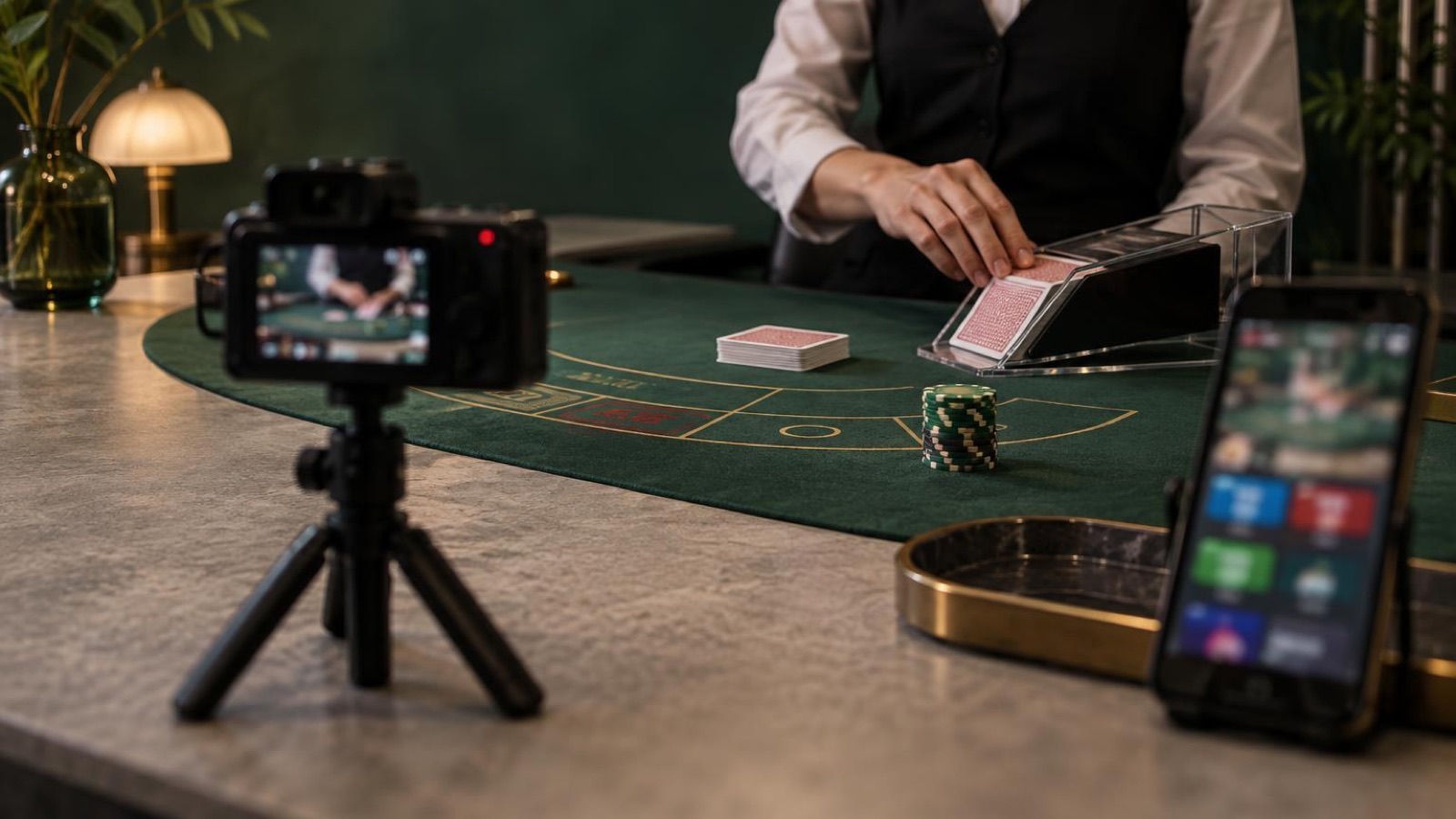
A live dealer casino is a table game where the cards, the wheel and the dealer are real, and a camera streams the whole thing to your screen. You are not playing against software. You are watching a person in a studio deal a physical shoe, and your bet is placed through the same screen you are watching.
That is the whole difference from a standard online table. In a regular digital game, a random number generator decides the outcome the moment you click. In a live game, the outcome is decided by a real shuffle and a real spin, and the software's job is only to record your bet, show you the table, and settle the result.
Studios are built to look like a casino floor. A live baccarat table is a standard 1450x800mm round cut table with three betting spots for the player, tie and banker3. A live blackjack table uses the same footprint, with places for up to seven players on one side and the dealer on the other3. The dealer stands or sits in front of the camera, the shoe sits on the table, and the whole thing runs on a schedule of rounds.
Because the dealer is a person, the pace is slower than a digital game. That is part of the appeal for a lot of players. You see the cards come out, you see the dealer's hands, and you see the result happen rather than appear.
The games on offer are broad. Offshore sites serving players in the region run live versions of blackjack, baccarat, roulette, Dragon Tiger and Sic Bo, plus game shows2. Licensed platforms in the Philippines list live baccarat, live dealer roulette and slots side by side8. A single live studio can carry dozens of tables at once, each with its own limits and its own dealer.
How a live dealer round works, from bet to payout
The mechanics are the same across games, and once you have played one round you have played them all.
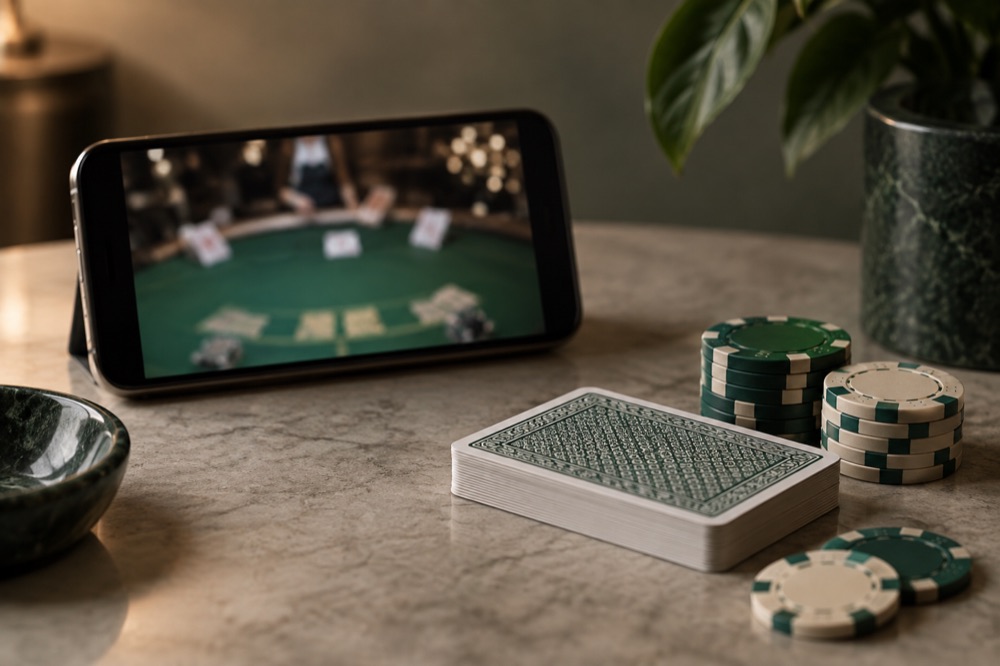
- You open the table and the video loads. You see the dealer, the table and a betting timer counting down.
- You place your chips on the layout on your screen. The timer is the deadline. Bets placed after it closes are not accepted.
- The dealer deals or spins. In baccarat, four cards come out, two for the player box and two for the banker box9.
- The result is read off the table and the software settles every bet automatically.
- Winnings land in your balance. You can leave the table, switch tables, or keep playing the next round.
The settlement is automatic, which is why live tables feel fast even though a person is dealing. You do not have to claim anything. The system knows what you staked and where.
Blackjack works the same way with a few extra decisions. You get two cards face up and the dealer gets two, one face up and one face down10. You then choose to hit, stand, double or split. If you split a pair, you separate them into two hands and must make another bet equal to your original bet, and the dealer gives the first hand a second card before moving to the second11. The dealer's own play is fixed by the table rules, usually drawing to 16 and standing on 173, or standing on all 17s at some tables1.
Payouts at a live blackjack table are straightforward. Winning wagers pay at least 1 to 1, except blackjack, which pays at least 3 to 23. If you take insurance, it pays 2 to 1, and the insurance bet is half your original stake3.
One practical point about timing: live tables run on a loop, so if you miss the betting window you wait for the next round. There is no pause button. If you want to think, do it before the timer starts.
Baccarat: the rules behind the most common live table
Baccarat is the game most live studios are built around, and it is also known as punto banco12. It is especially popular among high rollers and Asian players, which is why so many live tables are baccarat tables12.
The rules are simpler than they look. The goal is to get a hand as close to 9 as possible, and the highest possible total is nine4. Card values are fixed: aces count as 1, and 10, jack, queen and king all count as 04. If a hand goes over 9, only the rightmost digit counts, so a 7 and a 6 make 3, not 134.
You do not play a hand yourself. You bet on one of three outcomes: the player hand wins, the banker hand wins, or the two tie. The dealer deals two cards to each side, and then the drawing rules decide whether a third card comes out.
The player hand draws a third card if its first two cards total 0 to 5, and stands on 6 or 74. The banker hand receives a card if its total is 0 to 5, and stands on 6 or 7 when the player hand stood4. The full banker drawing table has more conditions, but in practice the software and the dealer handle it, and you never have to remember it.
The one rule worth knowing before you sit down is the natural. If either hand totals 8 or 9 on the first two cards, that is a natural, the round is over immediately, and bets on the winning hand are paid9. If either the player or banker has a natural 8 or 9, both hands automatically stand, no exceptions3.
Live baccarat is usually played with eight decks, each deck having 52 cards without jokers, and two cutting cards, one cutting seven cards from the back of the stack3. Some tables use six decks or a single deck, and the return tables differ slightly between them12.
Baccarat payouts and house edge: banker 1.06%, player 1.24%, tie 14.36%
This is the part that decides whether baccarat is worth your time, and the numbers are not close.
| Bet | Payout | House edge |
|---|---|---|
| Banker | 1 to 1 minus 5% commission | 1.06% |
| Player | 1 to 1 | 1.24% |
| Tie | 8 to 1 | 14.36% |
A winning player bet pays 1 to 14. A winning banker bet also pays 1 to 1, but the house takes a 5% commission on the amount you won, collected automatically at the time of payment3. A winning tie bet pays 8 to 13.
The commission exists because the banker hand wins more often than the player hand. Without it, everyone would bet banker and the house would lose. The 5% cut brings the banker edge down to 1.06%, which is the lowest of the three4. The player bet sits at 1.24%4. The tie bet, despite the tempting 8 to 1, carries a 14.36% house edge4, which is why most experienced players leave it alone.
The commission is taken automatically, so you do not have to track it. If you bet 100 on banker and it wins, you are paid 100 minus 5, and 95 lands in your balance. The dealer takes a 5% commission on winning bets on the banker's hand as a matter of course13.
One thing that trips up first-timers: a tie does not lose your banker or player bet. Those wagers are returned, and only the tie bet pays. That is why the tie bet is a separate, much worse proposition rather than a hedge.
Roulette at live tables: wheel types, bets and payouts
Live roulette comes in two main wheels, and the difference matters more than most players realize.

European roulette has a single zero and is still offered in many casinos as an alternative to the American version15. American roulette adds a double zero, which raises the house edge. If you have a choice at a live table, the single-zero wheel is the better game.
The bets themselves are the same as at any roulette table. You can bet on a single number, a split, a street, a column, a dozen, red or black, odd or even, or high or low. Payouts scale with the odds: a single number pays the most, an even-money bet pays the least. The wheel decides, and the dealer calls the result.
Some live studios run a faster format. Rapid Roulette speeds up the action with scheduled spins and interactive video terminals, where bets are placed on individual screens and a big screen shows the wheel spin15. This suits players who want more rounds per hour, and it removes the need to reach across a physical table.
The practical difference between live roulette and a digital wheel is the same as everywhere else on this page: you are watching a real ball land in a real pocket. The betting layout on your screen mirrors the physical table, and the timer works the same way.
Game-show style tables: Monopoly Live by Evolution
Game shows are the newest category of live table, and they sit somewhere between a casino game and a TV quiz.
Monopoly Live is the best-known example. It is built around a money wheel with segments, and the game mixes a live host, a spinning wheel and a bonus round that plays out on a 3D board. The appeal is the bonus round, where the multiplier can climb well above what a standard table offers.
The trade-off is the house edge. Monopoly Live runs at an RTP of 96.23% on the operator's own rules page, and the operator's marketing describes it as over 96%1. Either way, it is a higher edge than banker baccarat, and the game is designed for entertainment rather than grinding out a small advantage.
Minimum bets on game show tables vary. At many live dealer tables aimed at players in the region, bets start at around EUR 0.105. Game show tables often carry a higher minimum than a standard baccarat table, so check the table info before you join.
If you are new to live tables, game shows are a reasonable place to watch how the format works, because the pace is slower and the host explains what is happening. Just do not treat the bonus round as a strategy. It is a random segment on a wheel.
Side bets and table limits
Side bets are where live tables make most of their money, and they are worth understanding before you click one.

The general rule at most tables is that a side bet cannot stand alone. At Fortune 3 Card Poker, side bets such as the six card bonus and the progressive jackpot may not be operated independently without the base bets, and may only be placed in combination after a player has placed a base bet16. In practice that means you have to be in the main hand before you can add the extra.
Blackjack tables follow the same logic. A live blackjack game can include optional side bets such as Perfect Pairs and 21+31. You place your main bet first, then decide whether to add the side bet. If you skip the main bet, the side bet is not available.
Other table games show the same pattern. Caribbean Stud Poker requires a mandatory ante bet to join the game, with an optional $1 progressive jackpot side bet and a raise of 2x the original ante17. Casino War lets you bet on whether your card beats the dealer's, with an optional tie bet on whether the two cards match18. Three Card Poker pushes your ante and play bets into the next round if you and the dealer tie19.
Table limits are set per table, not per game. A live studio will run several baccarat tables at once with different minimums, so you can pick the one that matches your bankroll. The EUR 0.10 figure is the low end at many tables5, and high-roller tables sit far above it.
One timing rule that catches people out: at some tables you must place your bet before the dealer shakes the dice, and after the shake no bets, additions, reductions or moves are accepted20. The same principle applies to the betting timer on every live table. Once it closes, you are locked out of that round.
Where live dealer casinos are legal: the Japan example
This is the part that decides whether any of the above is available to you, and it depends on where you are, not where the studio is.
Japan is the clearest example. Gambling on an online casino from inside Japan is a crime even when the operator is legally run overseas6. That applies regardless of the name or content of the game, including baccarat, slots and sports betting6. It also applies to free versions and free bonus points, not just paid play6.
The reasoning is that using a smartphone in Japan makes it a domestic act, and a foreign license does not justify it7. The police position is that gambling by connecting from Japan is a crime regardless of whether it is legal in the country where the server sits, and enforcement is active21. There are no licensed and regulated online casinos inside Japan2, and well over 99% of the offshore operations serving Japanese players are licensed somewhere2, which does not change the player's position.
For players in Japan, the practical picture is simple. Offshore sites offer live blackjack, roulette, baccarat, Dragon Tiger, Sic Bo and game shows2, and the studios are real, but logging in from Japan is the illegal act. The same logic runs through the region: what you can legally play depends on your location, and the country guides on this site set out the position jurisdiction by jurisdiction.
If you are in a jurisdiction where licensed live tables are available, the practical steps are the same everywhere. Check the operator's license, complete identity verification before your first withdrawal, and read the table limits before you sit down. If you are in Japan, the answer is no, and the studio's location does not change it.
Common Questions
Can I play live dealer games on my smartphone?
Yes. Live tables are built to run in a mobile browser or app, and the major platforms support iPhone, iPad and most Android devices as well as desktop computers. You need a stable connection because the video streams in real time, and a slow link is the usual reason a table feels laggy.
Why does the banker bet charge a 5% commission?
The banker hand wins slightly more often than the player hand, so the house takes a 5% cut of your profit on a winning banker bet to balance the odds. You still get paid 1 to 1 on the stake, but the commission comes off the amount you won.
What is a 'natural' in baccarat?
A natural is a first two-card total of 8 or 9 for either hand. When that happens the round ends immediately, no third card is drawn, and bets on the winning hand are paid. If both hands have a natural, the higher one wins.
Do I have to place a main bet before a side bet?
At most tables, yes. Side bets such as a six card bonus or a progressive jackpot usually cannot be placed on their own and only run alongside a base bet. Some blackjack tables let you add optional side bets like Perfect Pairs or 21+3 once you are in the hand.
What is the minimum bet on Monopoly Live?
It varies by table and operator, but live dealer tables aimed at players in the region often start at around EUR 0.10. Game show tables can carry higher minimums than standard baccarat or roulette, so check the table info before you sit down.
Is it legal to play at an online casino from Japan if the site is licensed overseas?
No. Gambling on an online casino from inside Japan is a crime even when the operator is legally run overseas, and that applies to paid games, free versions and free bonus points alike. A foreign license does not change your position as a player in Japan.
How fast are withdrawals on Philippine sites like BingoPlus?
Payout speed depends on the operator, not on the game type. Some sites advertise deposits and withdrawals around the clock and say a correctly submitted withdrawal can complete within about two hours, but you should still expect identity checks before a first payout.
What happens to my banker or player bet if the round ends in a tie?
A tie does not lose your banker or player bet. Those wagers are returned to you, and only the tie bet pays, at 8 to 1. That is why the tie bet carries a much bigger house edge than the two main bets.
Sources21 sources
- Live Casino Blackjack, 888casino
- Best Online Casinos for Players from Japan, Wizard of Odds
- House Rules, GGPoker
- Baccarat, GameSense
- Best Online Casinos for Players from Thailand, Wizard of Odds
- Online Casino, National Police Agency Japan
- Online Casino Research, National Police Agency Japan
- List of Authorized Online Remote Gaming Platforms, PAGCOR
- How to Play Baccarat, PlaySmart
- How to Play Blackjack, PlaySmart
- How to Play Blackjack, PlaySmart
- Baccarat, Wizard of Odds
- How to Play Baccarat, PlaySmart
- How to Play Baccarat: Details, PlaySmart
- How to Play Roulette, PlaySmart
- Fortune 3 Card Poker, DICJ Macau
- Caribbean Stud Poker, PlaySmart
- How to Play Casino War, PlaySmart
- Three Card Poker, PlaySmart
- Mahjong Bacarrat, DICJ Macau
- Online Casino Survey Report, National Police Agency Japan