Why betting sites get blocked in Asia
When a betting site stops loading, one of two very different things has happened, and telling them apart is the first step.
The first is a block ordered from above. A regulator or government body decides a gambling site should not be reachable from its country and tells internet providers to stop resolving or routing traffic to it. This is what most people mean when they say a site is "blocked."
The second is a block applied by the operator itself. Betting companies decide where they will and will not do business, and they enforce that decision with technology. Stake, for example, uses IP address-based geo-blocking so that no gaming services are offered in countries where such activity is not permitted4. Some operators go further and refuse registration entirely from countries that prohibit their products5.
Even licensed, state-approved operators do this. Singapore Pools account holders may only place bets from Singapore, and placing bets through the website or mobile apps via foreign IP addresses is prohibited6. So the same site can be reachable in one country, geo-blocked in a second, and regulator-blocked in a third.
The rules behind who may gamble online where are covered in detail on our page on online gambling law in Asia; this page is about the mechanics of blocking itself.
DNS blocks: how they work and what they stop
Every website has an IP address, a string of numbers that computers use to find it. Nobody types those numbers; instead you type a name like "example.com," and a system called DNS (the Domain Name System) looks up the name and returns the address, like a phone book for the internet.
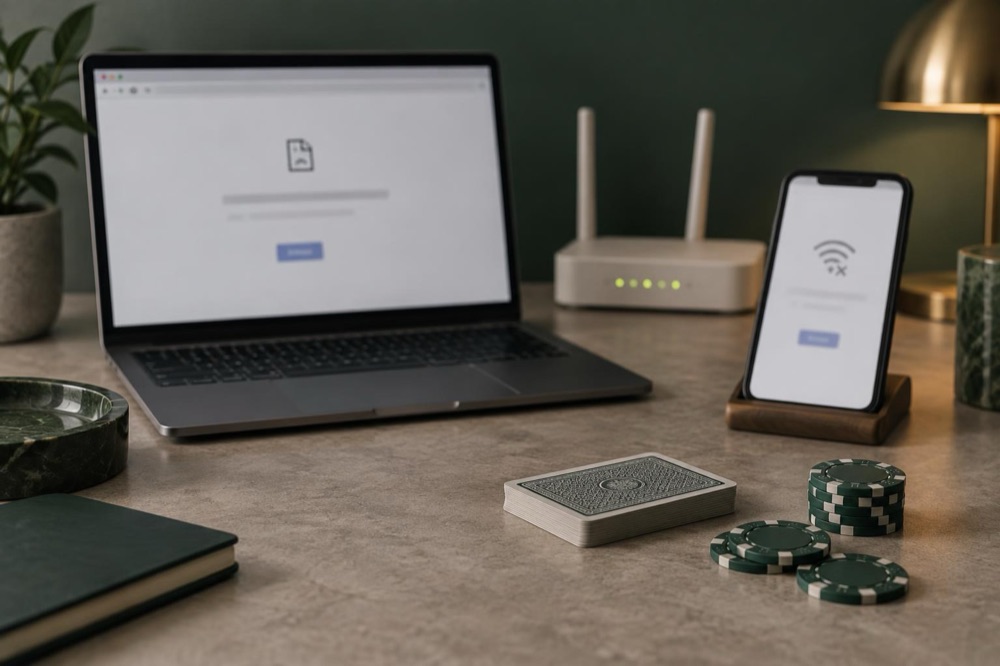
A DNS block works by corrupting that lookup. The regulator gives internet providers a list of gambling domain names, and when you try to visit one, the provider's DNS server refuses to return the real address. Your browser shows an error, and the site never loads. Your internet connection is fine; the phone book entry has simply been torn out.
What a DNS block stops is the domain name, not the server. The site itself keeps running, which is why blocked operators can often reappear quickly on a new address. It also means the block has to be applied by each provider, which is why blocking orders are normally written to cover all of them at once.
Operators do their own version of the same thing, but from the other direction. Instead of blocking the name, they check where each visitor's IP address appears to come from and refuse service accordingly. The messages differ by operator but say the same thing.
| Operator | What visitors from blocked or restricted locations see |
|---|---|
| CoinPoker | A plain notice: "Unfortunately, players from your location are not allowed to visit this site"7 |
| 20Bet | "Looks like you're visiting from a restricted location"8 |
| MyBookie | An explanation that online sports betting is not available in some regions where its block page is shown9 |
| 1xBet | An access-denied page asking visitors to check whether their country is on the site's banned list, whether gambling is prohibited in their country, or the status of their VPN2 |
That last message is worth noticing: operators assume some visitors arrive through a VPN, and many treat that as a reason to deny access rather than a way around it. We cover that separately on our page about using a VPN to gamble online.
Who orders the blocks: regulators and their numbers
Blocking is not automatic. Someone has to decide which addresses go on the list, and in Asia that work sits with a handful of agencies.
In Singapore, the Gambling Regulatory Authority (GRA) is the body that cuts off access. It uses advanced website blocking alongside payment transaction blocking, and major Singaporean banks, including DBS, UOB and OCBC, are mandated to block transactions to known gambling domains1. The pattern is consistent: the regulator blocks the address, and the banks block the money.
Operators do part of the work themselves. Some will not accept and will block users who come from restricted or prohibited jurisdictions, who deceive about their location, or who do not provide the identification information requested3. Others apply geoblocking or access limits where required, and expect players to follow local laws and age restrictions3. That scale is the reality of blocking: it happens at the regulator's network level and again at the operator's own door.
Blocking sits alongside other enforcement tools. In Singapore, the Gambling Regulatory Authority pairs website blocking with payment transaction blocking, and major banks such as DBS, UOB and OCBC are mandated to block transactions to known gambling domains10. Operators add their own checks, refusing and blocking users from restricted or prohibited jurisdictions and users who deceive about their location11.
The numbers tell you the practical truth about blocks: they are issued continuously, in batches, and no list stays finished.
Mirror sites: why blocked operators keep changing address
Because a DNS block targets a domain name rather than the server behind it, the simplest countermeasure is a new domain name. These alternative addresses are called mirror sites: same operator, same games, same account, different URL.
Operators make this easy on themselves by running many country-specific domains in the first place. The same company can be reached at korea.1xbet.com, uz.1xbet.com and nepali.1xbet.com, each showing the same access rules about banned countries12. When one address is blocked, another can be publicized, and the cycle repeats.
Whether using a mirror is legal is a different question from whether it works. Shuffle, a crypto betting site, states plainly that its service is legal in many regions, depending on local laws, eligibility and platform terms13. In other words, the mirror inherits exactly the legal status of the original site in your country: if the original was blocked because it is not permitted there, the mirror is not permitted either. A new address changes nothing about the law, only about the phone book.
App removals from official stores
Blocking does not stop at websites. Gambling apps disappear from the Apple App Store and Google Play for the same underlying reasons, either pulled at the request of a regulator or removed because the operator's licensing does not cover that market.
The app route also matters to operators because it is easier to police than the open web. Store operators apply their own regional rules, so an app available in one country can be absent in the next without any regulator asking.
What operators watch closely is how people try to get around regional app restrictions. Bet365's terms list prohibited activities that include using a VPN or similar technology to disguise your location14. The concern is not only legal; it is that the operator cannot lawfully serve a customer it cannot place. We cover the app side, including sideloaded APKs, on our page about gambling apps in Asia.
Blocked site or scam site: how to tell the difference
Here is the trap: when a site stops loading, fake versions rush in to fill the gap. Scammers know that people search for a blocked brand's new address, and they build lookalikes to catch that traffic.
China's lottery authorities warn about exactly this, noting that fraudulent lottery websites are mostly hosted overseas, which makes recovering money or enforcing any rights very difficult15. A mirror site you found through a search ad is far more likely to be one of these than the real operator.
Before depositing anywhere, do the boring checks. The UK Gambling Commission's advice to players is to read the terms and conditions for each gambling product, which helps you understand exactly what you are betting on and make an informed decision about gambling with that operator17. A site with no terms page, or with terms that do not match the brand, is a warning sign regardless of whether the original was blocked.
We go deeper on the mechanics on our page about fake and rigged online casinos.
When the problem is your account, not the site
Sometimes the site is fine and you are the one who has been blocked. This is more common than regulator blocking, and it is worth ruling out first.
The most frequent cause is location. Bet365 restricts accounts and blocks access to its products if the device is identified as being in a location where gambling is not permitted, including where that identification comes via a web server or an active VPN18. Nothing is wrong with the site; your account simply cannot be served from where you are right now. This is why licensed apps often stop working when you travel, a situation we cover on its own page about licensed betting apps abroad.
The second cause is your own account status. At Hong Kong Jockey Club, the right to access the internet betting facility terminates immediately on closure of the corresponding betting account, and the Club may refuse access, refuse a bet, or handle funds without giving any reason19. If your account is closed or suspended, the site may load but refuse you personally.
The third cause is voluntary. HKJC offers a Voluntary Account Suspension Service, and during the suspension period the user cannot bet through the existing betting account and cannot open a new one20. If you ever signed up for something like this and forgot, that is your answer.
Blocks you choose yourself
Not every block is imposed on you. A whole category of tools exists so you can block gambling sites on your own devices, and it works on the same principle as a national block, just at your end.
- Bet Blocker and GamBan let you block sites you do not want access to, or set time limits21. BetBlocker is free to the public22, while GamBan works on a monthly or yearly paid subscription after a trial and blocks thousands of gambling websites and apps worldwide23
- Gamblock is another option, software that blocks access to internet gambling sites, which operators themselves recommend to players who want to stop24
- GAMSTOP covers the account side: registering prevents you from setting up gambling accounts with businesses licensed in Great Britain25
- Many banks let you block gambling payments on your debit or credit card; this does not close the account or affect your credit score, and some banks include a cooling-off period before the block can be removed23
- E-wallets can do it too: Skrill has a gambling block feature on its Verification and Features page, ensuring the account cannot be used to deposit at online casinos26
- Browser-level options exist as well: adding gambling sites to your browser's restricted site list can help, and Chrome and Firefox both offer site-blocking extensions27
Licensed operators also offer self-exclusion, which the Malta Gaming Authority defines as a tool that prevents players from gambling by blocking access to the gaming website the player has excluded with, for a definite or indefinite timeframe that the player can extend28.
One honest caveat from the support organizations: blocking software is not a complete solution, but it can be a useful tool as part of a good strategy for quitting gambling. We compare the tools in detail on our page about blocking gambling sites on your own devices.
What a block does and does not mean for players
A block tells you one thing only: this site is not permitted in this place. It does not automatically tell you that the operator was prosecuted, that it cheated anyone, or that it is a scam. Many blocked operators hold licenses elsewhere and were blocked simply for serving a market they are not licensed for. That is why the same brand can be a regulated, licensed business in one country and a blocked address in another.
For you as a player, the practical meaning depends on where you are. In China, official guidance is blunt: participants in cross-border gambling face administrative penalties of detention and fines under the Public Security Administration Punishments Law, and criminal liability if a crime is constituted, besides possible large property losses16. In most other jurisdictions the risk sits more with the operator than the individual, but that varies, and we cover it jurisdiction by jurisdiction on our page about online gambling law in Asia and our page on enforcement against players.
Two things a block never changes: your money still sits with the operator, and a mirror site is the same operator under a different name. If a site you use gets blocked, the safest move is to withdraw through whatever channel still works rather than chase the brand to its next address. And if a payout is being withheld, that is a separate problem with its own playbook, which we cover on our page about when an online gambling site won't pay out.
Common Questions
Why is my betting site suddenly unreachable?
Two things can stop a site loading: a block ordered by a regulator in your country and applied by internet providers, or a geo-block applied by the operator itself because it does not serve your location. The error message on the page often tells you which.
Can a DNS block affect every internet provider in the country?
A national blocking order is usually written to cover all internet providers, so switching mobile networks or home broadband rarely helps. Some blocks target specific domains, though, and operators can also block by IP address on their side.
Are mirror sites legal to use?
A mirror is just another web address for the same operator. Whether using it is legal depends entirely on the law where you are, not on the address. If the original site was blocked in your country, the mirror usually carries the same status.
Why did the betting app disappear from my app store?
App stores remove gambling apps on request from regulators or when the operator's licensing does not cover your country. Some operators also pull their own apps from markets where they are not licensed.
How do I know if a site was blocked or is just down?
A block usually shows a specific message, such as access denied or a notice that you are visiting from a restricted location. A site that is simply down tends to show a generic timeout or error page with no explanation.
Do blocks mean the operator was breaking the law?
Not always. Many blocked sites hold licenses elsewhere and are blocked simply because they are not licensed for your country. A block tells you the site is not permitted there, not that the operator was prosecuted.
Sources28 sources
- Police arrest nine over 153 illegal gambling sites in South Korea, Seoul Economic Daily, September 15, 2026
- KYC Policy, 1xBet, September 26, 2026
- Online Gambling Malaysia 2026, Casino Pro Review, 2026
- Anti-Money Laundering Policy, Stake, September 26, 2026
- User Agreement, 888sport, 2026
- Singapore Pools Account Terms and Conditions, Singapore Pools, December 6, 2025
- Restricted Countries, CoinPoker, September 26, 2026
- Terms and Conditions, 20Bet, September 26, 2026
- Terms and Conditions, MyBookie, September 26, 2026
- Supreme People's Court publishes four typical internet rule of law cases, Xinhua, September 16, 2026
- Ministry of Public Security publishes ten typical cases from Jingwang 2026 campaign, Xinhua, September 17, 2026
- Payment Information, 1xBet, September 26, 2026
- Shuffle Sports, Shuffle, September 26, 2026
- Terms and Conditions, bet365, August 25, 2026
- Lottery Information, General Administration of Sport of China, November 23, 2023
- Public Security Notice on Cross-Border Gambling, Chifeng Public Security Bureau, February 6, 2026
- What to look at before you gamble, UK Gambling Commission, August 23, 2021
- Gambling restricted in location, bet365, September 26, 2026
- Betting Facilities Rule 9, Hong Kong Jockey Club, 2020
- Responsible Gambling: Exclusion, Hong Kong Jockey Club, September 25, 2026
- Gambling is Random, ResponsibleGambling.org, September 25, 2026
- How to Exclude: Help, HowToExclude, September 26, 2026
- Gambling Blocking and Self-Exclusion, BeGambleAware, September 25, 2026
- Responsible Gaming, Dafabet, September 26, 2026
- Self-Help: Self-Exclusion, GamCare, July 10, 2026
- How to Deposit Saudi Riyal (SAR), Stake, August 24, 2026
- Safer Gambling Tips, ResponsibleGambling.org, September 25, 2026
- Safer Gambling, Malta Gaming Authority, October 7, 2025