

E-wallets and the shift away from card payments
Card payments to gambling sites have been getting harder for years, and the gap has been filled by e-wallets, local bank transfers and, in some markets, crypto. That shift matters to you because each route leaves a different trail and triggers a different set of rules.
An e-wallet transfer is not anonymous. It carries your verified identity, the receiving account and a timestamp, and it runs through a licensed payment institution that keeps records and answers requests from regulators and police. Splitting a deposit across several wallets, or routing it through a friend, does not break that chain. It creates a pattern that compliance teams are trained to spot.
The clearest sign of where payments will not clear is the blocklist an operator publishes. One offshore casino lists Afghanistan, Bahrain, Belarus, Belgium, China, Cuba, Cyprus, Estonia, Georgia, Greece, Guam, Iran, Iraq, Israel, Japan, Latvia, Lithuania, Malta, Myanmar, North Korea, Poland, Romania, Russia, Syria, Ukraine, the United Kingdom, the United States and Venezuela among the places where real money play is prohibited6. If your country is on that list, the site is telling you it will not knowingly take your money, and any deposit you force through is at risk of being reversed or confiscated.
Where gambling is licensed, the picture is different. Licensed operators in Asia generally run their own deposit and withdrawal accounts, and the payment is treated like any other commercial transaction. The friction you meet is usually the operator's own rules rather than a bank block.
India: advisories flagging offshore betting platforms like YOLO247
India is the clearest example of how payment pressure arrives before legislation does. There is no central law that explicitly governs offshore online betting platforms, and several states have their own regulations, so the practical position depends on where you are7.
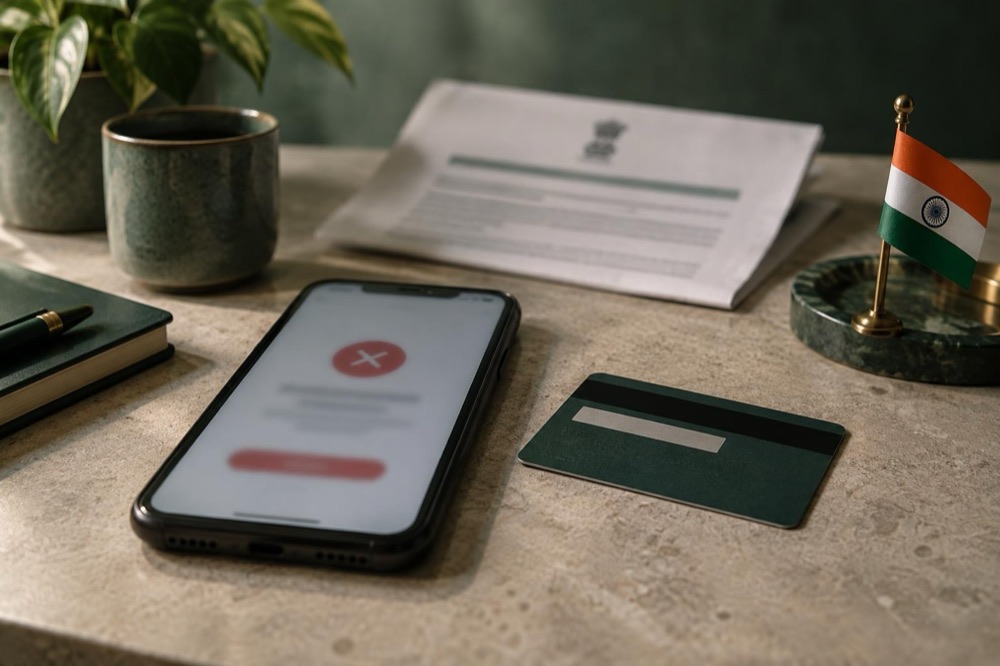
What has changed is enforcement at the promotional and payment level. In September 2026 the Ministry of Information and Broadcasting issued advisories against promoting offshore betting platforms, and YOLO247 appears among the flagged platforms. Advisories of that kind do not criminalize a player, but they push payment providers, app stores and advertisers to cut ties, which is what actually stops money moving.
For a reader in India, the practical sequence is: the platform stays reachable, the marketing disappears, the payment rails get withdrawn, and deposits start failing. If you are mid-withdrawal when that happens, your balance can sit in an account you can no longer fund or verify. Operators in this position typically point users to their own state's rules and tell them to check what applies locally7.
What the law does not cover
Not every transfer that touches gambling is a gambling payment. The line most jurisdictions draw is between organized betting and small-stakes recreation.
China's guidance is explicit: recreational activity with small money stakes that is not for profit, and businesses such as chess and card rooms that charge only normal venue and service fees, are not treated as gambling8. That distinction is what keeps a mahjong table at home, or a card room charging table fees, outside the payment rules that catch betting sites.
Licensed lottery and betting payments sit on the other side of the line in a different way. They are legal, and the operator's own rules govern how money moves. Hong Kong's lotteries rules let the operator pay prizes or refunds in cash, by check, by cash voucher, or by crediting the betting account used to place the bet, at its sole discretion9. Bets are paid by cash, cash vouchers and/or betting account unless announced otherwise9. Those payments are not the kind of transfer a bank flags.
The money follows the ticket, not the payment method.
The practical takeaway: if the operator is licensed and the payment goes through its own channels, you are inside the system. If the operator is offshore and unlicensed where you are, you are outside it, and the payment is where that shows up first.
Penalties for players and payment intermediaries
The risk in an unlicensed payment is not only losing the deposit. Several Asian jurisdictions attach penalties to the player, and some attach them to anyone who moves the money.
Singapore is the most concrete. Gambling with an unlicensed gambling service provider, or at an unlawful gambling place, knowing or reasonably ought to have known, carries a fine of up to S$10,000, up to 6 months in prison, or both3. Proxy gambling on a gaming machine from outside the gaming machine room carries up to S$10,000 or up to 12 months10.
Hong Kong's maximum for participating in illegal gambling, such as betting with an illegal bookmaker, is a HK$50,000 fine and 9 months in prison4.
China goes further and targets the money itself. Gambling abroad, online gambling, and providing funds or technical support for gambling all violate the Criminal Law and the Public Security Administration Punishment Law5. Participants in cross-border gambling face detention and fines under the Public Security Administration Punishments Law, criminal liability if a crime is constituted, and possible large property losses13. Participating in gambling with relatively large stakes can bring detention or a fine on its own14.
The Philippines puts the obligation on the operator. Online gaming platforms must accept funding, withdrawals and transfers only through the player's own registered payment or banking accounts; anything else is strictly prohibited and penalized1. That rule exists precisely because third-party transfers are how mule accounts get used.
For payment intermediaries, the exposure is real. A person who lets a betting site move money through their account, or who recruits others to do it, is not a bystander in these regimes. In China the funding itself is the offense5.
| Jurisdiction | Player penalty for unlicensed gambling | Payment angle |
|---|---|---|
| Singapore | Up to S$10,000, up to 6 months, or both3 | Proxy gambling: up to S$10,000 or 12 months10 |
| Hong Kong | Up to HK$50,000 and 9 months4 | Illegal bookmaker bets covered11 |
| China | Detention and fines; criminal liability if a crime13 | Providing funds is an offense5 |
| Philippines | Operator-level penalty | Only the player's own registered accounts allowed1 |
Resident or visitor: which rules apply to you
Payment rules follow the person, not the website, and in several Asian markets the rules differ depending on whether you are a citizen, a resident or a visitor.
Singapore is the clearest split. A casino operator must not allow a Singapore citizen or permanent resident to enter or remain on casino premises unless they have paid the entry levy15. The 24-hour levy covers a consecutive 24-hour period, and the annual levy covers a consecutive 12 months16. The levy is not refundable, in whole or in part, even if you never enter or stay on the premises during the validity period16. Foreign visitors pay no levy. Separately, third-party exclusions and visit limits exist to protect financially vulnerable citizens and permanent residents who gamble at the local casinos or who have a poor credit record18.
Japan applies entry limits, an entry fee and restrictions on lending by casino operators to Japanese nationals and foreigners residing in Japan19. Visitors are outside those particular controls. Japan's casino resorts are not open yet, so this is a rule for the future rather than something you can use today.
The Philippines splits by residency and income. PAGCOR casinos admit tourists and foreigners who are not residents of the Philippines, and residents with a gross income for the previous year of at least P50,000 certified by the Bureau of Internal Revenue; guests of qualified persons are limited to two and must be at least 2120. In South Korea, the Hyatt Regency casino is for foreigners only21.
Hong Kong's betting rules are personal in a different way. Facilities and services applied for under the betting facilities rules may only be used for the bettor's personal use2, and the e-wallet must not be transferred and may only be used by the betting account holder permitted to use it22. If you hand your account or wallet to someone else, you have broken the operator's rule regardless of your nationality.
For a visitor, the practical summary is: you can usually pay into licensed venues that admit you, and you are outside the resident-specific levies and exclusions. For a citizen or resident, the levy, the exclusion regime and the income test are the things that decide whether your payment is accepted at all.
What should I do if my account is frozen?
A freeze is usually a request from an authority to the bank, not a decision by the bank itself. The first step is to ask your bank which authority made the request and under what reference, and to get that in writing if you can.

Keep everything:
- Statements
- Transfer confirmations
- Chat logs with the operator
- The site's terms
If the freeze relates to a deposit you made to an offshore site, the transfer record is the document that will be asked for first.
Do not move the remaining balance to another account, and do not ask a friend to hold funds for you. In jurisdictions where providing funds for gambling is itself an offense, that looks like an attempt to hide money and can turn a payment problem into a criminal one5.
Expect the operator to be unhelpful. Offshore sites commonly suspend or cancel accounts of players who appear on a negative list, and they are not required to register those players in the first place23. Licensed operators have their own forfeiture rules too: if a winning ticket holder or betting account holder fails to register within the specified time and manner, the operator may refuse to pay the winnings, which are then forfeited2.
If the freeze is on a licensed operator's payment, the operator's customer service is the right first call, because the money is inside a regulated system and there is a paper trail on both sides.
Which countries in Asia block gambling transactions at bank level?
Blocking happens at three levels, and it helps to know which one you are hitting.
The first is the operator's own blocklist. Offshore casinos publish the countries they will not accept real money play from, and those lists are long and specific6. If you are in one of those countries, the site has told you in advance that your deposit is not welcome.
The second is the payment provider. Banks and e-wallets in China, Singapore, Japan and several other Asian markets decline or delay transfers they classify as gambling related, and they do it without telling you why. This is where most failed deposits actually happen.
The third is the regulator. Licensing regimes in Singapore, Hong Kong, Macau and the Philippines set the rules for how licensed operators may take and pay money, including the requirement that online platforms use only the player's own registered accounts1.
A VPN does not move you between these levels. It hides your location from the website, not from your bank or your payment provider, and it does not change which law applies to you. If your payment is blocked, the block is on the account, not on the connection.
Common Questions
Can my bank refuse a transfer to a licensed casino?
Yes. Banks and payment providers can decline or delay any transfer they flag as gambling related, even to a licensed operator. In practice most licensed casinos and lotteries take deposits by card, cash or their own account, so a refusal usually means using a different payment route rather than a legal problem.
Are e-wallet transfers to gambling sites traceable?
Yes. E-wallet transfers carry the sender's identity, the receiving account and a timestamp, and they pass through a licensed payment institution that keeps records. Moving money through several wallets or a friend's account does not break the chain, and regulators in several Asian markets treat that pattern as a red flag.
What should I do if my account is frozen?
Contact your bank first and ask which authority requested the freeze and under what reference. Keep your statements and any transfer records. Do not move remaining funds to another account or ask someone else to hold them, because that can look like an attempt to hide funds and worsen your position.
Is using a third party to move gambling money illegal?
In several Asian jurisdictions, yes. China treats providing funds or technical support for gambling as an offense in itself, and the Philippines requires online gaming platforms to accept funding and withdrawals only through the player's own registered accounts. Using a friend's account or a mule can expose both of you.
Do the same rules apply to lottery payments?
No. Legal lotteries and licensed betting operators pay prizes and refunds through their own rules, usually by cash, check, cash voucher or credit to the betting account used to place the bet. Those payments are not treated as gambling transfers, so banks rarely block them.
Which countries in Asia block gambling transactions at bank level?
China, Singapore, Japan and several others restrict or block gambling related payments, and offshore operators themselves exclude whole countries from real money play. The list of excluded countries published by an operator is often the clearest sign of where payments will not clear.
Does a VPN change how payment laws apply?
No. A VPN hides your location from the website, not from your bank or your payment provider, and it does not change which law applies to you.
Sources23 sources
- Regulatory Framework for the Accreditation of Service Providers, PAGCOR, 2024-06-13
- Betting Facilities Rules, Chapter 2, Hong Kong Jockey Club, 2020
- Gambling Control Act 2022, section 20(3), Singapore Statutes Online, 2024-06-17
- Gambling Ordinance: maximum penalty for illegal gambling, Government of Hong Kong, 2025-06-04
- Cross-border gambling and providing funds, National Immigration Administration, 2021-02-05
- Terms and Conditions, 7BitCasino.com, 2026-05-11
- About Lotus365, Lotus365, 2026-09-26
- Interpretation on Gambling Criminal Cases, Article 9, Embassy of China in Malaysia, 2026-08-12
- Lotteries Rule 2, Hong Kong Jockey Club, 2020
- Gambling Control Act 2022, section 28(2), Singapore Statutes Online, 2026
- Gambling Ordinance: penalty for betting with illegal bookmakers, Government of Hong Kong, 2025-06-04
- Gambling Ordinance: fine and imprisonment on conviction, Government of Hong Kong, 2025-06-04
- Participants in cross-border gambling: penalties, Chifeng Public Security Bureau, 2026-02-06
- Public Security Administration Punishments Law guidance, Beijing Municipal Public Security Bureau, 2025-02-08
- Casino Control Act 2006, section 116, Singapore Statutes Online, 2026-09-26
- Casino Control (Entry Levy) Regulations, Singapore Statutes Online, 2010-02-02
- Casino Control (Entry Levy) Regulations, validity period, Singapore Statutes Online, 2010-02-02
- Third Party Exclusions and Visit Limits, Ministry of Social and Family Development, 2026-09-25
- 特定複合観光施設区域整備法, House of Councillors, 2018-07-27
- Republic Act No. 9487, PAGCOR, 2026-09-26
- Hyatt Regency casino: foreigners only, Visit Korea, 2026-09-25
- Betting Facilities Rules, Chapter 10, Hong Kong Jockey Club, 2020
- Revised Regulatory Framework for the Remote Gaming Platform, PAGCOR, 2023-11-15















