
Card networks and where they are accepted for gambling
The four big card networks do not treat gambling the same way, and neither do the countries in Asia where you might be holding a card.
Visa is the most widely accepted card at online gambling sites in the region. Among online casinos that cater to Singaporean players, Visa Debit is offered across most of them, which makes it the default card option for deposits in that market1. The same pattern holds for offshore sites serving other Asian countries: if a site takes any card at all, it usually takes Visa.
Mastercard is accepted at many of the same offshore sites. Offshore casinos that accept South Korean players, for example, list Visa Debit and Mastercard alongside bank transfers, e-wallets and cryptocurrencies7. The catch with Mastercard comes at the other end of the transaction: card issuer rules generally stop operators from paying winnings back to it, which we cover below.
UnionPay is the dominant card for mainland China, and its gambling story is almost entirely a Macau story. UnionPay cards cannot be used for online gambling from mainland China, since credit cards and bank transfers cannot be used for gambling there at all6. Instead, UnionPay matters for cash withdrawals at Macau ATMs, and those withdrawals are capped and tightly controlled, as the sections below explain.
JCB is the Japanese network, and its role in gambling is mostly domestic and indirect. Japan's legal gambling channels, such as the Takarakuji lottery, do accept credit cards for online purchases, but only cards in the member's own name: family cards and corporate cards cannot be used9. JCB's acceptance at offshore gambling sites is thinner than Visa's, so Japanese players more often reach for a Visa-branded card or a domestic payment service.
One thing worth knowing before you swipe anything: Macau's casinos are open 24 hours a day8, and the floors run on cash and chips. Cards at a casino cage or ATM are a way to get that cash, not a way to bet directly.
Can I use my card for gambling? What the networks allow
The card networks themselves do not ban gambling. What decides whether your card works is a combination of the network's rules for the merchant category, your issuing bank's policies, and the law where you and the operator are.

In practice, three gates stand between you and a successful card deposit:
- The operator's own rules. Some operators exclude cards for certain markets. 888sport, for example, tells UK customers they cannot use credit card because of regional gambling restrictions10. The same operator may happily take a debit card from the same customer.
- The regulator's rules. Great Britain has gone furthest: the UK Gambling Commission has banned gambling on credit cards outright, to keep people from betting money they may not have11. In Hong Kong, the Jockey Club's proposed basketball betting license conditions state plainly that credit card betting must not be accepted12, and the government confirmed the same restriction when the regime was settled: no credit card bets13. Debit cards and direct bank payment remain the route there.
- Your bank's rules. Even where the operator and the law allow card gambling, your bank can decline the transaction on risk grounds. If that happens, the reasons are usually merchant codes and risk checks rather than anything you did wrong.
The networks also draw a line between debit and credit. Debit cards, which spend money you already have, face fewer restrictions than credit cards, which lend you the money. That is why a Visa Debit works at sites where a Visa credit card is refused, and why several regulators in Asia have followed the UK in barring credit card betting specifically rather than card betting in general.
Responsible gambling bodies in the region give the same practical advice from the player's side: watch out for hidden fees when using a credit card to play14, and the same warning appears in the Chinese-language guidance15. PlaySmart's poker guide puts it more bluntly: consider using cash only and leaving credit cards at home, and set a budget and a win limit in advance16.
Extra fees on gambling card payments
Card gambling deposits are notorious for costing more than they look. The fees come from two directions.
Fees from the gambling site. Some operators charge for handling card payments outright. 7BitCasino lists a 2.5 percent fee on credit and debit card withdrawals4. Cloudbet reserves the right to charge up to 5 percent on deposits and withdrawals to cover transaction costs3. These are operator charges, before your bank adds anything.
Fees from your bank. Many card issuers classify a gambling transaction as a cash advance rather than a purchase. A cash advance typically carries its own upfront fee, starts accruing interest immediately, and may count against a separate, lower credit limit. This is the "hidden fee" that responsible gambling guides in both English and Chinese warn about14.
Stack the two together and a single deposit can shrink noticeably before you place a bet. A worked example: deposit the equivalent of USD 200 at a site charging 5 percent for card handling, and USD 10 is gone at the door. If your bank then codes the transaction as a cash advance with its own fee, you lose a slice more, plus interest from day one.
The advice from the game guides is consistent: avoid using credit and debit cards to bet with additional funds17. If you do use a card, check the operator's payments page for handling fees first, and expect your bank statement to show the transaction differently from an ordinary purchase.
Why cards often cannot receive payouts
Here is the asymmetry that surprises most first-time card users: depositing with a card is easy, but getting paid back to the same card often is not.
The main reason is MasterCard. Due to rules imposed by the issuers of MasterCard and Eurocard credit and debit cards, 888casino and 888sport are not permitted to make withdrawals to those cards5. So you can fund an account with a Mastercard, but your winnings have to come out some other way: a bank transfer, an e-wallet, or whatever alternative the operator offers.
This is one example of a broader pattern called closed-loop payment, where operators pay you back through the same method you deposited with. When the card network blocks that loop, the operator has to offer a fallback, and the fallback usually takes longer and may carry its own fee, like the 2.5 percent card withdrawal charge at 7BitCasino4.
The practical consequences for you:
- Expect to verify a second payment method before your first withdrawal, even if you only ever deposited by card.
- Expect card withdrawals, where they are possible at all, to be slower than deposits, since the operator checks them against the card network's rules.
- If you are choosing between Visa and Mastercard for gambling, know that Visa's payout path is generally smoother in markets where both are accepted1.
UnionPay caps: RMB10,000 a day and RMB100,000 a year overseas
Mainland China-issued UnionPay cards face hard limits on cash withdrawals outside the mainland, and these limits shape every gambling trip to Macau.
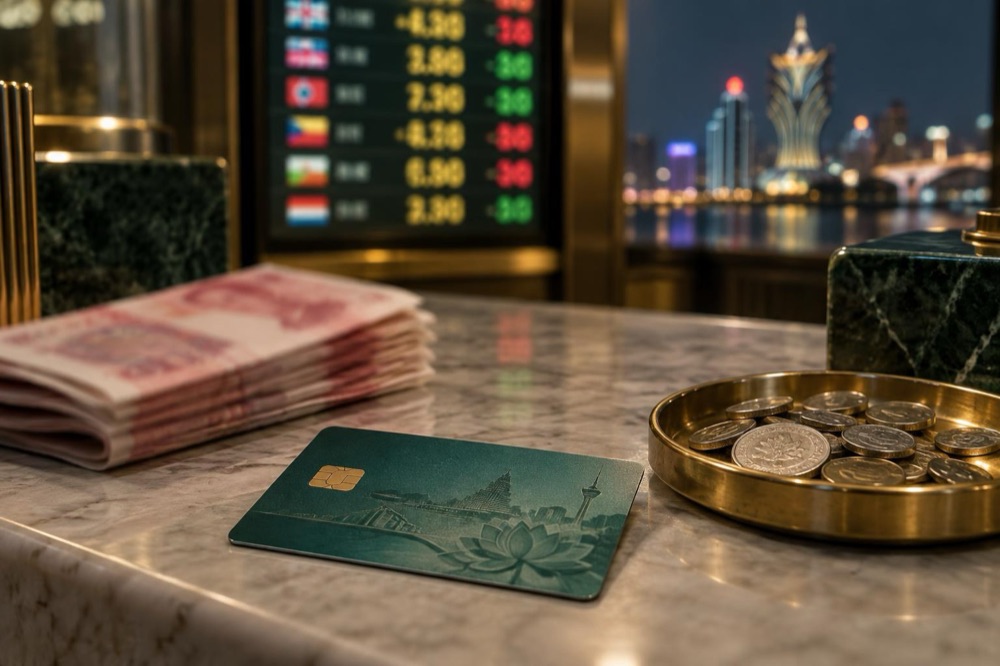
The caps came in two steps:
| Cap | Amount | When it applied |
|---|---|---|
| Daily overseas cash withdrawal cap per card | RMB10,000 | From September 30, 20152 |
| Temporary cap per card | RMB50,000 | Until the end of 20152 |
| Annual overseas cash withdrawal cap per card | RMB100,000 | Starting the following year, confirmed by China's State Administration for Foreign Exchange; applies not only to UnionPay cards but also to mainland China-issued Visa and MasterCard cards2 |
What this means for a Macau gambling trip, in plain numbers:
- Per day: you can pull at most RMB10,000 in cash from ATMs outside the mainland.
- Per year: across the whole year, each card can deliver at most RMB100,000 in overseas cash, whatever the daily cap allows on any given day.
- Per card, not per person: the caps count cards individually, which is precisely why schemes to multiply cards and terminals became an enforcement target, as the next section describes.
Analysts at the time judged the impact on ordinary visitors to be limited, since most tourists withdraw far less than the caps2. The caps were aimed at the large, repeated cash flows associated with high-stakes casino play.
UnionPay cash-out schemes and enforcement in Macau
The caps created an incentive to get around them, and Macau's enforcement record shows what happened next.
The most common workaround, though, did not involve rigged machines at all. According to a Credit Suisse research note on Macau gaming, the purchase and resell of goods using UnionPay cards is a more common way to withdraw bigger sums in the territory for premium mass market players18. A customer buys merchandise with the card at a shop near the casino, then sells it straight back for cash, turning a card payment into spending money without ever touching an ATM.
The card limits were not much of a barrier in practice. The same research note observed that players can easily get around the rule by using multiple cards to cash the desirable amount19. Someone carrying several UnionPay cards could simply run the same withdrawal over and over, one card at a time, until they had the sum they wanted.
All of this came at a cost as well as a risk. Traditional payment routes in the territory typically carried fees of 3-5%, a slice taken out of every cash-out before the chips ever reached the table20. That fee burden is one reason players went looking for workarounds in the first place.
The consequences are not limited to the operators of the schemes. Chinese authorities warn that participants in cross-border gambling face administrative detention and fines under the Public Security Administration Punishments Law, and criminal liability where a crime is constituted, on top of possible large property losses21. Using a rigged terminal to cash out is exactly the kind of arrangement that can pull the cardholder into that territory, not just the people running the device.
The safe version of the rule is simple: use your UnionPay card only at genuine bank ATMs, within the daily and annual caps, and walk away from anyone offering card-to-cash "purchases" near a casino.
Macau suspends UnionPay withdrawals at non-KYC ATMs
The second big disruption was not a rule on cards at all but a public health emergency. Macau's casinos and related entertainment businesses were suspended for 15 days from 00:00 on February 5, 2020, in an effort to prevent the spread of illness22. For two weeks there was nowhere to withdraw cash for play, because there was no play.
The point of the measure is that the machine now checks that the person withdrawing the cash is the cardholder, which undercuts the practice of sending runners through ATMs with a stack of other people's cards. Combined with the daily and annual caps, it means your UnionPay cash in Macau is personal, verified and limited.
The same era of Macau enforcement also touched the tables themselves. Since May 9, 2016, the use of phones at gaming tables inside Macau casinos has been prohibited by the SAR Government23. The measure also pointed at proxy betting, since registered clients at local VIP rooms had previously been allowed to use phones while gambling or place bets through a junket over the phone23. For a card user, the relevance is indirect but real: the whole ecosystem of remote, third-party and borrowed-money play that the ATM rules target has been squeezed from several directions at once.
Alternatives: e-wallets, QR codes and cryptocurrency
Where cards fail, blocked, capped or too expensive, Asian gamblers have moved to three broad alternatives.
E-wallets. For players in mainland China, where credit cards and bank transfers cannot be used for gambling at all, the alternatives are international e-wallets such as Skrill, Neteller, PayPal and Payz, and some offshore casinos also accept domestic e-wallets like Alipay and WeChat Pay6. Offshore casinos serving South Korean players similarly support e-wallets alongside bank transfers7.
QR codes and domestic e-wallets. For players in China, credit cards and bank transfers cannot be used for gambling, but some casinos accept RMB and domestic e-wallets like AliPay and WeChat Pay24. That is the retail and deposit side, though, not the gaming floor: QR and e-wallet payments fund accounts and settle shopping and dining around the casinos, while table play itself stays on cash and chips.
Cryptocurrency. Crypto is the fastest-growing card replacement. Offshore casinos accepting South Korean players take Bitcoin, Ethereum, Tether and Dogecoin7. CryptoGames accepts a long list of coins, including Bitcoin, Bitcoin Cash, BNB, Ether, Dogecoin, Litecoin, Solana, Shiba Inu, Pepe, Polygon, USD Coin, Tether and Ripple25. Some crypto sites even close the loop back to cards: CryptoGames lets you deposit fiat via credit card through an Onramper integration, currently for BTC and ETH deposits25, effectively selling you crypto at the checkout to gamble with.
Two cautions on the crypto route. First, using cryptocurrency does not necessarily avoid gambling laws: if players are wagering assets that carry monetary value, authorities may still regard the activity as gambling, and digital assets may fall under separate financial or payment-related regulations3. Second, the same limits on regular banking apply in spirit; crypto changes the payment channel, not the nature of the bet. If you want the mechanics of crypto deposits and payouts in detail, see crypto deposits and withdrawals and USDT for gambling.
What the card rules do not cover
Card network rules and ATM caps are about moving money. They do not decide what gambling is legal in the first place, and it helps to know where their edge is.
They do not change what counts as gambling. China's judicial interpretation on gambling cases states that recreational activities with small money stakes, not for profit, and businesses such as chess and card rooms charging only normal venue and service fees are not treated as gambling26. The same interpretation, restated in 2026, keeps that line in force26. But the moment mahjong or poker in a chess and card room becomes a gambling tool, it is illegal under the Public Security Administration Punishment Law, and in some cases criminal27. No card rule affects that distinction either way.
They do not apply inside licensed casinos the same way. Singapore's Gambling Control Act 2022 is a good illustration: several of its parts, including the sections on gambling outside licensed premises, do not apply to gambling carried on within a casino28. So the rules that constrain card use at an offshore site are not the rules that govern the casino floor itself.
They do not override local betting rules. Hong Kong's basketball betting regime bars credit card betting as a license condition12, and the Jockey Club's card products, such as the Smart Card and the Electronic Shroff Card, are limited to betting account holders, are non-transferable, and can be refused or withdrawn by the Club at any time without a reason being given29. Those are operator account rules, not card network rules, and they apply regardless of which bank issued your Visa or Mastercard.
They do not protect you from the underlying activity. The Chinese warnings about cross-border gambling apply to participants regardless of how they paid: detention, fines, criminal liability where warranted, and possible large property losses21. A card that works is not a sign that the bet is lawful where you are.
For the wider picture of how all the payment methods compare, see gambling payments in Asia, and for the specific question of betting on credit, see credit card gambling bans.
Common Questions
Do banks charge extra for gambling transactions?
Yes, often. Many card issuers treat a gambling deposit as a cash advance, which carries its own fee and interest from day one. On top of that, some gambling sites charge their own card handling fee, commonly around 2.5 to 5 percent, so a single deposit can cost you twice.
What is the daily limit on UnionPay withdrawals abroad?
A mainland China-issued UnionPay card can withdraw up to RMB10,000 in cash per day at ATMs outside the mainland, and no more than RMB100,000 per card per year. The annual cap also applies to mainland-issued Visa and MasterCard cards.
Why did Macau restrict UnionPay ATM withdrawals?
From July 4, 2019, holders of mainland-issued UnionPay cards could only withdraw cash at ATMs in Macau fitted with know-your-customer cameras and ID readers. The measure was aimed at tightening control over cross-border cash flows tied to casino play.
Can I use Alipay in Macau casinos?
Alipay QR code payments launched in Macau in late 2015 and were accepted in over a hundred local stores, but casino gaming floors run on cash and chips. Do not expect to fund table game play directly with a mainland e-wallet inside a casino.
Is cryptocurrency accepted instead of cards?
Yes at many offshore sites. Bitcoin, Ethereum, Tether, Dogecoin and other coins are widely accepted at crypto casinos, and some even let you buy coins with a credit card at checkout. Whether using them is allowed depends on where you live.
What happened in the UnionPay POS cash-out arrests?
Macau police arrested 17 people in 2015 accused of modifying UnionPay POS terminals so mainland customers could swipe cards for fake purchases and receive cash, and 23 more in 2016 over rogue terminals. Four mainlanders were also arrested in a hotel-room card-to-cash scheme.
Sources30 sources
- VISA Debit, Wizard of Odds, 2026-09-26
- How we make gambling safer, UK Gambling Commission, 2026-05-12
- Cloudbet Terms, Cloudbet, 2026-09-25
- 7BitCasino Payments, 7BitCasino, 2026-09-26
- 888sport Withdrawal Policy, 888sport, 2022-09
- Best Online Casinos for Players from China, Wizard of Odds, 2026-05-05
- Best Online Casinos for Players from South Korea, Wizard of Odds, 2026-05-06
- Gaming, Macao Government Tourism Office, 2021-10-27
- Takarakuji Account Guide, Takarakuji Official, 2026-09-26
- 888sport Cashier, 888sport, 2026
- Credit Suisse: impact of annual cap on UnionPay cards to be limited, Macau Business, 2015-09-30
- Basketball betting licence conditions, HKSAR Government, 2025-06-09
- Gambling Control Act 2022, Singapore Statutes, 2026
- Safer Gambling Tips, Responsible Gambling, 2026-09-25
- Safer Gambling Tips (Simplified Chinese), Responsible Gambling, 2026-09-25
- How to Play Poker, PlaySmart, 2026-09-25
- How to Play Sic Bo, PlaySmart, 2026-09-25
- China in new UnionPay crackdown reports, GGRAsia, 2015-10
- Mainlanders indicted on illegal UnionPay transactions, Macau Business, 2015-01-25
- Macau police arrest 23 over rogue UnionPay terminals, GGRAsia, 2016-07
- Cross-border gambling warning, Chifeng Public Security Bureau, 2026-02-06
- Macau suspends UnionPay withdrawals from non-KYC ATMs, GGRAsia, 2019-07-04
- DICJ on some violations on proxy betting ban, Macau Business, 2016-05-16
- Union Gaming: Alipay positive for gaming, Macau Business, 2015-11
- CryptoGames FAQ, CryptoGames, 2026-09-26
- Interpretation on Several Issues Concerning the Specific Application of Law in Handling Criminal Gambling Cases, Embassy of China, 2026-08-12
- Warning on chess and card room gambling, Beijing Municipal Government, 2020-06-29
- Consultation paper on basketball betting regulatory regime, Home and Youth Affairs Bureau, 2025-04
- Betting Facilities Rule 8 (Chinese), Hong Kong Jockey Club, 2020
- Betting Facilities Rule 8 (English), Hong Kong Jockey Club, 2020