Traditional mahjong: the four-player game played in Macau
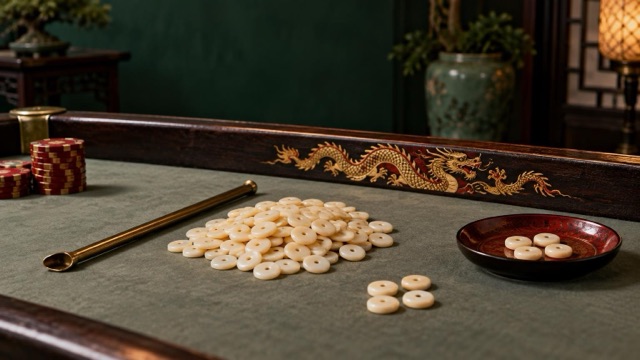
Mahjong in Macau is not just a parlor game. The government publishes official rules for it as a form of legal gaming, and the version played here is the classic four-player game. Four players take part, using a set of 136 tiles, one dealer marker, three dice and a standard mahjong table1.
The 136 tiles break down into five kinds: four each of the three Dragons (中, 發, 白), four each of the four winds, and four each of the 1 to 9 of bamboo, characters and dots1. If you have played Hong Kong-style mahjong, this is the same family: no flowers or jokers, just the core suits and honors.
The goal is simple. The first player to complete a hand of four sets and one pair, 14 tiles in all, wins1. How you get there, and how much the win is worth, is where the game gets interesting, and the sections below walk through it.
There is also a shorter variant, called Simple Mahjong, that the same official rules cover. It is played by two to four players with a 112-tile set, and a winning hand is just one set and one pair, five tiles1. It has no chow or pung: you can only take another player's discard when it completes your hand and wins1. It is a fast, stripped-down game, closer to a sprint than the traditional game's long middle distance.
How the walls, hands and winning hands are set up
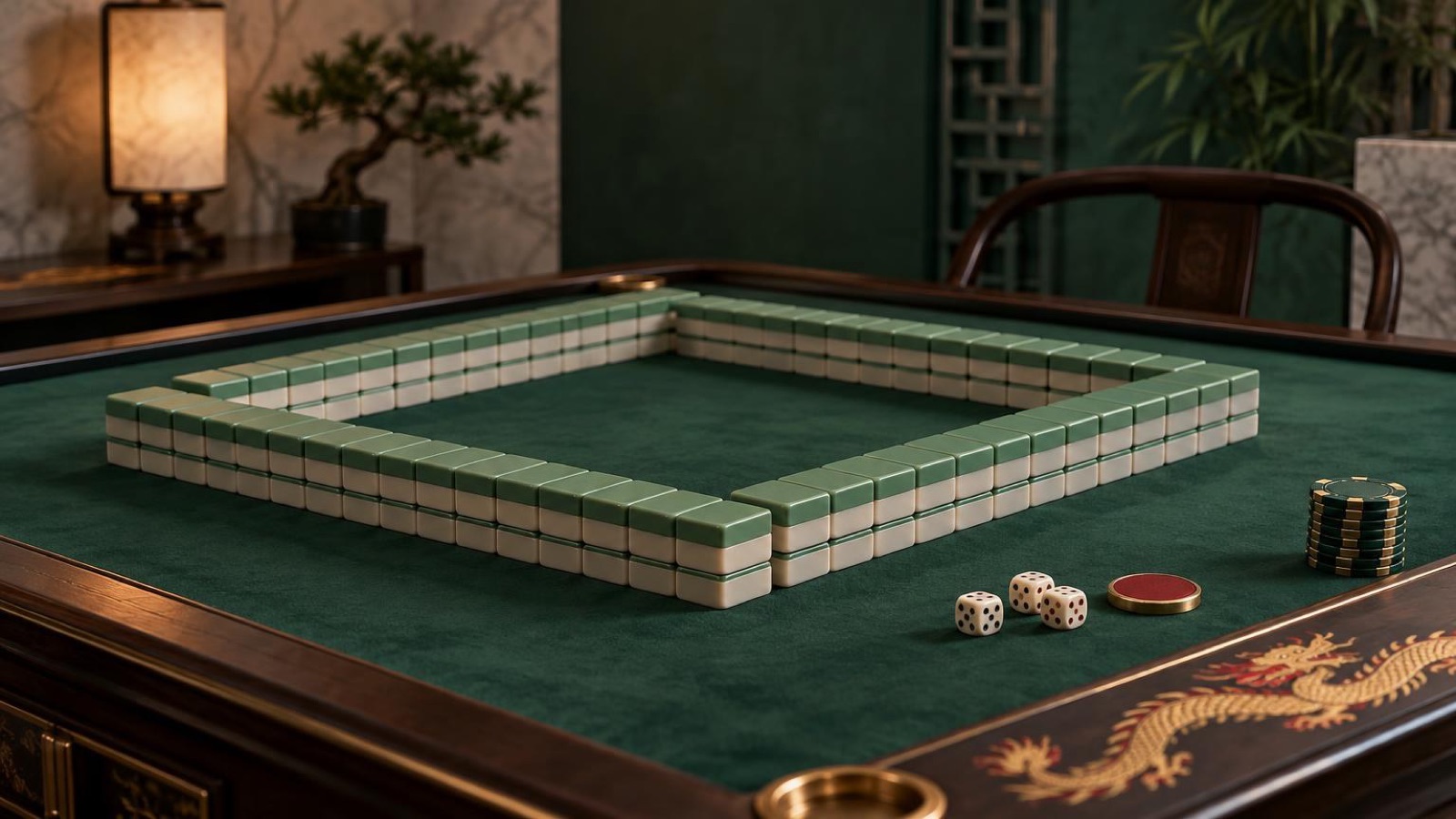
A round begins with building the wall. The 136 tiles are shuffled face down, and each player stacks them into four rows of two-tile stacks, 17 stacks per row, arranged in a square1. (Simple Mahjong, with its smaller set, builds 14 stacks per row instead1.)
Dice are thrown to decide where the wall is broken and who deals, and each player draws a starting hand. In the traditional game you hold 13 tiles and draw one more on your turn, keeping 14 while you decide what to discard1.
The winning hand is always the same shape: four sets and one pair. A set is either a chow (three consecutive tiles of one suit), a pung (three identical tiles) or a kong (four identical tiles)1.
A few house rules from the official text are worth knowing before you sit down:
- A discarded tile cannot be taken back once it hits the table1.
- If you decline a pung you could have claimed, you void your right to win on that tile1.
- You may not look at other players' hands, and an accidental look bars you from declaring a kong that round1.
- A winner can only collect up to the amount of money actually in hand at the table, so bring what you intend to play with1.
Chow, pung and kong: what you can claim from a discard
Discards are the engine of the game. When a player throws a tile away, the others may be able to claim it, and the rules are precise about who can claim what.
Chow. Only the player to the right of the discarder, the "next" player counting counterclockwise, may claim a discard to form a chow. Claiming it costs you that turn's draw from the wall1.
Pung and kong. Any player holding a pair can pung a matching discard, exposing the three tiles. A player holding three identical tiles can kong when the fourth is discarded. Kong can be exposed or concealed, and after any kong the player draws one tile from the end of the wall and discards one, to keep the hand at 13 tiles1. In Simple Mahjong the same rule keeps the hand at five tiles1.
Winning off a discard. If one discard lets two or three players win at once, only one collects: the player seated to the lower right of the discarder, counting counterclockwise1.
The rules also assign liability for careless discards. If you hold back the last copy of an honor tile (for example the last Green Dragon) and then discard something else that lets a player win, you pay for all the players. The same applies if you discard a tile that completes a full flush of nine exposed tiles, the big three dragons or the big four winds, or if you break a pung or fail to declare a win you could have made1. A false win declaration carries its own penalty: the dealer pays two fan to the dealer and one fan to each other player1. On the other hand, all-honors and all-terminal hands never trigger liability, and discarding a fresh Dragon or wind tile that lets another player win requires no liability payment1.
Fan scoring: one-fan and two-fan hands
Wins are scored in fan, and the fan count sets the payout. The official Macau rules list the hands in two tiers.
One-fan hands include1:
- A pung or kong of any Dragon
- A pung or kong of the prevailing wind
- A pung or kong of your own seat wind
- Robbing an exposed kong to win
- Winning on the replacement tile after a kong
- An all-pung hand
- A chow hand (with a pair that is not Dragons or honor winds)
- A mixed one-suit hand
- Winning on the last tile of the round
- Little three dragons
- Little four winds
- Mixed terminals
Two-fan hands, the top of the scale, include1:
- Heavenly hand (the dealer wins with the original deal)
- Earthly hand (a non-dealer wins on the first go-around)
- A pung or kong of a double-value wind
- A kong-on-kong win
- A mixed one-suit chow hand
- A full flush
- Thirteen orphans
- An all-pung hand with no exposed pungs
- Big three dragons
- Big four winds
- Pure terminals
- All honors
In Simple Mahjong the list is shorter: robbing an exposed kong, winning on the last tile of the round, and winning with a Green Dragon tile each add one fan1.
Payment follows the dealer structure. When the dealer wins, the other three players pay double. When a non-dealer wins, the two other non-dealers pay single and the dealer pays double1. So a win against the dealer's hand is worth twice a win against anyone else, and the fan count multiplies through the same logic.
Mahjong Bacarrat: the casino table game
Mahjong Bacarrat (the official spelling) is a different animal: a casino table game, listed in Macau's gaming law alongside baccarat, blackjack, pai gow, fan tan and the other games casinos are licensed to spread2. It is not the four-player tile game; it is a banking game built from tiles, closer in spirit to baccarat, which is the game that dominates Macau's floors and that Chinese gamblers favor over poker and blackjack6.
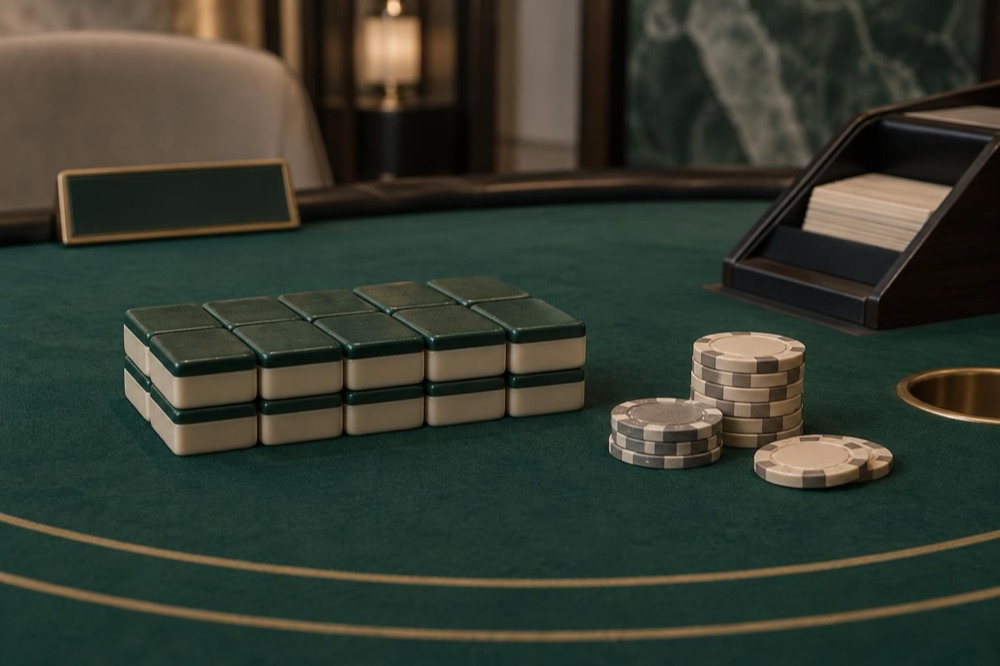
The equipment is distinctive: twenty tiles, the same shape and size as pai gow tiles, divided into ten pairs, ranked K, 9, 8, 7, 6, 5, 4, 3, 2, A. The K counts as no points and the A as one point3.
Each seat receives two tiles. The sum of the two tiles is that seat's points, and nine is the highest. If the sum exceeds ten, only the last digit counts, exactly like baccarat's totals3. So a 7 and an 8 make 5, and a 9 and a K make 9.
The banker position rotates: each seat may take turns as banker, limited to two rounds at a time unless the other seats agree otherwise3. Only one person per seat may turn the tiles, and no one may leave the table to look at tiles during a round3.
How a Mahjong Bacarrat round is bet and paid
Betting happens up front. Players must place their bets before the banker shakes the dice; after the shake, the house accepts no bets, no additions or reductions, and no moved bets3. You can bet on one or more of the ten seats, and each seat can also carry backing bets. The player with the highest bet on a seat is the one who turns that seat's tiles3.
The tie rule is the big difference from baccarat. If the banker and a player both hold the same top combination, the banker wins, regardless of tile size or combination3. In baccarat, by contrast, a tie is usually a push with the original stake returned7. This is the edge that makes the banker seat worth taking, and worth paying for.
The house's cut is 5 percent of the amount won by each winner3. That matches the commission structure across Macau's tables: baccarat takes 5 percent of winning banker bets8, and fan tan's house commission is uniformly set at 5 percent9.
World Series of Mahjong tournaments in Macau
Macau has also been the home of competitive mahjong at the highest stakes. The World Series of Mahjong has hosted tournaments using the Zung Jung scoring system, with events in 2007, 2008, 2010, 2013 and 201510. The tournament format tweaks the game for competition: World Series of Mahjong games are 8 hands long, rather than the longer sessions of casual play4.
The money is serious. Total prizes have reached one million American dollars, with first place taking half4. Entry is not cheap: it costs approximately $1,250 USD just to enter4.
The 2015 edition gives a concrete picture.
| Detail | Figure |
|---|---|
| Main event entry (general entrants) | HKD 8,88811 |
| Registration fee | HKD 77511 |
| Total prize pool | over HKD 4,444,000 (about TWD 22,000,000)11 |
| Grand final | held in December at a physical casino in Macau11 |
For comparison, tournament gaming in Macau more broadly is thriving. The Macao Poker Open's main tournament cost HK$12,000 to enter, drew over 1,200 players and paid out more than HK$8,000,000 in prize money12. If mahjong tournaments are not running during your visit, poker rooms usually are.
Where to play: tables, tournaments and practical tips
Casinos. Macau's casinos are open 24 hours5, and many have restaurants serving international cuisine, so a visit can easily combine gaming with dinner5. Mahjong Bacarrat tables are not as common as baccarat, which dominates the floors, so call ahead or ask at the casino cage if you specifically want the tile version. The major resorts are the natural starting point: The Parisian Macao's casino covers 135,000 square feet with 400 tables, and MGM Macau offers 1,271 gaming machines and 427 table and poker games13. You can read more about individual properties on our pages for casinos in Macau and specific resorts like The Parisian Macao and MGM Macau.
Stakes. Table minimums vary by property and by room. In the VIP sector, patrons were traditionally expected to bring a gaming budget of over MOP500,000 per visit, though casinos sometimes relaxed this threshold during periods of intense competition14. Main-floor tables run far lower. For the traditional tile game itself, remember the official rule that a winner can only collect up to the money actually in hand at the table1.
Tournaments. The World Series of Mahjong has come to Macau repeatedly, and entry has run around $1,250 USD with million-dollar prize pools4. Keep an eye on event announcements if you want to watch or play; the 2015 final was held in a Macau casino in December11. Free-entry mahjong tournaments also exist in the region, such as the MSMC annual tournament, where registration is 100 percent free10, though these are club events rather than casino events.
Practical tips for a first visit.
- Slot machines are available in slot lounges and most casinos if you want a low-stakes warm-up15.
- For the traditional game, learn the fan table before you sit down: knowing that a full flush or thirteen orphans pays two fan, while a Dragon pung pays one, tells you what hands are worth chasing1.
- Watch the discard pile. Liability rules mean careless discards near the end of a round can cost you the whole table's payment1.
- For Mahjong Bacarrat, bet before the dice are shaken; the house will not accept late money3.
- Factor the 5 percent commission into any Mahjong Bacarrat win: a 1,000 pataca win pays out 9503.
- If you are new to Macau's floors generally, start with our guides to casino entry rules and money and payments.
Whether you come for the clack of tiles in a traditional game or the quick rounds of Mahjong Bacarrat, Macau is one of the few places in the world where both live under official rules, side by side with the biggest casino floors anywhere.
Common Questions
How many tiles are in a traditional mahjong set?
A traditional Macau mahjong set has 136 tiles: four each of the three Dragons, the four winds, and the 1 to 9 of bamboo, characters and dots. The set also comes with one dealer marker, three dice and a standard mahjong table.
How much does it cost to enter the World Series of Mahjong?
Entry has cost around $1,250 USD. The 2015 main event in Macau charged general entrants HKD 8,888 plus a HKD 775 registration fee, with a total prize pool of over HKD 4,444,000.
What is the house commission in Mahjong Bacarrat?
The house takes 5 percent of the amount won by each winner. This is charged on winnings, not on your stake, and matches the 5 percent commission Macau casinos charge on winning banker bets in baccarat.
Can two players win from the same discard?
Yes, it can happen, but only one player collects. If one discard lets two or three players win, the player seated to the lower right of the discarder, counting counterclockwise, is the one who wins the hand.
How many players can play Simple Mahjong?
Simple Mahjong, the shorter Macau variant, is played by two to four players. It uses a 112-tile set and each player needs only one set and one pair, five tiles, to win.
What happens if the banker and player tie in Mahjong Bacarrat?
If the banker and a player both hold the same top combination, the banker wins regardless of tile size or combination. This differs from baccarat, where a tie is usually a push with stakes returned.
When do players bet in Mahjong Bacarrat?
All bets must be placed before the banker shakes the dice. Once the dice are shaken, the house accepts no new bets, no additions or reductions, and no moved bets.
Sources15 sources
- Mahjong rules, DICJ, 1991
- Mahjong Bacarrat rules, DICJ, 2026
- Law No. 16/2001, Macau Printing Bureau
- McGill Mahjong blog (archived), McGill Mahjong, 2020
- Macau tourism gaming page, Macao Government Tourism Office, 2021
- Macau casino gambling news (archived), CNN Money, 2014
- Banker and player odds and rebates, GSBet88
- Baccarat rules, DICJ, 2004
- Fan-Tan, Wikipedia, 2026
- McGill Mahjong blog, McGill Mahjong, 2015
- 2015 World Series of Mahjong press release, Yam News, 2015
- Poker guides: Macao, SoMuchPoker, 2026
- Macau's best casinos, CNN Travel, 2018
- The Transformation of Macao's Gaming Industry, University of Macau, 2026
- Gaming and casinos, Macao Government Tourism Office, 2026