Fan tan: how the count works
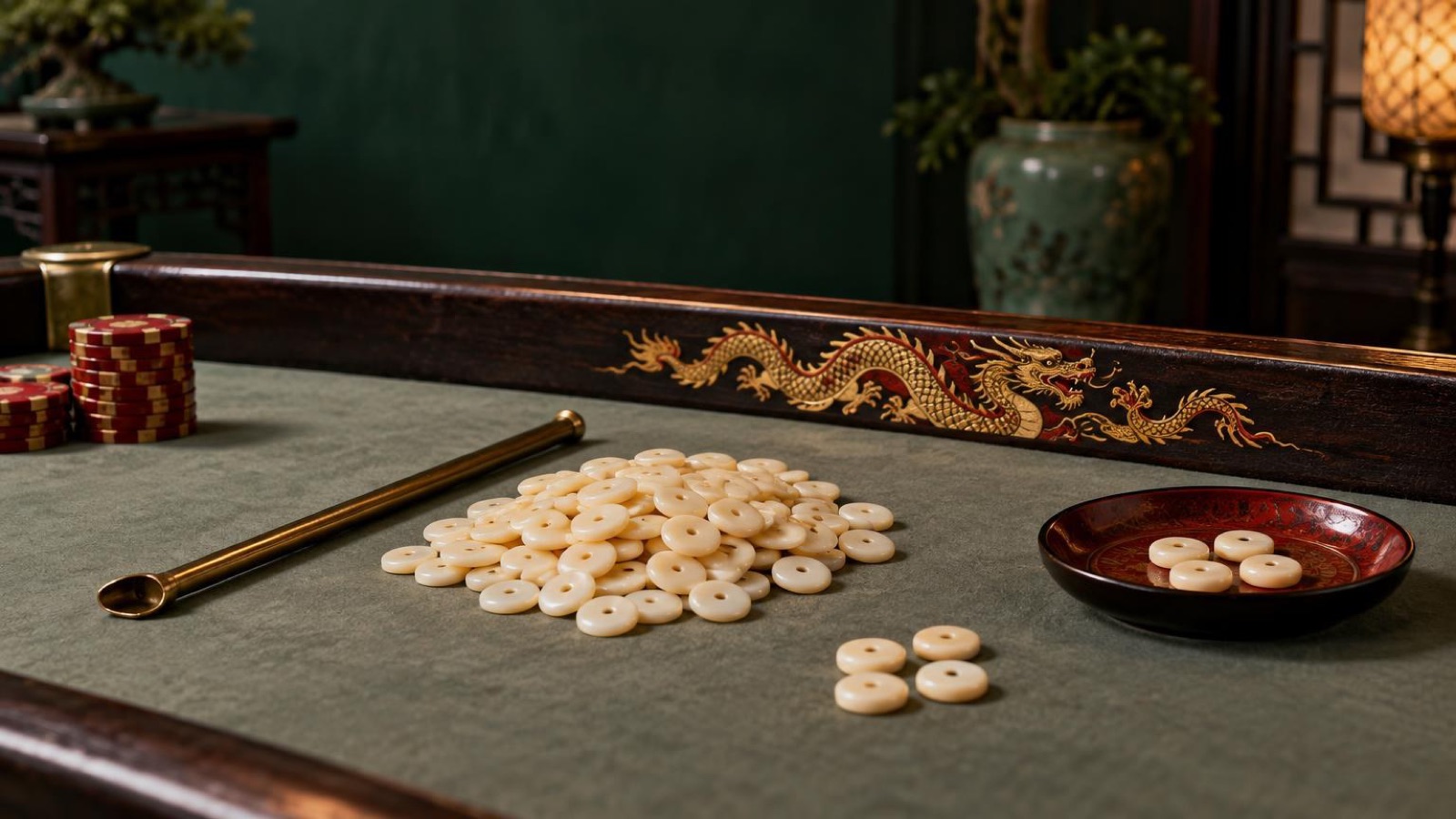
Fan tan is the simplest of Macau's traditional games and one of the oldest. The croupier takes a pile of small buttons, covers a random handful with a metal cup, then removes the buttons four at a time until only a few remain. You are betting on the remainder when the total is divided by four: one, two, three or four6. Gamblers bet on the remainder of the total number of tokens divided by four, and the croupier removes four tokens at a time until one, two, three or four remain6.
The table is marked with the numbers 1, 2, 3 and 4, and you place your chips on the number you think will be left. The classic game offers four potential bets, known as Fan, Hong, Kwok and Nim, which let you cover single numbers, pairs of numbers or splits between them3. A straight Fan bet on a single number pays 3 to 1 when your number comes up4.
| Bet | What it covers |
|---|---|
| Fan | A single number, one to four |
| Hong | A pair of numbers |
| Kwok | A split between two numbers |
| Nim | A three-way split |
One practical note: the four bets, Fan, Hong, Kwok and Nim, are the only wagers Culin recorded at the fan tan table, so the count itself is the whole game2.
Fan tan payouts and the 5% commission
The house commission on fan tan in Macau casinos is uniformly set at 5%3. The commission is deducted from your winnings before payout4, so a winning single-number bet at 3 to 1 pays out 3 to 1 minus the 5% cut.
Because the game is a pure division by four, each of the four numbers has an equal chance of coming up, and the commission is the house's only edge. The same 5% figure appears across Macau's traditional games: mahjong baccarat charges winners 5% of their winnings too7.
Pai Gow: tiles, hands and the banker
Pai gow is a Chinese gambling game played with 32 domino-like tiles5. The name means "to make nine," and that is the whole challenge: arrange your tiles so your hands score as close as possible to nine, the perfect score5.
Each player and the dealer receive four tiles, which they must split into two pairs: a high hand and a second hand5. To win, both of your hands must beat the dealer's corresponding hands. If only one of your hands beats only one of the dealer's, it's a tie and your bet pushes5.
The banker role is important. The banker covers the wagers of the other players on each round, wins on all ties and has special betting privileges5. Instead of the house always banking, the dealer offers the role around the table before each round5. If you are new, feel free to ask the dealer about the rules around hands, playing as the banker, or general gameplay9. To buy chips, place cash on the table and the dealer will exchange it; money and chips are never exchanged directly between a dealer and player10.
How pai gow hands rank
Pai gow hand rankings are unlike any Western game. Any matched pair of tiles is called a Bo, and its ranking depends on the value of the combination5. Certain tile pairs have fixed ranks: a Gong of 12 and any 8 ranks 19th, and a Gong of 2 and any 8 ranks 20th5.
The famous pair is the Gee Joon, the tiles marked 2-4 and 1-2. In the historical game, a round won with this pair, called chí tsün, pays the winner four times if taken by another player and twice by the others, and four corresponding pairs pay eight times and four times respectively11. The Gee Joon remains the highest pair in the modern casino game.
Below the pairs, hands are scored by adding the pips on each tile, with tens dropped, and the goal is to get as close to nine as possible on each of your two hands5.
| Hand type | How it ranks |
|---|---|
| Bo (matched pair) | Ranked by the value of the combination |
| Gong of 12 and any 8 | 19th |
| Gong of 2 and any 8 | 20th |
| Gee Joon (2-4 and 1-2) | Highest pair |
| All other hands | Pips added, tens dropped, closest to nine |
Mahjong baccarat: rules and betting
Mahjong baccarat (mahjong-bacará) is one of the permitted games in Macau's casinos1 and plays like baccarat with tiles. The equipment is twenty tiles the same shape and size as pai gow tiles, divided into ten pairs: K, 9, 8, 7, 6, 5, 4, 3, 2 and A. Tiles rank in that order, with K counting as no points and A as one point7.
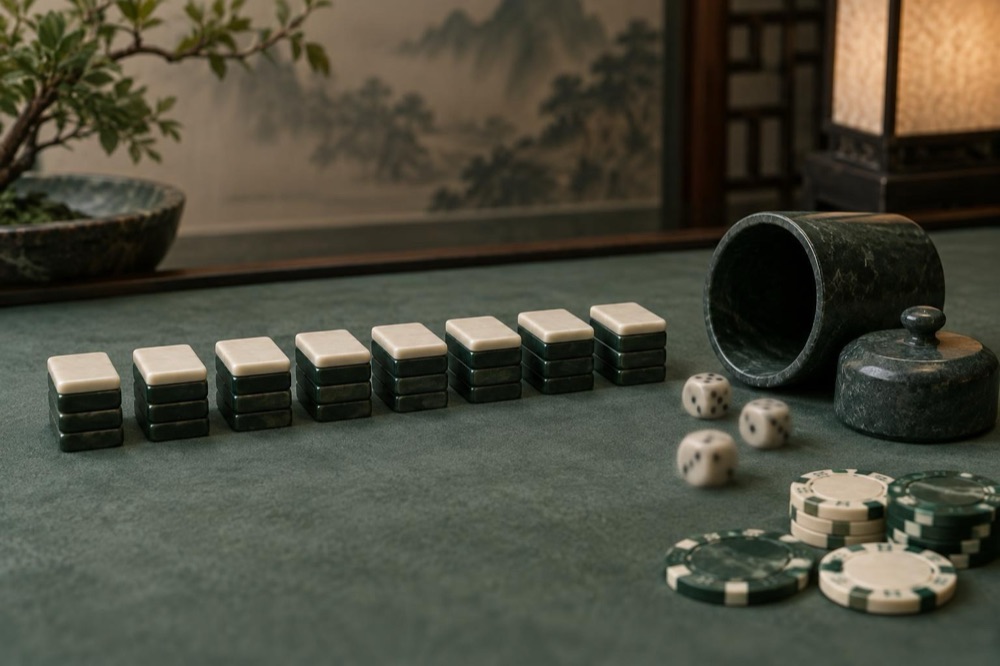
Players must place bets before the banker shakes the dice; after the shake, no bets, additions, reductions or moves are accepted7. You may bet on one or more of the ten seats, and each seat may also carry backing bets. The player with the highest bet turns the tiles for that seat7.
The sum of the two tiles is the seat's points, and nine is the highest. If the sum exceeds ten, only the last digit counts7. If banker and player both hold a tight ten, the banker wins regardless of tile size or combination7.
Each seat may take turns as banker, limited to two rounds each time unless the other seats agree otherwise. Only one person per seat may turn the tiles, and no one may leave the table to look at tiles during a round7. The house charges winners a commission of 5% of winnings7.
| Tile pair | Points |
|---|---|
| K | 0 |
| 9 | 9 |
| 8 | 8 |
| 7 | 7 |
| 6 | 6 |
| 5 | 5 |
| 4 | 4 |
| 3 | 3 |
| 2 | 2 |
| A | 1 |
The older games behind today's tables
The games on Macau's floors today grew out of a family of Chinese gambling games documented in the 19th century, and knowing them explains some of the quirks you'll see at the tables.
Tá t'in kau, an old four-player game, had a scoring system based on tricks: a trick counts 1 point, the holder of four or more tricks pays nothing, a player with two tricks pays for 2 points, one trick pays 3 points, and a player who takes no trick pays 5 points11. The first player, or tsò chong, always pays twice when he loses and is paid double when he wins; if he holds the position, the ratio rises to 3 to 1 in the second game and 4 to 1 in the third11.
Ts'ung shap, another old game, counted a pair (tái) as 10 for each spot on the tiles, a three-piece combination that was a multiple of 10 as 1 point per spot, and a sweep (táp tí) as 4011.
Big Two, still played socially across the region, has its own scoring: pieces with 8 or more spots are tái ü, "large fish," and count 2 points for each spot, while pieces below 8 are sai ü, "small fish," and count 1 point for each red spot11. A related Macau card variant of Crazy Eights uses the Jack as a rank wish card, letting the player choose the rank the next player must serve, with wish cards stackable; the game ends when a player first scores two winning points12.
Even mahjong has deeper roots: the early game of wang ma que was played with thirteen tiles, the same hand size as today13.
Where to find these games in Macau's casinos
Fan tan, pai gow, mahjong, mahjong baccarat and mahjong pai gow are all on the official list of 24 games of fortune permitted in Macau's casinos, alongside baccarat, blackjack, sic bo and roulette1. Casinos are open 24 hours2.
The big Cotai resorts carry the widest selection. The Parisian Macao runs 365 gaming tables14. MGM Macau has run 423 gaming tables15. Traditional game tables tend to sit in the main mass-market floors rather than VIP rooms, so walk the floor and look for the fan tan table's metal cup and button pile.
Away from the casinos, Macau Fisherman's Wharf is the city's only large waterfront leisure and entertainment complex16. For the full picture of the resorts, see casinos in Macau; for who may enter, see casino entry rules in Macau.
Mahjong in Macau
Mahjong itself is a permitted casino game in Macau1, and the regulator's official rules cover both simple and traditional forms. In simple mahjong, certain wins score extra fans: robbing an exposed kong, winning on the last tile of the round, and winning with a Green Dragon tile each count one extra fan17.
Traditional mahjong carries a longer list of two-fan hands, including:
- the heavenly hand and earthly hand
- a pung or kong of a double-value wind
- kong on kong
- mixed one-suit chow hands
- full flush
- thirteen orphans
- all-pung hands with no exposed pungs
- big three dragons
- big four winds
- pure terminals and all honors17
For the full story on tiles, scoring and where to play, see our in-depth page on mahjong in Macau.
Common Questions
Is fan tan legal in Macau casinos?
Yes. Fan tan is one of the games of fortune expressly permitted in Macau's casinos, and you will find it on the floors of the major resorts alongside baccarat and sic bo.
What is the best pair in Pai Gow?
The best pair is the Gee Joon, the tiles marked 2-4 and 1-2. When played together as a pair they rank highest, and they can also count as either 3 or 6 when used individually.
How many tiles are in a Pai Gow set?
A pai gow set has 32 domino-like tiles. Each player and the dealer receive four tiles, which they split into a high hand and a second hand of two tiles each.
What happens if fan tan and the player tie?
Fan tan has no tie. The croupier counts buttons into piles of four and the remainder, one to four, is the result. If a button breaks during the count, the round is void.
Can I play Pai Gow against the house instead of a player-banker?
Yes. The dealer offers the banker role around the table before each round, and if no player takes it the house banks the game. Ask the dealer if you are unsure how it works.
What is the highest straight in Big Two?
The highest straight runs from ace down to ten, with the ace of the highest suit leading. Straights must contain exactly five cards of consecutive rank.
How much is the commission on a winning Pai Gow bet?
The house takes 5 percent of your winnings, deducted before payout. The same 5 percent commission applies to fan tan and mahjong baccarat in Macau casinos.
Where can I play fan tan in Macau?
Fan tan tables sit in the main gaming floors of the big casino resorts, which are open 24 hours. Look for the low tables with a pile of buttons and a metal cup.
Sources17 sources
- Law 16/2001, Macau SAR
- Gaming, Macao Government Tourism Office, October 27, 2021
- Fan-Tan, Wikipedia
- Rules Live, FB88
- Pai Gow Tiles: how to play, PlaySmart
- Fantan, PMC
- Mahjong Bacara rules, DICJ
- Hustler Casino Pai Gow rules, California Attorney General
- Pai Gow Poker etiquette, PlaySmart
- Pai Gow Poker: how to play, PlaySmart
- Culin 1893, Chinese games with dice, Smithsonian
- Crazy Eights rules, Macau variant, Lite Games
- Flowers and Kings: their function in early ma que, The Mahjong Tile Set
- The Parisian Macao, Sands China
- MGM 10-K 2014, SEC
- Macau Legend overview, Macau Legend
- Mahjong rules, DICJ