Malaysian three-player mahjong is a fast, local variant of mahjong played with three people instead of four, a single suit instead of three, and a joker tile called the Fly. It is one of the traditional games you will find in homes and clubs across Malaysia, alongside games covered on our page about traditional gambling games in Malaysia. Hands are short, the scoring is aggressive, and the joker rules give it a flavor all its own.
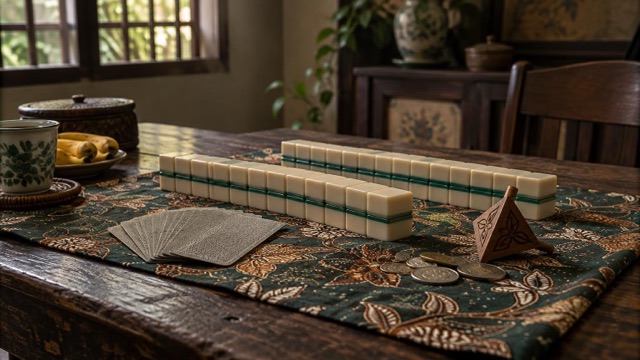
The tile set: 88 tiles, 84 in play
The Malaysian three-player set contains 88 tiles, but only 84 are needed1. The spares mean a lost or damaged tile does not ruin the set, which matters for a game that often lives in a family cupboard for decades.
The breakdown is unusual compared with the mahjong most visitors know. There is only one numbered suit: 36 Dot tiles1. Alongside them are 12 Dragons, 16 Four winds tiles, 8 Flowers and Seasons, 4 Animals (treated as extra Flowers), 4 Faces (also extra Flowers), and 4 Fly tiles, which are jokers1.
The single suit is the biggest structural difference. In standard mahjong you build hands from three suits (Dots, Bamboos and Characters) plus honors. Here, everything numeric is Dots, so the wall is smaller, the draws are faster, and the honor tiles and bonus tiles carry more of the scoring weight. The four-player Malaysian game is a different animal altogether: it uses 164 tiles, including 24 flowers and 4 jokers3.
Players, seats and the wall
The game is organized for exactly 3 players2. With no fourth chair, the players are called East, South and West; there is no North player1. The North wind tiles still exist in the set and are played like any other wind tile, they just do not belong to a seated player.
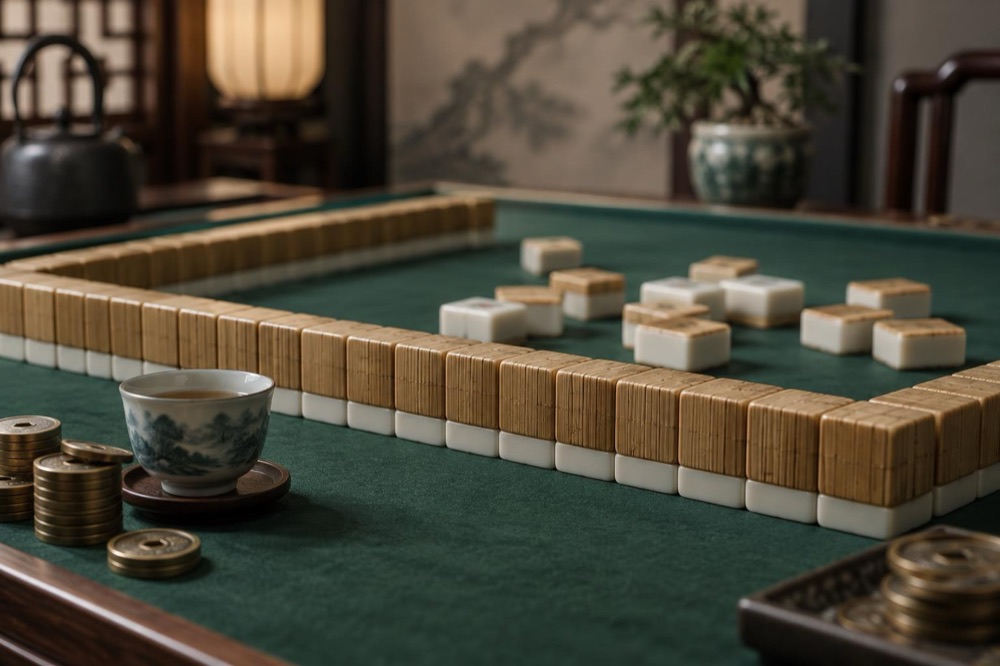
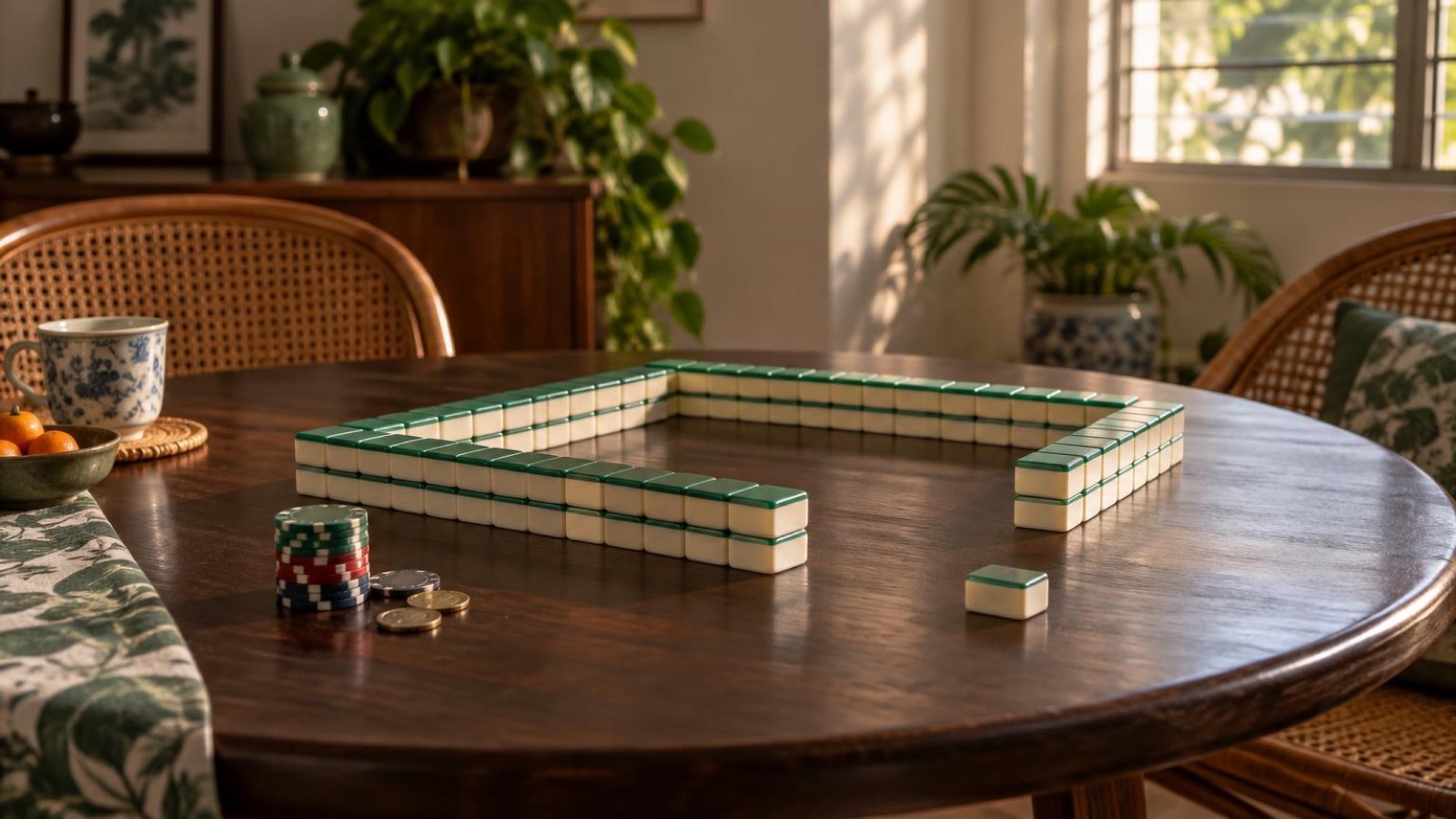
Each player builds a 14-tile-long wall, 2 tiles high, as in other forms of mahjong1. Each wall therefore holds 28 tiles, and three walls make the 84 tiles in play, which is why the set needs exactly that many.
The dealer starts with 14 tiles and the other players with 132. Play then proceeds as in ordinary mahjong: the dealer discards, and each player in turn draws a tile from the wall and discards one, unless they claim a discard to form a set. When a player completes a hand of four sets and a pair, they win the round.
The Fly tile: joker rules and limits
The Fly is the joker of this game, and it is where most of the strategy lives. The Fly can be used to represent any tile in making a 3-tile set1. So if you hold two Red Dragons and draw a Fly, the Fly can stand in as the third Red Dragon for a PONG.
There are limits, and they are strict:
- A GONG set (four of a kind) cannot contain a Fly2. If you want four Red Dragons, you need all four real tiles.
- You cannot PONG with 3 Fly tiles2. Three jokers do not make a set on their own.
- You may use 2 Fly tiles to PONG a discarded tile, alongside one real tile2.
- You can use 1 Fly to CHOW another player's discarded tile, filling a run with the joker2.
- Using 2 Fly tiles to CHOW counts as a PONG, and you can also make a concealed CHOW with 2 Fly tiles2.
If two players want to PONG the same discarded tile at the same time and one is using Fly tiles, the player without the Fly gets the PONG2. Real tiles beat jokers in a tie, which is worth remembering before you commit your Flies to a claim.
A Fly can also act as a flower, contributing 1 fan if you find yourself short of the fan you need to win2. This escape hatch matters a great deal because of the high minimum hand, covered next.
Scoring and points: 20 points per fan
Scoring in this game is built around the fan, a unit of hand value. One fan equals 20 points, and the minimum winning hand has 100 points for 5 fan1. That minimum is the headline rule of the variant: you need a minimum of 5 fan to win1. In many other versions a much weaker hand can take the pot, so players coming from Hong Kong or Japanese mahjong need to adjust their expectations. A hand that would be a comfortable winner elsewhere may be worth nothing here.
The winning hand itself carries a base of 100 points1. Fan are then added from a long list of patterns and bonuses. Each Fly you hold scores 50 points on its own1. Common fan sources include:
| Pattern | Fan |
|---|---|
| One face | 1 |
| Four faces | 1 |
| One animal | 1 |
| Four animals | 1 |
| Four flowers | 1 |
| Four seasons | 1 |
| Own flower or season | 1 |
| Number four flower or season | 1 |
| PONG of North or East wind | 1 |
| PONG of own wind | 1 |
| PONG of Dragon | 1 |
| Two PONG and a pair of dragons | 3 |
| Mix one suit | 1 |
| Same suit only | 3 |
| All CHOW with eye as dot tile | 1 |
| All PONG/GONG | 2 |
| Winning on loose tile (flower) | 1 |
| Winning on loose tile (GONG) | 1 |
| Seven twin | 1 |
| Stealing GONG | 1 |
The dealer gets a small edge: a dealer with an East wind PONG scores 2 fan instead of the usual 1 for a PONG of own wind1.
Certain hands double the score and are called Max Fan, worth 200 points1. Max Fan hands include 13 Unique Wonders (only possible with all 3 suits, so not in this single-suit game), Nine Gates, a PONG of four winds, four GONG, four Fly, winning with the first or last tile, sixteen flowers, or a hand worth ten fan or more1. If a winning hand contains more than one Max Fan type, the max fan point is doubled per type, for example 200 times 3 equals 600, or 200 times 5 equals 1000, though this depends on what the players agree before starting1.
GONG scoring is separate from fan. A revealed GONG is worth 50 points, and a concealed GONG is worth 100 points, with both other players losing points on a concealed one1. A revealed set of flower, seasons, faces or animals costs each other player 100 points from the initial hand, and 50 points after the first hand1.
Payoffs: self-draw vs winning on a discard
How you win changes who pays. If a player or the dealer wins by self-draw, meaning they draw the winning tile from the wall themselves, each player loses double the winning points to the winner1. A self-drawn win is therefore the most lucrative outcome, since both opponents pay the doubled amount.
If a player wins on another player's discard, the discarder loses double the winning points, and the other player loses just the winning points1. The player who threw away the winning tile pays for everyone's carelessness, which is the same principle found in mahjong payment systems generally, where the discarder pays extra and the others pay a base amount4.
A worked example makes it clear. Suppose you win a hand worth 100 points (the minimum 5 fan) on a discard from the South player. South pays you 200 points, double the winning points, and West pays you 100 points, for 300 points in total. If instead you had drawn the winning tile yourself, both players would pay double, and you would collect 400 points. A Max Fan hand at 200 points won on a discard collects 400 from the discarder and 200 from the third player.
How it differs from the mahjong you may know
The obvious difference is the player count, but the deeper ones are the single suit, the 5-fan minimum and the Fly joker. In the four-player Malaysian game the set balloons to 164 tiles with 24 flowers and 4 jokers3, and other regional variants differ again: some Chinese versions use 108 tiles with suit tiles only and no winds or dragons3.
The minimum-hand rule is where habits from other games will cost you. In Korean mahjong, for example, you must make at least 2 fan unless you finish a fully concealed hand5. In competition rules a hand must score at least 8 points to declare a win6. The Malaysian game sits between these in spirit but demands more fan than most casual versions, and the Fly-as-flower rule exists precisely to help players scrape together the fifth fan.
Scoring caps also differ. Some traditions cap a single hand's payment, with a maximum a loser could pay of 3000 points in one limit-hand system7, while others set a 2000-point limit per hand8. The Malaysian game has no such stated cap; instead the ceiling comes from the Max Fan doubling rules, which the players themselves agree on before play.
What to expect at a first game
Each round takes about 5 to 15 minutes1, so a session moves quickly. There are no round winds and no limit on the number of rounds to play; the game ends when 2 or more players agree to stop1. That makes the length of a session entirely social: one hand after dinner, or an entire afternoon if the table is enjoying itself.
For a first game, the things to nail down before the first deal are the house agreements. The doubling of Max Fan for multiple types depends on player agreement1, so ask how the table handles it. Confirm how points are being tracked, whether on paper, with chips or with coins, since the payoffs after each hand are the whole point of the exercise.
Practical points for a newcomer:
- Learn the fan list before you play, not during. With a 5-fan minimum, you cannot win by accident, and you need to know which patterns stack.
- Hold your Fly tiles until they matter. They are worth 50 points each in hand and can rescue a hand that is one fan short.
- Watch what you discard late in a hand. The discarder pays double, so a careless throw can cost you more than the other player combined.
- Remember there is no North seat. If you are used to four-player etiquette, the rotation and the wind rounds work differently here, and there are no round winds at all.
If you are in Malaysia and want to see the wider gambling landscape this game sits inside, from casinos in Malaysia to the Malaysia lottery, our country guide covers what is available and where. And if you enjoy traditional local games, Penang rummy is another variant with its own regional quirks.
Common Questions
How many tiles are in a Malaysian 3-player mahjong set?
The set contains 88 tiles, but only 84 are needed for play. The extra tiles are spare flowers and jokers, so a chipped or lost tile does not end the game.
Why is there no North player?
With only three players, the seats are East, South and West. North is simply left out, and the wind tiles, including North wind, stay in the set and are played like any other tile.
What is a Fly tile and how is it used?
The Fly is a joker. It can stand for any tile when you make a three-tile set, and it can act as a flower worth 1 fan. It cannot be used in a GONG, and you cannot PONG with three Flies.
What is the minimum fan needed to win?
You need at least 5 fan to declare a win. This is higher than in many other versions of mahjong, so a hand that would win elsewhere may not qualify here.
How many points is a winning hand worth?
Each fan is worth 20 points, and the minimum winning hand of 5 fan is worth 100 points. A Max Fan hand doubles the score to 200 points, and multiple Max Fan types can double it again.
What happens if two players want to PONG the same tile with Fly tiles?
The player without the Fly tile gets the PONG. Using real tiles beats using jokers when two players claim the same discard at the same time.
How long does one round take?
Each round takes about 5 to 15 minutes. Because there are only three players and 84 tiles in play, hands move faster than in the four-player game.
When does the game stop?
There are no round winds and no fixed number of rounds. The game ends whenever two or more players agree to stop, so a session can last one hand or a whole evening.
Sources8 sources
- Malaysian 3-Player Mah-Jongg, Sloperama, accessed 2026
- Malaysian 3-Player Mah-Jongg, Sloperama, accessed 2026
- Mah-Jongg FAQ 2b: Variations and Other Tile Games, Sloperama, 2002
- A Guide to Mahjong, Mahjong MIL, 2024
- Mahjong Rules, Gareth J M Saunders, archived 2013
- McGill Mahjong Blog, McGill Mahjong, 2017
- How to Play Mahjong, Zenblaster, archived 2003
- NMB-NTS Spelregelboekje, Mahjong Bond, 2019