The traditional games played in Malaysia
Walk into a Malaysian home during a festival, a coffee shop after work, or a club room on a weekend, and the games you are most likely to see are not the ones on a casino floor. They are games that grew up in this part of the world: a three-player version of mahjong that is found almost nowhere else, Malay card games like Ceki and Cherki that date back to the Straits Settlements, quick banking games played for small stakes, and spinner games that need nothing more than a teetotum and a mat.
The historical record shows how deep this tradition runs. Under the gambling farms of the old Malay States, operators licensed games like chap-ji-ki, where bets were made on which character the banker would drop into a box, and fan-tan, which involved betting on the correct number of hidden counters6. Those farm games have mostly faded, but the family and club games around today carry the same mix of Chinese, Malay and Peranakan influences that shaped them.
The games themselves sit in an odd legal position. Lotteries, casino games and horse racing are lawful in Malaysia, while sports betting at bookmakers and online gambling are not4. The licensed world consists of one casino operator, the licensed lotteries and number forecast operators, and horse racing at three turf clubs in Penang, Perak and Selangor7. The traditional games described on this page are mostly played privately among friends, and for Muslim Malaysians almost all types of gambling, online and offline, are prohibited4. If you are a visitor or expat invited to a game, the practical point is simple: these are social games played in homes and clubs, not licensed casino products, so treat any invitation as a private matter.
Malaysian three-player mahjong: how it differs from the Chinese game
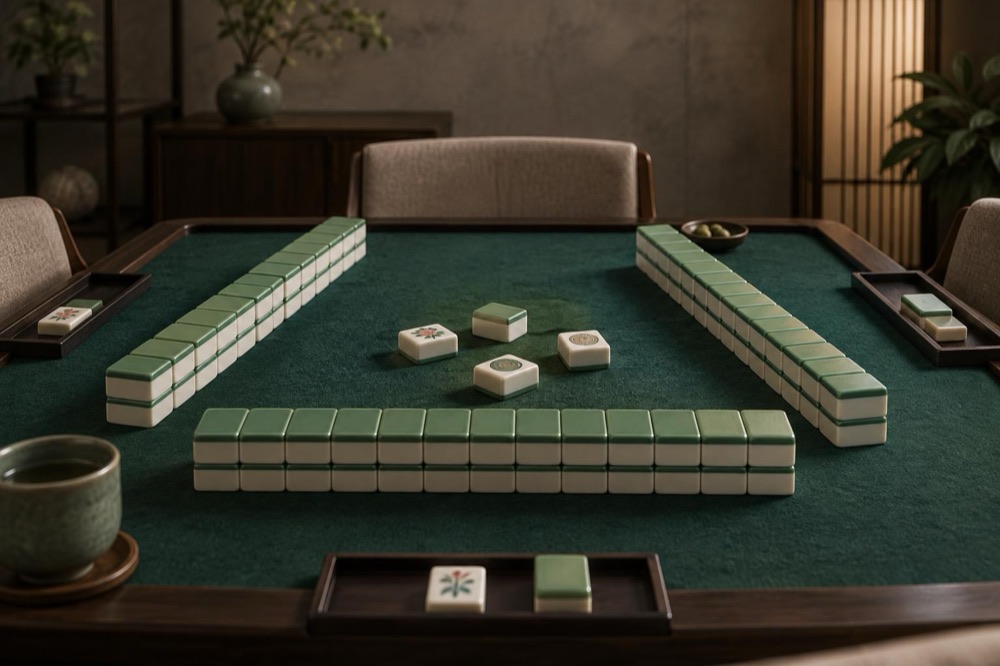
The first thing that strikes anyone who learned mahjong in China, Hong Kong or the West is that this version is built for three players, not four. There being no North player, the three players are called East, South and West1.
The differences go well beyond the missing seat:
- The dealer starts with 14 tiles and the other players with 13, as in other forms of mahjong, but the wall each player builds is only 14 tiles long, two tiles high1.
- There are no round winds and no limit on the number of rounds. The game simply ends when two or more players agree to stop1.
- You need a minimum of 5 fan to win, which is a higher bar than most Chinese variants set and shapes how cautiously you have to build a hand1.
The payment rules also differ in a way that matters to your wallet. If a player or the dealer wins by self-draw, each player loses double the winning point to the winner. If the win comes on another player's discard, the discarder loses double the winning point while the third player loses only the single winning point1. So the player who feeds the winning tile carries the heaviest loss, a rule that makes Malaysian players famously careful about which tile they release.
There is also a Malaysian four-player variant, which uses 164 tiles including 24 flowers and 4 jokers, so the three-player game is not the only local form1. But the three-player version is the one most often meant when Malaysians talk about "Malaysian mahjong."
Malaysian three-player mahjong: tiles, walls and scoring fans
The tile set is where the Malaysian character of the game really shows. The full equipment list1:
| Tile type | Count |
|---|---|
| Dot tiles | 36 |
| Four winds | 16 |
| Dragons | 12 |
| Flowers and Seasons | 8 |
| Animals (or extra Flower) | 4 |
| Faces (or extra Flower) | 4 |
| Fly (or Joker) | 4 |
The fly tiles are the local invention. A fly can be used to represent any tile in making a three-tile set, and it can act as a flower contributing 1 fan, but it cannot be contained in a GONG set and you cannot PONG with three flies1. Each fly is worth 50 points when the scoring is settled, so a hand with several flies on the table moves real money1.
Scoring runs on fan, the unit of hand value. Some of the standard fan awards1:
- One face: 1 fan
- Four faces: 1 fan
- One animal: 1 fan
- Four animals: 1 fan
- Two PONG and a pair of dragons: 3 fan
- All CHOW with the eye as a dot tile: 1 fan
- Stealing GONG: 1 fan
- Winning on a loose tile (flower or GONG): 1 fan each
Certain hands trigger what players call Max Fan, which doubles the score. These include thirteen unique wonders (only with all three suits), Nine Gates, a PONG of four winds, four GONG, four flies, winning with the first or last tile, sixteen flowers, or any hand worth ten fan or more1.
Revealed sets carry their own point costs. A revealed GONG is worth 50 points, and if it comes from a discard, the discarder loses 50 times 2, or 100 points. For a revealed set of flowers, seasons, faces or animals from the initial hand, each player loses 100 points; after the first hand, that drops to 50 points each1.
If you want the full rule set, tile by tile and fan by fan, our dedicated page on Malaysian three-player mahjong goes through the whole game.
Ceki and Cherki: the card games of the Straits settlements
Ceki is a Malay card game with roots in the Straits Settlements era, and it is still played in kampung houses and family gatherings. Cherki is a closely related Peranakan version of the same game, and the two names are often used interchangeably.
The objective is to form three mata, or sets, each consisting of three cards of the same value regardless of suit2. Each player receives eight cards, dealt two at a time clockwise, four times, so the whole deal is quick2.
The play has a distinctive moment that gives the game its name. A player who achieves two full mata and one pair shouts "ceki" while placing the pair face down, and from that point may no longer change the two mata2. That call locks your hand and signals to the table that you are one card from going out.
Scoring is where the money moves. Each mata is worth the sum of its card values, so a mata of three jits is worth 21 points, three times seven2. The kaki cards, the illustrated cards unique to this deck, are worth only one point each, so a mata of three kaki is worth just 3 points, and kaki cards only form mata of the same pattern, such as three of the same figure2. At the end of each round, the winner receives an amount of money equal to the points scored, paid by the opponents2.
Because the values are printed on the cards themselves, a first game is easy to pick up: match three of a kind, shout when you are close, and count the points at the end.
Daun Tiga: the three-card banking game
Daun Tiga, whose name simply means "three leaves" or three cards, is a fast banking game in the same family as the casino game Dragon Tiger. The structure will be familiar to anyone who has played that game: there are two betting spots, one for each side, the banker deals one card to each, and the higher card wins, with players choosing between the two sides or a tie8.
Card ranking follows the convention of the region: the king is the highest card and the ace is the lowest3. Because each round is a single card against a single card, a hand takes seconds to play, which is exactly the appeal. Stakes in home games are typically small, and the banker position usually rotates around the table so no one holds the edge all night.
It is a game of pure luck rather than skill, which makes it the traditional choice when a mixed group of ages and abilities sits down together and nobody wants to spend the evening learning rules.
Belangkai: the spinning teetotum game
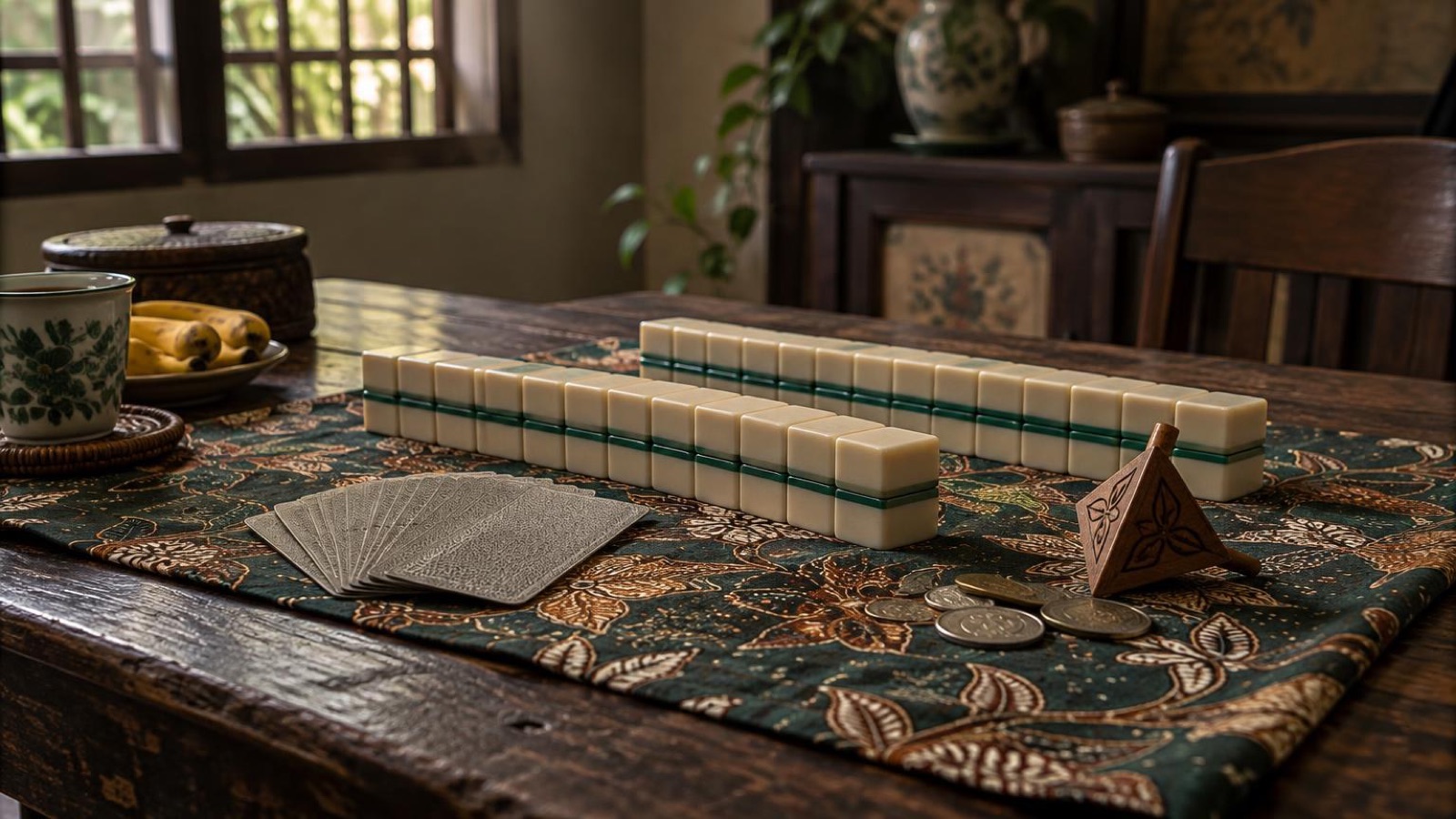
Belangkai is the most low-tech game in the Malaysian tradition. It uses a teetotum, a small spinning top marked with symbols, usually four, one on each face. Players bet on which symbol the top will land on, the banker spins, and the bets are settled when the top falls.
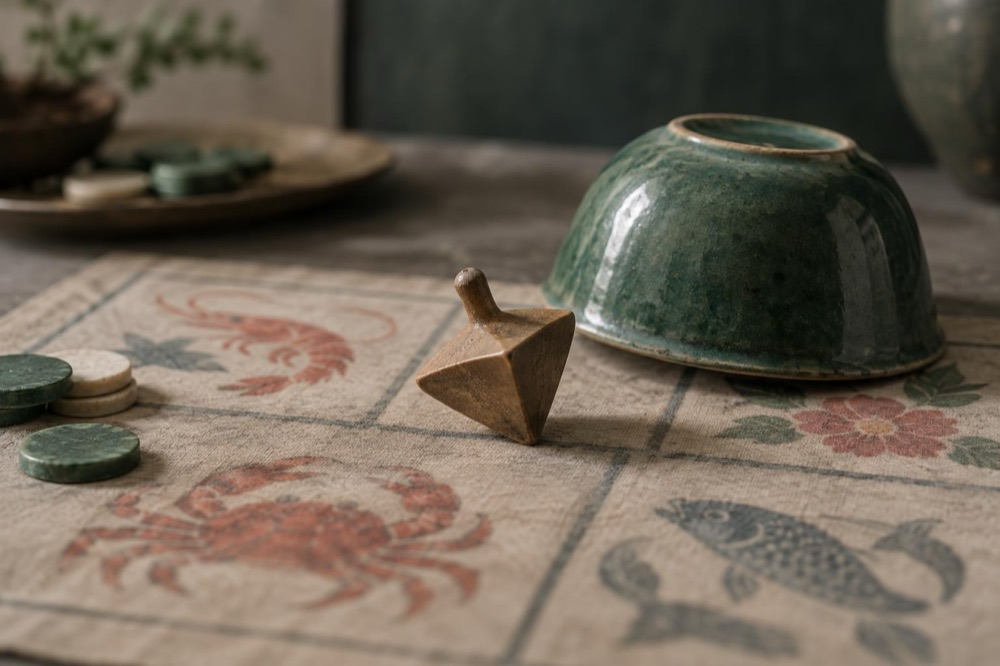
It belongs to the same old family of banker games as chap-ji-ki and fan-tan, the licensed farm games of the Malay States, in which players bet on an outcome the banker produces, whether a character dropped into a box or a count of hidden counters6. Belangkai needs no cards, no tiles and no table beyond a flat surface, which is why it survived as a children's game in some households and a gambling game in others.
Payout conventions vary from house to house, so if you sit into a game, ask the banker how the symbols pay before the first spin. The game's charm is precisely that everything is settled in one spin.
Where to read more: game guides on expatbets
We have dedicated pages that go much deeper on the games and the wider Malaysian gambling scene:
- Malaysian three-player mahjong: the complete rules of the three-player game, the full fan table, the fly tile rules, the Max Fan hands and the payment arithmetic for self-draws and discards. If you want to actually play, start here.
- Penang Rummy: the local rummy tradition of Penang, the island whose club life has long been a center for card games, alongside the practical side of visiting, since the Penang Turf Club at Racecourse, Jalan Batu Gantong, 10450 Penang, still hosts race days with off-course races operated every Saturday and Sunday9.
Beyond the traditional games, you can read about the licensed side of things in our guides to casinos in Malaysia, the Malaysia lottery and horse racing in Malaysia, or get the big picture on gambling in Malaysia.
Common Questions
How many players does Malaysian three-player mahjong need?
Exactly three, seated as East, South and West. There is no North player, which is one of the main structural differences from the standard four-player Chinese game.
What are fly tiles worth in Malaysian mahjong?
Each fly is worth 50 points when scored. A fly can also stand in for any tile when completing a three-tile set, and it can act as a flower worth 1 fan, but it cannot be part of a GONG set.
How do you win at Ceki?
Build three mata, meaning three-card sets of equal value. When you hold two full mata plus a pair, you shout ceki and lay the pair face down. The winner collects from each opponent an amount equal to the points scored.
What is the minimum fan needed to win a hand of Malaysian three-player mahjong?
You need at least 5 fan to go out, which makes the game tighter than most Chinese variants. Certain hands, like Nine Gates or thirteen unique wonders, trigger Max Fan and double the score.
Sources10 sources
- Malaysian Mah-Jongg, Sloperama, accessed 2026
- Ceki, Wikipedia Bahasa Melayu, accessed 2026
- Rules Live, FB88, accessed 2026
- The state of gambling in Malaysia, NewsBytes, February 24, 2022
- Travelling to Malaysia? Here's all you need to know about gambling there, TravelDailyNews Asia, July 5, 2022
- History of gambling in British Malaya, British Malaya blog, November 1, 2022
- Online gaming in Malaysia, Advennt, 2025
- Online casino games, Natural8, accessed 2026
- Penang Turf Club off-course races, Penang Turf Club, accessed 2026
- Fixtures and results 2013, Penang Turf Club, 2013