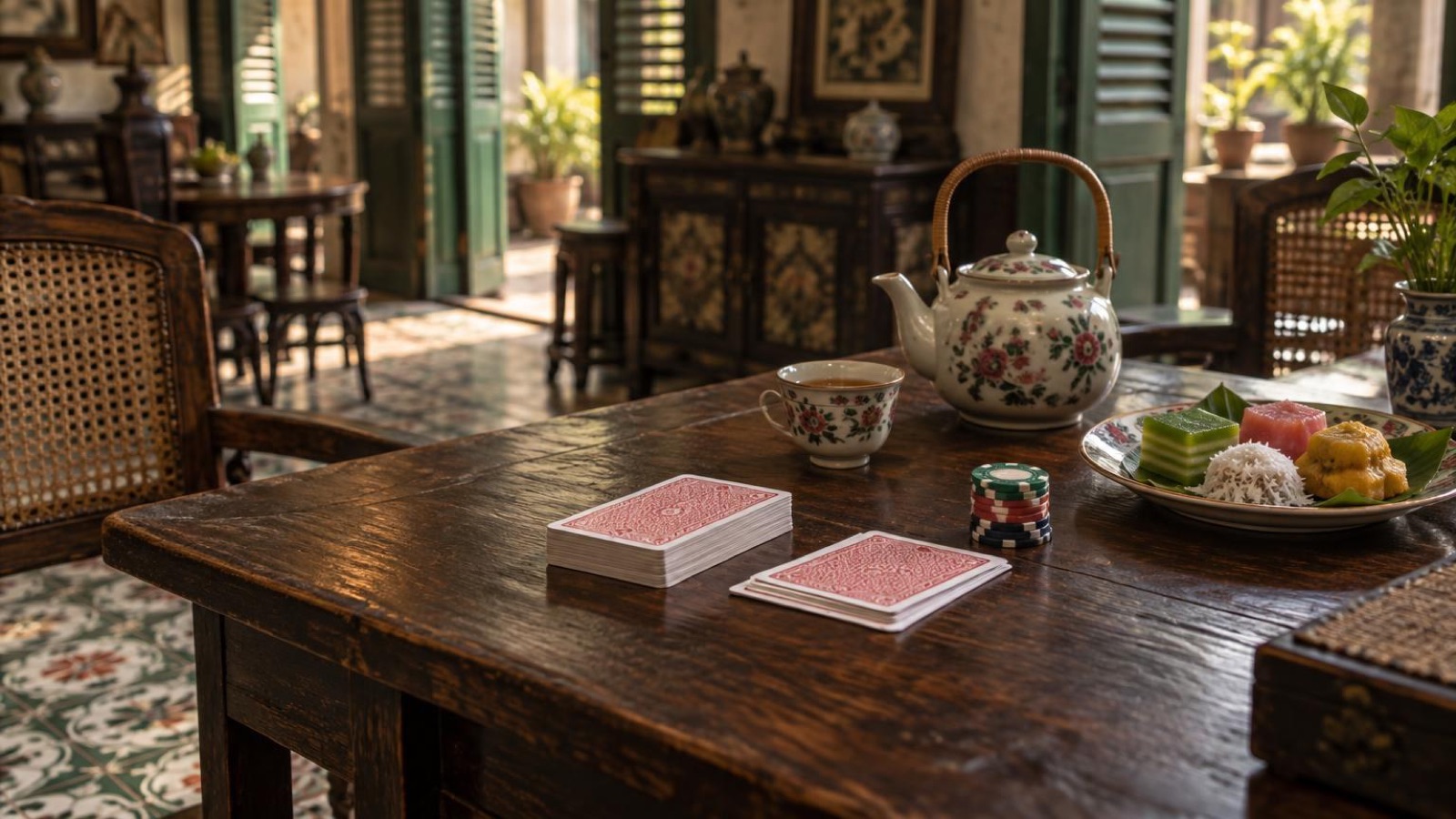
What Penang Rummy is
Penang Rummy is Malaysia's homegrown entry in the rummy family, the group of draw-and-discard card games where you collect cards into matching combinations while shedding the ones that do not fit. If you have seen Indian Rummy, gin rummy or any of the Asian rummy variants, you will recognize the skeleton immediately: you are dealt a hand, you draw a card each turn, you discard a card each turn, and the first player to organize everything into valid combinations wins.
The game belongs to a wider Malaysian tradition of social card play. The country has a long history of card and tile games played in homes, coffee shops and social clubs, and Penang, with its mix of Chinese, Indian and Malay communities, has always been a place where several card traditions sit side by side. The Malay game ceki, for example, is a three-card game where, at the end of each round, the winner receives an amount of money equal to the points scored, paid by the opponents3. That pay-the-points structure is exactly how rummy games are settled for money across the region, and it is how a money session of Penang Rummy typically works too.
The rummy structure the game follows is well established. Games of this type are played by 2 to 6 players, dealt from one or more packs of 53 cards each, with each pack including one printed joker1. Each player receives 13 cards1. That player count and hand size make the game flexible: it works as a quiet two-player contest or as a lively six-player family game, which is part of why rummy variants spread so easily from one community to another.
What marks Penang Rummy as Malaysian rather than simply "rummy played in Penang" is the setting and the local flavor around the table. House rules vary from one family to the next, stakes are usually small and social, and the game is as much an excuse to gather as it is a contest. It sits alongside other traditional games covered in our guide to traditional gambling games in Malaysia.
How a hand is played
A hand of Penang Rummy follows the standard rummy rhythm, and a single hand moves quickly once everyone knows the flow.
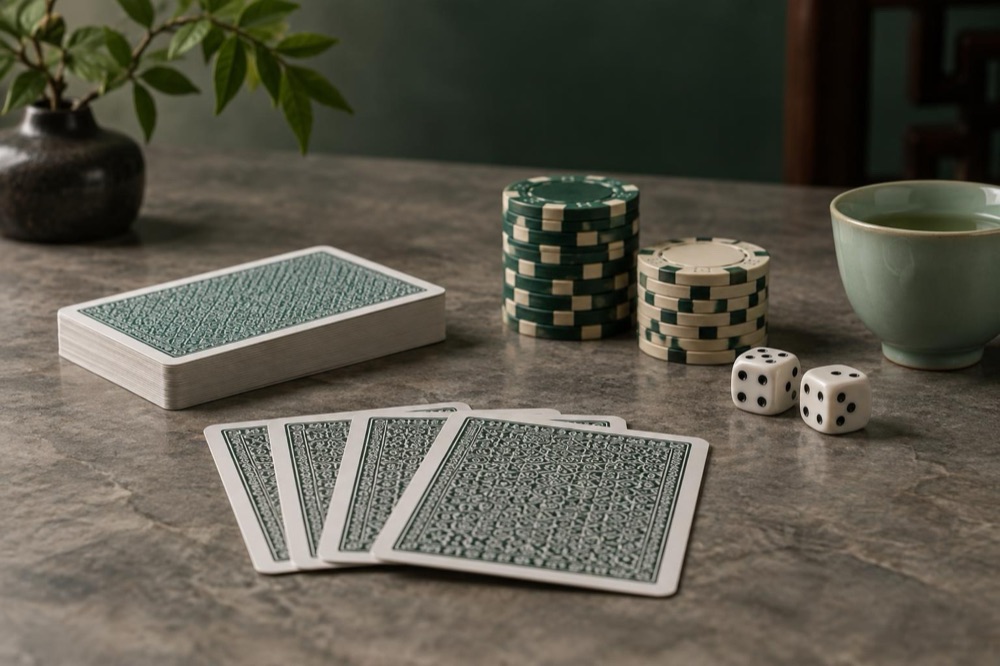
The deal. Each player is dealt a set of 13 cards, dealt randomly from the deck1. With more players at the table, more decks are used, each deck being 53 cards including its printed joker1. The remaining cards form the draw pile, with one card turned face up to start the discard pile.
The objective. Your goal is to arrange your 13 cards into valid combinations: sequences, which are consecutive cards of the same suit, and sets, which are cards of the same rank in different suits. In rummy games of this type, the objective requires two compulsory sequences, one of which must be pure, meaning made without a joker2. A joker can stand in for any missing card in a combination, but a pure sequence has to be built from actual suited cards.
Your turn. On each turn you draw one card, either the top card of the draw pile or the top card of the discard pile, and then discard one card face up onto the discard pile. Draw, consider, discard. That loop continues around the table until one player has organized their whole hand into valid combinations and can finish.
Going out. The player who finishes the hand after meeting the game objective wins2. In practice this means laying down your completed combinations, with the final discard closing the hand. The other players then count what is left in their hands, which is where the scoring comes in.
A few practical points for a first game:
- Keep an eye on what other players pick up from the discard pile. It tells you which combinations they are chasing.
- The pure sequence requirement means you cannot rely on jokers for everything, so an early suited run is worth more than it looks.
- Because each player holds 13 cards and the draw pile is shared, a six-player game burns through the deck faster than a two-player game, so more packs are used1.
Scoring and how points are counted
Scoring in Penang Rummy follows the points system used across rummy games of this type, and it is simple enough to settle on the back of an envelope.
Card values. Every card carries a point value, and the loser's score is the sum of the points carried by the cards left in their hand2. The winner scores zero. Face cards and aces carry the heaviest values, which is why holding them late in a hand is dangerous.
The sequence rule. The key scoring rule is what happens to a player who goes out of the hand without the two compulsory sequences, one of which must be pure: their score is the sum of the points carried by all cards in their hand2. In other words, if you have not built your compulsory sequences when someone else finishes, nothing in your hand is safe, and you pay for every card you are holding. A player who has met the sequence requirement only pays for the cards that do not fit into valid combinations.
The minimum. In a deal-show situation, where hands are very close, the minimum points a losing player can get is 2, for scores of 2, 3, 4 and 51. So even the luckiest loser pays something, and the winner always collects.
Settling up. In money play, the regional tradition is direct: at the end of each round, the winner receives an amount of money equal to the points scored, paid by the opponents3. In organized deals-rummy formats, the same idea is expressed as winnings equal to the sum of the points of all opponents, multiplied by one tournament chip per point1. At a kitchen table in Penang, it usually just means each loser pays the winner according to their deadwood, in ringgit, at an agreed rate per point.
A worked example: say you agree RM1 per point.
| Player | Unmatched points | Settlement |
|---|---|---|
| Winner | 0, clean hand | Collects RM33 for the hand |
| Opponent 1 | 24 | Pays RM24 |
| Opponent 2 | 9, met the sequence requirement | Pays RM9 |
That is the whole settlement, done in under a minute, and the next deal begins.
Where the game is played in Penang
Penang Rummy is a domestic and social game, and that is where you will find it. There is no rummy room, no casino floor spread and no public venue that hosts the game the way a card club might. The natural homes of the game are:
- Family living rooms, especially on weekends and around festivals, when generations gather and card games come out.
- Coffee shops and kopitiam back tables, where regulars play long social sessions, usually for small stakes.
- Community and clan association halls, which have long been gathering points for Penang's Chinese community and host card and tile games of many kinds.
- Private friend groups, where the game travels by invitation rather than by venue.
This is in keeping with Penang's wider gambling geography. The island's one great licensed gambling institution is the Penang Turf Club at Racecourse, Jalan Batu Gantong, 10450 Penang, Malaysia5, which hosts horse racing and betting, and visitors must be 18 or older, with children under 18 not admitted6. But that is racing, not cards. Card games like rummy live in the informal economy of home play, and always have. Historically, gambling was illegal in Penang while it was permitted in neighboring Perak7, which pushed card play firmly into private settings, and that pattern stuck even as the legal landscape around licensed operators changed.
If you are a visitor to Penang and want to play, your realistic route is being invited to a game. Expats and long-term residents often find their way into regular sessions through colleagues, neighbors or community groups. There is no walk-in option, and that is part of the game's character: it is played by people who know each other.
For the licensed side of gambling on the island and beyond, see our guides to gambling in Malaysia, horse racing in Malaysia and casinos in Malaysia.
Playing in person vs playing online
In person. Penang Rummy is at heart a table game, and the live version is where it thrives. In-person card play tends to be softer and less competitive than online play, with a weaker, more social player pool8. People chat, they play slower, they make moves for fun rather than for edge. For a game whose whole point is the gathering, that is not a flaw, it is the product.
The live table also gives you information that a screen never will. You can watch how opponents react when they draw, how long they hesitate before discarding, and what their body language says about the hand they are building. Live play is slower, giving you more time to read opponents9, and in a game where the discard pile is public information, watching the humans matters as much as watching the cards.
Online. The situation parallels other regional card games: Manila poker, for example, cannot be played online anywhere for real money10, and plenty of local variants share that fate. What you find online instead are the big international rummy platforms, which offer the same 13-card structure in organized formats like deals rummy1, but they are a different experience: faster, anonymous and competitive.
Online play is faster, with more hands per hour9, and online players tend to be more aggressive than live players8. If you learned Penang Rummy at a family table and then sit down at an online rummy table, expect a brisker, less forgiving game.
On playing for money online. This is the one part of the subject that needs a plain word. Gambling in Malaysia is generally criminalized except for licensed operators, and online gambling is unregulated but likely falls within existing gaming regulations11. The country's licensed gambling offering is limited to lotteries, sweepstakes, number forecast games, gaming machine operators, horse racing at the three turf clubs in Penang, Perak and Selangor, and one licensed casino operator11. An offshore rummy or card site accepting Malaysian players is none of those things.
The practical reality is that enforcement focuses on operators rather than players, and prosecutions of individual players are rare, though players are not entirely immune from legal consequences4. The biggest risk is financial: if an offshore site withholds your winnings, freezes your account or acts fraudulently, you have no legal recourse in Malaysia4. That is worth weighing before you put money on any online card table, whatever game is on the screen.
For the full picture of the rules, see gambling rules and penalties in Malaysia, and for the online landscape generally, online gambling in Malaysia.
Common Questions
How many players can play Penang Rummy?
Rummy games of this type are built for 2 to 6 players, which suits the family and friend-group setting the game is usually played in. Two players works well for a quiet game, while six makes for a livelier table.
How many cards are dealt to each player?
Each player is dealt 13 cards at the start of a hand, from one or more packs of 53 cards, with each pack including one printed joker. The rest of the deck forms the draw pile.
What is the difference between Penang Rummy and Indian Rummy?
The core structure is shared: 13 cards, sets and sequences, and point values for unmatched cards. The difference is local character. Penang Rummy belongs to the Malaysian tradition of card games played in homes and coffee shops, alongside games like ceki, rather than the organized online tournament scene around Indian Rummy.
Is there a joker in Penang Rummy?
Yes. The game is played with packs of 53 cards, each including one printed joker, and jokers can stand in for missing cards when you build sets and sequences.
What is the lowest number of points a losing player can finish with?
In rummy games of this type, a losing player can end up with as few as 2 points in a deal-show situation, for scores of 2, 3, 4 and 5. The winner is the player who meets the game objective and finishes first.
Can Penang Rummy be played for money legally in Malaysia?
Gambling in Malaysia is generally criminalized except for licensed operators, so small-stakes card games sit in a gray area, and prosecutions of individual players are rare. The practical risk of playing for money online is financial: an offshore site that withholds winnings or freezes an account leaves you with no legal recourse in Malaysia.
How is the winner of a round decided?
The player who finishes the hand after meeting the game objective, arranging all cards into valid sets and sequences, wins the round. In money play, the winner receives an amount equal to the points scored, paid by the opponents.
Sources11 sources
- Deals Rummy Format, RummyCircle, 2025
- Rummy Points System, RummyCircle, 2025
- Ceki, Wikipedia (Malay), 2026
- Malaysia Online Gambling Laws, MB5 Casino, 2025
- Penang Turf Club Fixtures and Racing Information, Penang Turf Club, 2013
- Visit Penang Turf Club, Penang Turf Club, 2026
- History of Gambling in British Malaya, British Malaya, 2022
- Live vs Online Poker, CoinPoker, 2025
- Cách chơi Xì tố, WPT Global, 2026
- Manila Poker, PlayPokerOnline (archived), 2010
- Online Gaming in Malaysia, Advennt, 2025