The traditional games people actually bet on
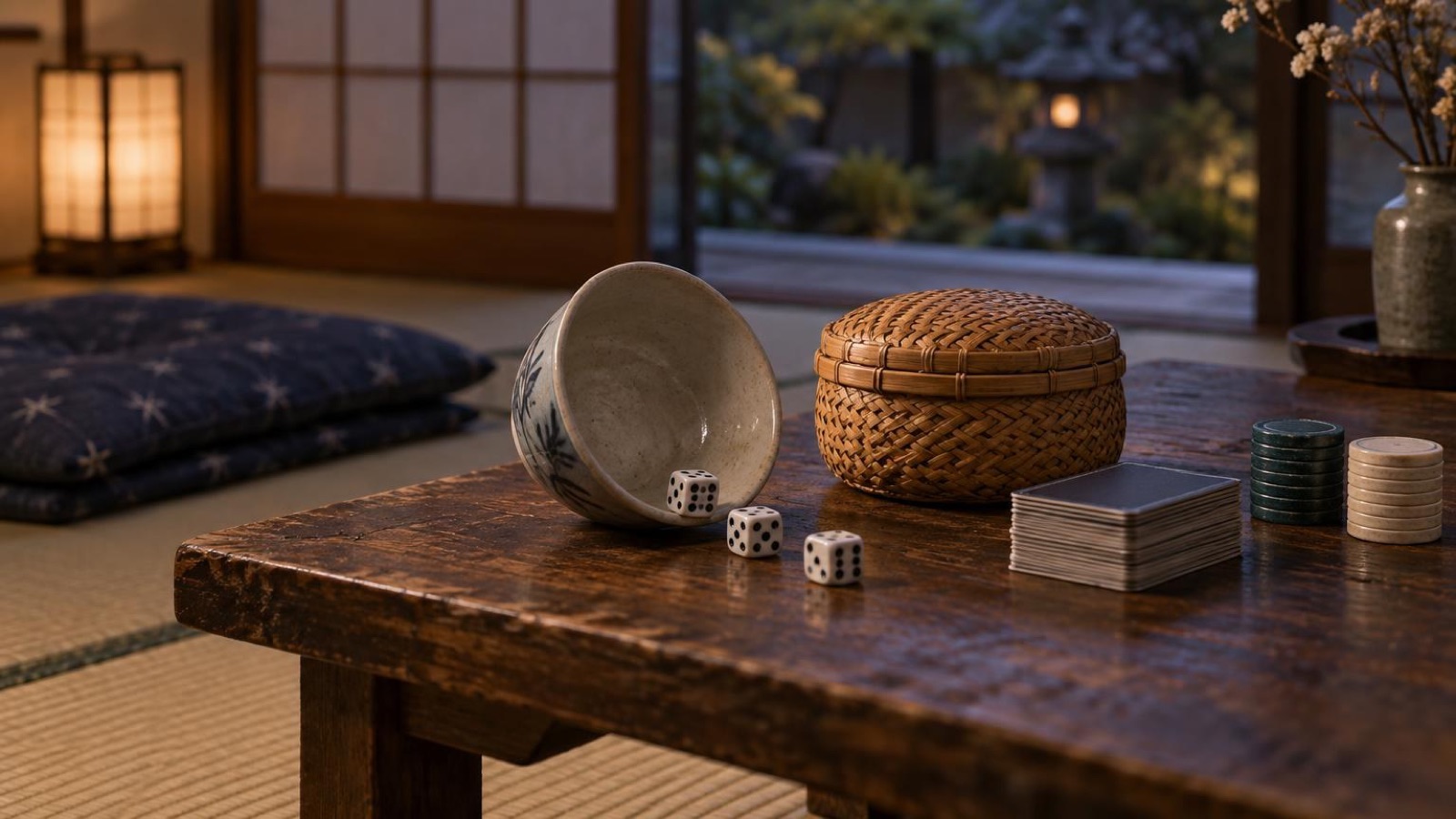
When people picture old-school gambling in Japan, four games come up again and again: Chō-Han, Chinchirorin, Koi-Koi and Oicho-Kabu. All of them are simple enough to play on the floor of a room with a bowl, some dice or a deck of cards, which is exactly how they were played in the teahouse gambling dens of the Edo period and after. You will still see all of them in samurai films and TV dramas, where a masked dealer shakes a cup of dice and a room of players shouts "丁!" or "半!".
Chō-Han and Chinchirorin are dice games. Koi-Koi is played with hanafuda, the 48-card "flower cards" deck, and Oicho-Kabu with kabufuda, a deck of cards numbered 1 to 10. Around these core games sits a family of smaller kabufuda pastimes, including kachikachi and choboichi, which you can read about further down the page.
These games are not the gambling most people in Japan actually do today. That would be pachinko, horse racing, boat racing and the public lottery. But the traditional games remain the cultural root of it all, and they are still played at home for small stakes or just for fun. If you learn one, make it Koi-Koi: it is the one most Japanese people know, and hanafuda decks are sold in ordinary shops for a few hundred yen.
Chō-Han: dice and even-odd betting
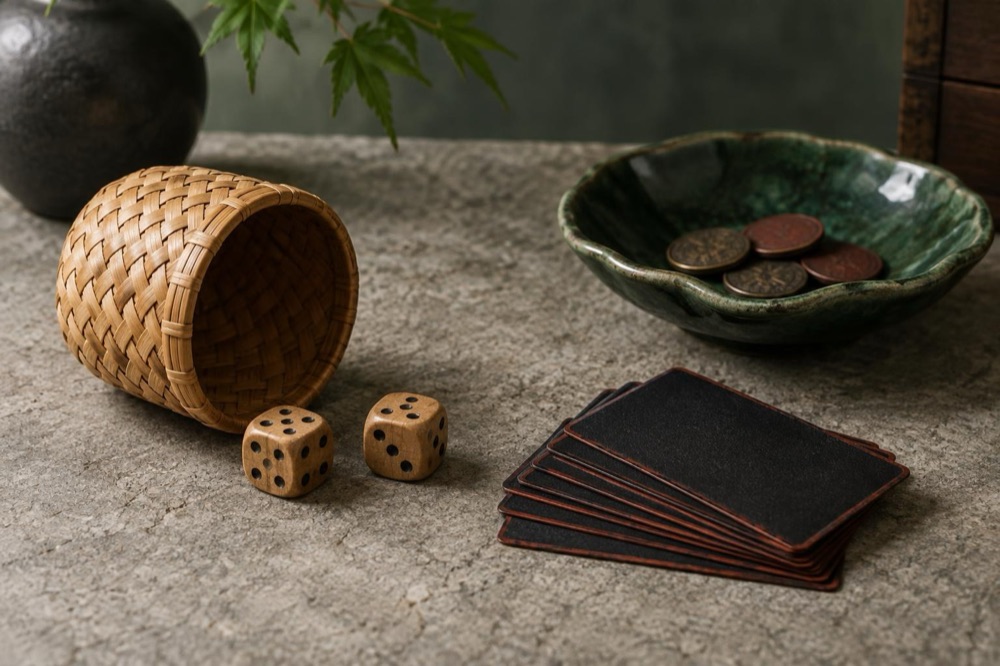
Chō-Han is the simplest of all Japanese gambling games. Two dice are shaken in a tsubo, a bamboo basket about the size of a rice bowl, and players bet on whether the sum will be even (chō, 丁) or odd (han, 半). The dealer lifts the basket to reveal the result, and half the room wins1.
The odds are exactly 1 in 2 for either outcome, so it is a pure coin-flip game1. What makes it interesting is the house cut. In the classic den setup, 5 bu of each pot, meaning half of it, goes into the box as tera money, the boss's income, a practice known as gobu-dera or bantera-gobu1. On top of that, when a "biri" comes up, meaning the dice total 7 with combinations like (1,6), (2,5) or (3,4), or when doubles (zorome) appear, a further 10 percent tera money goes into the box as the underlings' income1.
So in a real den, a winning even-money bet was not really even money after the cuts. Among friends, of course, nobody takes tera money and the game is a straight 50/50 proposition.
Chō-Han needs no equipment beyond two dice and a cup, which is why it survived so long as street and den gambling. It is the game most often shown in yakuza films, with the dealer in a half-mask shouting the result.
Chinchirorin: the three-dice street game
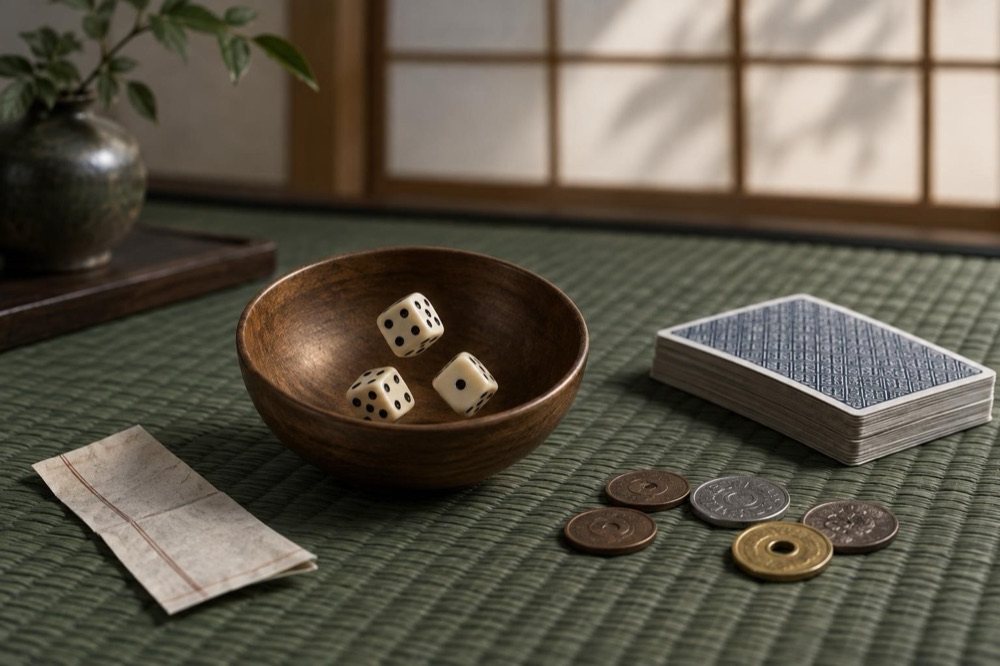
Chinchirorin (ちんちろりん) uses three dice and a bowl or teacup2. It works differently from Chō-Han: here one player acts as the banker and throws the dice, and the other players bet against them. The banker role is not fixed; it rotates among the players in a system called mawari-dono, so everyone gets a turn2. Any number of people can play, from two up in theory, though a handful is usual2.
The banker gets up to three throws. If after three throws they have landed no scoring combination and no shonben (more on that below), it counts as a losing "menashi" and the banker loses2.
The scoring rolls are the ones you would expect from any three-dice game:
- Doubles with a single (1-1-4, for example): the single die's value is the score
- Triples (zorome, "arashi"): the special paying hands, described below
- 1-2-3: a losing roll for the banker
- 4-5-6: a winning roll for the banker
If even one die falls out of the bowl, that is a shonben, an automatic loss for the banker. The banker must then pay each player, working from the right around the table, an amount equal to that player's stake, until the banker's own stake is exhausted, and then gives up the banker role5. It is a harsh rule, and it is why careful bankers shake gently.
What Chinchirorin pays
The basic bets pay even money, but triples (arashi) pay multiples, and this is where local rules vary widely. Three common variants are recorded2:
- Five-zoro (5-5-5) pays 5× and pinzoro (1-1-1) pays 10×, with all other triples paying 3×
- Pinzoro pays 5× and all other triples pay 3×
- Pinzoro pays 10× and other triples pay their own number: 2-zoro pays 2×, up to 6-zoro paying 6×
So before you sit down to play, it is worth asking which arashi rule the table uses, because the difference between 3× and 10× on a pinzoro is significant. The table decides the rule; there is no single national standard.
Koi-Koi: the two-player flower card game
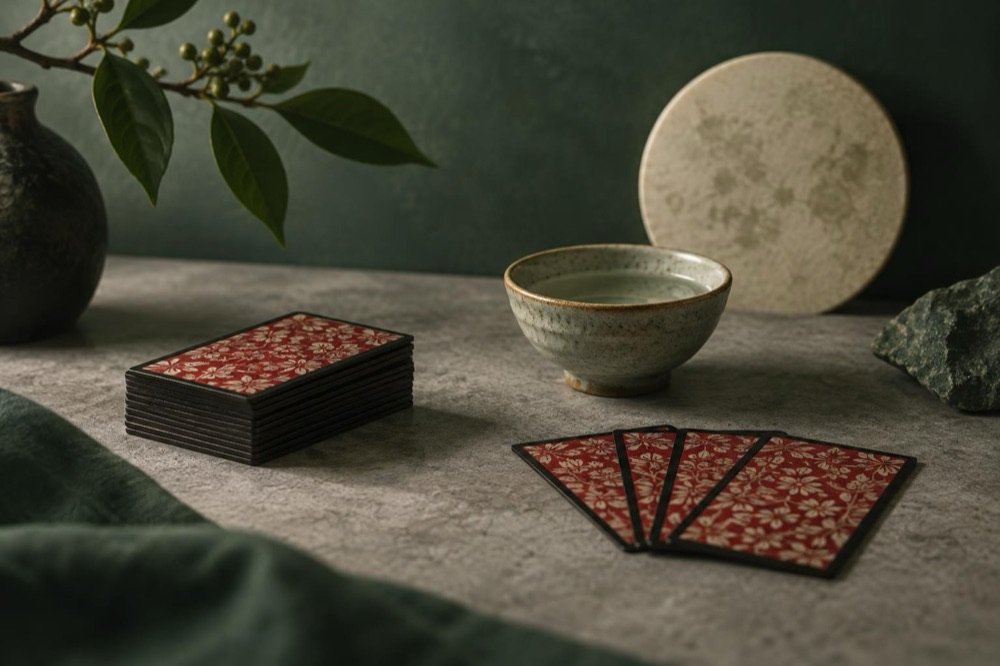
Koi-Koi (こいこい) is the best-known game played with hanafuda, the 48-card flower deck. It is a two-player game, one acting as the dealer (oya) and one as the child, and it is a game of collecting matching cards to form scoring hands called yaku.
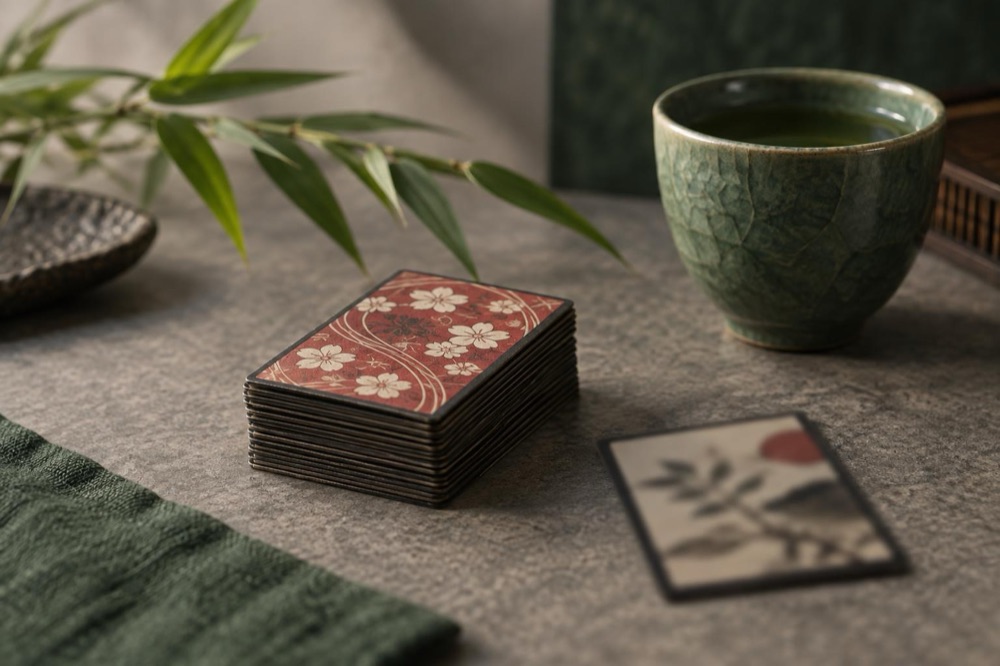
The deck has 48 cards, one for each month of the year, each showing a flower or plant of that month: pine for January, plum for February, cherry for March, and so on through maple and willow at the end of the year. Each card belongs to one of four types:
- Hikari (light) cards: the highest-value cards, featuring special scenes such as the moon, the crane, and "Yanagi ni Ono no Toufuku" (Ono no Toufuku under the willow)
- Tanzaku (ribbon) cards: red and blue poetry ribbons
- Tane (animal) cards: birds, animals and objects like the boar, the deer, the butterfly, the sake cup
- Kasu (plain) cards: the ordinary cards of each month
The game is a race to collect sets of these cards, and the yaku you can form, listed in the next section, are combinations of specific cards or counts of a card type.
How a Koi-Koi round is played
At the start of a round, 8 cards are dealt face up to the table, 8 to each player's hand, and the rest are left face down as a draw pile3.
Play alternates between the dealer and the child. On your turn you do two things in order:
- Play one card from your hand. If it matches a card of the same month on the table, you capture both. If not, your card stays on the table.
- Flip the top card of the draw pile. Again, if it matches a card on the table, you capture both; otherwise it stays on the table.
Captured cards go to your pile, and it is from your captured cards that you form yaku. The strategy is in what to play and what to leave: sometimes you deliberately leave a card on the table hoping to match it next turn, and sometimes you play a card to stop your opponent from taking it.
The round ends when both players have used all their hand cards. If neither player has formed a yaku by then, the round is generally a draw and no points are scored3.
Koi-Koi yaku and their point values
The scoring hands, with their standard point values (common variants in brackets), are3:
| Yaku | Cards required | Points |
|---|---|---|
| Goko (five lights) | all 5 light cards | 10 (15) |
| Shikou (four lights) | 4 light cards, excluding "Yanagi ni Ono no Toufuku" | 8 (10) |
| Ameshikou (rain four lights) | 4 light cards including "Yanagi ni Ono no Toufuku" | 7 (8) |
| Sankou (three lights) | 3 light cards, excluding "Yanagi ni Ono no Toufuku" | 5 (6) |
| Inoshikachou (boar-deer-butterfly) | "Hagi ni Inoshishi", "Momiji ni Shika", "Botan ni Chou" | 5 (6) |
| Akatan / Aotan | the red or blue poetry ribbon sets | 5 (6) |
| Tsukimi de ippai (moon viewing) | "Susuki ni Tsuki" and "Kiku ni Sakazuki" | 5 (3) |
| Hanami de ippai (flower viewing) | "Sakura ni Maku" and "Kiku ni Sakazuki" | 5 (3) |
| Bukku (six ribbons) | the 6 tanzaku of pine, plum, cherry, peony, chrysanthemum and maple | 10 (12 or 15) |
| Nomi (sake cup set) | "Sakura ni Maku", "Susuki ni Tsuki", "Kiku ni Sakazuki" | 10 (6) |
| Tane (animals) | any 5 of the 9 tane cards | 1 |
| Tan (ribbons) | any 5 of the 10 tanzaku cards | 1 |
| Kasu (plains) | any 10 kasu cards | 1 |
A few combination rules matter. Goko does not combine with shikou, ameshikou or sankou, and shikou and ameshikou do not combine with sankou, so you count only your best light-card yaku3. Bukku does not combine with akatan or aotan3. For the count-based yaku of tane, tan and kasu, each additional card of that type beyond the minimum adds 1 extra point, so 6 tane cards score 2, 7 score 3, and so on; some rules extend this to inoshikachou, akatan and aotan as well3.
There are also two hands based on your dealt hand rather than captures: teyon, four cards of the same month in your initial 8-card hand, worth 6 points, and kuttsuki, four pairs of same-month cards in the initial hand, also worth 6 points. Neither is adopted under all rules3.
Doubling rules: koi-koi calls and koibai
Here is the heart of the game's name. When you form a yaku during a round, you face a choice3:
- Stop: declare "shoubu" or "agari", take your points, and end the round
- Continue: declare "koi-koi" (or just "koi") and keep playing, hoping to build a bigger yaku
The risk is obvious: if you call koi-koi and your opponent forms a yaku before you improve yours, the opponent scores their yaku instead, and you get nothing.
The reward is the koibai rule, adopted in many (not all) circles: your score doubles with each koi-koi declaration. One call makes it 2×, two calls 4×, three calls 8×, in general 2 to the power of n3. So a player who forms a 5-point sankou, calls koi-koi twice and then finishes with a 10-point goko can turn a modest hand into a big one.
A separate doubling rule also exists: the score is doubled when the total yaku score is 7 points or more, and doubled again when the opponent has declared koi-koi, so both conditions together give 4× the score. This rule is not adopted everywhere either3. As with the arashi payouts in Chinchirorin, agree on the doubling rules before you start.
Oicho-Kabu and the other kabufuda games
Oicho-Kabu (おいちょかぶ) is a banking game played with kabufuda, cards numbered 1 to 10, plus chips and seat cushions (zabuton)6. Players compete against the banker to assemble a hand whose value is as close as possible to 9, counting only the last digit of the total, exactly like baccarat4. Each player is dealt 2 or 3 cards, and the one whose total's final digit is closest to kabu (9) wins the staked points6.
The game's numbers have their own traditional names, and this is where the word "yakuza" comes from: the worst hand in Oicho-Kabu is 8-9-3, ya-ku-sa, and the name of the gangster organizations is said to derive from it. The traditional names for 1 through 10 are pin, nizo, sanzun or santa, yotsuya, gosu, roppo, nanaken or naki, oicho, kabu and buta4.
One special rule: if the first, second and third cards dealt to the field are all equal in value, that is an arashi (storm) hand, and any players who bet on it receive double their bet in addition to having the original bet returned, a 3 to 1 payout in total4. Before playing, the group must also agree on the tie rule: either a tie between dealer and player is a draw with the bet returned, or the dealer wins4. In Japan the draw version is the more common reading, though dealer-wins variants exist6.
Around Oicho-Kabu sits a family of smaller kabufuda games:
- Kachikachi: a game where the dealer sets the rate by placing chips, non-dealers match that amount to join, and a player may fold ("Shimo" or "Ori") on their turn, forfeiting their entry fee and bets to the winner. It uses 20 cards, 2 each of 1 to 10, and ordinary playing cards can substitute7
- Choboichi: players place chips on a predicted number from 1 to 6, then the dealer rolls one die; the winner receives 4× the chips bet on the rolled number, everyone else loses their chips8
Chinchirorin, Chō-Han and the yakuza image
The film image of these games, a smoky den run by gangsters with a masked dealer, is not wrong for Chō-Han, which was historically a den game and a yakuza income source. But the games differ a lot in this respect.
Chinchirorin, unlike Chō-Han, has not typically seen yakuza involvement as den operators or a funding source; it is usually played among friends2. Its image as a friendly street or festival game, with players shouting "chinchiro!" as the dice rattle, is closer to the reality.
Koi-Koi and the kabufuda games sit somewhere in between: they were played in dens, but they were equally at home in ordinary households, and hanafuda in particular became a mainstream family game. Nintendo, before it made video games, was a hanafuda manufacturer. Today all of these games are more likely to appear at a New Year's gathering with relatives than anywhere else, and the den versions live on mainly in period dramas.
Where these games sit under Japanese law
Japan's Penal Code makes gambling for money a crime, and playing repeatedly can bring the heavier habitual gambling charge; this applies to anyone in Japan, citizen, resident or visitor alike9. The practical upshot is simple: you will not find Chō-Han, Chinchirorin, Koi-Koi or Oicho-Kabu offered for real stakes in any licensed venue, because no license exists for them. The legal gambling options are the public ones: pachinko and pachislot (which operate in a legal gray zone, not officially classified as gambling for money10), horse racing, boat racing, keirin, auto race, the lottery and sports betting, plus the integrated resort casino licensed under the 2018 law, MGM Osaka.
So the traditional games survive as home play for tokens or trivial stakes, which is how most Japanese people encounter them. If a friend offers to teach you Koi-Koi over a few drinks, that is the game in its natural habitat, and well worth learning.
Common Questions
What does 'koi-koi' mean and when do you call it?
It means roughly 'come on' or 'keep going'. When you form a scoring hand you can either stop and declare 'shoubu' or 'agari' to bank your points, or call 'koi-koi' to continue playing for a bigger score. Each koi-koi call can double what you win.
How many dice are used in Chinchirorin?
Three dice, shaken in a bowl or teacup. The banker gets up to three throws to land a scoring combination, and the other players bet on the outcome.
What happens if a die falls out of the bowl in Chinchirorin?
That is a shonben, an automatic loss for the banker. The banker pays each player an amount equal to their stake, from the right around the table, until their own stake is gone, and then loses the banker role.
What is the highest-scoring yaku in Koi-Koi?
Goko, five light cards, is worth 10 points, or 15 under some rules. It cannot be combined with shikou, ameshikou or sankou, so it stands alone as the top hand.
Can Koi-Koi end in a draw?
Yes. If both players play out all their cards without forming a yaku, the round is generally a draw and no points are scored.
Is Chinchirorin linked to yakuza gambling dens?
Not usually. Unlike Chō-Han, Chinchirorin has not typically been run by yakuza as a source of den income. It is normally played among friends.
What cards do you need to play Koi-Koi?
A hanafuda deck of 48 flower cards. Eight cards go face up on the table, eight to each player, and the rest stay face down as a draw pile.
Sources10 sources
- 丁半, Wikipedia (Japanese)
- ちんちろりん, Wikipedia (Japanese)
- こいこい, Wikipedia (Japanese)
- Oicho-Kabu, FudaWiki, November 12, 2025
- タブ (賭博)), Wikipedia (Japanese)
- おいちょかぶ, Wikipedia (Japanese)
- かちかち, Wikipedia (Japanese)
- ちょぼいち, Wikipedia (Japanese)
- ギャンブル依存症 パンフレット 12, SCGA
- Gambling in Japan, Oxford Brookes University, September 2007