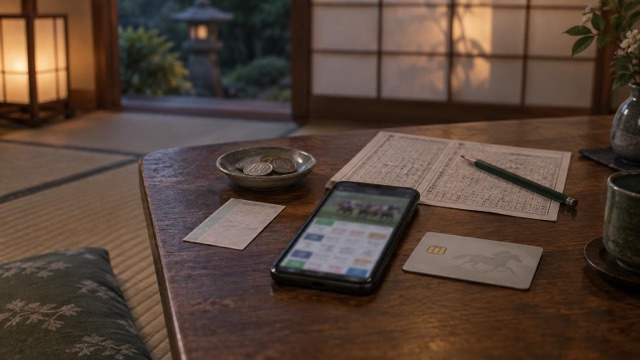
Horse racing in Japan: what is on offer and where
Horse racing in Japan, called keiba, fills 10 JRA racecourses from Hokkaido in the north to Kyushu in the south, plus a nationwide network of 38 off-course betting facilities called "WINS"1. Betting runs through official channels and is fully legal.
On top of the central JRA circuit there is a parallel world of local racing, run by prefectures and cities at tracks such as Tokyo City Keiba (Oi), Funabashi, Kanazawa and Kasamatsu. Between the two systems you are rarely far from a race meeting or a betting shop anywhere in Japan.
A standard racing day runs 12 races, usually from late morning or mid-afternoon into the evening at tracks that hold night racing3. The biggest days, such as the Japan Cup at Tokyo Racecourse, draw tens of thousands of spectators and are major social events, with many attendees dressing up.
Two racing worlds: JRA central racing and local chiho keiba
Japanese horse racing is split into two systems. Central racing is run by the Japan Racing Association (JRA), which owns the ten major racecourses: Tokyo, Nakayama, Kyoto, Hanshin, Chukyo, Sapporo, Hakodate, Fukushima, Niigata and Kokura. Local racing, known as chiho keiba and organized under the NAR, is run by regional governments at their own tracks2.
The two systems have separate horses, jockeys and calendars, but they overlap in betting. JRA betting tickets are sold at many local venues and off-course shops, and local racing can be bet online through services such as Odds Park, where you can buy tickets and watch the races7.
Local racing has its own character. Tokyo City Keiba at Oi, in the heart of Tokyo, was the very first racetrack in Japan to host night racing, and its January through March meetings run in the daytime while the rest of the year features evening cards under the lights8. Tracks like Kasamatsu in Gifu, Funabashi in Chiba and Kanazawa in Ishikawa are smaller and more relaxed than the JRA giants, with admission and seating to match9. If you want the full picture of the local circuit, see local horse racing (chiho keiba).
Bet types: from win and place to WIN5
JRA currently offers nine bet types: win, place, bracket quinella, horse number quinella, wide, exacta, trio, trifecta and WIN55. In Japanese these are tan-sho, fuku-sho, waku-ren, uma-ren, wide, uma-tan, 3-ren-fuku, 3-rentan and WIN55.
The basics are simple. A win bet (tan-sho) pays if your horse finishes first. A place bet (fuku-sho) pays if your horse finishes in the top two, or top three in races with eight or more starters. From there the bets get more complex: the quinella pays for two horses in any order, the exacta requires the correct order, the trio covers three horses in any order, and the trifecta requires all three in exact order5.
WIN5 is the hardest and can pay the most: you must pick the winner of all five races designated by JRA on a card11. The target races are chosen by JRA, and one ticket costs the same 100 yen unit as everything else.
Which bet types are actually sold depends on the field size12:
| Starters | Bet types sold |
|---|---|
| 2 | Win only |
| 3 | Win, quinella and exacta |
| 4 | Win, quinella, trifecta and trio, wide |
| 5 to 7 | All of the above, with place paying to 2nd |
| 8 or more | All of the above, with place paying to 3rd |
Local racing sells a slightly different menu. Hokkaido racing, for example, offers win, place, bracket quinella, quinella, wide, trio and trifecta13. For a full walkthrough of every ticket, how to mark a betting card and how to read the form, see Japanese horse racing bet types.
What betting tickets pay out
All Japanese horse racing betting is pari-mutuel: the pool is shared among winners, so payouts depend on how many people backed the same horse. The law requires that not less than 70 percent of turnover is paid back to holders of winning tickets6.
Bets are sold in units. At local tracks such as Kanazawa, one ticket is 100 yen and you buy integer multiples of it12. The legal minimum face value for a JRA ticket is 10 yen, used for some multi-horse combination bets6.
Odds work as a direct multiplier. If the odds for horse No. 2 are 1.9, a bet of 100 yen pays out 190 yen1. Payouts are shown on the boards and screens around the track, and winning tickets are cashed at payout machines or counters.
One quirk worth knowing: when a win or place payout would otherwise fall below 100 yen per 100 yen bet, JRA tops it up to 110 yen under its "JRA Plus 10" scheme, so a winning favorite never returns less than a small profit5.
Entry levies and what a day at the track costs
A day at Japanese racing is remarkably cheap to enter. Admission to a JRA racecourse is 200 yen (about $2 US) for Tokyo, Nakayama, Kyoto, Hanshin and Chukyo, and 100 yen for Sapporo, Hakodate, Fukushima, Niigata and Kokura3. The regulations allow the JRA president to set levies anywhere from 100 yen to 5,000 yen per person per day, so big race days with special enclosure access can cost more14.
At local tracks the same pattern holds. Kasamatsu Racecourse charges 500 yen for its U Hall and 600 yen for special seating on its own race days9. Inside, food stalls, restaurants and beer gardens sell at normal Japanese prices, and a modest day out is easy to manage.
Gates open well before the first race. At Tokyo City Keiba, gates open between 13:00 and 15:00 depending on the meeting, with first post between 14:00 and 15:30 on afternoon cards and the main race around 20:10 on twilight cards15. The track offers free Wi-Fi (SSID "TCK Free Wi-Fi", password 5501, no registration needed), a beginners' counter on the 1st floor of the L-WING, and a general service counter on the 1st floor of the G-Front8.
Getting to Oi is easy: it is a 10-minute drive from Haneda Airport, a 2-minute walk from Oi Keibajo Mae station on the Tokyo Monorail, or a 12-minute walk from Tachiaigawa station on the Keihin express line16. For the JRA tracks, Tokyo Racecourse is at 1-1 Hiyoshi-cho, Fuchu-shi, and Hakodate Racecourse is about 25 minutes by tram from JR Hakodate Station17.
Ban'ei racing: draft horse racing at Obihiro
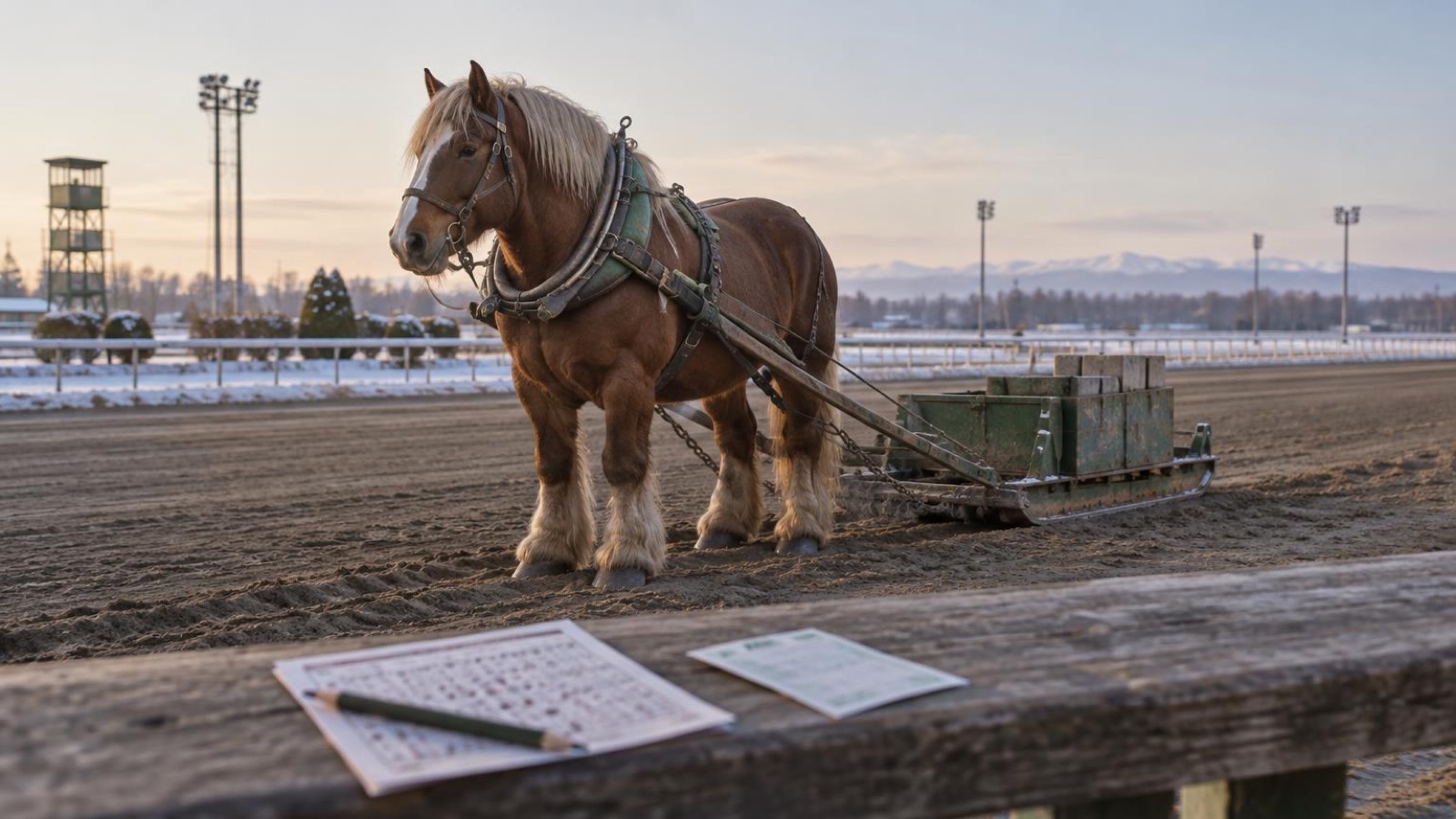
Ban'ei racing is a sport found nowhere else: draft horses weighing from 800 to 1,200 kg compete by pulling a sled carrying a jockey and a prescribed heavy load over a 200-meter dirt track with two humps. It is held only in Hokkaido, at Obihiro Racecourse2.

The horses are enormous Percheron-type breeds, and the racing is a slow, grinding test of strength rather than speed, as each horse hauls its sled over the two obstacles. It is a beloved local tradition with a devoted following.
Ban'ei race meetings can be bet on away from Obihiro too: J-PLACE Sapporo sells tickets for all ban'ei race meetings and all main races18. Obihiro Racecourse is at 9-1 Minami, Nishi-13-jo, Obihiro-shi10. For the full story of the sport, see ban'ei racing.
Big races and the racing calendar
The JRA calendar is built around its G1 races, and Tokyo Racecourse hosts more of them than anywhere else: the Japan Cup, the Tokyo Yushun (Japanese Derby), the Tenno Sho (Autumn), the Yasuda Kinen, the Yushun Himba (Japanese Oaks), the February Stakes, the NHK Mile Cup and the Victoria Mile19.
The summer circuit moves north. Hakodate Racecourse hosts the Hakodate Sprint Stakes, the Hakodate Kinen and the Hakodate Nisai Stakes, all G3 races, during its July meetings17.
Local racing has its own big days, graded on the Jpn scale. The NTV Cup at Hokkaido racing is a JpnIII race, and the February 2026 calendar shows meetings at Kasamatsu, Oi, Himeji, Kochi and Urawa running through the month, with JRA tickets sold alongside local races on many of those days20. For the full list of championship races and when to see them, see major horse races in Japan, and for Japan's most famous international race, see the Japan Cup.
Betting online and by phone: JRA net betting and A-PAT
You do not need to go to a track. JRA telephone and internet betting has four forms of membership2:
- A-PAT (a dedicated bank account system)
- Soku-PAT (internet-based)
- JRA Direct
- ARS
A-PAT covers all races at all racecourses where central JRA racing is held, plus designated overseas races, and sells every bet type including WIN521. The smartphone site's menu covers Pay-easy deposits, normal betting, odds betting, WIN5 betting, overseas racing and NAR local racing betting22. Accounts are funded by bank transfer to a JRA financial institution account, credit card transfer, or deduction from a stored-value identification card14. At the track or a betting shop you can pay with cash, a mark card or the UMACA card system23.
One caution, said once and plainly: betting through channels other than those prescribed by the Horse Racing Act constitutes the crime of gambling under the Penal Code, and buying from overseas internet operators or malicious tipster businesses carries real legal risk, so buy only at official counters and official online services2. For step-by-step setup of each service, see betting on Japanese horse racing online.
Off-track betting: J-PLACE, Aiba and WINS shops
If you cannot reach a racecourse, Japan's off-course network has you covered. JRA's 38 WINS betting offices are spread across the country2. On top of these, J-PLACE venues sell JRA tickets from locations outside the traditional horse racing network, a service that began expanding in 201525.
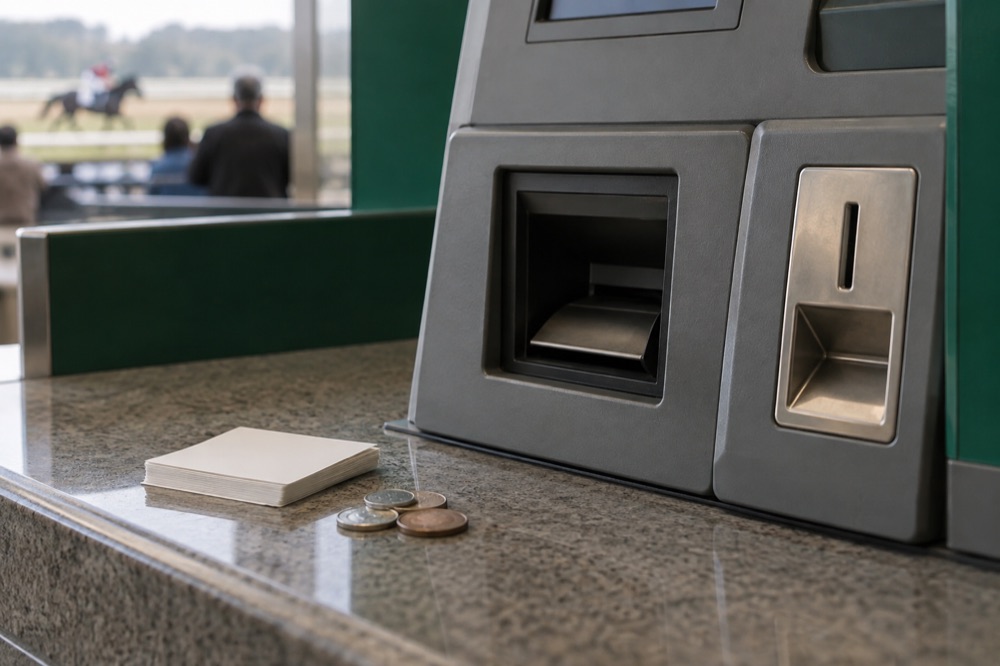
Typical J-PLACE shops, such as DASH Fukuyama-Ekimae and DASH Yokawa, sell eight bet types: win, place, bracket quinella, quinella, wide, exacta, trio and trifecta, on both local racing days and JRA betting days26. JRA win tickets are also sold at local racecourse venues: sales at the 16 Hokkaido venues began in March 2013, using the Local Horse Racing Totalisator System28.
Note one practical rule: tickets for Hokkaido racing bought at a J-PLACE are refunded at JRA main offices (Ebisu and WINS) and some local WINS venues, not necessarily where you bought them13. In Hokkaido, the local off-course shops are called Aiba, such as Aiba Shizunai and Aiba Chitose10. For local racing away from the track, the Odds Park service lets you buy tickets and watch races online7.
Beyond horse racing: boat race, keirin and auto race venues
Horse racing is one of four public racing sports in Japan, alongside boat race (kyotei), keirin cycle racing and auto race. All four work the same way in principle: pari-mutuel betting at official venues, and all four welcome spectators who just want to watch.
Boat Race has 24 venues located across Japan, from Kiryu in Gunma down to Omura in Nagasaki, and seven special venues host night races29. Six boats compete in each race, and betting tickets come in seven types, any of which can be bought from 100 yen30. You can come to any Boat Race venue to watch the races, enjoy the food and check out the attractions without placing a single bet, and if you do win, machines all over the venue pay out prize money on the spot29.
A few venues stand out for visitors:
| Venue | Where | What makes it special |
|---|---|---|
| Boat Race Heiwajima | Tokyo, 15 minutes from Haneda Airport | Entry only 100 yen, close to Tokyo and Shinagawa stations, stage shows during big races31 |
| Boat Race Suminoe | Osaka, about half an hour from the city center | Hosts the SG Grand Prix most often, night racing, seats right at the water's edge32 |
| Boat Race Marugame | Kagawa, Shikoku | Night racing year-round33 |
| Boat Race Miyajima | Hiroshima, 7 minutes from Miyajimaguchi Station | Views of Itsukushima Shrine from every floor, a real motorboat on display30 |
For the full picture of the sport, see boat racing (kyotei) and boat race betting. Keirin velodromes, such as those covered in the Hakodate velodrome guide, and auto race tracks like those in Kawaguchi and other auto race cities, round out the same family of venue-based betting sports, each with its own page on this site.
Common Questions
How much does it cost to enter a Japanese racecourse?
Tokyo, Nakayama, Kyoto, Hanshin and Chukyo charge 200 yen on live race days. Sapporo, Hakodate, Fukushima, Niigata and Kokura charge 100 yen. Extra charges apply only for special seating.
How many bet types are there in Japanese horse racing?
JRA currently offers nine: win, place, bracket quinella, quinella, wide, exacta, trio, trifecta and WIN5. Local racing offers a slightly different set, typically seven or eight types.
Can I bet on Japanese horse racing online?
Yes, through official JRA services such as A-PAT, which cover all JRA races plus some overseas races. Bets bought from unlicensed overseas internet sellers are illegal, so use official channels only.
What is the Japan Cup and where is it run?
The Japan Cup is a G1 flat race run at Tokyo Racecourse in Fuchu, one of eight G1 races hosted there, alongside the Japanese Derby, the Tenno Sho (Autumn) and the Yasuda Kinen.
What is ban'ei racing?
Ban'ei is draft horse racing held only in Hokkaido, at Obihiro. Horses weighing 800 to 1,200 kg pull a sled carrying a jockey and a heavy load over a 200-meter dirt track with two humps.
What is the payout rate on Japanese horse racing bets?
By law, at least 70 percent of turnover is returned to winners. A 100 yen win bet at odds of 1.9 pays 190 yen, and win or place payouts that would fall below 100 yen are topped up to 110 yen.
Where is Tokyo City Keiba and how do I get there?
It is at Oi Racecourse in Shinagawa, central Tokyo, a 10-minute drive from Haneda Airport. Take the Tokyo Monorail to Oi Keibajo Mae station, a 2-minute walk, or the Keihin express to Tachiaigawa, 12 minutes on foot.
Sources33 sources
- Go Racing guide (PDF), Japan Racing Association, 2026
- Horse Racing in Japan guidebook 2026 (PDF), Japan Racing Association, 2026
- Go Racing: guide, Japan Racing Association, 2026
- Go Racing: how to go racing, Japan Racing Association, 2026
- Betting ticket glossary, JRA, 2026
- Horse Racing Act (English translation), Japan Racing Association, 2026
- Nagoya Keiba betting and Odds Park, Nagoya Keiba, 2026
- About Tokyo City Keiba, Tokyo City Keiba, 2026
- Kasamatsu Racecourse facilities, Kasamatsu Racecourse, 2026
- Local racecourse and OTB addresses, Japan Racing Association, 2026
- Beginner's guide, JRA, 2026
- Betting tickets: types and units, Kanazawa Racecourse, 2026
- Ticket sales and refunds, Hokkaido Racing, 2026
- JRA Racing Implementation Regulations (PDF), JRA, 2026
- Tokyo City Keiba schedule, Tokyo City Keiba, 2026
- Tokyo City Keiba access, Tokyo City Keiba, 2026
- Hakodate Racecourse, Japan Racing Association, 2026
- J-Place Sapporo ban'ei sales (archived), JRA, 2015
- Tokyo Racecourse, Japan Racing Association, 2026
- Boat Race ticket types (Chinese guide), Boat Race, 2026
- A-PAT instructions, JRA, 2026
- A-PAT smartphone betting menu (PDF), JRA, 2026
- Beginner's Book (PDF), JRA, 2024
- Gambling crime and public racing (research paper, PDF), National Tax College, 2025
- J-PLACE venues, keiba.go.jp, 2026
- DASH Fukuyama-Ekimae (J-PLACE), Sonoda-Himeji, 2026
- DASH Yokawa (J-PLACE), Sonoda-Himeji, 2026
- JRA ticket sales at local venues (archived), JRA, 2013
- Boat Race step-by-step guide, Boat Race Promotion Association, 2026
- Boat Race Miyajima, Boat Race, 2026
- Boat Race Heiwajima, Boat Race, 2026
- Boat Race Suminoe, Boat Race, 2026
- Boat Race Marugame, Boat Race, 2026