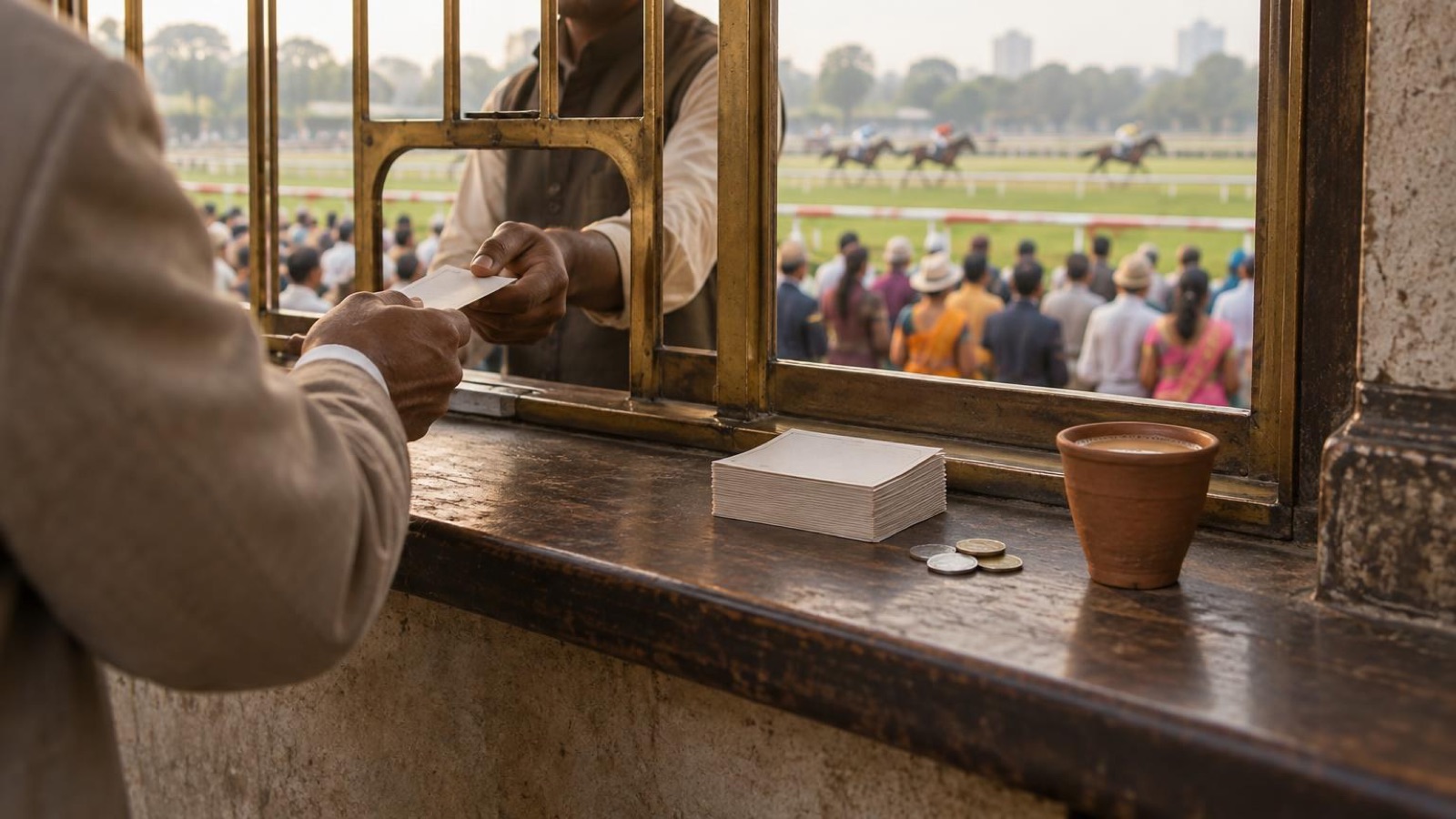
Horse racing holds a special place in Indian gambling. It is the only sport on which betting is legally allowed in the country, and race day at a big turf club is a genuine social occasion, with everyone from first-time visitors to serious punters crowding the Tote windows and the bookmakers' ring. If you are new to it, the system is simpler than it looks: this page walks you through where you can bet, how the Tote works, every major bet type, what it costs, and what happens when things go wrong, such as withdrawn horses or abandoned races. For the wider picture of what you can and cannot play in the country, see our page on gambling in India.
Where horse race betting is legal in India
Betting on horse racing is treated differently from almost every other form of gambling in India because the courts consider it a game of skill rather than pure chance, a classification supported by the Supreme Court of India5. Most state gambling legislation specifically excludes betting on horse races from its scope, and a license is typically required where betting is permitted under state law6.
The Supreme Court has also drawn a clear line on where the betting happens. Wagering on horse racing is legal when it takes place within the premises of the club on the day of the race; betting elsewhere, such as in streets or bazaars, does not enjoy that protection7. In practice, that means on-course betting at licensed turf clubs on race day, and the same skill-game exemption does not automatically extend to online betting8.
Horse-race betting is allowed in Telangana, Assam, Delhi, Haryana, Karnataka, Maharashtra, Meghalaya, Punjab, Tamil Nadu, Uttar Pradesh and West Bengal, and active racing currently takes place at the turf clubs in Bangalore, Chennai, Delhi, Hyderabad, Kolkata, Mumbai, Mysore, Pune and Ooty1. Alongside rummy and casinos in two states, horse racing is one of the few legal forms of gambling in India9.
Online betting on horse racing has been approved in Maharashtra, Karnataka (in abeyance), Tamil Nadu, Telangana and West Bengal, and in 2021 the turf clubs in Mumbai, Pune, Bangalore, Hyderabad and Kolkata were given approvals to conduct and operate online betting1. Each club runs its own betting operation: Royal Western India Turf Club in Mumbai and Pune offers Win, Place, Jackpot, Super Jackpot, Treble, Forecast, Quinella, Tanala and Second Horse pools; Madras Race Club in Chennai offers Win, Place, Quinella, Forecast, Tanala, Treble and Jackpot; Royal Calcutta Turf Club offers Win, Place, Quinella, Tanala, Treble and Jackpot; and Bangalore Turf Club adds Second Horse, Exacta and its own Tannala pool to the usual lineup2. For the racing itself, see horse racing in India.
Tote betting: how it works and how to place a bet
The Tote (short for totalizator) is pool betting. Your stake goes into a pool together with everyone else's bets on the same market, the operator takes a percentage of the fund, and the rest is shared out equally between those who placed the winning bet. The payout is called a dividend10. Unlike a bookmaker's fixed odds, the dividend is not known until betting closes, because it depends entirely on how much money is in the pool and how many people picked the winner.
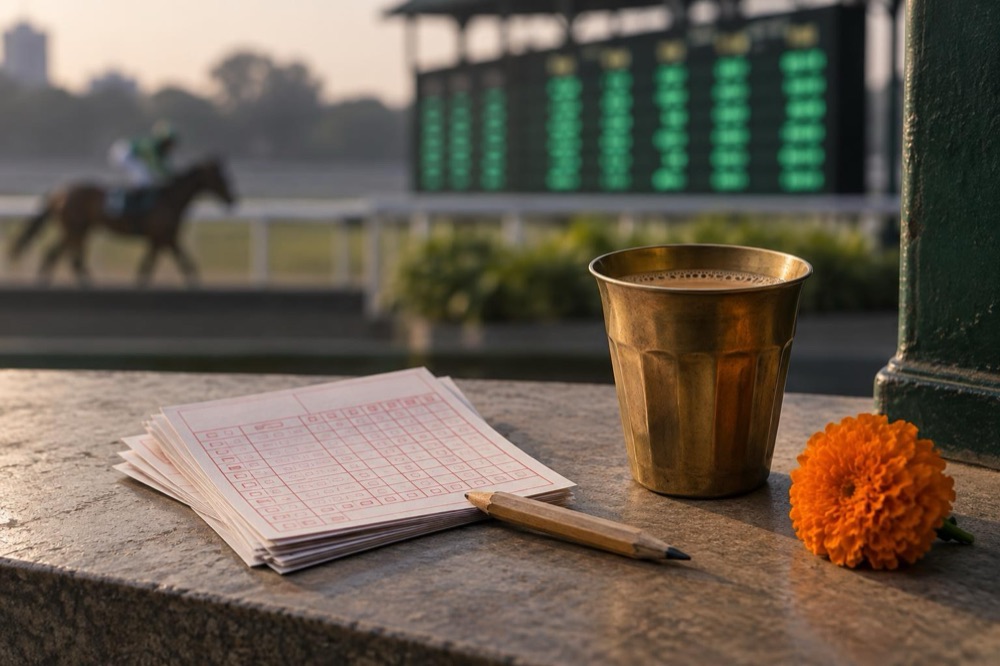
There are three ways to place a Tote bet at an Indian racecourse. You can go to a manned Tote window, buy a cash voucher from a Tote Service Outlet, or call over the roving operator who carries a hand-held computer and will take your bet where you stand3. Bets can be as little as Rs.1011.
You also have a choice of odds. You can bet at variable Tote odds or at fixed Tote odds4. With variable odds, your dividend depends on the final size of the pool and the number of winners. With fixed Tote odds, the winning amount at the odds prevailing at the time you make your wager is guaranteed and printed on your ticket4. The Tote board odds are continuously updated according to how much bettors wager on each horse, right up until the race starts, so the board gives you a live picture of where the money is going12.
At Hyderabad Race Club, Tote transactions close at the actual start of each race, and no bet is accepted after the race start bell is given13.
What you need to tell the Tote window
When you reach the window, have five pieces of information ready for the operator14:
- The race meeting, meaning the center where the race is being run (this matters on days when the club is also taking bets on races at other venues)
- The race number
- The amount of money you want to bet
- The type of bet (Win, Place, Quinella, and so on)
- The number or numbers of the horse or horses you are backing
So a complete request sounds like: "Mumbai, race 4, Rs.20 Win on number 7." The operator prints your ticket, and that ticket is your only proof of the bet, so check it before you step away. The same five details, track, race number, amount, horse number and bet type, are what a teller needs anywhere in the world, so the habit travels well if you bet at racecourses abroad15.
Bet types: Win, Place and Each way
Win is the simplest bet on the card. You get a dividend only if your horse finishes first16. Win betting requires a race with at least four declared starters17.
Place pays if your horse finishes near the front without necessarily winning. At the Tote, you pick a horse to finish first, second or third; in races with seven or fewer runners, your choice must finish first or second18. The rules at bookmakers are similar: at Hyderabad, bookmakers pay on three placed horses when there are eight or more starters, and on two placed horses when there are between four and eight starters13.
Each way combines the two. You place half of your stake on the horse to win and half on it to place19, so an each-way bet on a horse that places but does not win still returns the place half. Bookmakers treat each way as a Win and Place bet together18.
As an example of how odds translate into money, a horse at odds of 5 to 1 pays 5.00 profit per 1.00 bet, while a horse at odds of 1 to 5 is odds-on and returns 2.40 on a 2.00 stake, a profit of just 0.20 per 1.00 bet12. The same arithmetic applies at Indian Tote windows once the dividend is declared.
Forecast, Quinella and Tanala pools
These three pools all ask you to pick more than one horse, and they differ only in how strict they are about the finishing order.

Forecast: pick two horses to finish first and second in the correct order16. If your horses finish in the reverse order, the ticket loses.
Quinella: the same idea, but the order does not matter. You win if your choices finish first and second, or second and first16. Because it is easier to land, the dividend is usually smaller than the Forecast on the same two horses.
Tanala: the big three-horse pool, and one you will not find outside Indian racing. You pick three horses to finish first, second and third in the exact order, or buy a combination ticket that covers several orders3. The payout structure rewards precision: if your first three choices finish in the exact 1-2-3 order, you earn the full dividend, and a consolation dividend is paid where the order of the second and third horses is interchanged, so a 1-3-2 finish still collects something3. At clubs that run the pool on a national basis, the Tanala pool pays a 100% dividend with no consolation16. Madras Race Club's rules describe the dividend as payable on the first, second and third placed horses in the correct order, in all combinations20.
On dead heats, the Forecast, Quinella and Tanala pools all pay equal dividends for all combinations20.
Multi-race bets: Kenchi and the Super Jackpot
These are the bets that build the biggest pools, because they ask you to be right across several races.
The Jackpot and Treble are the classic multi-race pools. On a typical race card, the Jackpot covers five designated races and the Treble covers three; on inter-venue days, when the club is betting on races at other centers, you may see two or even three separate Jackpots and Trebles listed for different groups of races2.
The Super Jackpot at Royal Western India Turf Club has six legs, meaning six races designated for the pool at the declaration stage, and you can buy a single ticket or a combination4. The payout is split: if you nominate the winners of the first five legs, you share in the 30% dividend amount, and if you get all six legs right, you share in the 70% dividend amount4. The minimum unit is just Rs.5, which is why the pool attracts so many small stakers chasing a huge dividend4.
The Kenchi is a uniquely Indian bet. It is a permutation of the Accumulator Win or Place wager, accepted for a chosen group of three, four or five races3. In plain terms, you pick more than one horse in some or all of the races, and the bet covers every possible combination of your selections winning. For the minimum unit of Rs.10, a 3-race Kenchi requires an investment of Rs.40, a 4-race Kenchi costs Rs.110, and a 5-race Kenchi costs Rs.2603. The more horses you add, the more combinations you cover and the more the ticket costs, so a Kenchi can grow expensive quickly.
Minimum bets and dividends by pool
The Tote is a cheap day out by any standard. Here is what each pool costs at the major clubs4:
| Pool | What you pick | Minimum bet |
|---|---|---|
| Win | First placed horse | Rs.10 |
| Place | Horse to finish 1st, 2nd or 3rd | Rs.10 |
| Forecast | 1st and 2nd in correct order | Rs.10 |
| Quinella | 1st and 2nd in either order | Rs.10 |
| Tanala | 1st, 2nd and 3rd in order | Rs.10 |
| Second Horse | Second placed horse | Rs.10 |
| Third Horse | Third placed horse | Rs.10 |
| Show Horse | Horse to finish in the places | Rs.10 |
| Treble | Winners of 3 designated races | Rs.10 |
| Super Jackpot | Winners of 6 designated races | Rs.5 |
Bookmakers are a different market. At Hyderabad Race Club, the minimum for inter-venue transactions is Rs.6013. Winning cash cards must be encashed within 15 days of issue13.
Withdrawn horses, dead heats and void races
Things go wrong on race days, and every pool has rules for it.
Withdrawn horses. At the Tote, bets on horses that become non-starters are void and refunded. If withdrawals leave fewer than the required number of starters for a bet type, all bets in that pool are void and refunded, and the same applies if no horse finishes or the race is declared void17. In the Win pool specifically, if fewer than two runners remain, all tickets are refunded20. With bookmakers, the treatment is different: your liability on remaining horses is reduced according to the odds of the withdrawn horse. If the withdrawn horse was at evens or odds on, the deduction is 50 paise in the rupee; if over evens and under 4 to 1, 25 paise; if 4 to 1 and under 10 to 1, 12 paise; and if the withdrawn horse was 10 to 1 or over, the liability is unchanged13.
Dead heats. If two or more horses dead heat for first in a Win pool, the net pool is divided equally among the winning combinations that were backed21. With bookmakers, the liability, including your stake, is reduced by 50% in a dead heat for Win or Place13. In the Quinella, Forecast and Tanala pools, dead heats produce equal dividends for all combinations20.
Void and abandoned races. If a race is void or abandoned, all Win tickets are refunded20. For multi-race pools, if all legs are void, all bets are refunded; if some legs are run, the bets remain valid on the races actually run, with the void races ignored22. If a race meeting is abandoned before the first race, race clubs refund subscriptions in full or carry them over to the next race day23.
Complaints. If something goes wrong with a transaction at Hyderabad Race Club, all complaints must be reported immediately, in writing, to the Chief Operating Officer or Secretary at the club office13.
One last practical point: you must be 18 or older to bet at the Tote or enter the bookmakers' ring, and children under 18 are not permitted to do either at Mahalaxmi and Pune Race Course3. Keep your tickets until the dividends are declared, and remember that a Tote dividend is per unit of stake, so a Rs.20 ticket pays twice the declared Rs.10 dividend.
Common Questions
What is the minimum age for betting at the races in India?
You must be 18 or older to bet at the Tote or enter the bookmakers' ring at Indian racecourses such as Mahalaxmi in Mumbai and Pune Race Course. Children under 18 are not permitted to place Tote bets or enter the bookmaker ring.
What is the minimum bet at the Tote?
Most Tote pools at Indian race clubs take bets from Rs.10, including Win, Place, Forecast, Quinella, Tanala, Treble and the Second and Third Horse pools. The Super Jackpot pool goes lower, at Rs.5 per unit.
How does a Tanala pool pay out?
You pick three horses to finish first, second and third. If your first three choices finish in the exact 1-2-3 order you earn the full dividend. A consolation dividend is paid where the second and third placed horses are interchanged, so a 1-3-2 finish still pays something.
What happens to my Win bet if a race is abandoned?
If a race is void or abandoned, all Win tickets are refunded. Bets on horses that are declared non-starters are also void and refunded, and if withdrawals leave fewer than the required number of starters, the whole pool is refunded.
Do I need to give my name to a bookmaker?
At Hyderabad Race Club, bookmakers must record the names and addresses of backers making transactions of Rs.5,000 or more, or winning Rs.10,000 or more. Cash transactions of Rs.2,000 or over cannot be accepted unless you give your name.
What is the difference between fixed and variable Tote odds?
Variable Tote odds move as money enters the pool, and your dividend depends on the final pool. With fixed Tote odds, the amount you win at the odds shown when you place the wager is guaranteed and printed on your ticket.
How do I complain about a betting transaction at Hyderabad Race Club?
All transaction complaints must be reported immediately, in writing, to the Chief Operating Officer or Secretary at the Hyderabad Race Club office. Do not wait until after the race day to raise the issue.
Sources23 sources
- Horse-race betting in India: state-by-state position, Lexology, June 8, 2021
- India, Asian Racing Federation, archived November 4, 2013
- Beginners guide, Royal Western India Turf Club, 2026
- Beginners guide, Royal Western India Turf Club, 2026
- India Gambling, Khaitan & Co, July 2026
- Legal route to gambling: Indian perspective, India Law Offices, 2026
- State of Tamil Nadu v Junglee Games India Pvt Ltd, Supreme Court of India, May 27, 2026
- Real money online casino legal states India guide, Gamble Press, August 24, 2026
- Gambling in India, George et al, 2017
- Tote betting, Irish Racing, April 14, 2026
- Betting channels, Royal Western India Turf Club, 2026
- Understanding odds, Ontario Racing, 2026
- Bookmakers betting rules, Hyderabad Race Club, 2026
- Beginners guide, Royal Western India Turf Club, 2026
- How to place a bet, Ontario Racing, 2026
- National Tote pools, Royal Western India Turf Club, 2026
- Horse race betting game rules, Singapore Pools, July 6, 2026
- Betting pools, Royal Western India Turf Club, 2026
- Horse racing terms glossary, Betway, 2026
- Tote rules, Madras Race Club, November 8, 2022
- Betting rules chapter 6, Hong Kong Jockey Club, May 2025
- Betting rules chapter 3, Hong Kong Jockey Club, January 2023
- Refund policy, Mysore Race Club, 2026