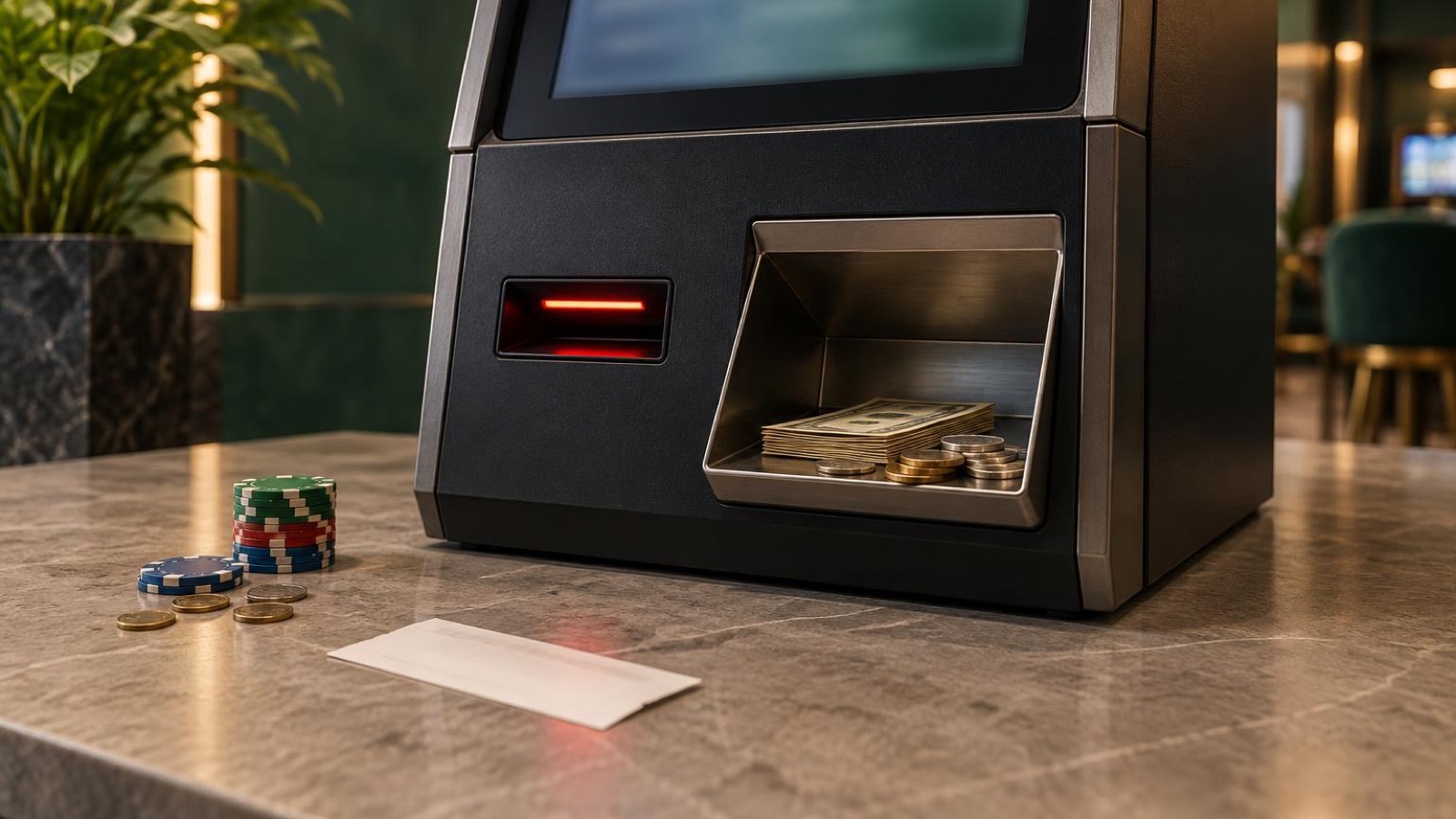
Slots look simple from the outside, but the part that confuses most first-timers is the money: how your cash becomes credits, what the machine does when you press cash out, and what that barcoded slip of paper is worth after you walk away. This page walks through the whole cycle, from the bill acceptor to the cashier cage, including the ticket-in ticket-out (TITO) system used in casinos from Manila to Macau, the medal counters of Japanese pachinko parlors, and the card-based cashless systems spreading through the region. If you want the wider picture of where you can play, see slots in Asia.
How a slot machine converts your money into credits
The first thing a slot machine does is turn your money into a number on a screen. On a modern machine you feed banknotes into the bill acceptor (many also take coins), and the machine immediately shows the value as credits, usually at the denomination you have chosen. Japanese betting machines work the same way at the front end: you insert banknotes or coins, and on some machines you can even reuse a winning ticket from an earlier bet to fund the next one10.
Not every venue takes raw cash at the machine. Some clubs sell you a stored-value credit first. At one club raided in Vietnam, players exchanged cash for "Cashin Ticket" credits or deposited US dollars directly into the gaming machines11. In Singapore's casinos, payment into play can be made by direct debit from a deposit account you hold with the operator, by exchanging chip purchase vouchers the casino has issued, or by another mode the regulator has approved12. In Hong Kong, the Jockey Club lets you buy a cash voucher that can be used to pay for any bet, and you can also transfer funds from your bank account to the Club's account in exchange for cash coupons13.
The practical point is the same everywhere: once your money is in, it is credits, not cash. The number on the screen is what you are playing with, and getting it back out is a separate step.
How to cash out: tickets, buttons and the cage
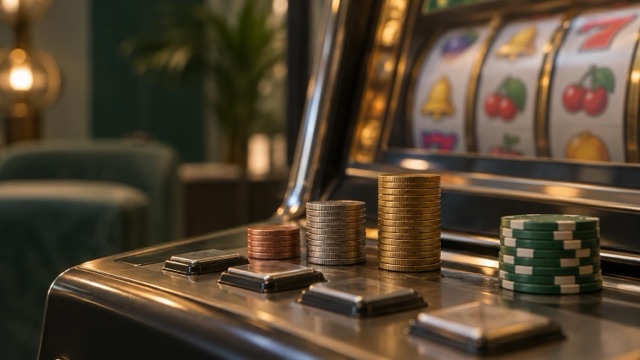
When you finish playing, you press the cash out button and the machine converts your remaining credits back into something you can carry. On a TITO machine this prints a ticket with a barcode, printed value and timestamp. On older or simpler machines it may return coins to a tray, and on card systems it writes the balance back to your card.
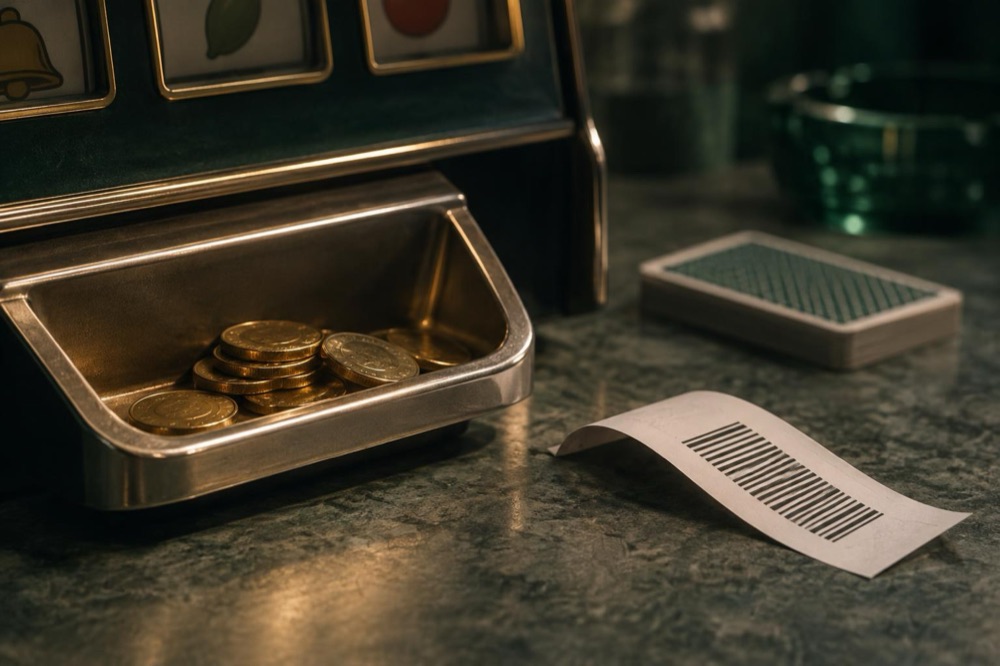
Japanese machines give you a preview of the same idea with the seisan (精算, settlement) button. At a betting machine you can cash out at any time: insert your ticket and push the green seisan button, and the machine settles up1. The same button dispenses your change when you buy1. Korean and Chinese-language guides for the same machines describe the identical move: insert the winning ticket, press the settlement button, and the money comes out of the machine4.
Where you take your ticket depends on the venue:
- Redemption kiosks. Many casino floors have standalone ticket redemption machines that read the barcode and pay cash on the spot.
- The cashier cage. Any ticket the kiosk will not take, and any large amount, goes to the cage. Staff scan the ticket and pay you.
- The counter the venue names. In smaller venues there may be one point of sale counter that handles both play and redemption6.
One rule worth knowing from the table-game side: chips bought at a roulette table can only be cashed out at that same table, not at the cage15. Slots are the opposite: a slot ticket is good anywhere in the venue that accepts it, which is the whole convenience of TITO.
A slot ticket is the same: it is a bearer instrument, so whoever holds it can redeem it.
TITO: dedicated tickets and where to exchange them
Ticket-in ticket-out means the same slip of paper works in both directions. You insert a ticket into the bill acceptor to load credits, and the machine prints a new ticket when you cash out. Some venues go further and issue dedicated tickets for specific purposes.
In Ontario's charitable gaming halls, TAP 'N PLAY cabinets work exactly like this: press cash out and the machine prints a voucher you redeem at the point of sale counter. If you win $1,000 or more, the machine prints a separate jackpot voucher, which you present to the cashier for redemption5. Play on Demand games work on the same model: all winnings are added to your player account balance and are available when you cash out at a point of sale counter6.
Japan's sports lottery shows how far the dedicated-ticket idea can go, and it is useful if you ever redeem anything in Asia that prints a slip:
- Winnings from tickets bought at a shop can be collected in cash at credit unions handling sports lottery, at some lottery stands that allow payouts, and at 7-Eleven7.
- At 7-Eleven, you scan the ticket barcode yourself on the Multi Copy Machine, print a refund acceptance slip, and take that slip plus your ticket to the register17.
- Payout hours differ by store, so a ticket that is redeemable at one counter may not be redeemable at another at the same hour18.
- In Singapore, toto cash prizes of SGD 5,000 or below can be claimed at any betting outlet19.
The same pattern of named redemption points appears across the region:
| Lottery | Where winnings are received |
|---|---|
| WINNER | Credit unions handling sports lottery, some lottery counters that allow payouts, and 7-Eleven20 |
| DUNK | Credit unions and some lottery sales offices where payout is possible21 |
| Thailand's Government Lottery Office | By transfer to your bank account, or by a Krung Thai Bank check at its G floor counter22 |
If you buy through an online member account instead, the payout can be automatic: Club toto transfers winnings straight to your registered bank account, so there is nothing to carry at all23.
The pattern carries over to slots: a TITO ticket is normally redeemable anywhere in the same casino, but dedicated tickets, jackpot vouchers and promotional slips often name one specific counter, so the ticket itself and the venue's signs tell you where the money is released.
Medal systems: borrowing, returning and settling at the counter
Japan's pachinko and pachislot halls run on medals rather than credits. You buy medals at a counter or from a machine, play with them, and at the end you take whatever you have back to the counter to settle. The counter is the heart of the system: it is where you borrow, where you return, and where the final exchange happens.
Some halls now layer a cashless card on top. At boatrace stadiums in Japan, a cashless membership system lets you load a card, play, and have any cash winnings credited on the spot to the card by staff24. The medal or card balance is what you carry between machines, and the counter is where it becomes money again.
The machines themselves distinguish between two worlds. On CR machines, odd symbols are chance-variation symbols and even symbols are normal symbols; on cash machines, odd symbols give an 8-round big win with a 100-spin time-shortening period, and even symbols give a 4-round big win with 50-spin time shortening25. The practical takeaway for a visitor: the same-looking machine can behave differently depending on whether it is a CR machine or a cash machine, and each hall settles winnings at its own counter.
Cashless and card play: what to take with you when you leave the machine
Cashless systems replace the ticket with a card or an app. You load money onto the card at a kiosk or the counter, tap in at the machine, play, tap out, and the balance stays on the card until you settle. The stadium cashless card above is one example24; Singapore's deposit-account and voucher system is a casino-scale version12.
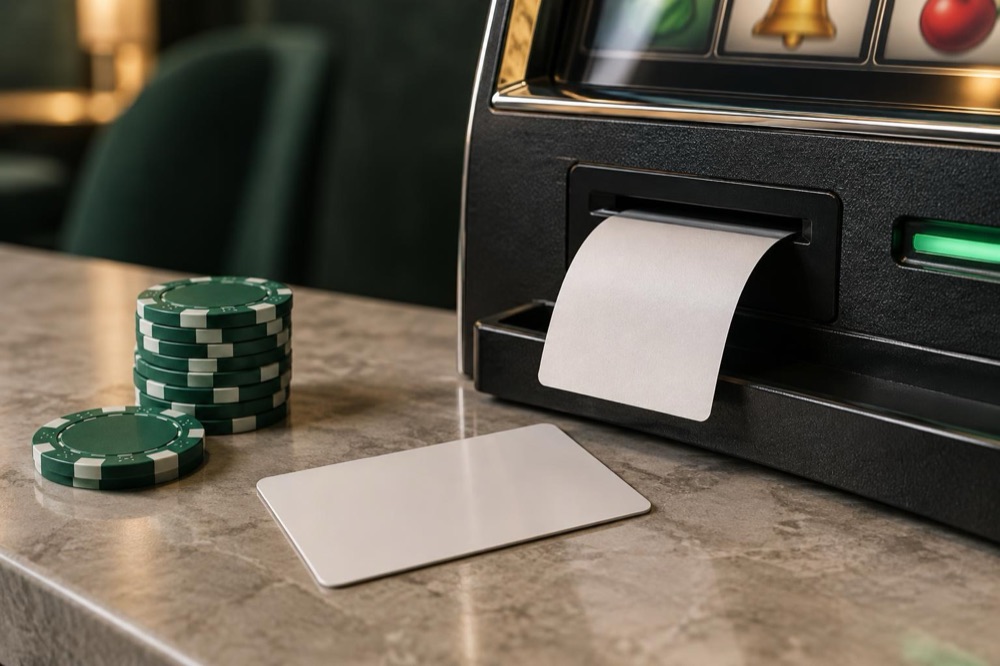
What matters is what you take with you when you stand up:
- Your card. The balance lives on it, not on the machine. Lose the card and you have lost the balance.
- Your ticket. If the machine printed one, that paper is the money.
- Nothing left on the screen. If credits remain and the machine will not print, undispensed ticket credit is cashed in and paid only upon management's verification of the correct credit amount9.
A few practical notes from venues that run card and cash systems side by side. Some charitable games are cash only, so play there is bounded by the cash you bring or the on-site ATM5. Poker rooms advise players to consider using cash only and to leave credit cards at home, setting a budget and a win limit in advance26. And in sports betting, a Cash Out function that lets you settle a bet early is only available if you place your bets through your remote betting account27, a reminder that the fancy features of any cashless system usually depend on you being registered in it first.
Paylines, bets and the paytable: what determines a win
Before you can cash anything out, the machine has to decide whether you won. That decision comes from the paytable: the list of symbol combinations and what each pays at your bet size. If you want the full mechanics, see how slot machines work and how to read a slot paytable.
The size of your win is a multiplication. In Japan's sports lotteries the formula is spelled out plainly: the prize is the payout odds (the payout multiplier) times the purchase amount20. Racing payouts are indicated as the amount paid for a ¥100 bet, so a payout of 300 means ¥300 back for every ¥100 staked29. The same logic sits inside every slot paytable: symbol value times your line bet.
Scratch and instant games show the same structure in a different skin. INSTANT MONEY MACHINE asks you to scratch five lucky numbers, two bonus numbers and twenty of your own numbers, with prizes from $5 to $5,00030. Slot games are certified individually: AMAZING MONEY MACHINE, version vs10amm, is a licensed SLOT game with its own game ID31. And payouts can vary by situation even within one game: in craps, an odds bet pays differently depending on what the point is32, just as a slot's scatter or bonus feature pays differently from its line wins.
For what wild and scatter symbols actually do on the reels, see wild and scatter symbols.
RTP, house edge and denomination: what the odds look like
The return to player (RTP) is the percentage of all money wagered that a machine pays back over its lifetime. In the Philippines, the regulator has set the range for electronic games of the slot machine type: the RTP shall be from 90.00% to less than 97.00%8. That is the legal corridor in which every licensed slot machine in that jurisdiction operates.
Two things follow. First, the house edge is the mirror of RTP: whatever percentage of money wagered the machine does not return is what the operator keeps over time. Second, denomination does not change the principle. A higher-denomination machine costs more per spin, so the numbers moving through it are bigger, but the percentage framework is the same. For the full picture, see slot return to player and slot bet sizes.
Other games state the same truth in their own words. Bingo does not pay out to players as much as it takes in; the operator keeps a portion of the cost of play to offer the games33. Japan's WINNER lottery even publishes the theoretical payout: the payout multiplier times the purchase amount, with a theoretical value of unit price times number of options times 50%34. Games of chance are built so that the house keeps a slice. That is the business model, not a defect.
Random number generators: why previous spins tell you nothing
Every spin on a modern slot machine is decided by a random number generator, a program that produces outcomes with no connection to what came before. The bingo version makes the point vividly: the ball blower ensures the selected numbers are completely random, so no single number has a greater chance of appearing than any other33. A slot's RNG does the same job electronically, thousands of times a minute.
This is why the ideas in the "due to pay" family of beliefs do not hold up, and it is why there is no skill involved. Casino War is advertised on exactly that basis: it requires no skill to play35. Slots are the same. The machine does not know how long you have been sitting there, does not know whether you are up or down, and does not adjust. For more, see are slots due to pay out and does skill matter in slots.
One last practical point about randomness and machines. If a system or machine malfunctions, the venue's rules say that all plays and pays are voided, and any ticket credit that was not dispensed is cashed in and paid only upon management's verification of the correct amount9. So if the screen freezes mid-spin or a ticket fails to print, the standard procedure is to stay at the machine, note the credit shown and call a staff member; continued play on a misbehaving machine is void anyway. For the full story on disputed jackpots, see slot machine malfunctions.
Common Questions
What do I do with a slot ticket after the game ends?
Take it to the cashier cage, a ticket redemption machine or the counter named on it, and exchange it for cash. The physical ticket is needed to claim the money, so it works like cash until it is redeemed.
How do I cash out on a Mocha slot machine?
Press the cash out button and the machine prints a voucher for your remaining credit. Take that voucher to the club's redemption counter and staff exchange it for cash. Large wins may be paid as a separate jackpot voucher handled at the counter.
What is the return lever or return button on a slot machine?
It is the control that ends your session and returns your unused credit, usually printing a ticket instead of coins. On Japanese betting machines the equivalent is the seisan (settlement) button, which pays out your change or winnings.
Do higher-denomination slot machines pay more?
Not automatically. Regulated slot machines return a set percentage of money wagered over time, within a fixed range, regardless of denomination. A higher denomination means each spin costs more, so wins and losses are simply larger.
What are wild and scatter symbols?
Wilds substitute for other symbols to complete winning combinations, while scatters pay or trigger features regardless of position. On some Japanese machines, odd and even symbols carry different win lengths and time-shortening rounds.
Is there any skill in playing slot machines?
No. Slot outcomes are decided by a random number generator the moment you press the button, and games of this type require no skill to play. Nothing you do at the machine changes the result.
What happens to my credits if I take a break from the machine?
Credit left in a machine is paid only after staff verify the correct amount, so the standard practice is to cash out before stepping away. If the machine malfunctions, plays and pays can be voided.
Sources35 sources
- How to Bet, Tokyo City Keiba, 2026
- Ticket Purchase, KRA Boatrace, 2026
- How to Use SMAPPY, Japan Racing, 2026
- How to Bet, Sonoda Racecourse (Himeji), 2026
- TAP 'N PLAY: How to Play, PlaySmart, September 25, 2026
- Play on Demand: How to Play, PlaySmart, September 25, 2026
- Toto: How to Play, Sports Promotion Lottery, September 25, 2026
- Regulatory Framework for the Accreditation of Gaming Affiliates and Support Service Providers, PAGCOR, October 2, 2025
- Regulatory Framework for Gaming Venue Operations, PAGCOR, November 6, 2025
- Beginner's Guide to Betting, Kanazawa Racecourse, 2026
- Dozen foreign nationals caught illegally gambling at Nha Trang hotel, Vietnam News, April 10, 2026
- Casino Control (Prescribed Premises Specialised Casino) Order, Singapore Statutes Online, 2009
- Betting Facilities Rule 6, Hong Kong Jockey Club, 2020
- Betting Facilities Rule 7, Hong Kong Jockey Club, 2020
- Roulette: How to Play, PlaySmart, September 25, 2026
- Toto Refund Shops, Sports Promotion Lottery, September 25, 2026
- 7-Eleven Toto Refund Service, Sports Promotion Lottery, September 25, 2026
- Toto Refund, Sports Promotion Lottery, September 25, 2026
- Toto: How to Play, Singapore Pools, September 26, 2026
- WINNER: How to Play, Sports Promotion Lottery, September 25, 2026
- DUNK Refund, Sports Promotion Lottery, September 25, 2026
- Reward Payment Channels, Government Lottery Office, September 25, 2026
- DUNK Web Purchase, Sports Promotion Lottery, September 25, 2026
- Stadium Information, Boatrace.jp, April 17, 2019
- ギンギラパニック, Wikipedia, 2026
- Poker: How to Play, PlaySmart, September 25, 2026
- Football Betting Game Rules, Singapore Pools, May 29, 2026
- WINNER, Sports Promotion Lottery, September 25, 2026
- Go Racing Guide, Japan Racing, September 26, 2026
- Instant Money Machine: How to Play, PlaySmart, September 25, 2026
- PPY App Kit, PAGCOR, November 20, 2025
- How to Play Craps, PlaySmart, September 25, 2026
- Bingo Odds, PlaySmart, September 25, 2026
- Sports Lottery Press Release, Japan Sports Promotion, June 12, 2026
- Casino War: How to Play, PlaySmart, September 25, 2026