Pachinko and slots: the short answer
They look similar on the outside, and that is where most of the confusion comes from. Both involve a machine, a screen or a playfield, and a result you cannot control. But they sit in completely different categories in Japan.
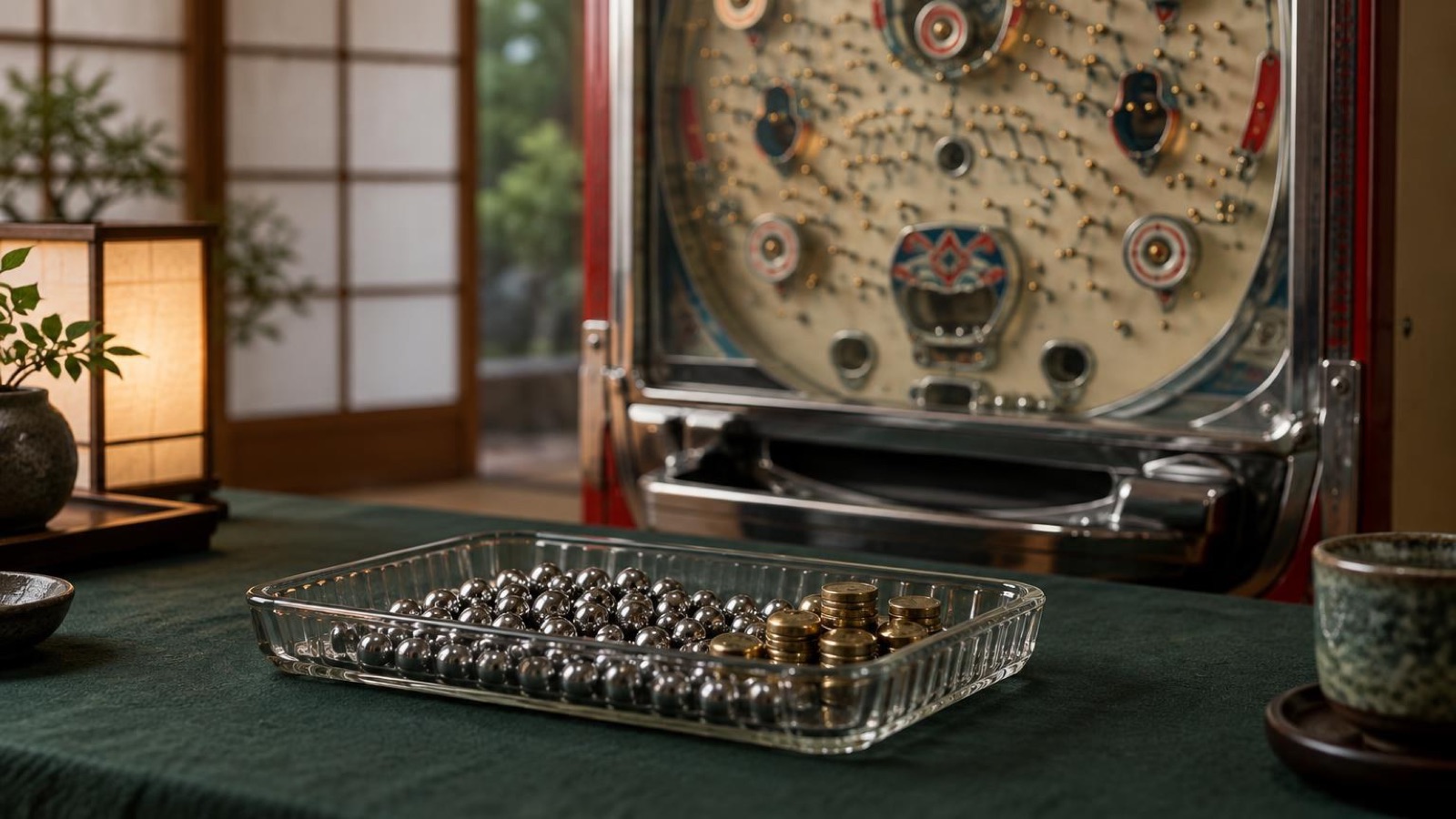
Pachinko is a pinball-style game where steel balls drop through a playfield. Pachislot, often shortened to pachi-suro, is a reel machine that works much like a slot but pays out tokens rather than cash. Both are played in halls that are legal and common across the country2. Neither is officially classified as gambling for money, which is the reason they can operate at all1.
A casino slot machine, the kind you find in Macau, Singapore or Manila, pays cash directly from the machine or the cage. That version does not exist for players in Japan. There are no legal casino slot machines to sit down at, and the casino resorts that would host them are not built yet2.
So the practical answer is: pachinko and pachislot are legal and you can play them; slots in the casino sense are not something you can play in Japan, and playing them online from Japan is a crime3.
Slot machines are illegal for players in Japan
Japan separates games from gambling. Pachinko and pachislot halls have operated for decades because they are treated as gaming rather than betting, and that is why they are tolerated despite looking like gambling to a visitor1.
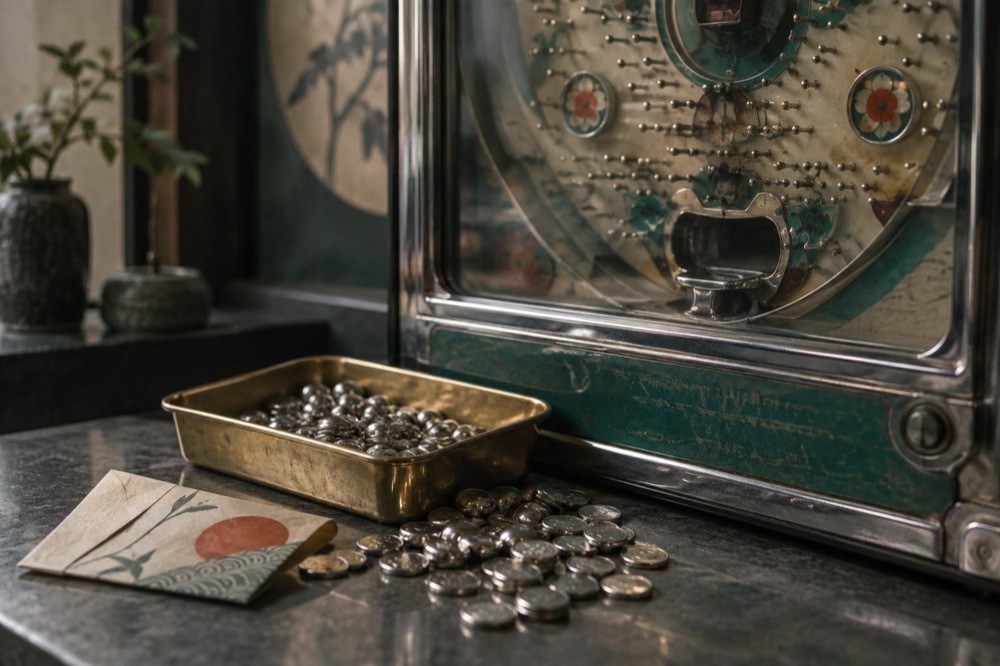
The line is drawn at cash. If a machine paid cash straight out, it would be gambling, and gambling for money is not permitted outside a narrow set of state-run and licensed activities. That is why pachinko winnings come out as tokens and prizes instead.
The same logic applies to poker. Even tournament poker, where players pay an entry fee and compete for a prize pool, runs into the restriction that cash prizes for winners are not legally possible in Japan4. Poker rooms operate, but the prizes are not cash.
For a visitor, this matters in a simple way. You can walk into a pachinko hall and play. You cannot walk into a venue anywhere in Japan and play a cash slot machine, because there is no such venue open to the public.
How the two games actually differ
The mechanics are further apart than the cabinets suggest.
Pachinko is a vertical pinball game. You buy balls, feed them into the machine, and they cascade down through pins. Landing in certain pockets triggers a payout of more balls, and on modern machines it can also trigger a screen animation or a spin. The odds are not fixed the way a slot's are. On some models the chance of hitting the main payout can start around 1 in 300 and then improve to roughly 1 in 30 after a single win, which is why pachinko feels streaky in a way slots do not2.
Pachislot is closer to a slot machine. You borrow tokens from a dispenser beside the machine, feed them in, and spin the reels5. When you finish, an attendant counts your remaining tokens and gives you a receipt showing the number. You take that receipt to the prize exchange counter and pick prizes worth the number of tokens you won5.
Casino slots pay cash. The return to player is set by the game's math, and slot machines generally return less to the player than table games such as blackjack, roulette or pai gow poker6. Volatility also varies: some slots pay small amounts often, while high-volatility games have long dry spells between bigger hits7.
| Type | Legal for players in Japan? | Where | Payout | Minimum age |
|---|---|---|---|---|
| Pachinko | Yes | Pachinko halls nationwide | Balls, then prizes | 188 |
| Pachislot | Yes | Pachislot halls | Tokens, then prizes | 188 |
| Casino slot machines | No | Not available | Cash | n/a |
| Online slots | No | Offshore sites | Cash or crypto | n/a3 |
Legal forms of gambling in Japan
Pachinko is not the only thing you can legally do. Japan runs several state-controlled betting and lottery operations, and these are the ones where cash actually changes hands.
- Horse racing and local racing. Racing is run under a public system, and night races are held at four racecourses in the country9. You bet at the track or through official channels.
- Public lotteries and sports betting. These are operated under the same public framework that covers racing and the toto football pools10.
- Pachinko and pachislot. The everyday option, available in almost every town, with token and prize payouts2.
What is not on that list is casino gambling. There is no licensed casino open to the public in Japan, and no slot machine that pays cash to a player.
For visitors, the practical point is that the legal options are mostly the same as for residents. You can buy a lottery ticket, bet on a race and play pachinko. What you cannot do is find a casino.
Online casinos: a gray area with real risks
It is not actually gray. Playing on an online casino from Japan is illegal, and the police say so plainly.
Online casino games are defined as games played through a smartphone or computer where you wager cash, crypto assets or electronic money on the outcome. That covers slots, card games, puzzle games and sports or combat contests10. The name of the game makes no difference: baccarat, slots, sports betting and anything else played online for money is a crime3.
Two details matter if you are thinking about it anyway.
First, the location of the site does not help. Even if the operator is licensed and legal in another country, connecting from Japan and playing is illegal, and Japanese law applies11. Police have said they enforce this strictly regardless of whether the operator is legal where it is based12.
Second, not knowing does not get you out of it. A mistaken belief that the activity was legal does not remove intent, so it is not a defense11.
That applies to residents and citizens. For visitors, the same rule applies while you are physically in Japan, because the act happens where you are sitting, not where the server is.
If you want to understand how these games work before deciding anything, the mechanics are the same everywhere: reels, symbols, a random number generator and a paytable. You can read about how slot machines work and about slot return to player without touching a real-money site.
Minimum ages: 18 for pachinko, 20 for most betting
Age rules in Japan are not uniform, and the pachinko age is lower than many visitors expect.

Pachinko and pachislot: 18. Under the entertainment business rules, anyone under 18 is barred from entering a pachinko parlor as a customer, and operators are expected to thoroughly check the age of anyone who might be under 188. In practice, staff will ask for ID if you look young. This applies to tourists exactly as it applies to residents.
Betting and lotteries: 20. The public betting and lottery operations sit under the adult age of 20, which is the general threshold for gambling in Japan. If you are 18 or 19, you can play pachinko but not place a bet on racing or buy into the state betting products.
For comparison, the region is not consistent, and it is worth knowing before you travel:
| Country | Casinos | Betting and lotteries |
|---|---|---|
| Japan | No casinos open | 20 |
| Singapore | 21 to enter14 | 18 for horse racing, sports and lottery15 |
| Philippines | 2116 | 2116 |
| Macau | 1817 | 1818 |
If you are planning a trip that includes machine play, the age you need depends entirely on where you are standing. At 18 you can play pachinko in Tokyo but not enter a Singapore casino. At 21 you can do both.
Planned casinos and what they would change
Japan has been talking about casino resorts for a long time. Proposals for introducing casinos have been debated since 2001, and no casino has been established2. That is still true today.
If integrated resorts do open, they would be the first places in the country where a player could sit at a cash slot machine legally. Until then, the only machine play available to you in Japan is pachinko and pachislot, with token and prize payouts.
For a visitor, the practical takeaway is simple. Do not plan a Japan trip around a casino. There is nothing to visit. If you want casino slots in Asia, the established destinations are Macau, Singapore, the Philippines and Cambodia, and each has its own age and entry rules.
If you are comparing what is available across the region, our guide to where slots are legal in Asia sets out the differences country by country, and the Japan country guide covers the full picture of what you can and cannot do there.
Common Questions
Can tourists play pachinko in Japan?
Yes. Pachinko parlors are open to anyone aged 18 or over, and staff check age if you look young. You do not need to be a Japanese citizen or resident. Bring cash, since machines take notes and coins, and expect a hall that is loud, smoky in places and mostly Japanese-language.
Why do pachinko parlors use prize tokens instead of cash?
Pachinko is treated as a game rather than money gambling, so winnings come out as tokens or prizes, not cash from the counter. In practice many halls sit next to a separate exchange kiosk where you can swap prizes for cash, a long-standing arrangement known as the three-store method.
What is the minimum age for pachinko?
You must be 18 or older to enter a pachinko parlor as a customer. Operators are expected to check the age of anyone who might be under 18. This applies to visitors and residents alike, and there is no lower age for tourists.
Are there any legal slot machines in Japan?
Not in the casino sense. Pachislot machines exist inside pachislot halls and pay out tokens rather than cash, which is why they are allowed. True casino slot machines with cash payouts are not available to players anywhere in Japan, and the planned casino resorts are not open yet.
Can Japanese residents be arrested for playing online slots?
Yes. Playing on an offshore casino site from Japan is treated as illegal gambling, and a foreign license does not change that. Police have stated they enforce this strictly, and saying you did not know it was illegal does not remove intent.
When will Japan's first casino open?
No casino has opened yet. Proposals have been debated since 2001 and no resort is operating. If you are planning a trip around a Japanese casino, there is nothing to visit at the moment, so treat any opening date you see online with caution.
Is online pachinko legal?
No. Anything played online for money, whatever it is called, counts as illegal gambling in Japan. That covers baccarat, slots, sports betting and anything branded as online pachinko. The name or the game type makes no difference to how it is treated.
Sources18 sources
- Gambling in Japan, Oxford Brookes University, September 2007
- Mainichi: Japan gambling and pachinko, Mainichi, July 20, 2018
- Online Casino Guidance, National Police Agency, September 25, 2026
- JOPT 2025 Tokyo Guide, Japan Open Poker Tour, July 12, 2025
- How to Play Pachislot, Slot Pioneer, 2023
- How Do Slot Machines Work, GameSense, 2021
- How to Play Slots Online, Shuffle, May 15, 2026
- Basic Plan for Measures against Gambling Addiction, Cabinet Secretariat, March 21, 2025
- Local Racing in Japan, Japan Racing, 2026
- Toto Integrity, Toto Dream, 2026
- Research Paper on Online Casino Gambling, National Police Agency, 2026
- Online Casino Investigation Report, National Police Agency, January 2025
- Age Verification Guidance for Pachinko, Cabinet Office, 2023
- Casino Control Act 2006, Singapore Statutes Online, December 31, 2024
- Gambling Regulatory Authority Bill, Ministry of Home Affairs Singapore, May 9, 2018
- Responsible Gaming, PAGCOR, September 25, 2026
- Legal Framework for Fortuna Azar, DICJ Macau, 2001
- Lot Despacho, DICJ Macau, May 27, 2005