
What these games have in common
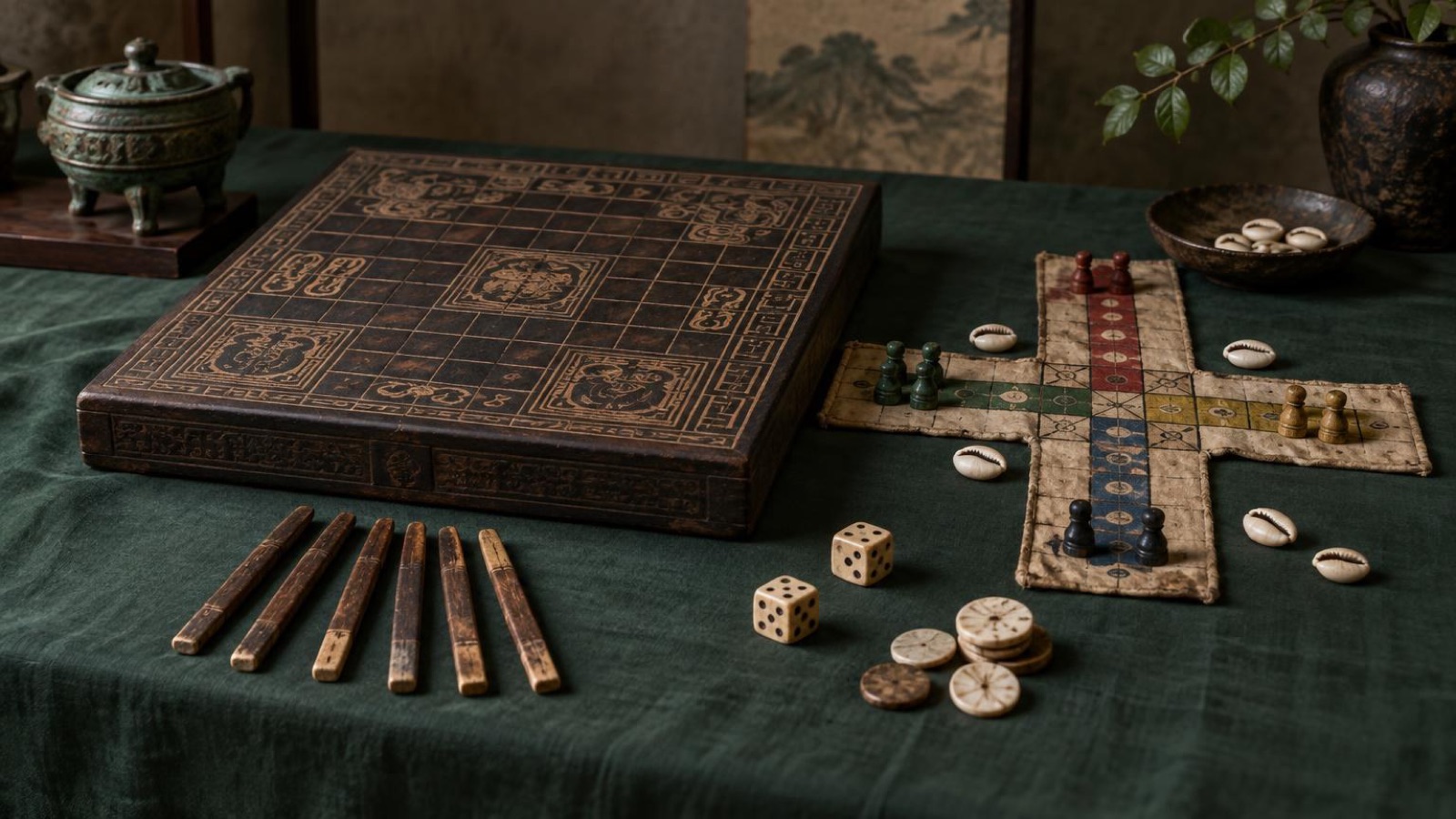
The board and race games of old Asia were not quiet pastimes. They were social events with money on the table, played in teahouses, courts and gambling dens, and the equipment itself was often valuable. A game like Liubo needed a carved board, a set of pieces and a handful of throwing sticks. Shengguan Tu needed a printed paper sheet listing every rank in the imperial bureaucracy, plus dice and a pile of chips. These were objects you owned and kept, not disposable amusements.
What ties them together is the mix of chance and skill. The throw decided how far you moved, but the player decided which piece to move and when to take a risk. That combination is the same one that runs through modern table games. Sic Bo, for instance, is described in official rules as an ancient Chinese dice game, and it still uses three dice of equal weight, each pair of opposite faces summing to seven5. The equipment survived even when the original rules did not.
The stakes could be small or serious. Shengguan Tu was played for a stake, and the game circulated in several variants, including a modernized form and a Republican-era version printed in Taipei in 1962 under the title Gailiang qingdai Shengguan tu3. In other words, people kept reprinting and adapting it because they kept playing it.
Some of these games also crossed borders. Kachikachi, a Japanese gambling game played with kabufuda stock cards, is similar to "Solo" in Okinawa and "Sotta" in Korea6. The family resemblance matters: a game that works tends to travel, and the versions that survive are the ones that stayed fun to play for money.
Liubo: the 'six sticks' game of the Han court
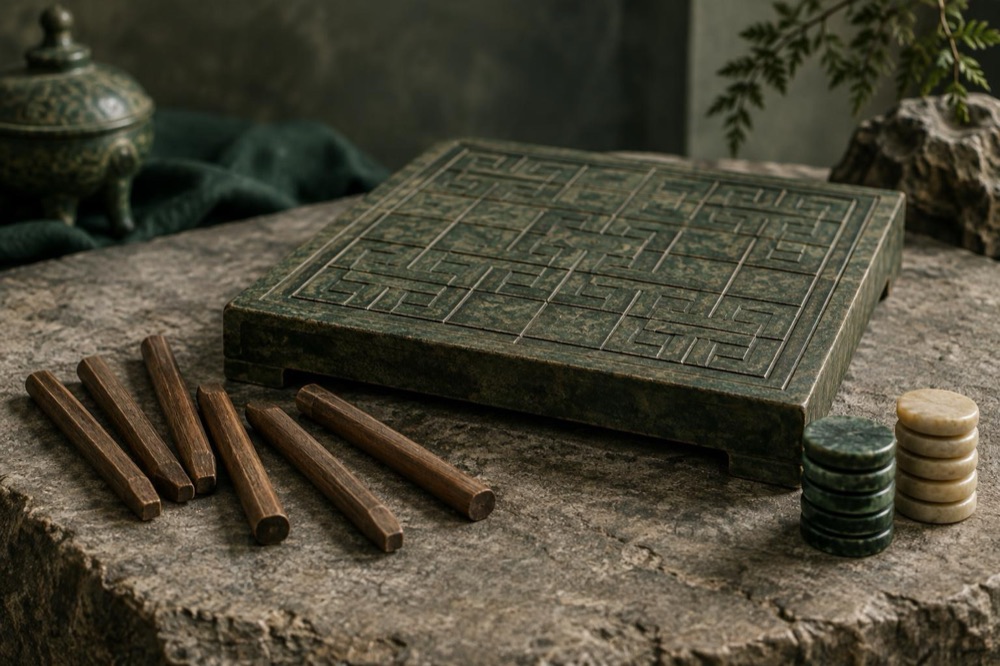
Liubo is the oldest and most mysterious of the group. It was a two-player game, and the name refers to the six sticks used to generate throws rather than to dice. The board was square, marked with a pattern modern scholars call TLV, and each player had six pieces to move around it.
For most of recorded history, nobody knew exactly how it was played. Boards survived, pieces survived, and references in old texts survived, but no complete rulebook did. That is why Liubo became a byword for a lost game: you could see the equipment in museums and still not know the sequence of play.
The game had a long life at the top of society. It appears in tomb art and in surviving sets, and it was played at court during the Han dynasty. A green-glazed red pottery group of two Liubo players and a gaming table sold at Christie's New York in March 2008 for $277,500, which tells you how seriously collectors treat the surviving material.
If you want the full story of the game and its disappearance, there is a dedicated page on what Liubo is and when it disappeared.
How Liubo was played: pieces, sticks and the TLV board
The physical setup is easier to describe than the rules. A Liubo board is square, with a marked pattern in the center and around the edges, and the pieces are small enough to sit on the intersections. The throwing sticks, six of them, were cast to produce a result, and the result determined how a piece could move.
Each player had six pieces. The board's markings created zones and paths, and the game appears to have involved both racing and capturing, which is why it is often grouped with the race games rather than with pure dice games. The owl figure that appears in some sets is one of the details that made the game hard to reconstruct: it clearly mattered, but how it mattered was not written down in any surviving text.
What changed everything was the discovery of written rules. In 2019, more than 1,000 bamboo slips from the tomb of the Marquis of Haihun were confirmed to record the long-lost rules of Liubo. The tomb held more than 5,200 slips in total, and the Liubo section was identified among them. That is the single most important find in the study of the game, and it turned a guessing game into a readable one.
For a visitor, the practical takeaway is simple. You will see Liubo boards and pieces in Chinese museums and in traveling exhibitions, and you will see reproductions for sale. What you will not find is a working commercial version you can sit down and play for money, because the game belongs to history rather than to the modern floor.
Pachisi: the national game of India
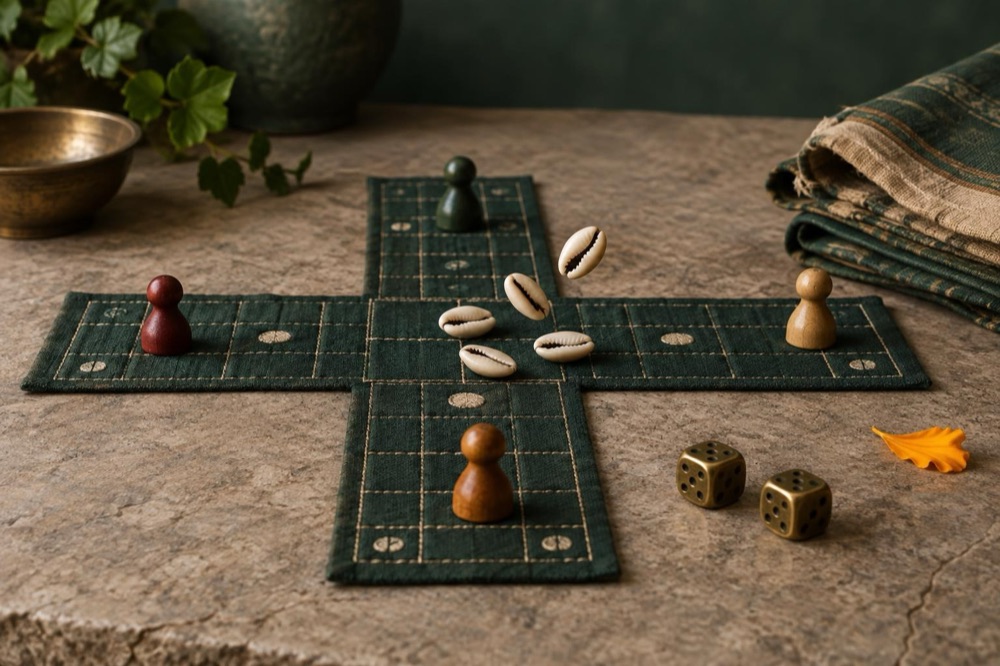
Pachisi is the best known of the Indian race games and the direct ancestor of the modern mass-market board games most people grew up with. It is traditionally a four-player game, with partners sitting opposite each other, though two players can also compete. The board is cloth, shaped like a cross, and the pieces race around the arms toward home.
The randomness comes from cowrie shells rather than dice. Shells that land mouth-up or mouth-down produce different counts, and the count decides how far a piece moves. Landing on an opponent's square sends that piece back, which is where the tension in the game comes from. It is a race with contact, and the contact is what makes it worth playing for stakes.
Pachisi's status in India was close to national. It was played at court, in villages and in clubs, and it spread outward from India into other parts of Asia and eventually into Europe, where it was reworked into the parlor games that became standard family entertainment. The cross-shaped board and the four-arm race are the recognizable signature.
If you want to see the game played, look for heritage demonstrations and museum collections rather than commercial venues. The cloth boards and cowrie shells are still made, and the game is still taught as part of Indian cultural history.
Chaupar and the race-game family
Chaupar is Pachisi's close relative, played on the same cross-shaped cloth with cowrie shells or dice, and it belongs to the same family of race games. The family also includes Chowka Bara, the South Indian version played on a square grid of squares, where pieces move according to the throw and capture by landing on an occupied square.
The family resemblance is the point. Once you understand one of these games, you understand the shape of all of them: a track, a throw, a set of pieces, and a rule about what happens when two pieces meet. The differences are in the size of the track, the number of pieces and whether the throw comes from shells, dice or sticks.
These games were played for stakes across the region, and they were common enough that observers wrote them down in detail. The race-game family is wide: Pachisi, the board game that originated in medieval India and is called the national game of India, was created in the 6th century and is usually played by 2 to 4 players, with the winner the first to move all pawns home2. Chauka Bara is another race game, for two to four players racing their respective coins3. That is the same social world the race games belonged to: tables where the game was the excuse and the money was the point.
For a modern reader, the practical value of knowing this family is that it explains where Ludo and its relatives came from. They are simplified, de-staked versions of games that were once played hard for cash.
Shengguan Tu: the promotion game played with dice and chips
Shengguan Tu is the odd one out, because it is not a race around a track. It is a promotion game. The board is a printed sheet listing the civil and military ranks of the imperial bureaucracy, arranged as a ladder, and players move up and down that ladder according to their throws. The game is described as an ancient gambling game played on paper with official ranks, dice and chips, and it was played for a stake1.
The game is old. It is said to go back to the caixuan or bo guan duo of the Tang era, and it was established in its mature form during the Ming and Qing dynasties3. The board is usually divided into 64 or 66 fields, and it is classified among the start-to-finish games by the German Games Archive at the University of Marburg3.
The equipment is simple. Players throw four dice, and the result moves them along the ladder of ranks3. In the Hong Kong version, each player contributed 100 chips to a common pool at the start of the game1. Five to seven players were considered the best number for a session1.
There were regional variations. In Taiwan, players used a four-sided spinning top instead of dice, with each face marked with one of the characters de, cai, gong or zang1. There was also a Buddhist-themed variant with a similar structure, called Shengfo tu3.
Shengguan Tu is not a game you will find in a modern casino. It began in the Tang dynasty and settled into its familiar form under the Ming and Qing, and it has been played for more than a thousand years1. It circulated in several variants, including a modernized form and a Republican-era version printed in Taipei in 1962 titled Gailiang qingdai Shengguan tu2. Five to seven players were considered the best number for a game1.
Bài chòi and UNESCO recognition
Bài chòi is the Vietnamese member of this group, and it is the one with the clearest modern status. It is a card game played with songs, performed in a hut-like structure with a caller and a crowd of players, and it is closely tied to the Lunar New Year and to community festivals in central Vietnam.
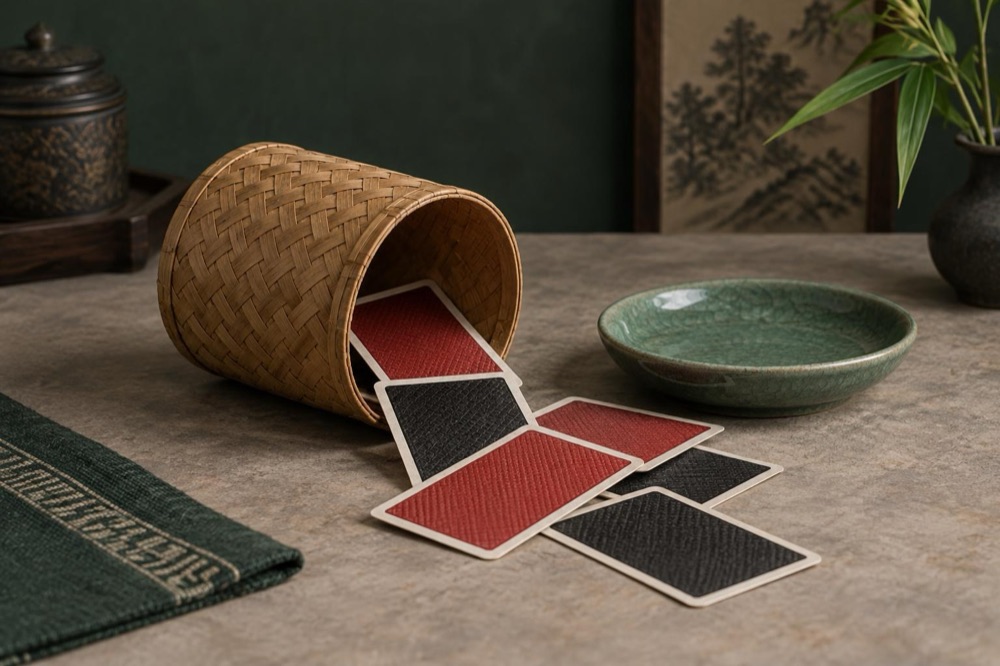
UNESCO conferred intangible cultural heritage status on bài chòi in December 2017, at a meeting held on Jeju Island in South Korea. The recognition covers the game and its associated performance style, which is why bài chòi is often described as an art form as much as a game.
If you are in central Vietnam, bài chòi is the most accessible of the games on this page. It is performed at festivals and cultural events, and it is a spectator-friendly format: the caller sings a riddle, the players mark their cards, and the winner is the first to complete a set. There is a full account of the recognition and its background on the page about when UNESCO recognized bài chòi.
Where you can see these games today
The honest answer is that none of these games is a live commercial gambling product in the way a modern casino game is. They survive as museum pieces, heritage demonstrations, reproductions and festival performances. Here is where to look.
| Game | Where to see it | What you will find |
|---|---|---|
| Liubo | Chinese museums and traveling exhibitions | Boards, pieces, tomb art and reproductions |
| Pachisi | Indian heritage collections and cultural demonstrations | Cloth boards, cowrie shells, teaching sessions |
| Chaupar and Chowka Bara | Indian cultural events and museum collections | Cloth boards and grid boards, shells or dice |
| Shengguan Tu | Antique markets in mainland China; Taiwan heritage sites | Printed paper boards, dice, chips, modernized sets |
| Bài chòi | Central Vietnam festivals and cultural events | Live performances with songs and cards |
For the wider context of how these games fit into Asian gambling culture, the gambling culture and history section covers traditions, superstitions and famous venues. If you are interested in games that were recognized as heritage rather than banned, there is a page on gambling games recognized as cultural heritage.
One practical note for anyone hoping to play these games for money today: the modern versions are almost always de-staked. The Fongyi Academy sets, the museum reproductions and the festival performances are all played for fun or for small prizes, not for cash. The stakes belong to the history, not to the present.
If you want to see how the descendants of these games are played now, the country guides cover what is legal and where. Start with:
- India for the race-game heartland
- China for the board-game tradition
- Vietnam for bài chòi
- Japan for the kabufuda card games that grew out of the same gambling culture
Common Questions
What does the name Liubo mean?
Liubo translates roughly as 'six sticks,' a reference to the six bamboo throwing sticks used instead of dice. The name describes the game's equipment rather than its rules, which is one reason the game stayed mysterious for so long.
How many players did Liubo have?
Liubo was a two-player game. Each player moved six pieces around a square board marked with a TLV pattern, and the throwing sticks decided how far a piece could travel on each turn.
Why are the rules of Liubo unknown?
For roughly two thousand years no complete rulebook survived, only board layouts, pieces and passing references in old texts. That changed in 2019, when more than 1,000 bamboo slips recording the rules were confirmed in the Marquis of Haihun tomb.
What is the owl piece in Liubo?
Some Liubo sets included a carved owl figure alongside the ordinary pieces. Its exact role in play is still debated, but it appears in surviving sets and in tomb art showing the game in progress.
How many players can play Pachisi?
Pachisi is traditionally a four-player game, with partners sitting opposite each other, though two players can also compete. Each player races pieces around a cross-shaped cloth board using cowrie shell throws.
What is Shengguan Tu played with?
Shengguan Tu is played on a paper board printed with the ranks of the imperial bureaucracy, using dice and chips. Players move up and down the official ladder according to their throws, and the game was traditionally played for a stake.
When did bài chòi get UNESCO heritage status?
UNESCO conferred intangible cultural heritage status on bài chòi in December 2017, at a meeting held on Jeju Island in South Korea. The recognition covers the card game and its associated songs and performance style.
Sources6 sources
- 陞官圖研究, NTNU
- Chinese Games with Dice and Dominoes, Smithsonian Institution
- Shengguan tu, Oriens Extremus
- Tứ sắc, Wikipedia
- Sic Bo: How to Play, PlaySmart
- かちかち, Wikipedia















