
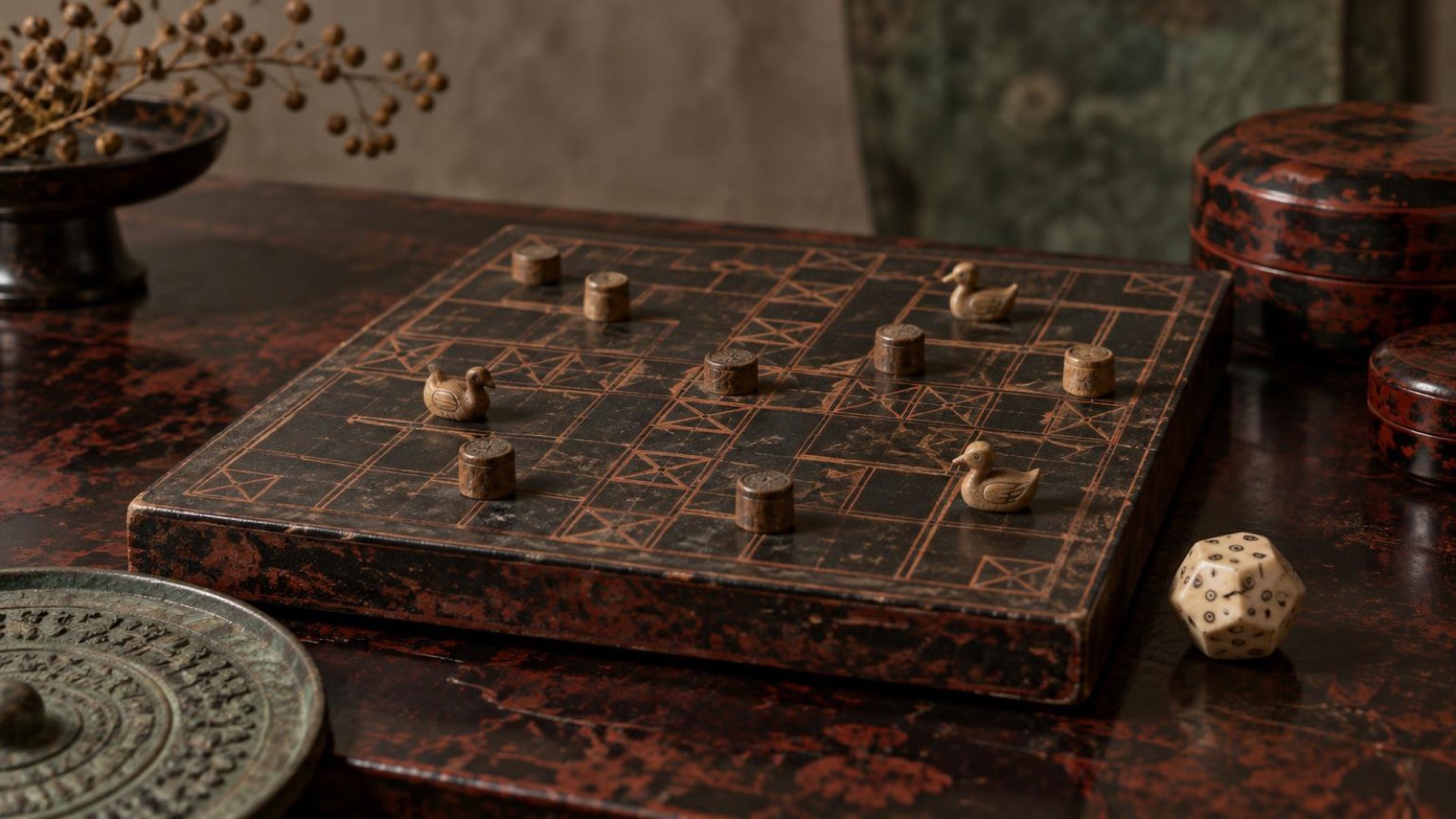
A game for two players
Liubo was played by two people. That much is clear from the surviving evidence, and it shapes everything else about the game: the board, the pieces and the dice all point to a head-to-head contest rather than a group activity.
The equipment was simple in outline.
- There was a board, marked with a pattern that scholars have studied closely
- There were playing pieces, often carved and sometimes quite elaborate
- Dice decided the moves, and a throw told you how far a piece could travel, so chance and choice were mixed together in every turn
That combination is worth pausing on. A game where dice decide the distance and the player decides the direction is not pure luck and not pure skill. It sits in between, which is exactly the space that most enduring gambling games occupy. The same balance shows up in Chinese games that survived into the modern era, where a throw or a draw sets the terms and the player responds.
For comparison, think of how other traditional games handle player numbers. Some are rigid about it, while others are flexible.
| Game | Players |
|---|---|
| The tile game described by Wilkinson in his 1890 notes | "one for four players, neither more nor less"4 |
| A domino game recorded in the 1890s | two or three people, played with two sets of dominoes5 |
| Another domino game in the same account | two players, played with one set of dominoes5 |
Liubo sits at the fixed end: two sides, facing each other.
The pieces themselves were not identical counters. Carved examples recovered from tombs show real variety in form, which suggests the two sides were distinguished clearly and that some pieces may have had different roles. Without a rulebook, though, the exact function of each piece remains a matter of interpretation.
Where the evidence comes from: texts and Western Han tombs
Everything known about liubo comes from two places: ancient texts that mention it, and physical objects dug out of the ground. Neither is complete on its own, and together they still leave gaps1.
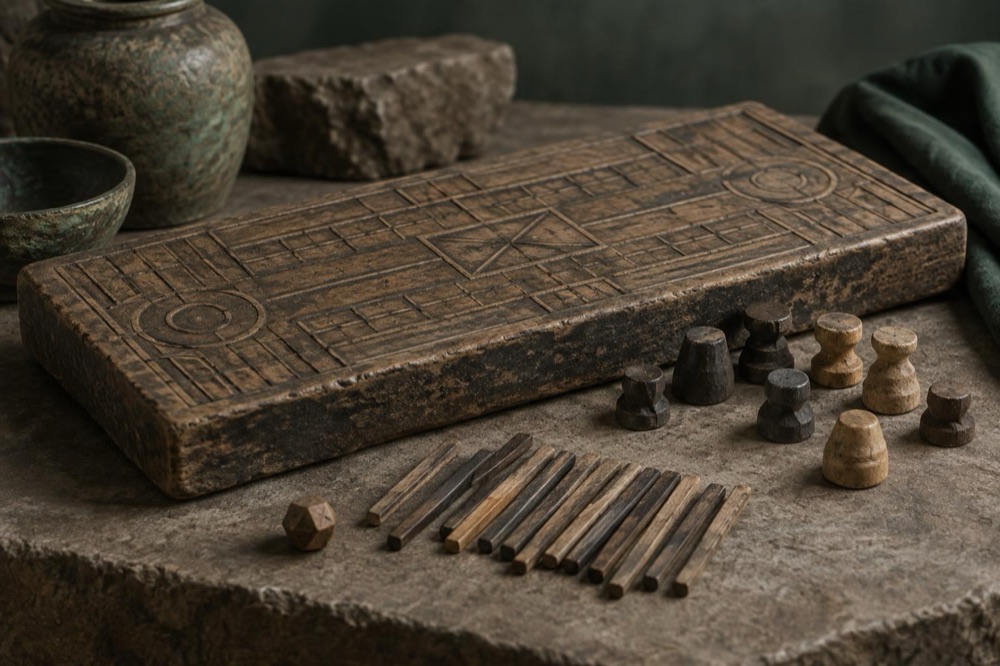
The textual side gives us the name, the general reputation of the game, and scattered descriptions. Ancient Chinese writings refer to liubo, and those references establish that it was a real and recognized pastime rather than a later invention. What the texts do not give us is a rulebook. Nobody wrote down, in a form that survived, how a game was set up and played from start to finish.
The archaeological side is more concrete. Game boards and playing pieces have been found in Western Han Dynasty tombs1. Tomb finds matter because they preserve objects that ordinary life would have worn out or thrown away. A board placed in a tomb was meant to accompany the deceased, which tells you something about how seriously the game was regarded.
Western Han tombs have been a rich source for this kind of material. The boards recovered show the marked layout, and the pieces show the carved forms. Put the two together with the textual mentions and you get a rough picture: a board game, two sides, dice, movement around a marked surface.
The limits of that picture are worth stating plainly. Scholars can describe the equipment with reasonable confidence. They cannot describe a full game with the same confidence, because the rules were never preserved in a usable form2. That is why you will see different reconstructions of liubo rather than one agreed set of rules.
This is not unusual for ancient games. Chinese game history has several examples of equipment surviving better than rules. The board game Shengguan Tu, an ancient gambling game played on paper with official ranks, dice and chips, is documented in the scholarly literature, and its paper format survived in a way that wooden boards often did not6. Even so, reconstructing play from equipment alone is always partial work.
What the boards and playing pieces show
The board is the most distinctive part of liubo. It carries a marked pattern, and that pattern is what most people picture when they hear the name. The markings divide the surface into zones and points that pieces moved between.
The pieces were carved, and surviving examples show a range of shapes. Some are plain enough to read as counters. Others are more worked, which has led to debate about whether they represented something specific or simply reflected the taste of the owner. In a tomb context, a finely carved set was also a display of status.
Dice completed the set. Their presence is what makes liubo a game of chance as well as a game of movement. A throw determined the distance, and the player chose what to do with it.
To see how much equipment can tell us, it helps to look at games where the rules did survive. Pai Gow, a Chinese gambling game, is played with 32 domino-like tiles, and because the rules are documented we know exactly how those tiles are used7. Pai Gow Poker takes the same ancient game and mixes it with seven-card poker, again with rules that are written down and checkable8. Liubo has the tiles, so to speak, but not the rulebook.
Other Chinese games show the same pattern of equipment outliving explanation. A game recorded in Tientsin used 32 bamboo slips about 14 inches long, and the player drew three slips and won if the three marks formed a particular combination called "perfect tablets"5. That description survives because someone wrote it down. Where nobody wrote it down, the objects sit in museums and the play is guessed at.
The board markings have been the subject of real scholarly effort. Researchers have tried to work out the sequence of movement from the layout, using the texts as a guide and the physical boards as a check. The results are plausible rather than certain. Different readings of the same board are possible, and they have been published.
What the boards do show clearly is that liubo was not a casual scratch game. The marking is deliberate and consistent across examples, which means there was a standard form. A standard form implies a standard game, played by people who knew the rules and did not need to write them down.
Why the game faded from use
Liubo fell out of use and its rules were lost by the time of the Tang Dynasty, which ran from A.D. 618 to 9071. That is the short answer. The longer answer is about how games lose their place.
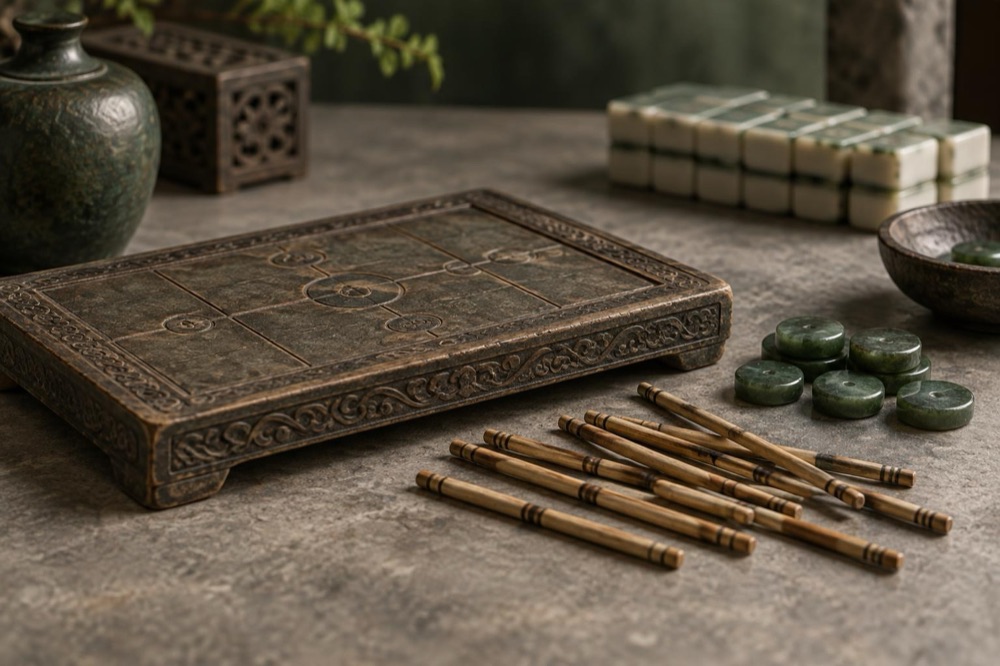
The first thing to note is that losing the rules and losing the game are the same event here. Liubo was not banned and then remembered. It simply stopped being played, and once the players were gone, the knowledge went with them. There was no printed manual to fall back on.
The second thing is that Chinese game culture did not stand still. Games rose and fell in fashion, and the ones that survived were often the ones that kept being written about. The tile game that became mahjong is a good example of the opposite trajectory. In Suzhou the tile game mo ziang was not yet fashionable before 1892, and as late as 1883 or 1884 it had not spread there at all, with the older 105-tile game of tong qi still prevailing instead3. Liubo had centuries of play and then no continuation.
Fashion mattered more than people sometimes assume. A game can be well known in one city and unknown in another a short distance away. Multiply that over centuries and you can see how a game could thin out and vanish.
There is also the question of who was playing and why. Games of chance in premodern China appear to have been shaped over time so that the odds gave a moderate but favorable edge to the house3. That is a description of gambling games, and it tells us that the line between a board game and a betting game was thin. Liubo, with its dice, sat close to that line. When tastes moved on, there was no institutional reason for anyone to keep it alive.
Compare the games that did survive. Sic Bo, an ancient Chinese dice game played with three dice where players guess the outcomes, is still played in casinos today9. Chinchirorin came from China, was popularized in Japan after World War II, and in turn produced the American game Cee-lo through Chinese immigrants10. These games survived because they kept being played in places where people gathered to bet. Liubo did not make that transition.
So the disappearance was gradual and unremarkable from the inside. People played it less. Fewer people learned it. The last players died. By the Tang Dynasty the rules were gone, and what remained were boards in tombs and mentions in texts1.
What liubo left behind
Liubo did not vanish without a trace. It left objects, and those objects have been studied for a long time. Boards and pieces from Western Han tombs are the core of the physical record, and they are what allow anyone today to see what the game looked like1.
It also left a place in the wider story of Chinese games of chance. That story runs from ancient board and dice games through to the tile and card games of the nineteenth century and on to the casino games of the present day. Liubo sits near the beginning of it.
If you want to see how that tradition continued, the tile games are the clearest line. The 105-tile game of tong qi was superseded in Shanghai by the fashionable mo ziang tile game3, and the same game was still working its way outward decades later, having not yet reached Suzhou around 1883 or 18843. Those are the trails of a game that kept being played.
Liubo has no such trail. Its record is archaeological and textual, not commercial. Nobody was printing rules for it, and nobody was selling sets. That is the difference between a game that fades and a game that spreads.
For anyone curious about the broader setting, the tradition of staked board games in Asia is covered in ancient board games played for stakes in Asia, which places liubo alongside games from other cultures. The wider context of how Asian societies have treated gambling over time is set out in gambling culture and history in Asia, and the specific question of why so many jurisdictions restrict the activity is handled in why many Asian countries restrict gambling.
One practical note for anyone reading about liubo today. Gambling in mainland China is prohibited under Chinese law, and the prohibition has been in place since 194911. That applies to betting, not to studying an ancient board game, but it is worth knowing if you are reading about Chinese games and wondering what you can actually take part in while you are there. The rules that governed liubo are lost; the rules that govern gambling in China today are not, and they are strict.
Common Questions
How many players did liubo have?
Liubo was a game for two players. Each side moved pieces around a marked board, with throws of the dice deciding how far a piece could travel. The board's markings and the surviving pieces suggest a contest between two opposing sets rather than a group game.
When did liubo disappear?
Liubo fell out of use and its rules were lost by the time of the Tang Dynasty, which ran from A.D. 618 to 907. It had been played for many centuries before that, and no complete rulebook survived, so what we know comes from texts and tomb finds.
What is liubo?
Liubo is an ancient Chinese board game played with dice and playing pieces on a decorated board. Scholars know about it from references in ancient texts and from game boards and playing pieces found in Western Han Dynasty tombs. Its exact rules are not fully understood today.
Where have liubo boards been found?
Liubo boards and playing pieces have been recovered from Western Han Dynasty tombs in China. These archaeological finds, alongside descriptions in ancient texts, are the main evidence for how the game was played and what its equipment looked like.
Is liubo related to gambling?
Liubo was a game of chance as well as skill, since dice decided the moves. Games of chance in premodern China, including gambling games, appear to have been shaped over time so that the house held a moderate but favorable edge, which places liubo in the same broad tradition.
Are there references to liubo in ancient Chinese texts?
Yes. Ancient texts mention liubo, and those references are one of the two main sources of knowledge about the game. The other is physical evidence: boards and playing pieces excavated from Western Han Dynasty tombs, which show how the equipment was laid out.
Can liubo still be played today?
Not in its original form. The rules were lost by the Tang Dynasty, so no continuous tradition of play survived. Modern reconstructions exist, but they are scholarly attempts to fill the gaps rather than a recovered rulebook, and they differ from one another.
Sources11 sources
- Archaeologists Reconstruct Ancient Chinese Board Game, Archaeology Magazine, March 13, 2019
- Ancient Chinese board game reconstructed, Xinhua, March 13, 2019
- The Cultural Evolution of Games of Chance: A Historical Investigation of Chinese Gambling, PubMed, 2024
- Mahjong Terms 1780-1920, The Mahjong Tile Set
- Chinese Games with Dice, Smithsonian Institution, 1893
- 陞官圖研究, National Taiwan Normal University, June 2005
- How to Play Pai Gow Poker, PlaySmart
- Pai Gow Poker Details, PlaySmart
- How to Play Sic Bo, PlaySmart
- チンチロリン, Wikipedia
- 赌博行为的法律后果, Anyang Municipal Government, September 12, 2024















