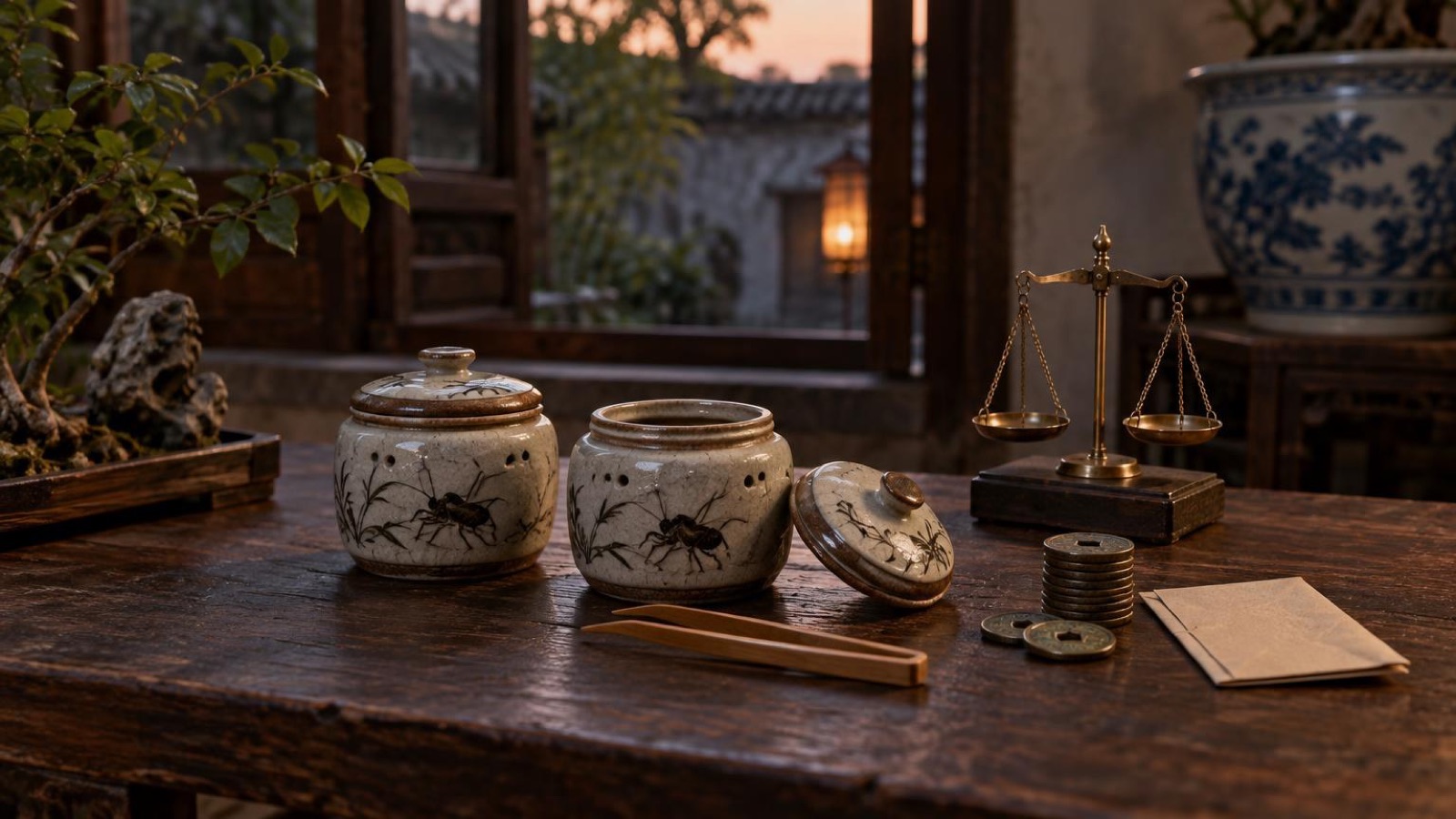
Gambling in China spans more than two thousand years of betting on dice, cards, dominoes, lotteries and even insects, and rulers have been trying to stop it for almost as long. This page walks through that history: the ancient bans, the games emperors and commoners played, the curious case of cricket fighting, the Cultural Revolution crackdown, and what the underground scene looks like now.
Gambling in China today: illegal since 1949
When the Communist Party took power in 1949, gambling was banished from the mainland, and it has stayed that way ever since5. All forms of gambling are illegal under Chinese law, and there is no licensing system and no gambling regulator of the kind you find in Britain or Malta6. Cash poker rooms and casino-style tournaments are not permitted on the mainland8.
The practical exceptions are narrow:
- The state runs two official lotteries, the China Welfare Lottery and the China Sports Lottery, with games such as the 4 Goals football game at CNY 2 per bet3 and 7 Xing Cai, whose single-draw sales have generally fluctuated between CNY 10 million and 12 million9.
- Selling lottery tickets over the internet without authorization is prohibited, so official sales happen through physical terminals10.
- Macau, a special administrative region, is the exception on Chinese soil: it is the one place with legal casinos, which is why the mainland's gamblers and its history of high-stakes play flow there4.
One point that catches many people off guard: the ban follows Chinese citizens abroad. Chinese law treats gambling overseas, online gambling, and providing funds or technical support for gambling as violations of the Criminal Law and the Public Security Administration Punishment Law11, and opening a casino overseas to attract Chinese citizens as primary customers can constitute a gambling crime12. Gambling as a crime carries a maximum penalty of three years, which places it in the range where an offense may end up unpursued, one reason the authorities lean so heavily on warnings and travel advisories instead13. For the current picture, see gambling in China and gambling trips abroad from China.
Earliest bans: the Canon of Laws of the Warring States
China's first known gambling law is remarkably old. The Canon of Laws for gambling was enacted in the State of Wei during the Warring States period, roughly 476 to 221 BC1. That means rulers were legislating against betting more than two thousand years ago, before the Roman Empire existed.
The prohibition was never a one-off. Dynasty after dynasty renewed it in its own way:
| Period | The ban |
|---|---|
| Warring States, about 476 to 221 BC | The Canon of Laws outlawed gambling in the State of Wei1 |
| Tang, about AD 618 to 907 | The Tang Code made betting with one's property, running a gambling house, providing gambling tools and assembling people to gamble unlawful1 |
| Tang and later dynasties | Severe punishments such as deportation and mutilation were imposed to deter gambling1 |
| Qing, 1794 | A ban on gaming was imposed14 |
| British Concession in Shanghai, 1865 | Gambling was prohibited15 |
In other words, the 1949 ban was the latest chapter in a very long book, not a sudden invention of the Communist era.
From Tang emperors to Song commoners
For all the bans, gambling ran through Chinese society at every level. Cricket fighting was nurtured by Tang Dynasty emperors more than 1,000 years ago and later popularized by the commoners2. The sport as we know it dates back to the Song Dynasty, from 960 to 1279, and it originated as a gambler's sport before gradually becoming a source of entertainment for the elite16.
Dice and board games of chance had their own life. A historical study of Chinese games of chance found that they culturally evolved into their documented forms through selective imitation and retention, and that the odds in premodern games often appeared "designed" to ensure a moderate yet favorable house advantage, much like a modern casino's edge17. Games such as shengguan tu, a traditional Chinese gambling game played with a board, were widespread enough to be documented in Manchu as well as Chinese sources18.
By the late Qing period, gambling was woven into daily life despite the official bans. In Guangzhou during the Tongzhi period, from 1861 to 1875, there were more than a hundred licensed fantan houses in the city19. That pattern, official disapproval alongside enormous popularity, is the constant theme of Chinese gambling history.
Cricket fighting: a 1,000-year gambling tradition
Cricket fighting deserves its own section because it is the most vivid surviving link between ancient Chinese gambling culture and the present. Two male crickets are placed in a small arena, teased or riled up with a straw tickler, and the battle usually lasts only a few seconds. A winner is determined when one cricket stops fighting, and the insects are rarely injured. The crickets are weighed in like boxers before each match16.
The economics around the sport are startling:
- Ordinary crickets sell for $2 to $50, but exceptionally aggressive ones fetch much more2.
- A trained eye can supposedly differentiate 260 different grades and skin tones16.
- During the reign of the Ming emperor Xuan-Zhong, thousands of carefully selected crickets were sent to the capital each year20.
- During certain periods of the Qing dynasty, cricket fighting was treated as a national sport each autumn and was organized by the ministry of textiles20.
Most fights end in seconds, with a winner determined when one cricket stops fighting16. The fan base is made up mostly of men16, and the sport spread with migration: it is mainly found in the large cities of Shanghai, Beijing, Tianjin, Guangzhou and Hong Kong, and even in New York and Philadelphia, though the species used differ there20.
The gambling side never disappeared. Historically, the lower classes placed particular emphasis on betting on the fights20. At organized events like the Yu Sheng Cup on Chongming Island, betting on the games is illegal, and the winning team instead receives a certificate and 10,000 renminbi2. In practice, the reputations of the owners are on the line and there is still plenty of betting on the side, much of it covert21.
The Cultural Revolution ban and its aftermath
The Cultural Revolution, from 1966 to 1976, was the harshest crackdown in this long history. Mahjong was banned too, seen as a symbol of capitalist corruption22. Cricket fighting went underground and survived, reemerging after the Cultural Revolution ended in 197620.
The aftermath was a slow thaw rather than a reopening. Mahjong came back into homes and cricket championships resumed. But gambling itself stayed illegal, and the state drew a hard line between traditional pastimes and the wagering that historically accompanied them. After the Qing dynasty, the government had already officially prohibited cricket fighting because of its gambling reputation20; the modern state took the same approach in reverse, allowing the fights while banning the bets.
The long view is captured well by researchers: in premodern and modern China, gambling in almost all forms was consistently viewed negatively by authorities, despite occasional legalization for taxation purposes19. The Cultural Revolution was the extreme expression of a stance that dynasties had taken, in milder forms, for two millennia.
What the underground scene looks like
Because demand never went away, an underground scene has always filled the gap. Illegal gambling den operators in mainland China are now starting to congregate in abandoned buildings, using CCTV networks and paid lookouts to monitor for police23. Chinese gambling networks have also adapted to the digital age, using e-commerce gift cards as chips on illegal online casinos23. The scale is large: one investigation traced how illegal online gambling launders money from China, with all forms of gambling illegal under Chinese law7. Online gambling offers no legal protection in China, so players who are cheated have nowhere to turn24.
The games on offer in the dens are familiar ones. In one raid on underground gambling dens for migrant workers in Chiayi, poker cards were used to play Luosong, Niuniu and baccarat25. Local enforcement notices list the same catalog: mahjong, poker, dominoes, dice, the underground "Mark Six" lottery, electronic gaming machines, computer networks and WeChat red packets are all named as forms of prohibited gambling26.
The penalties are administrative for small-stakes play. Gambling that does not amount to criminal punishment can bring detention of up to 5 days or a fine of up to 500 yuan, and in serious cases detention of 10 to 15 days plus a fine of 500 to 3,000 yuan28. For providing gambling conditions for profit or participating with relatively large stakes, the current public security law sets detention of up to 5 days or a fine of up to CNY 1,000, rising to 10 to 15 days and CNY 1,000 to 5,000 when circumstances are serious29.
What ties the underground scene to the rest of this history is that it is not new. Cricket fighting's covert betting, the fantan houses of old Guangzhou, the fashionable mahjong of 1880s Cixi and today's abandoned-building dens are all the same phenomenon: a gambling culture more than two thousand years old, still thriving beneath a prohibition that is itself more than two thousand years old. For what is legal today, see the China lottery, sports betting in China and gambling laws in China.
Common Questions
When was gambling first banned in China?
The earliest recorded ban is the Canon of Laws, enacted in the State of Wei during the Warring States period, roughly 476 to 221 BC. It outlawed gambling, and later dynasties kept the prohibition, adding punishments of their own.
Is cricket fighting legal in China?
Keeping crickets and fighting them is a traditional pastime and organized tournaments exist, but betting on the fights is illegal. Matches are held openly, while the wagering that historically went with them happens quietly on the side.
How much can a fighting cricket cost?
Ordinary crickets sell for a few dollars, but exceptional fighters are worth far more. Traders have boasted of selling crickets for 10,000 yuan or more, and the most promising fighters have gone for around $1,500 apiece.
Where do the best fighting crickets come from?
The best specimens come from a few counties in northeastern Shandong Province. Serious trainers buy hundreds of males at Beijing's main insect market and sort through them for the aggressive ones.
How long does a cricket fight last?
Most bouts last only a few seconds, ending when one cricket stops fighting. But when two resolute, powerful crickets meet, a contest can stretch to half an hour or even 45 minutes.
What happened to cricket fighting during the Cultural Revolution?
From 1966 to 1976 the government banned cricket fighting as a bourgeois predilection, along with mahjong and other pastimes. The sport went underground and reemerged after 1976.
Is cricket fighting still popular in China?
It survives, with championships held after the fall equinox and more than 20 websites devoted to raising crickets, but its popularity has been dwindling and the fan base is mostly older men.
Sources29 sources
- Gambling in China: socio-historical evolution and current challenges, independent research paper, 2014
- Cricket fighting contests in China, Amusing Planet, November 9, 2011
- 4 Goals game rules, China Sports Lottery, 2026
- Adelson coverage on China and Macau, The New York Times (Chinese edition), August 15, 2012
- UN report warns of mainland China, Hong Kong and Macau's role in illegal gambling flow, Macau Business, 2026
- Poker in Asia: China, SoMuchPoker, 2026
- Cover story: how illegal online gambling launders $153 billion from China, Caixin Global, December 21, 2020
- Best online casinos for players from China, Wizard of Odds, 2026
- 7 Xing Cai news, China Welfare Lottery, October 14, 2020
- Guidance on internet lottery sales, General Administration of Sport of China, 2023
- Chinese embassy notice on cross-border gambling, National Immigration Administration, February 5, 2021
- Embassy news on online-gambling crimes, Embassy of the People's Republic of China in the Philippines, August 8, 2019
- China warns citizens over gambling in overseas casinos, Channel News Asia, March 21, 2024
- The transformation of Macao's gaming industry, University of Macau repository, 2026
- Mahjong terms 1780 to 1920, The Mahjong Tile Set, 2026
- Ancient sport of cricket fighting loses popularity in China, CTV News, October 2011
- The cultural evolution of games of chance: a historical investigation of Chinese gambling, PubMed, 2024
- Shengguan tu, a traditional Chinese gambling game, Oriens Extremus, 2003
- Gambling in China: socio-historical notes, NCBI PMC, May 31, 2024
- Chinese cricket culture, insects.org, 2026
- Hopping Mad: Crickets Fight It Out at China's Championships, Reuters, October 10, 2013
- The Asian game of mahjong is trending in the West, Smithsonian Magazine, February 7, 2025
- How Chinese gambling networks use e-commerce cards as chips on illegal online casinos, Casino Beats, May 27, 2026
- Online gambling offers no legal protection in China, ECNS, July 20, 2026
- Chiayi underground gambling dens for migrant workers, Cool Loud, May 7, 2009
- Notice on strictly cracking down on gambling crimes in accordance with the law, Liaoning Provincial Public Security Department, January 20, 2023
- Notice on cracking down on gambling crimes, Xinxing County government, January 17, 2019
- Public Security Administration Punishments Law, Article 82, Embassy of the People's Republic of China in Portugal, April 14, 2026
- Public Security Administration Punishment Law, Article 82, Chinese text, Embassy of the People's Republic of China in Portugal, April 14, 2026