
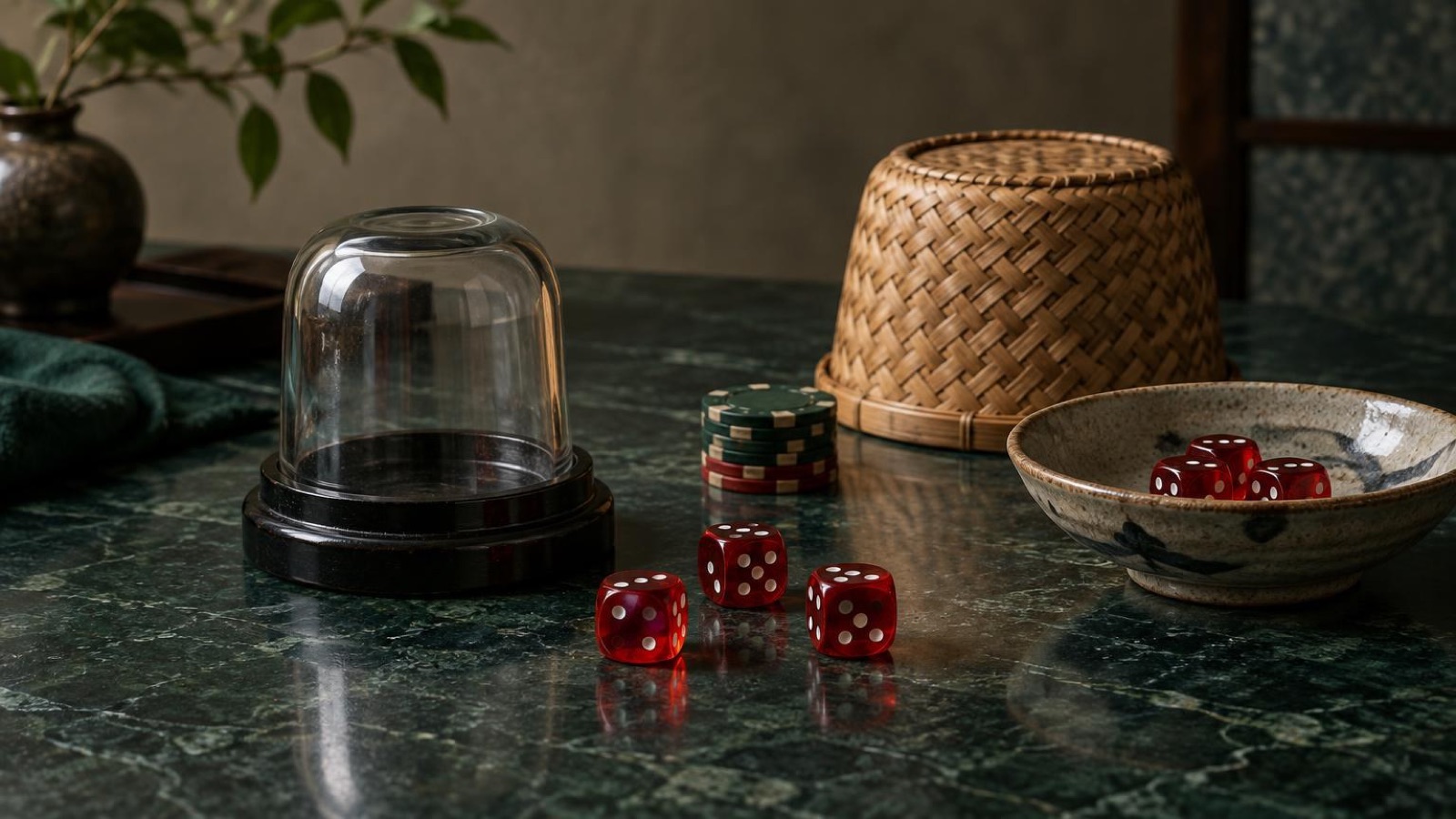
What counts as an Asian dice game
An Asian dice game is any game where dice decide the outcome and the betting or scoring follows a local tradition. The most familiar is Sic Bo, a casino game played with three dice1. Others, like Cho-Han and Chinchirorin, are played in bars, at festivals or among friends. Cee-lo is a banking game that spread across China and Southeast Asia.
These games share a few things. They use ordinary six-sided dice. They resolve in seconds. And most of them have a simple bet that anyone can follow after watching one round. That is why they survive in places where casino gambling is restricted: you can play them at home, at a festival stall or in a back room with no equipment beyond a cup and a few dice.
Some games that look similar are not dice games at all. Pai Gow Tiles uses 32 domino-like tiles, not dice4. Mahjong uses tiles. The games on this page are the ones where dice do the work.
Sic Bo: three dice, many bets
Sic Bo is the big one. It is an ancient Chinese dice game, originally pronounced SEE-BO, and it is now played in casinos across Asia and beyond1. The game is played with three dice, and players bet on the outcome of each roll1. It is fast-paced and requires some quick thinking, because the dice are shaken and the bets settle in a few seconds5.
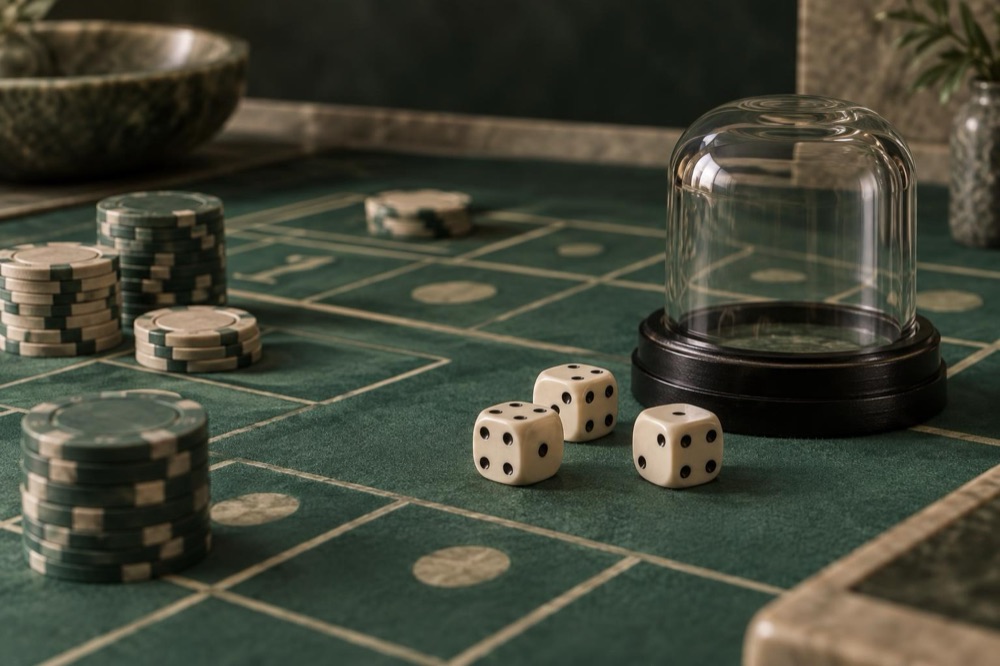
The equipment is simple. In Macau, the rules specify three dice of equal weight, each with opposite sides summing to seven, a special dice cup with a black opaque base, a glass cover and a removable lid, and one or more table plaques printed with the betting options6. In many modern casinos the dice are rolled using an electronic dice shaker activated by a button on the table1. Each Sic Bo table has two dealers who exchange chips, monitor the bets and keep the game moving1.
A round works like this. You place your chips on the betting areas before the dice are shaken. The dealer activates the shaker or lifts the cup. The three dice settle. The dealer calls the total and pays the winning bets. If the dice are stacked or leaning unevenly when the lid is lifted, the dealer declares the round void and a new round begins; players may not cancel bets but may bet again6.
There are six main categories of bets1:
- Single number bets
- Two number combinations
- Three number total bets
- Triple bets
- Pair bets
- Big and small bets
You can bet on any specific set of triples, any specific set of pairs, or that any triple will come up1. The higher the payout odds, the less likely the outcome will occur; lower payout odds mean greater chances of winning1.
Cee-lo: a banking game among players
Cee-lo is the game you will see played on a street corner or in a back room, not in a casino. It uses three dice and no table. One player is the banker, and the others bet against the banker's roll. The game is quick, loud and social.
The rolls have names. A 4-5-6 is the best roll, an automatic win for the player. A triple of any number, like 2-2-2 or 5-5-5, is also an instant win. A 1-2-3 is the worst roll, an automatic loss. Any other combination becomes your point, and you keep rolling until you match your point or roll a 1-2-3.
If your roll matches the banker's point, it is a tie. In most versions the banker wins ties, so check the house rules before you play. Some informal games treat a matching point as a push for both sides. The banker covers the wagers of the other players on each round and wins on all ties, which is the same advantage the banker holds in Pai Gow Tiles4.
Cee-lo has no house edge in the casino sense, because there is no casino. The edge sits with whoever is banking. If you bank, you take the risk and the tie advantage. If you bet, you are playing against the banker's luck.
How the two games differ
Sic Bo and Cee-lo look similar because both use dice, but they are different games. Sic Bo is a casino game with a table, a dealer and a fixed set of bets. Cee-lo is a player-run banking game with no table and no dealer.
The dice count differs too. Sic Bo uses three dice1. Craps, the Western game most often compared to Sic Bo, uses two dice, and players bet on the outcome of each roll7. Cho-Han also uses two dice, shaken in a bowl-sized bamboo basket called a tsubo, and players bet on whether the sum is even (cho) or odd (han)2.
The betting structure is the clearest difference. In Sic Bo you can cover many areas at once, from a single number to a specific triple1. In Cee-lo you bet against one banker on one outcome. In Cho-Han you pick one of two sides. The simpler the game, the faster the round.
The odds behind three-dice games
Three six-sided dice give 216 possible ordered outcomes. That number drives every payout in Sic Bo. The more ways a result can happen, the lower the payout. The fewer ways, the higher the payout.
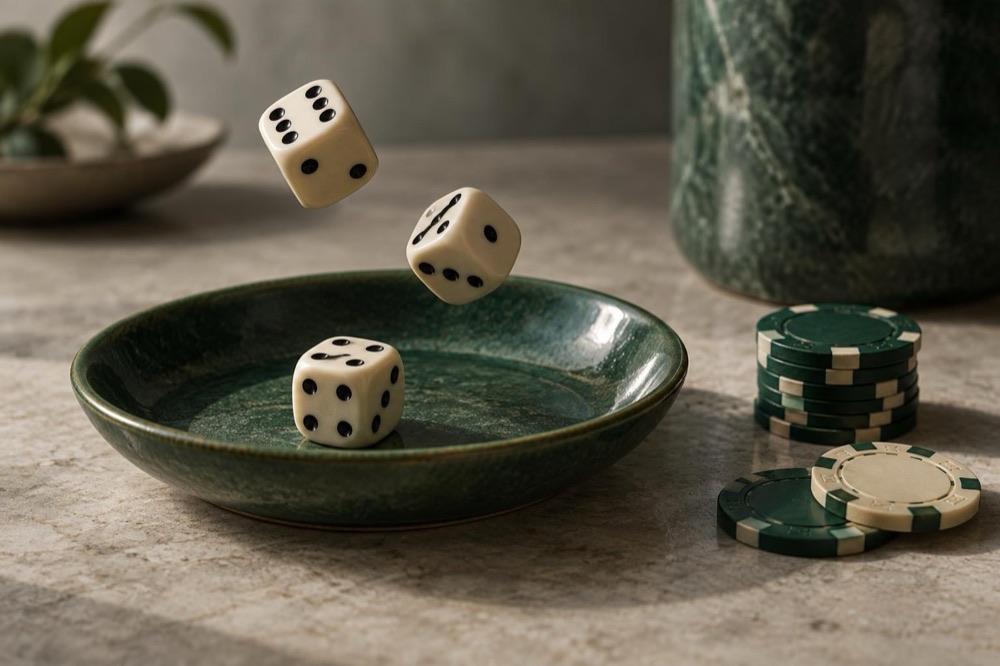
A specific triple, like three 4s, can happen in only one way out of 216. That is why it pays so much. A Big or Small bet covers a wide range of totals, so it pays even money. The gap between the two is the whole design of the game.
The same logic applies to the totals bets. A total of 4 or 17 is rare, so it pays 1 to 50 in Macau6. A total of 9, 10, 11 or 12 is common, so it pays 1 to 66. A total of 8 or 13 pays 1 to 86. A total of 5 or 16 pays between 1 to 18 and 1 to 30 depending on the table6.
This is not unique to dice. Every betting game prices its outcomes the same way. In baccarat, the Tie bet pays 8 to 1 but carries a house edge of 15.75 percent on a single deck, because ties are rare8. The principle is the same: rare outcomes pay more, and the house keeps its margin in the gap.
Payouts and house edge in Sic Bo
The payouts in Sic Bo vary by bet and by jurisdiction. The Macau rules give a clear picture. A Big bet covers a total of 11 to 17 points, and a Small bet covers 4 to 10 points6. If all three dice show the same number, Big and Small bets lose6. That rule is the source of the house edge on those bets.
Here is a table of the main Macau payouts6:
| Bet | What it covers | Payout |
|---|---|---|
| Small | Total 4 to 10 | 1 to 1 |
| Big | Total 11 to 17 | 1 to 1 |
| Specific triple | Three chosen numbers | 1 to 150 |
| Any triple | Any three of a kind | 1 to 24 |
| Three dice | One, two or three matching dice | 1 to 1, 1 to 2, 1 to 3 |
| Two dice same | Two dice same, one different | 1 to 50 |
| Three chosen dice | Three chosen face values | 1 to 30 |
| Three of four chosen | Three of four chosen numbers | 1 to 7 |
| Total 4 or 17 | Exact total | 1 to 50 |
| Total 5 or 16 | Exact total | 1 to 18 to 1 to 30 |
| Total 8 or 13 | Exact total | 1 to 8 |
| Total 9, 10, 11, 12 | Exact total | 1 to 6 |
The house edge on Big and Small is about 2.78 percent, because the triple rule takes away the even-money bets on three of a kind. The edge on a specific triple is much higher, around 30 percent, because it pays 150 to 1 but happens only once in 216 rolls. Single number bets sit in between.
For comparison, Caribbean Stud Poker has a house edge of 5.2 percent9. Baccarat's Banker bet carries 1.01 percent and the Player bet 1.29 percent on a single deck8. Sic Bo's Big and Small bets are competitive with those, but the exotic bets are not.
Where the games are played and their legal status
This is where the games differ most. Sic Bo is a licensed casino game in Macau, where the rules are published by the gaming authority6. It is also played in casinos in Singapore, the Philippines, Cambodia and other markets with regulated gambling. In those places you must be of legal age to enter the casino floor, and you buy chips at the table.
Cee-lo and Cho-Han are different. They are not casino games in most of Asia. They are played informally, and in Japan that matters. Gambling for money is illegal in Japan, and the police guidance is clear that mahjong gambling is a crime regardless of the place or name of the venue, including mahjong parlors, teaching facilities, homes and inns3. The same logic applies to dice games played for money. You can play Cho-Han for fun or for small prizes, but not for cash stakes.
In China, the line is drawn at profit. Normal chess and card games played for leisure without a profit motive in chess and card rooms are lawful entertainment protected by law10. Once money changes hands for profit, the game falls on the other side of the line.
In South Korea, the games offered through official channels are horse racing, cycling, boat racing, poker and blackjack11. Dice games are not on that list. If you want to bet legally in Korea, you use the licensed pools, not a dice game in a back room.
The practical rule for a visitor or expat is simple. If a game is offered inside a licensed casino, it is legal and regulated. If it is offered in a bar, a back room or a street corner for cash, it is almost certainly not. Ask before you put money down.
Betting limits and stakes
Sic Bo stakes are set by the table, not by law. Casinos post minimum and maximum bets at each table, and the limits vary widely. A low-limit table in Macau might take bets from a few dollars to a few hundred, while a high-limit table takes much more. You buy chips at the table and place them on the betting areas before the shake.
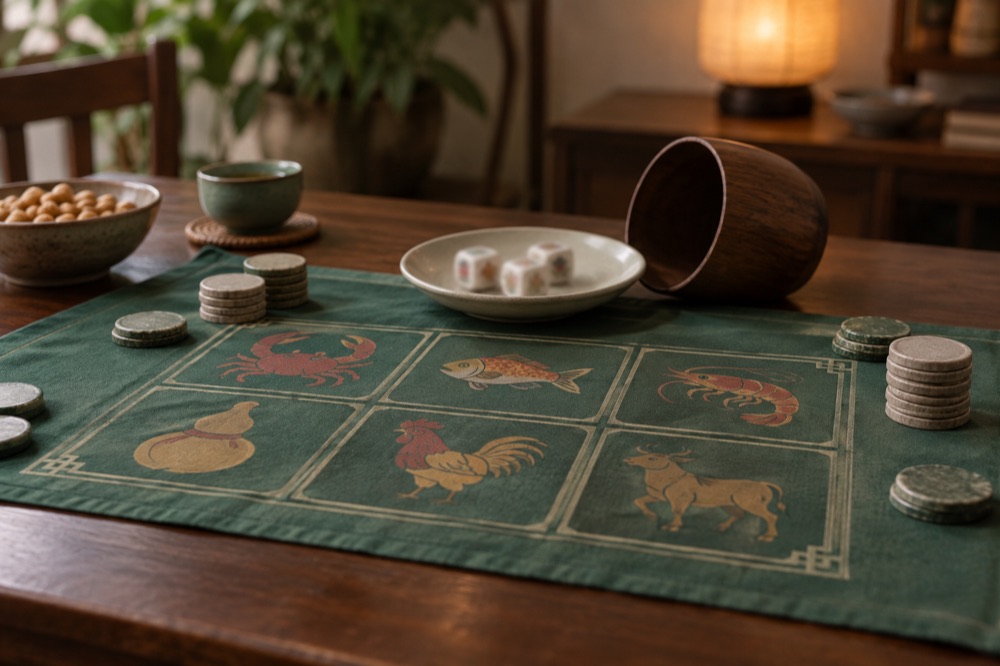
For comparison, regulated betting markets in Asia publish their limits clearly. KEIRIN online voting allows up to 3,000 bets per day and up to JPY 99,900 per bet for each user13. The Hong Kong Jockey Club may impose a maximum or minimum unit stake, a maximum dividend, a maximum total stake per betting day and a maximum dividend per betting day, changeable at its discretion without prior notice15. Singapore Pools publishes its Asian Handicap rules, where a stake can be based on half or full stake depending on the handicap assigned16.
Those numbers show how formal betting works: the operator sets the limits and publishes them. Informal dice games have no such protection. The stake is whatever the players agree, and the payout is whatever the banker honors. That is the real risk in a back-room game, not the odds.
If you are playing Sic Bo in a casino, the limits are on the table. If you are playing Cee-lo or Cho-Han informally, agree the stake before the first roll and keep it small.
Names and variants you will meet
The same game travels under different names. Sic Bo is also called Tai Sai and Hi-Lo. In Macau and Hong Kong, Tai Sai is the common name. The rules and payouts are the same.
Cho-Han is sometimes written as Cho-Han Bakuchi, and the two dice are shaken in a tsubo, a bamboo basket about the size of a rice bowl2. The bet is on even (cho) or odd (han)2. It is the simplest dice game in the region.
Chinchirorin is a Japanese game played with three dice in a bowl. It is a bar and festival game, not a casino game. Players roll three dice and score according to the combination, with special results like a 1-2-3 or a triple. It is played for fun or small prizes, not for cash stakes in a licensed setting.
Bo Bing is the Chinese mooncake dice game played during the Mid-Autumn Festival. Players roll six dice in a bowl and win mooncakes or small prizes according to the combination. It is a festival game, not a gambling game, and it is played at home and in community halls.
Cee-lo has its own regional names. In Vietnam, Xoc Dia is a different game entirely: it uses four coins or counters, not dice, and players bet on the number of heads and tails. It is often compared to Sic Bo because both are fast betting games, but the equipment is different.
If you are in a country and want to know what is legal there, the country guides cover the local rules in detail. The Asian gambling games overview lists the main games by country, and the guide to where Asian games are legal compares 12 jurisdictions side by side. If you want to play Cho-Han specifically, there is a full Cho-Han rules guide. For the difference between the Japanese and Western versions of the banking game, see Chinchirorin vs Cee-Lo.
Common Questions
What does the name Sic Bo mean?
Sic Bo comes from Cantonese and is usually written as sai bok in romanization. It means dice pair or dice game, and the name is pronounced SEE-BO. It is an ancient Chinese dice game that spread across Asia and later into Western casinos, where it is also called Tai Sai or Hi-Lo.
What is the best roll in Cee-lo?
The best roll is a 4-5-6, which is an automatic win for the player. A triple of any number, like 2-2-2 or 5-5-5, is also an instant win. A 1-2-3 is the worst roll, an automatic loss. Any other combination becomes your point.
Is Sic Bo the same as Tai Sai or Hi-Lo?
Yes. Tai Sai and Hi-Lo are other names for the same three-dice game. Tai Sai is the common Cantonese name used in Macau and Hong Kong, while Hi-Lo is a name used in some other markets. The rules, bets and payouts are the same.
What is the house edge on Sic Bo?
The house edge varies by bet. Big and Small bets carry a house edge of about 2.78 percent. Specific triple bets have a much higher edge, around 30 percent, because they pay 150 to 1 but are very unlikely. Single number bets sit in between.
What happens if a Cee-lo roll matches the banker's point?
If your roll matches the banker's point, it is a tie and your bet is returned. In most versions the banker wins ties, so check the house rules before you play. Some informal games treat a matching point as a push for both sides.
Can you bet on more than one area in Sic Bo?
Yes. You can place chips on as many betting areas as you like before the dice are shaken. Many players cover several numbers or combine a Big or Small bet with a single number bet. Each area is settled separately after the roll.
Sources16 sources
- Sic Bo: How to Play, PlaySmart
- Chō-Han, Wikipedia
- Gambling and Amusement Business Guidance, National Police Agency Japan
- Pai Gow Tiles: How to Play, PlaySmart
- Sic Bo Etiquette, PlaySmart
- Sic Bo Rules, DICJ Macau, 2004-05-12
- Craps: How to Play, PlaySmart
- Baccarat Basics, Wizard of Odds, 2017-02-23
- Caribbean Stud Poker, PlaySmart
- Chess and Card Room Guidance, Beijing Municipal Government, 2020-06-29
- K-Boat FAQ, K-Boat Korea
- K-Cycle FAQ, K-Cycle Korea
- KEIRIN User Policy, KEIRIN, 2026-05-01
- KEIRIN User Policy PayPay, KEIRIN, 2026-05-01
- Football Betting Rules Section 2.15, HKJC, 2026-03-30
- Sports Betting FAQ, Singapore Pools















