
What chinchirorin and cee-lo are
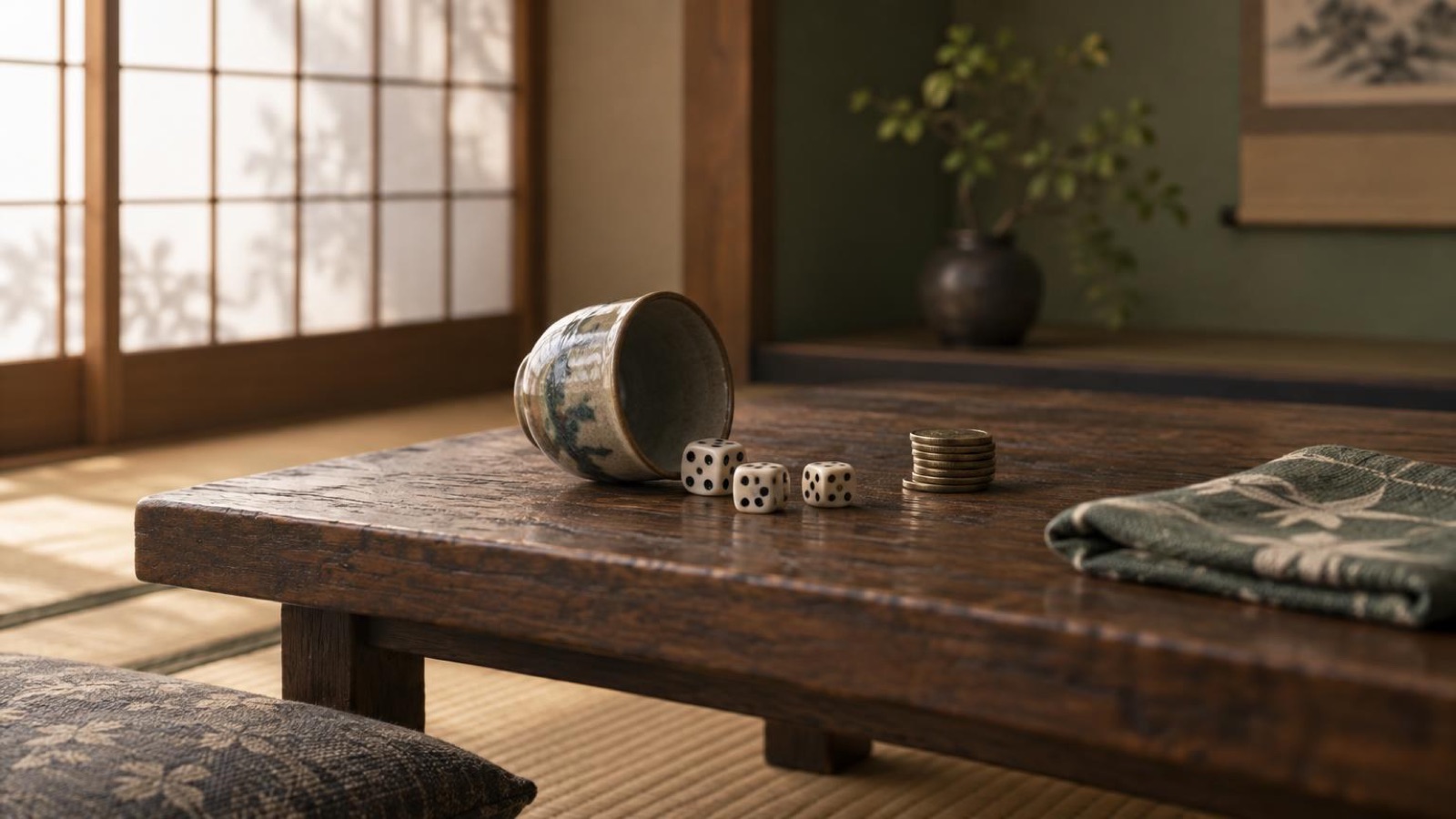
Chinchirorin is a Japanese dice game played with three dice and a bowl or teacup1. You shake the dice in the bowl and roll them out, and the combination you get decides whether you win or lose that round. The name comes from the rattle of the dice in the bowl, which is the sound the game is named after. It is a casual game, the kind played among friends rather than in a formal gambling house.
Cee-lo is the name most English-speaking players use for the same family of three-dice games. It is played with three dice, and players bet on the outcome of each roll2. The core idea is the same as chinchirorin: roll three dice, and certain combinations are strong while others are weak. The differences are in which hands count, how the banker works, and how the money moves.
Both games sit in the same family as other Asian dice games. If you want the wider picture, our guide to Asian dice gambling games compares xoc dia, bau cua, cho-han, chinchirorin and bo bing side by side. Cho-han, for example, is a simpler two-dice game where you bet on whether the sum is even or odd5. Chinchirorin and cee-lo add hand rankings on top of that basic idea.
How the two games differ: rules and dice roles
The biggest practical difference is the banker. In chinchirorin, the banker is not fixed. The right to be banker passes in turn among the players, a system known as a rotating banker1. That means everyone gets a turn at being the house, and the role moves around the table rather than staying with one person all night.

In cee-lo, the banker role is the anchor of the betting. Players bet against the banker's roll, and the banker covers those bets. The hands are what decide who wins, and the banker's hand is the one everyone else is trying to beat.
The hands themselves are where the two games really diverge. Chinchirorin has its own set of named combinations, and the ranking matters. A hand involving a 1, called Pin, beats a 9 but loses to pairs6. That is a specific ranking rule that does not exist in cee-lo in the same form.
Cee-lo has its own hand structure. The strongest hands are the triples, and then the point hands, where two dice match and the third is the point. A 1-2-3 is the weakest hand in both games, and it is where the two games share a name for the worst result.
There is also a fold rule in some related Japanese dice games. In kachikachi, a player may fold on their turn, and a folded player forfeits their entry fee and bets to the winner6. That kind of fold option changes the strategy, because you can get out of a bad round before the roll. Chinchirorin and cee-lo do not always include a fold, so check the house rules before you sit down.
One more difference is who runs the game. Chinchirorin is usually played among friends, and unlike cho-han, yakuza do not typically become involved as gambling den operators1. That is a practical point: chinchirorin is a social game, not a commercial one, in its usual form.
| Feature | Chinchirorin | Cee-lo |
|---|---|---|
| Dice | Three dice and a bowl or teacup1 | Three dice2 |
| Banker | Rotates in turn among players1 | Fixed for the round; players bet against the banker |
| Strongest hands | Pinzoro and other arashi (triples)1 | Triples, then point hands |
| Weakest hand | 1-2-3 (shonben)1 | 1-2-3 |
| Fold option | Not always included; check house rules6 | Not always included; check house rules |
| Usual setting | Social game among friends1 | Informal private game |
Chinchirorin betting structure and payouts
Chinchirorin betting is built around the rotating banker and the hand rankings. Because the banker passes in turn, the payouts are not fixed the way they are at a casino table. The stakes are whatever the players agree on, and the banker covers the bets for that round.
The payouts depend on the hand. The strongest hands pay more, and the weaker hands pay less or lose. The exact multipliers vary by local rule, and there are several common variants:
- In one common version, 5-zoro pays 5x and pinzoro pays 10x, with other arashi paying 3x1.
- In another, pinzoro pays 5x and other arashi pay 3x1.
- In a third, pinzoro pays 10x and other arashi pay according to their number, so 2-zoro pays 2x up to 6-zoro paying 6x1.
That range of variants is the key practical point. There is no single official payout table for chinchirorin. Before you play, agree on which variant you are using, because the difference between pinzoro paying 5x and 10x is significant.
The hand rankings also matter for the payouts. A Pin hand beats a 9 but loses to pairs6. So if you roll a hand with a 1 in it, you are in a middle tier: better than a plain 9, worse than any pair. Knowing where your hand sits tells you whether you are likely to win the round.
If you roll no hand, no yaku and no shonben after three throws, it is a losing menashi1. That is the bottom of the ladder. You get up to three throws to make something, and if you come up empty, you lose.
Cee-lo betting structure and payouts
Cee-lo betting is simpler to describe because the banker is fixed for the round. Players bet against the banker, and the banker's roll sets the target. The hands decide who wins, and the payouts follow the hand rankings.
The strongest cee-lo hands are the triples, and then the point hands. A point hand is two matching dice plus a third die that becomes your point. The higher the point, the better. A 1-2-3 is the weakest hand, and it usually loses to everything.
The payout structure in cee-lo is tied to the probability of the hand. The general rule in dice and table games is that the higher the payout odds, the less likely the outcome will occur, and lower payout odds mean greater chances of winning2. That principle applies to cee-lo: rare hands pay more, common hands pay less.
For comparison, casino dice games like sic bo use three dice and pay out according to the combination2. Sic bo is a useful reference point because it is a licensed casino game with published odds, while cee-lo is usually a private game with agreed stakes. If you want to see how a licensed three-dice game handles payouts, sic bo is the closest thing.
The practical takeaway for cee-lo is the same as for chinchirorin: agree on the stakes and the hand rankings before you play. Because cee-lo is often played informally, the payout rules can vary from table to table.
Both games are illegal for cash play in Japan
Playing chinchirorin or cee-lo for money is illegal in Japan. That applies to citizens, foreign residents and visitors alike. There is no licensed venue where you can play either game for cash, and no legal way to bet on them.
The same rule covers online play. Gambling at an online casino by connecting from within Japan is a crime, even if the casino is legally operated overseas3. That is the plain position: the location of the site does not matter, what matters is that you are connecting from Japan.
The reasoning is that using a smartphone in Japan makes it a domestic crime harming Japanese social legal interest, and a foreign license does not justify it6. A mistake about the illegality does not negate intent6. In practice, that means "I did not know it was illegal" is not a defense.
Online pachinko is also illegal7. That is a useful comparison point, because it shows the same principle applies across online gambling types, not just casino games.
So the practical risk is real. Playing on offshore casino websites is illegal in Japan, and players have been prosecuted. If you want to play chinchirorin or cee-lo, play them for fun at home, with no money on the table.
Legal gambling alternatives in Japan
If you want to bet legally in Japan, the options are the public sports and lotteries. Keirin, autorace, boat racing and horse racing are all legal, and they are the main ways to bet for cash.

The minimum age for these is 20. Purchase of betting tickets is prohibited for persons under 20 at keirin and autorace venues4. The same 20-and-over rule applies to boat race venues4. It also applies to horse racing venues and off-course betting shops4. So across all the public sports, the age line is 20.
You will need photo ID. Age checks are routine at the windows, and venues are prohibited from selling to anyone under 204. Bring your passport or residence card if you are a visitor or a foreign resident.
| Legal option | What you bet on |
|---|---|
| Keirin | Order of finish in cycling races |
| Autorace | Order of finish in motorcycle races |
| Boat racing | Order of finish in powerboat races |
| Horse racing | Order of finish in flat and jump races |
Minimum age: 204
Keirin is one of the most accessible options. It is a cycling sport where you bet on the order of finish, and the betting types include 2-renzan, where higher payouts than 2-shoh fukushiki are more likely8. If you are new to it, our guide to keirin betting explains the bet types, odds and mark cards.
Boat racing is another option. Our guide to boat race betting covers the kyotei and kyungjeong bet types and odds. Both keirin and boat racing run year-round at venues across the country.
For a wider view of what is legal where, our guide to where Asian games are legal compares 12 jurisdictions. And if you want the full country picture, see Can I gamble in Japan?.
Online play: a gray area with real risks
Online play is not a gray area in Japan. Gambling at an online casino from within Japan is a crime, even if the site is licensed overseas3. The same applies to online pachinko, which is illegal7.
The risk is not theoretical. Users accessing online casinos from Japan are committing an illegal act, and the Japanese criminal code applies as a gambling crime6. A foreign license does not change that, and a mistake about the illegality does not negate intent6.
Some offshore operators hold licenses from other jurisdictions. For example, some are registered with PAGCOR in the Philippines, and the register lists operators offering online poker games and electronic casino games9. Others hold Anjouan licenses, and those licenses exclude certain territories, including the USA, UK, France, Netherlands, Spain and Australia10. The exclusion list matters because it shows that even the licensing jurisdiction limits where the license applies.
There is also the question of what happens if something goes wrong. Under one Anjouan license, disputes, claims or complaints from players in excluded territories fall outside the regulatory scope and will not be entertained11. So if you are in an excluded territory and you have a dispute, the regulator will not help you.
Responsible gambling tools exist, but they are limited. In Macau, the responsible gaming information kiosks only provide self-exclusion applications12. That is a narrow function, and it shows that self-exclusion is the main tool available.
The practical advice is simple. Do not borrow to play13. And in Japan, do not play online for cash at all, because it is illegal.
If you want to play these games without risk, play them for fun. Chinchirorin and cee-lo are both enjoyable as social games with no money on the table. That is the version you can play legally, anywhere, with anyone.
Common Questions
Can you play chinchirorin or cee-lo for money in Japan?
No. Betting money on either game is illegal in Japan, and that applies to citizens, foreign residents and visitors alike. There is no licensed venue where you can play them for cash. You can play them for fun at home, but not for stakes.
What is a shonben in cee-lo?
A shonben is a hand of 1-2-3. In chinchirorin it is the weakest possible result and usually loses to everything. Some house rules treat it as an automatic loss, so check the local rules before you play.
What does the name chinchirorin mean?
The name comes from the sound the dice make rattling in the bowl. Chinchirorin is played with three dice and a bowl or teacup, and the rattle of the dice is where the game gets its name.
How many dice does each game use?
Both use three dice. Chinchirorin is played with three dice and a bowl or teacup. Cee-lo is also a three-dice game, and players bet on the outcome of each roll.
What happens if you roll 1-2-3 in chinchirorin?
A 1-2-3 is a shonben, the lowest hand. It normally loses to any other result. If you roll it, you generally lose your stake for that round unless the house rules say otherwise.
Is playing these dice games online safe for Japanese players?
No. Gambling at an online casino from within Japan is a crime, even if the site is licensed overseas. A foreign license does not protect you, and players have been prosecuted. Treat online cash play as illegal.
What is the minimum age for legal betting in Japan?
For legal public betting such as keirin, autorace, boat racing and horse racing, you must be 20 or older. Venues are prohibited from selling betting tickets to anyone under 20. Bring photo ID, since age checks are routine.
Sources13 sources
- チンチロリン, Wikipedia
- How to Play Sic Bo, PlaySmart
- オンラインカジノに関する注意喚起, Consumer Affairs Agency
- ギャンブル等依存症対策基本計画, Cabinet Secretariat
- 丁半, Wikipedia
- かちかち, Wikipedia
- オンラインカジノの違法性に関する講演資料, National Police Agency
- 2連勝複式, Boat Race
- List of PAGCOR Accredited Gaming System Administrators and Registered Brands, PAGCOR
- Anjouan Internet Gaming License Verification, Anjouan Gaming
- Anjouan Internet Gaming License Verification, Anjouan Gaming
- Responsible Gaming Information Kiosks, DICJ Macau
- Play Responsibly, Cash Sweep















