
What Cho-Han Is and How It Works
Cho-Han is a traditional Japanese gambling game played with dice. The name comes from the two possible bets: cho means even, and han means odd. Players wager on whether the sum of two dice will be an even or odd number1.
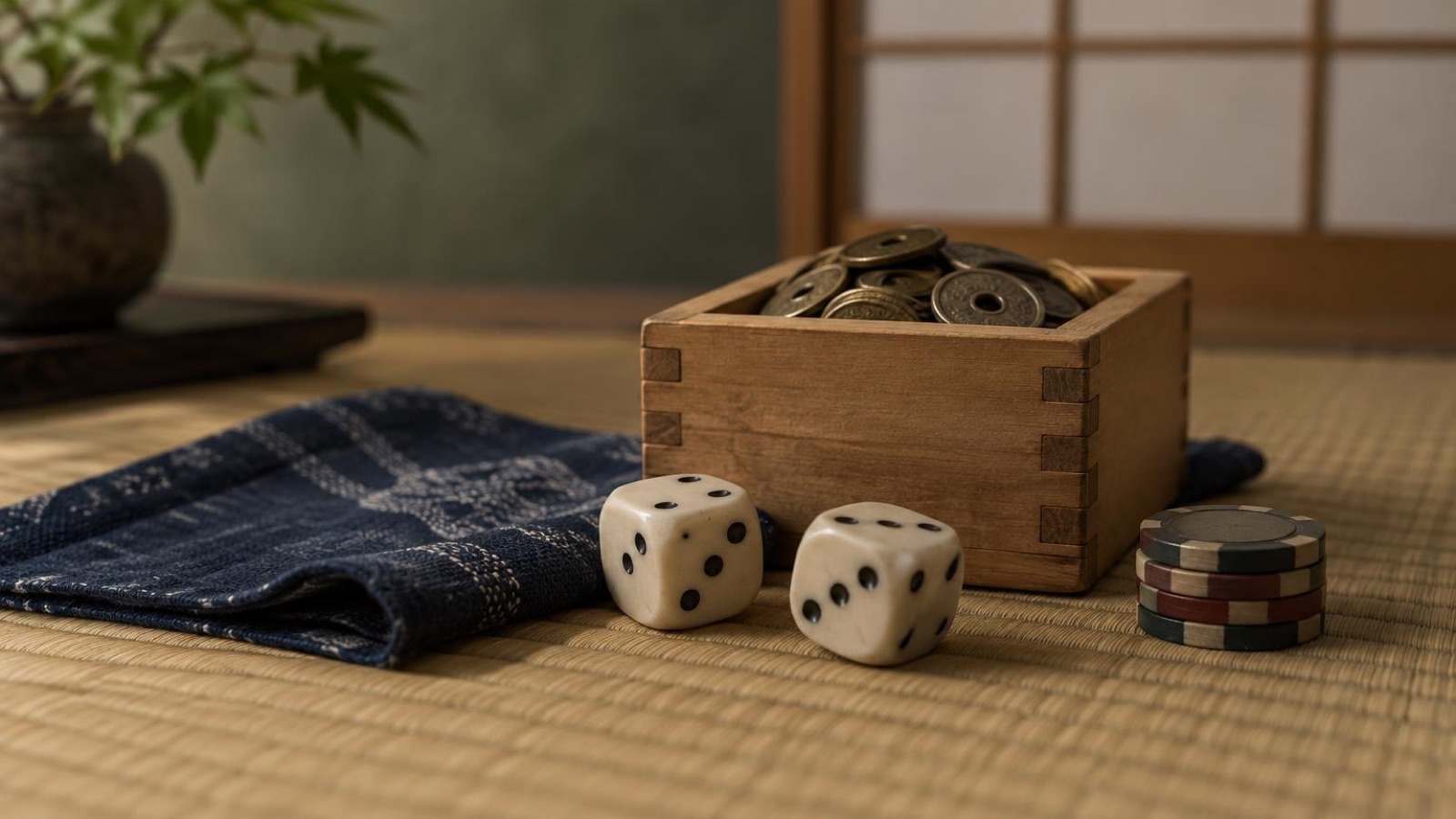
The game is simple to set up. You need two dice and a small bamboo basket called a tsubo, which is about the size of a rice bowl. The dealer, sometimes called the tsubo-mochi or bowl-holder, places the dice in the basket, shakes them, and then reveals the result. Players have placed their bets before the reveal, choosing either cho (even) or han (odd)1.
Cho-Han has been played in Japan for centuries. It is related to other Asian dice games, and you can read about how it compares to games like Xoc Dia, Bau Cua, and Chinchirorin in our guide to Asian dice gambling games.
The game traditionally involves a commission called tera money. In some versions, 10 percent of the pot goes into the hachi (the box) when certain outcomes appear, such as a sum of 7 (called biri) or doubles (called zorome). This commission is the underling's income. In other versions, the commission is higher. One historical rule describes a 5 bu fee, which is 50 percent of each pot, going to the boss as tera money. This was called "Gobu-tera" or "Bantera-gobu"1.
Regional variations existed too. In the Kanto region, certain outcomes like (1,1) and (1,6) were generally not treated as special roles. In Kansai, those same outcomes meant neither cho nor han won, and the house took the entire pot. These rules varied by region and local custom1.
How a Round Is Played, Step by Step
Here is how a typical round of Cho-Han works:

Step 1: Players place their bets. Before the dice are shaken, each player decides whether to bet on cho (even) or han (odd). Bets are placed in front of each player or in a central area.
Step 2: The dealer shakes the dice. The dealer places the two dice in the tsubo, a small bamboo basket. The basket is shaken to mix the dice thoroughly1.
Step 3: The dealer reveals the dice. The basket is turned over or opened so all players can see the result. The two dice are read, and their values are added together.
Step 4: The outcome is determined. If the sum is even (2, 4, 6, 8, 10, or 12), cho wins. If the sum is odd (3, 5, 7, 9, or 11), han wins. Players who bet on the winning side are paid. Players who bet on the losing side lose their wager1.
Step 5: The house takes its commission. Depending on the house rules, a percentage of the pot may be taken as tera money before payouts are made. This can range from 10 percent on certain outcomes to higher percentages in other versions1.
The game moves quickly. Each round takes only a minute or two, from placing bets to paying out. This fast pace is part of what made Cho-Han popular as a gambling game.
For comparison, other traditional Asian games have different pacing. Oicho-Kabu, a Japanese card game, deals four hands to the table and players bet on which hand will win4. Cho-Han is faster than that.
Reading the Dice: Odd and Even Bets
The core of Cho-Han is the bet on odd or even. With two standard six-sided dice, the possible sums range from 2 to 12. Here is how the sums break down:
| Sum | Dice Combinations | Even or Odd |
|---|---|---|
| 2 | 1+1 | Even (Cho) |
| 3 | 1+2, 2+1 | Odd (Han) |
| 4 | 1+3, 2+2, 3+1 | Even (Cho) |
| 5 | 1+4, 2+3, 3+2, 4+1 | Odd (Han) |
| 6 | 1+5, 2+4, 3+3, 4+2, 5+1 | Even (Cho) |
| 7 | 1+6, 2+5, 3+4, 4+3, 5+2, 6+1 | Odd (Han) |
| 8 | 2+6, 3+5, 4+4, 5+3, 6+2 | Even (Cho) |
| 9 | 3+6, 4+5, 5+4, 6+3 | Odd (Han) |
| 10 | 4+6, 5+5, 6+4 | Even (Cho) |
| 11 | 5+6, 6+5 | Odd (Han) |
| 12 | 6+6 | Even (Cho) |
The probability of cho (even) or han (odd) is 1/2, or 50 percent1. This makes the game simple to understand: you have roughly equal chances of winning or losing on each roll.
However, the payouts are not always even money. The house takes its commission, which shifts the odds in the house's favor over time. If the commission is 10 percent, you might bet 100 yen to win 90 yen. If the commission is higher, the house edge grows.
Some versions of Cho-Han treat certain outcomes as special. A sum of 7, called biri, might trigger a commission. Doubles, called zorome, might also trigger a commission. In some regional variants, specific doubles like (1,1) or (1,6) meant the house took the entire pot1.
For players used to casino dice games, Cho-Han is simpler than Sic Bo, which uses three dice and offers many more betting options5. It is closer to the even-money bets in craps, which uses two dice and lets players bet on outcomes like pass or don't pass6.
Is Cho-Han Legal in Japan?
Betting money on Cho-Han is illegal in Japan. The country's gambling laws are strict, and the Penal Code prohibits most forms of gambling for money2.
This does not mean the game has disappeared. Cho-Han is sometimes played at festivals, community events, or private gatherings for fun, without money changing hands. In those settings, it is a cultural activity rather than gambling. But as soon as real money is wagered, it crosses into illegal territory.
The law applies to everyone in Japan, whether you are a Japanese citizen, a foreign resident, or a visitor. There is no exception for tourists or for games that are traditional or cultural. If you are caught betting money on Cho-Han, you could face legal consequences.
That said, enforcement focuses on organized gambling operations rather than casual private games. The risk is highest when the game is run for profit, when large amounts of money are involved, or when it is connected to organized crime.
Where Gambling Is Legal in Japan: The Licensed Exceptions
Japan does allow some forms of gambling under specific laws. These exceptions exist to respect everyday entertainment or to return proceeds to social welfare2.
Public sports gambling includes the following, operated by local governments or authorized bodies:
- Horse racing
- Keirin (cycling)
- Boat racing
- Auto racing
You must be 20 or older to bet on these7. Night races are conducted at four racecourses in Japan8.
Pachinko and pachislot are legal for players aged 18 or older7. These are technically not gambling because players win balls or tokens that are exchanged for prizes, not cash. However, the prizes can be sold for cash at separate exchange shops, which is how the system works in practice. Pachinko parlors are allowed to operate through workarounds on transactions and a cultural carve-out9.
Sports lotteries like toto, BIG, WINNER, and DUNK are legal. The minimum age to purchase is 1910.
Casino resorts are planned but not yet open. The law that would allow integrated resorts with casinos has been passed, but no casino has opened yet. When they do open, they will be regulated and subject to specific rules11.
Here is a summary:
| Type of Gambling | Legal? | Where | Minimum Age |
|---|---|---|---|
| Cho-Han for money | No | Nowhere | N/A |
| Horse racing | Yes | Racecourses, off-track betting | 20 |
| Keirin (cycling) | Yes | Velodromes, off-track betting | 20 |
| Boat racing | Yes | Boatyards, off-track betting | 20 |
| Auto racing | Yes | Race tracks | 20 |
| Pachinko/Pachislot | Yes | Parlors nationwide | 18 |
| Sports lottery (toto, BIG) | Yes | Convenience stores, online | 19 |
| Casino resorts | Planned | Not yet open | TBD |
If you are visiting Japan and want to experience legal gambling, the public sports are your best bet. You can read more about the options in our guide to gambling in Japan.
Online Play and the Legal Grey Area
Online casinos are illegal in Japan. Connecting from Japan to gamble on an online casino is a crime, even if the casino is legally operated overseas12. This applies to free versions and free bonuses too7.
Japanese authorities have arrested players who used online casinos as customers. The crime is gambling (togeshi), and repeated play can lead to a more serious charge of habitual gambling7. The police have stated that they will strictly enforce the law regardless of whether the site is legal in its home country13.
The National Consumer Affairs Center has also issued warnings about online casinos, noting that gambling using online casinos from within Japan is illegal14. The police have published research showing that using a smartphone in Japan to access an overseas casino makes it a domestic crime, and a foreign license does not justify it15.
This is not a gray area in Japanese law. The law is clear: gambling from Japan on online casinos is illegal. The only ambiguity is how aggressively the law is enforced, but arrests have happened.
For comparison, other countries in Asia have similarly strict laws. In China, online gambling can lead to hefty fines and imprisonment16. Online football betting is explicitly illegal and a criminal offense17. In Hong Kong, operators are prohibited from allowing anyone under 18 to gamble18.
If you are in Japan and want to play casino-style games, your options are limited to the legal forms of gambling listed above. Online casinos are not one of them.
For more on how Cho-Han compares to other traditional games, see our guides to Oicho-Kabu and Chinchirorin vs Cee-Lo.
Common Questions
What does Cho-Han mean?
Cho-Han literally means even-odd. Cho refers to an even number, and han refers to an odd number. The name describes the two possible bets you can make on the sum of two dice.
How many dice are used in Cho-Han?
Two dice are used. They are shaken together in a small bamboo basket called a tsubo, which is about the size of a rice bowl. The dealer then reveals the dice to determine the outcome.
What is the dealer's role in Cho-Han?
The dealer, called the tsubo-mochi or bowl-holder, shakes the dice in the basket and reveals the result. The dealer also manages the betting, collects losing bets, and pays out winners. The dealer does not influence the outcome.
Can you play Cho-Han for money in Japan?
No. Betting money on Cho-Han is illegal in Japan. While the game is sometimes played at festivals or private gatherings for fun, wagering real money on it is a criminal offense.
What is the minimum age for gambling in Japan?
For public sports gambling like horse racing and boat racing, you must be 20 or older. For pachinko and pachislot, the minimum age is 18. Sports lotteries like toto prohibit purchase by anyone under 19.
Can you be arrested for playing online casino games in Japan?
Yes. Japanese authorities have arrested players who used online casinos. Connecting from Japan to gamble on an overseas casino site is a crime, even if the casino is legally licensed in another country.
Sources18 sources
- 丁半, Wikipedia
- 賭博及び富くじに関する罪, Wikipedia
- Boat Race Guide, Boat Race
- Oicho-Kabu, Fuda Wiki
- How to Play Sic Bo, PlaySmart
- How to Play Craps, PlaySmart
- ギャンブル依存症パンフレット, SCGA
- Local Racing, Japan Racing
- Best Online Casinos for Players from Japan, Wizard of Odds
- toto integrity, JSC
- カジノ事業に関する資料, MLIT
- オンラインカジノに関する警察庁の取組, National Police Agency
- オンラインカジノ実態調査報告書, National Police Agency
- 国民生活センター報告, National Consumer Affairs Center
- オンラインカジノに関する講演資料, National Police Agency
- Best Online Casinos for Players from China, Wizard of Odds
- 网络赌球, Xizang
- Gambling Ordinance, Hong Kong Government















