
What oicho-kabu is and how a round is played
Oicho-Kabu is a banking game. A group of players compete against a banker to assemble a hand of cards whose value is as close as possible to nine1. It is one of several nine-point card games played across Asia, and it shares that target with games like baccarat and pok deng, though the mechanics differ.
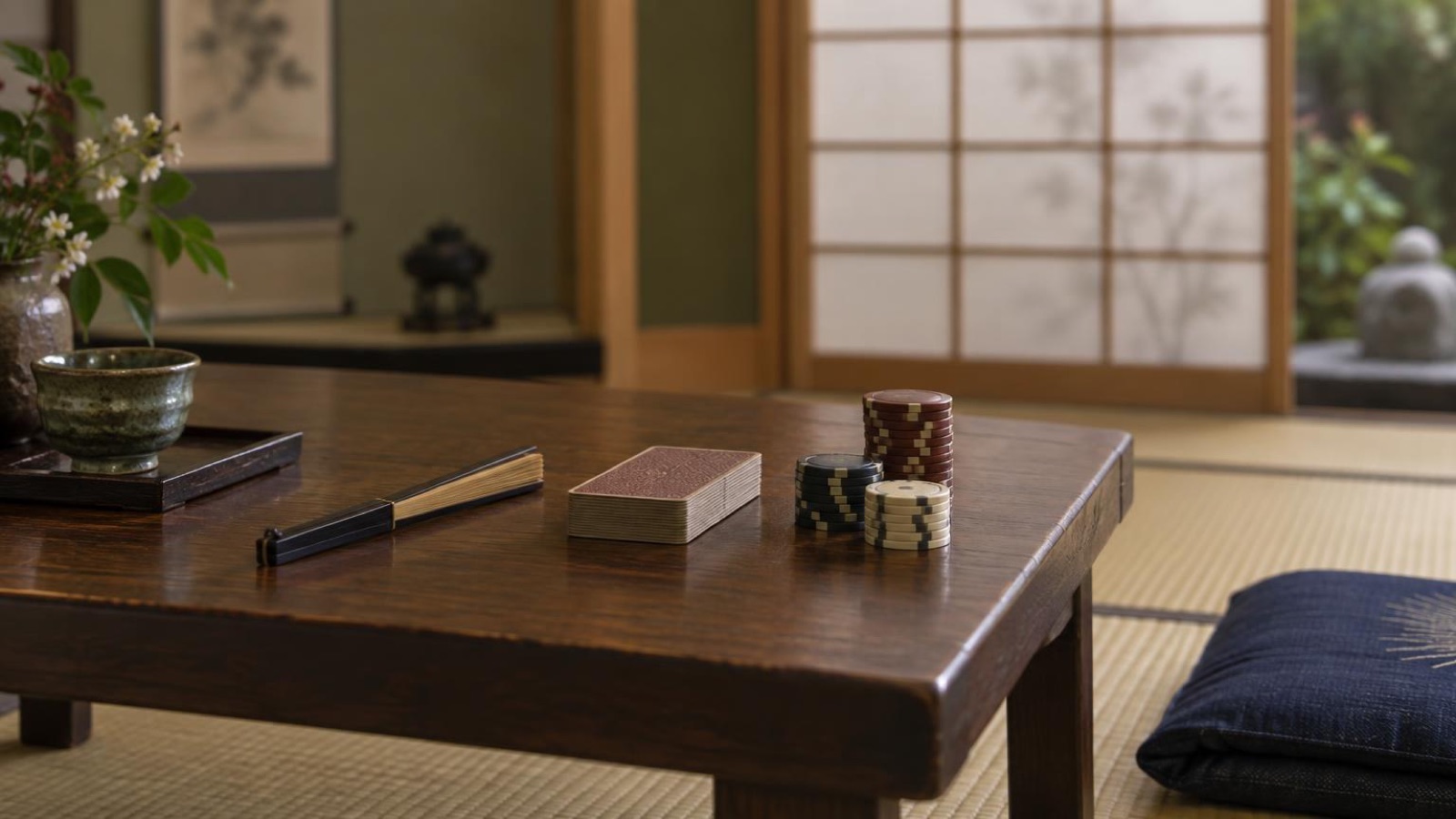
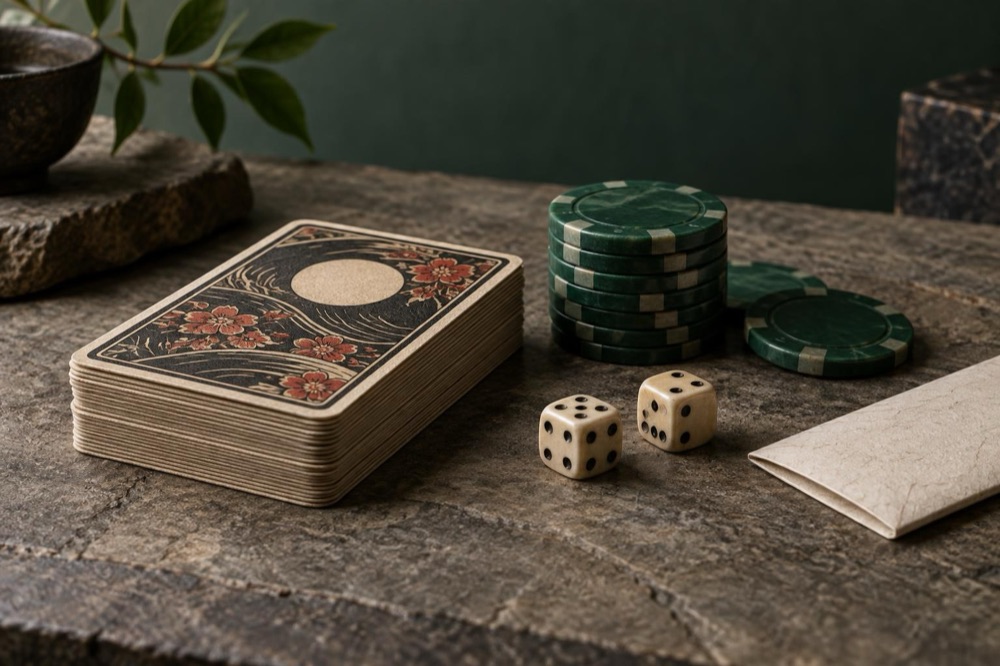
The equipment is simple. You need kabufuda cards, which are numbered 1 to 10, along with chips for betting and zabuton cushions to sit on2. Kabufuda are smaller and stiffer than standard playing cards, with a design that dates back centuries.
Here is how a round works:
- Dead cards are dealt. Each player receives one face-down card at the start. These cards are "dead" and take no further part in the play1.
- Four hands go to the table. The dealer deals four hands in a step-by-step process, and players bet on the hands they think are most likely to win1. Note that the first field is always four cards, regardless of how many players are seated1.
- Players place bets. You choose which hand or hands to back. There is a maximum total bet, a limit on the amount of points that can be wagered per round. Once that limit is reached, no further bets can be placed1.
- The dealer draws. The dealer's hand is the only one that belongs to a person. The four table hands are communal, and you are betting on them, not playing them yourself1.
- Totals are compared. The hand closest to nine wins. Only the last digit counts, so a total of 19 is treated as 92.
Before play begins, the group must agree on one rule: whether a tie is a draw with bets returned, or whether the dealer wins1. This matters because ties happen, and the outcome changes depending on which rule you have chosen.
Card values and drawing rules
Oicho-Kabu uses a simple counting system. Cards are worth their face value, and you add them up. The twist is that only the final digit matters. A hand of 9 and 10 totals 19, which counts as 9. A hand of 3 and 4 totals 7. There is no bust, so you never go over2.
The drawing rules are strict:
- If a hand's total value is 3 or lower, a third card must be taken1.
- If a hand's total value is 7 or higher, a third card cannot be taken1.
- If the total is between 4 and 6, the decision depends on the specific house rules or the dealer's choice.
This is different from baccarat, where the drawing schedule is fixed and automatic. In oicho-kabu, the rules are simpler but still leave room for variation depending on the group.
There is also a precedence rule that catches people out. A dealer hand of 4 and 1, or 9 and 1, takes precedence over three of a kind if both occur together1. The dealer rules are order-sensitive, meaning they do not apply if the order is reversed. This is a detail that matters in close games.
Legal status: cash card games are illegal in Japan
Gambling is basically illegal in Japan, but some gambling is legal under other laws, to respect everyday entertainment or return proceeds to social welfare3. That means the country has a patchwork of rules rather than a single blanket ban.
Card games played for cash fall on the illegal side. Poker tournaments in Japan cannot legally offer cash prizes for the winner, and organizers use alternative prizes instead6. The same principle applies to oicho-kabu: if you are playing for money, you are gambling, and gambling is a crime.
This applies to everyone physically in Japan. Citizens, foreign residents, and visitors are all subject to the same law. There is no tourist exemption.
Penalties for players
Playing oicho-kabu for cash is a gambling offense. If you do it repeatedly, it can escalate to a habitual gambling charge, which carries heavier penalties4. The law does not distinguish between the person running the game and the person placing bets.
Enforcement is real. There have been multiple reported cases of Japanese players arrested for using overseas online casinos, with gambling charges applied using access and money transfer records as evidence7. The same investigative techniques would apply to any form of illegal gambling, including card games.
For visitors, this is worth taking seriously. A criminal charge in Japan can affect your ability to remain in the country, and it will follow you home.
Online casinos are illegal for players in Japan
Playing on offshore casino websites is illegal in Japan, and players have been prosecuted. Even if the casino is legally operated overseas, connecting from within Japan to gamble is a crime8. This applies to free versions and free bonuses too, not just real-money play9.
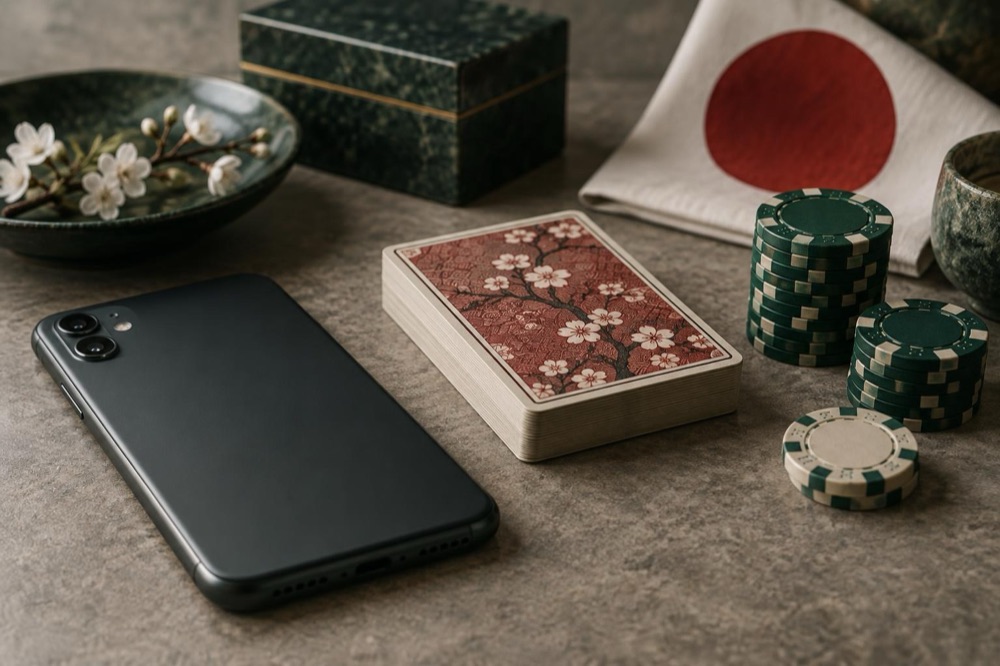
The reasoning is straightforward. Using a smartphone in Japan makes it a domestic act, and a foreign license does not justify it. Being mistaken about the law does not negate intent10. In practice, this means that any online card game where you wager something of value falls under the same prohibition.
There are no licensed and regulated online casinos inside Japan11. Offshore operators welcome players from Japan, but that does not make it legal for you to play11.
Legal gambling alternatives in Japan
If you want to gamble legally in Japan, you have several options. Public racing and sports gambling such as horse racing and bicycle racing are permitted, as are pachinko and pachislot12.
Here is a quick comparison:
| Type of gambling | Legal? | Where | Minimum age |
|---|---|---|---|
| Horse racing, keirin, boat racing, auto racing | Yes | Track venues and official online sites | 20 |
| Pachinko and pachislot | Yes | Parlors across the country | 18 |
| Sports lottery (toto, BIG) | Yes | Convenience stores and online | 19 |
| Oicho-kabu for cash | No | Nowhere | N/A |
| Online casinos | No | Nowhere | N/A |
Pachinko is the most accessible option for visitors. The machines are everywhere, and the minimum age is 184. Note that pachinko involves a maximum game fee of JPY 4 per ball, plus consumption tax equivalent, under the relevant cabinet order13.
Public racing requires you to be 20 or older4. You can bet at track venues or through official online platforms. Sports lotteries like toto and BIG prohibit purchases by anyone under 195.
Minimum ages: 20 for most betting, 18 for toto and pachinko
Age rules in Japan are not uniform. They depend on the type of gambling:
- Public sports gambling (horse racing, keirin, boat racing, auto racing): 20 or older4
- Pachinko and pachislo: 18 or older4
- Sports lottery (BIG, toto, WINNER, DUNK): purchase prohibited for under 195
For comparison, most countries set the minimum age for betting at 1814. Japan is stricter for racing and sports lotteries, which reflects the traditional view that these are more serious forms of gambling.
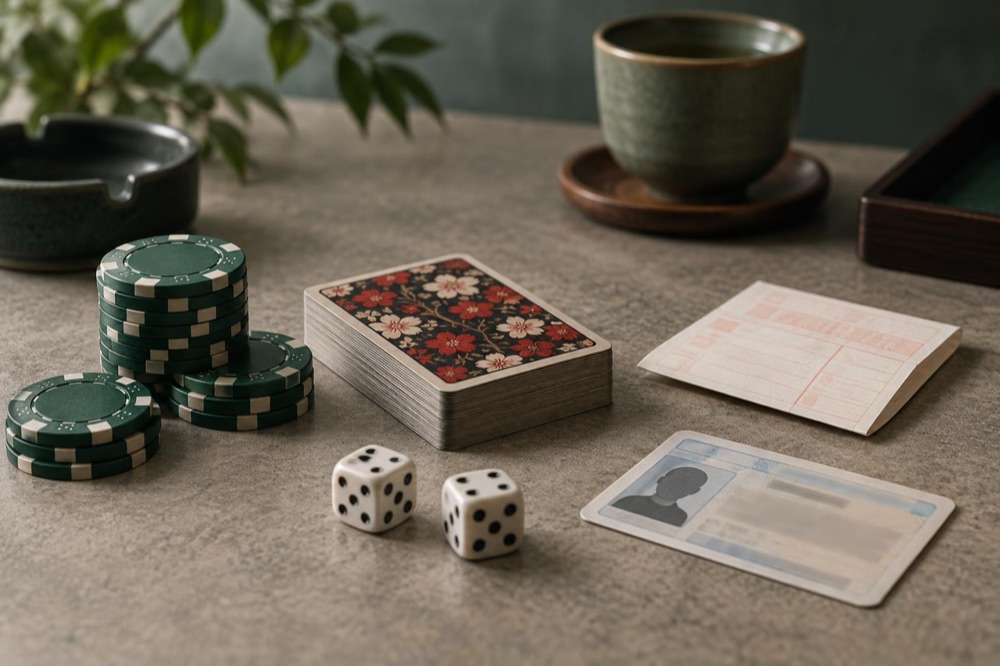
If you are a visitor planning to try pachinko, 18 is the threshold. If you want to bet on horse racing, you need to be 20. Bring identification, because parlors and tracks do check.
What to expect if you want to play oicho-kabu socially
Oicho-kabu still exists as a social game. You can find kabufuda decks at specialty shops and online, and the game is sometimes played at cultural events or among friends. If you are playing for fun, with no money changing hands, you are not gambling in the legal sense.
The line is money. Once chips represent cash, or once there is a prize with value, you are in gambling territory. Even small stakes count.
If you are curious about how oicho-kabu compares to other nine-point games, our guide to nine-point card games covers pok deng, bai buu, and similar games. For a broader look at traditional games across the region, see Asian gambling games.
Visitors who want to experience Japanese gambling culture legally should stick to pachinko parlors and public racing. Both are widely available, and both have clear age rules. For a full country overview, see Can I Gamble in Japan?.
Common Questions
Is oicho-kabu the same as baccarat?
No. Both aim for a total near nine, but oicho-kabu uses kabufuda cards numbered 1 to 10, deals four hands to the table for players to bet on, and has its own rules for when a third card must or cannot be drawn. Baccarat uses standard French-suited cards and a fixed drawing schedule.
Can I play oicho-kabu for money in Japan?
No. Betting money on card games is illegal in Japan. Even poker tournaments cannot legally offer cash prizes, and organizers use alternative prizes instead. Playing oicho-kabu for cash carries real legal risk for everyone involved.
What is the card value that counts as 19 in oicho-kabu?
In oicho-kabu, only the last digit of your total counts. A hand totaling 19 is treated as 9, which is the best possible result. There is no bust, so going over nine does not eliminate you.
Are there any legal casinos in Japan?
No licensed casinos operate in Japan yet. Integrated resort casinos have been planned for several years, but none have opened. The only legal gambling options are public racing, sports lotteries, and pachinko or pachislot parlors.
Can foreigners be arrested for playing oicho-kabu in Japan?
Yes. Japanese gambling law applies to anyone physically in Japan, regardless of nationality. Visitors and foreign residents face the same penalties as citizens if caught gambling illegally.
What is the legal gambling age in Japan?
It depends on the type. Public sports gambling like horse racing and keirin requires you to be 20 or older. Pachinko and pachislot are open to ages 18 and up. Sports lotteries like toto and BIG prohibit purchases by anyone under 19.
Sources14 sources
- Oicho-Kabu, Fuda Wiki, 2025-11-12
- おいちょかぶ, Wikipedia (Japanese), 2026
- 賭博及び富くじに関する罪, Wikipedia (Japanese), 2026
- ギャンブル依存症パンフレット, SCGA, 2026-09-26
- Integrity, Toto Dream, 2026-09-25
- JOPT 2025 Tokyo02 English Guide, Japan Open Poker Tour, 2025-07-12
- オンラインカジノの違法性, Bons, 2026-09-26
- オンラインカジノに関する注意喚起, Consumer Affairs Agency, 2026
- オンラインカジノについて, National Police Agency, 2026-09-25
- オンラインカジノの法的問題, National Police Agency, 2026
- Best Online Casinos for Players from Japan, Wizard of Odds, 2026-05-06
- ギャンブル等依存症に関する啓発, NCASA Japan, 2026-09-25
- 競馬法施行規則, e-Gov, 2026-08-24
- Responsible Gambling, HKJC, 2026-09-26















