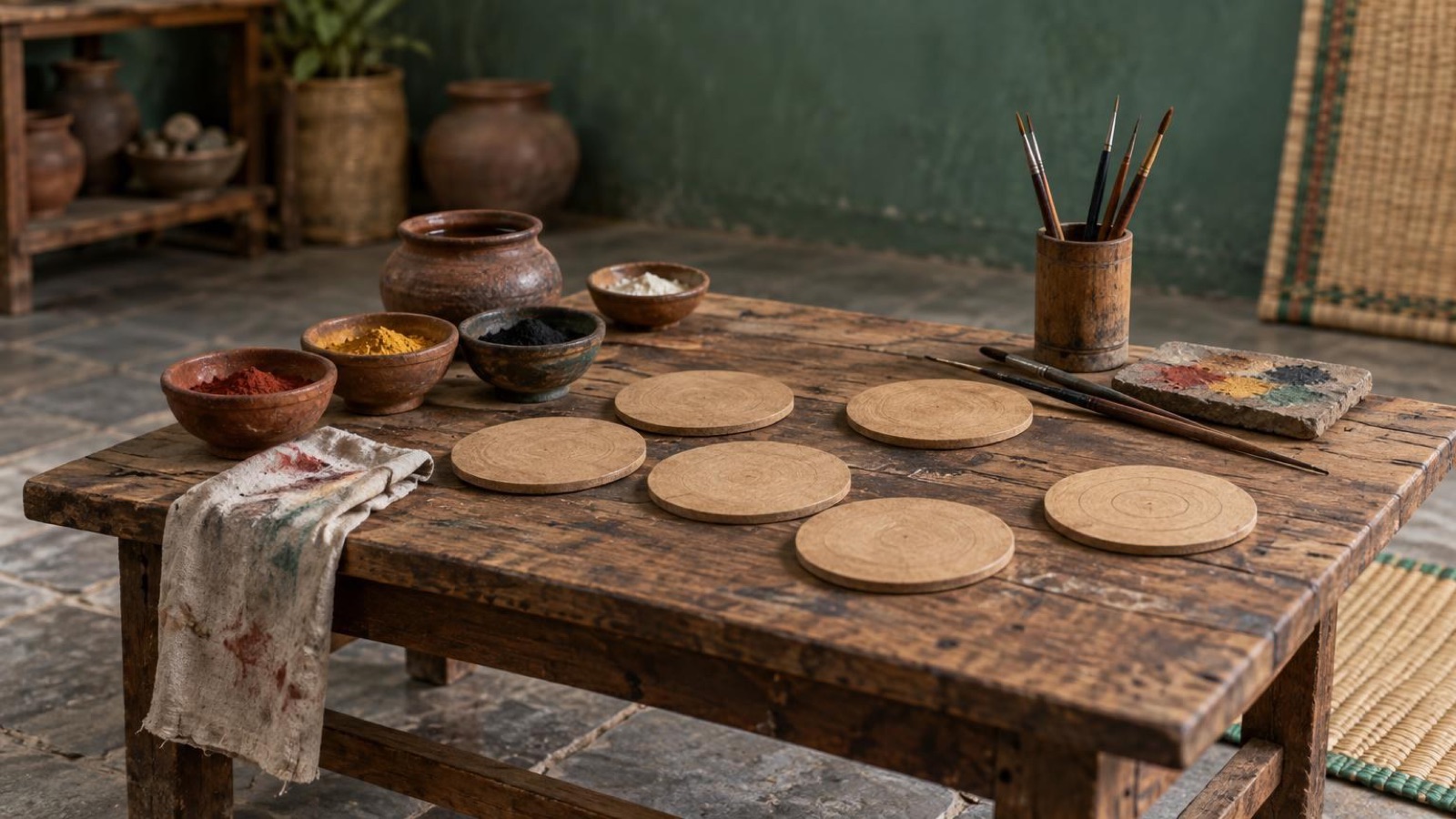
What Ganjifa is
Ganjifa is a family of Indian playing cards that predates the familiar French-suited deck by centuries. The cards were introduced and popularized in India by the Mughal emperors in the 16th century, and the name is usually traced to the Persian word "ganj", meaning treasure, treasury or minted money5. One researcher offers a different hypothesis, that the name drifted from the Chinese "Han Zhi Pai", meaning Chinese playing cards, through forms like Ganjafa and Ganjifa6.
At the Mughal court the game was lavish. Emperors played with decks made from precious metals and stones, and the game's popularity at court helped it spread to ordinary players, who used much cheaper versions painted on cloth, palm leaf or paper7. What made ganjifa distinct from a European deck was the structure:
- Many suits instead of four
- Only two court cards per suit, a king and a minister, rather than three6
Today ganjifa cards are well known to playing-card collectors but unknown to most Indian card players, and there are very few places where they are still used for actual play4. They survive mostly as an art form, and the games attached to them survive in fragments: rules written down by enthusiasts, remembered by the grandchildren of card makers, or recorded by colonial observers more than a century ago. If you want to see or play ganjifa today, you are looking at a small number of artisan workshops and a festival tradition, not a living everyday pastime.
For the wider picture of how card games fit into Indian gambling culture, see our pages on traditional card games in India and gambling in India.
Where Ganjifa cards are still made
Ganjifa making has shrunk to a few centers, each with its own style of deck.
| Place | State | Local style | Cards per set | Notes |
|---|---|---|---|---|
| Sawantwadi | Maharashtra | Changakanchan (Moghul Ganjifa) | 96 | One of the very few places where the cards are still made and occasionally played4 |
| Nirmal | Andhra Pradesh | Changarani (Moghul Ganjifa) | 96 | Made as craft objects; the artists themselves do not know the rules8 |
| Bishnupur | West Bengal | Dashavatara Taas | 120 | Only a single family still makes the cards9 |
| Ganjam and Puri districts | Odisha | Ganjapa (circular, pattachitra style) | 98 or 104 | The most active tradition; a handful of master artists still working10 |
Sawantwadi, Maharashtra. This former princely state in the Konkan region is the home of the classic Moghul Ganjifa of 96 cards, and it is one of the very few places where the cards are still made and occasionally played4. Sawantwadi sets are known as Changakanchan.
Nirmal, Andhra Pradesh. Nirmal artisans make the Changarani Moghul Ganjifa sets. Interestingly, no specific rules are supplied with the games there, and none are known to the Nirmal Ganjifa artists themselves; the cards are made as craft objects8.
Bishnupur, West Bengal. Bengal has its own tradition, the Dashavatara cards, which consist of 10 suits of 12 cards each, one suit for each of the ten avatars of Vishnu12. Card making here faces extinction: there is only a single family that makes the Dashabatar cards9.
Odisha. The Ganjapa cards of Odisha are the most active tradition, concentrated in Ganjam and Puri districts. Among the major artists still working are Berhampur-based Sitakant Mohapatra, Appanna Mohapatra of Chikiti and Prakashchandra Mohapatra of Parlakhemundi, all in Ganjam10. Many works have found a place in museums across the world, including Germany and London10.
Outside India, the Persian cousin of the game has its own story: Persian Gandjafa cards were only discovered and identified as playing cards in 1980, sitting unrecognized in the Austrian National Library6. In the 16th and early 17th centuries, and perhaps even earlier, a 96-card Ganjafa deck was in use in Persia, but no surviving cards are known and no rules of any of the games played with it survive1.
Mughal ganjifa: the 96-card set
The classic Mughal ganjifa set is an eight-suited deck of 96 cards5. Each suit has twelve cards: two picture cards and ten numerals1. The two pictures are always the same pair across Indian ganjifa traditions: a Raja, the king or upper court card, and a Mantri, the minister or lower court card5. Indian ganjifa cards always have only these two court cards, never more6.
The eight suits are distinguished by color, and each suit carries its own symbol. The two most important suits in play are Surkh, the red or "day" suit, and Safed, the white or "night" suit, because their kings decide who leads the game:
- Daytime game: started by the holder of the Raja of Surkh
- Night game: started by the Raja of Safed5
The 96-card Moghul Ganjifa is mainly found in Sawantwadi in Maharashtra, where it is usually played by three persons only8. The same physical set is also the base for other games: the Orissa game described below uses it, and Naqsh can be played with it after removing one suit3.
A related and larger set is the Dashavatara Ganjifa of 120 cards, with ten suits of twelve cards each, made in Bishnupur12. Every suit of a Dasavatara deck consists of 12 cards, again with a Raja and a Mantri plus ten numeral cards5. One Bishnupur card maker, Sital Fouzdar, supplies a leaflet of rules with sets of 120 cards5, which makes Bishnupur one of the few places where you can buy a set and know how to play it.
Ganjapa: Odisha's circular cards
Ganjapa is the Odia branch of the ganjifa family, and it is the most distinctive. The cards are circular, and the paintings on them are drawn in the traditional pattachitra style of Odisha2. The name is local: the cards are still known as Mughal Ganjifa in many regions of the state, but in Odisha everyone calls them Ganjapa10.
The tradition is old. Babur's memoirs mention Ganjapa, so the game can be traced back to the 16th century10. Historically the cards were used as playing cards by the royal class as well as the common mass throughout Odisha11. They were once a part of Odia social get-togethers and recreational life10.
A Ganjapa set is larger than a Mughal set: each playing card set contains 98 or 104 cards11. The number a card represents is usually shown in images of a common theme element, such as a tree, fruit, leaf, bird or mythological creature, and decks often depict tales of the Ramayan or Krishna's mythological tales10. The sets are named according to the number of colors used:
| Name | Colors used |
|---|---|
| Atharangi | 8 |
| Dasarangi | 10 |
| Vararangi | 12 |
| Chaudarangi | 14 |
| Solarangi | 1610 |
Because each card is hand painted, each set of Ganjapa cards differs from the other11. The cards are generally produced in two different sizes, one large and another miniature deck about 2 inches in diameter5.
Today Ganjapa is a dying art form, almost out of use, with only a few master artists able to create the decks10. The number of players has gone down drastically11, and the sets are now mostly used as decorative collectible items for art lovers11. The surviving artists named above in Ganjam district are the main makers, and their hand-painted sets are priced as craftwork rather than as ordinary decks.
Naqsh: the main game played with Ganjifa
Naqsh is the gambling game most associated with ganjifa cards, and it can also be played with standard international cards4. It is an old and once widespread game: until about 45 years ago, Naqsh was very popular in most parts of India, namely Madhya Pradesh, Uttar Pradesh, Gujarat, Rajasthan, Odisha, Bihar, Bengal and the Deccan, and it stayed popular in Delhi until about 35 years ago3. The game was observed by G. J. O'Donnell in the Purniah District of Bihar in 1877, played with French-suited cards3. One theory holds that Naqsh spread throughout South East Asia and the regions bordering the Indian Ocean aboard Portuguese ships in the sixteenth century3.
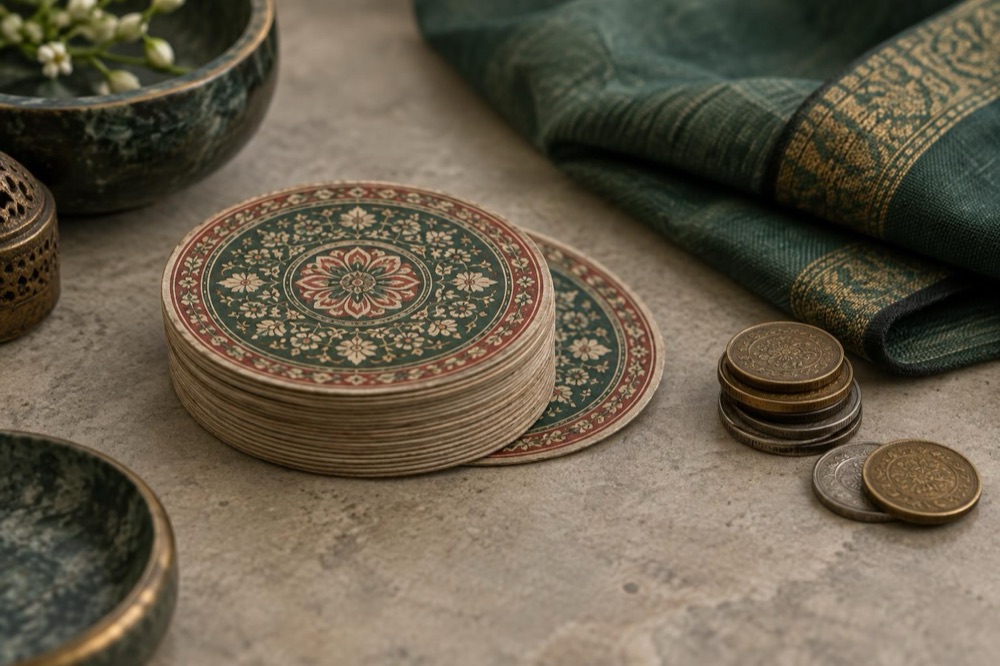
The cards. Naqsh can be played with any standard Indian or European deck consisting of 96, 84, 80, 60, 48, 40 or 36 cards3. The common options:
| Deck | Adjustment | Cards in play |
|---|---|---|
| Moghul Ganjifa (96 cards) | Remove the suit of Shamsher, the Swords | 843 |
| Standard French-suited deck (52 cards) | Remove the four jacks | 483 |
| Special Naqsh decks (Odisha, Rajasthan, Madhya Pradesh) | 3, 4, 5 or 8 equal series of 12 cards | 36 to 963 |
| Bishnupur Naqsh taas | 4 equal suits of 12 cards | 485 |
Players. There can be five to seven players for the game of Naqsh, but the proper number is six3.
The aim. The combination of cards in your hand must come to a total of 17 or 21 points in order to win the stakes3. The key card values:
- Mir: 12 points
- Ghodi: 11 points3
A Naqsh of 21 points must be declared with two cards only: a Mir and a Nine, or a Ghodi and a Ten3.
When it is played. Naqsh is a festival game. Gambling games like Naqsh are played especially during the festival season of Dussehra and Diwali in October or November, under the auspices of Lakshmi Devi3. The Bishnupur account agrees: it is a pastime for holidays, Janmastami and the auspicious time between Dussehra and Diwali or Kali Puja5. Naqsh taas there are generally played for gambling purposes5. This fits a wider Indian pattern, where card parties around Diwali grew from a family affair into a full week of invitations13.
Ath-Rangi Moghul Ganjifa: a recorded Orissa game
The best-documented ganjifa game from Odisha is the Ath-Rangi Moghul Ganjifa game, played with the 96-card set in 8 suits of 8 colors8. The rules were narrated around the mid 1980s by a grandson of a Ganjifa artist from Orissa8, which makes this one of the few ganjifa games with a full recorded ruleset.
Players and setup. There must be four players, not fewer, and each plays individually8. A central place is prepared by spreading a bedsheet or some kind of white cloth on the ground to make a playing dais8.
The deal. Cards are dealt four at a time to each player, from the dealer's right side, in an anti-clockwise direction8. Eight cards are laid on the dais, and the winner of that layout takes them as his first hand; after that, a hand is 4 cards8.
Who leads. The day and night rule from the Mughal tradition applies here too:
- Daytime: the player holding the King (Raja) of the Surya (Surkh) suit starts the game
- Night: the one who has the King of Chandra (Safed) suit leads8
Winning. The game is scored in sets. Less than six sets is the loser, more than six sets is the winner8. Stakes are simple: for example, the loser may pay Rs. 5 per set8.
Which cards to use. The games can be played equally with Changakanchan (Sawantwadi) and Changarani (Nirmal) Moghul Ganjifa sets8, so if you buy a set from either of those craft centers you have everything you need. Note that in Nirmal itself the artists do not know the rules8; the ruleset recorded in Orissa is the one to ask for.
If you would rather watch than play, the Ganjapa artists of Ganjam district are the living link to this tradition, and a hand-painted set doubles as a game and a piece of folk art. For other Indian card games you can actually find opponents for today, see our guides to Teen Patti, Andar Bahar and Indian Rummy.
Common Questions
How many cards are in a Mughal ganjifa set?
A full Mughal ganjifa set has 96 cards, arranged in eight suits of twelve cards each. Each suit holds two picture cards, a king and a minister, plus ten numeral cards. Smaller sets exist, and the related Dashavatara packs from Bengal have 120 cards in ten suits.
What is the difference between Ganjifa and Ganjapa cards?
Ganjapa is the Odia name for the same card tradition. Ganjapa cards are circular, hand-painted in the pattachitra style of Odisha, and a set usually holds 98 or 104 cards. Ganjifa is the wider family name used across India, including the rectangular Mughal sets.
Can Naqsh be played with a standard deck of cards?
Yes. You can play Naqsh with a standard French-suited 52-card deck by removing the four jacks, leaving 48 cards. It also works with Indian decks of 96, 84, 80, 60, 48, 40 or 36 cards, and with special Naqsh decks made in Odisha, Rajasthan and Madhya Pradesh.
How many players does Naqsh need?
Naqsh suits five to seven players, and the proper number is six. The related Ath-Rangi Moghul Ganjifa game from Odisha needs exactly four players, each playing individually rather than in partnerships.
When is Naqsh traditionally played?
Naqsh is a festival game, played especially during Dussehra and Diwali in October or November under the auspices of Lakshmi Devi. It is also played on holidays, on Janmastami, and during the auspicious stretch between Dussehra and Diwali or Kali Puja.
What is the winning score in Naqsh?
Your cards must total 17 or 21 points to win the stakes. A 21-point Naqsh must be declared with just two cards: a Mir and a Nine, or a Ghodi and a Ten. A Mir counts twelve points and a Ghodi counts eleven.
Can Sawantwadi or Nirmal ganjifa sets be used for Orissa games?
Yes. The Orissa games can be played equally with the Changakanchan sets from Sawantwadi and the Changarani sets from Nirmal, both of which are Moghul Ganjifa sets. The suits and structure match, so the same rules apply.
Sources13 sources
- Iran | Iran, Pagat, February 21, 2024.
- A unique pack of cards, The Hindu, August 29, 2012.
- Naqsh, Craft Revival, January 3, 2015.
- India | India, Pagat, accessed 2026.
- The Lost Game of Dashabatar Taas of Bishnupur, Chitrolekha Journal, March 1, 2013.
- ZentralAsien, Alta Carta, April 19, 2006.
- Indian Rummy Rules, Origin and Gameplay, Mumbai Gullies, archived February 23, 2023.
- Handedness in Card Games, Kishor Cards, accessed 2026.
- Preserving Bishnupur's heritage, The Hindu, December 5, 2015.
- Ganjapa cards: A dying art form, The Telegraph (Odisha), February 5, 2014.
- A unique pack of cards, The Hindu, August 29, 2012.
- Dashavatar card-making faces extinction in Bengal, The Hindu, February 5, 2015.
- The big fat Diwali taash party, The Hindu, November 9, 2015.