
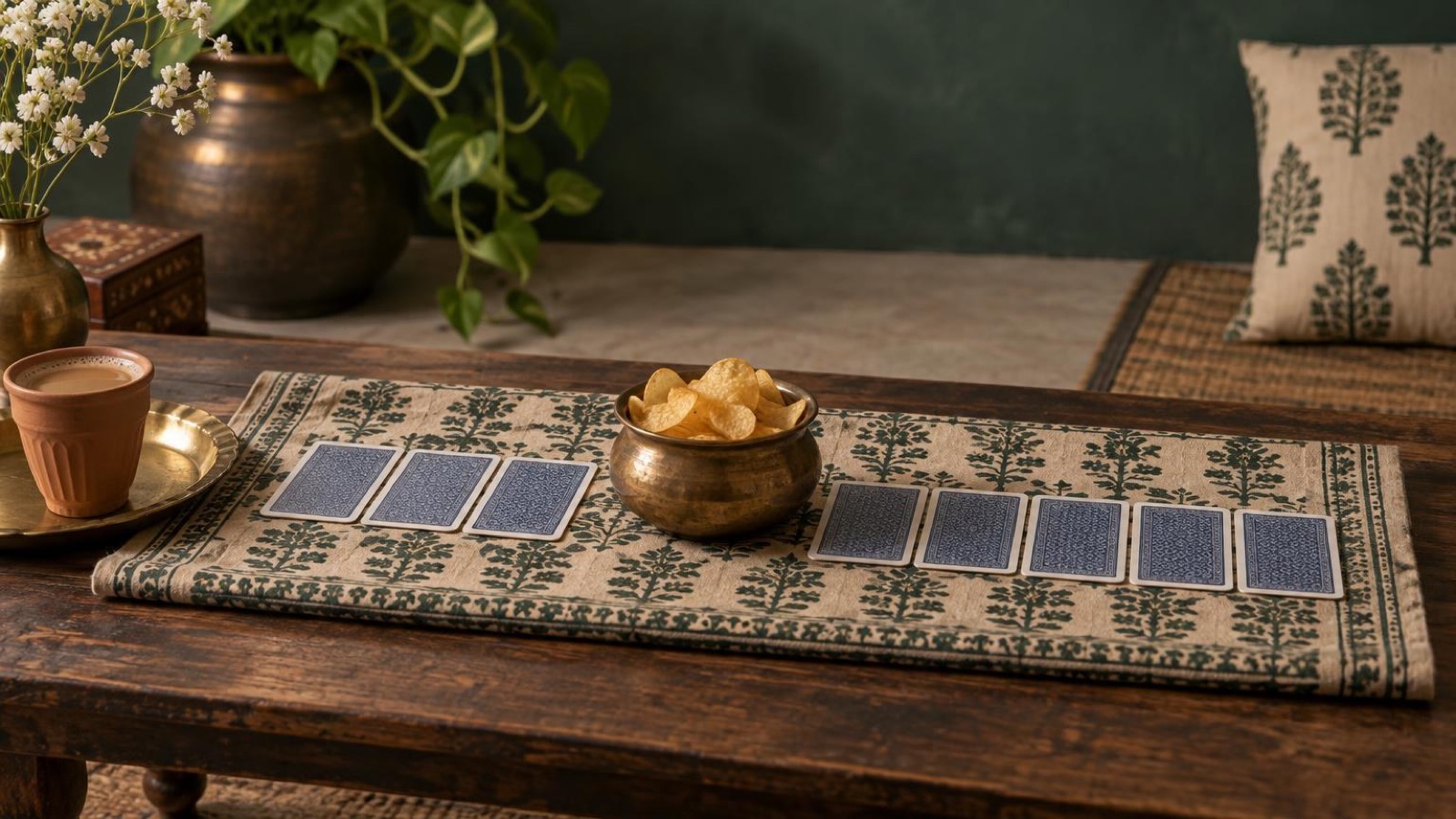
What Teen Patti and poker have in common
Both games run on the same hand rankings you already know from poker. A pair beats a high card, a straight beats a flush in the three-card versions, and the strongest three-card hand takes the pot or the payout. If you have played any poker variant, you can sit down at a Teen Patti table and follow the flow within a hand or two.
The bigger difference is who you are playing against. Teen Patti is a player-versus-player game: everyone at the table is trying to win the same pot, and reading the other players matters. Most casino poker games work the other way. In novelty poker games, you are pitted against the dealer or a pay table, not the other players at the table5. Caribbean Stud Poker is a clear example: players compete against the dealer, not one another6. Ultimate Texas Hold'em does the same, pitting players against the dealer5.
That single difference changes how you play. In Teen Patti, a strong hand is only as good as what the other players are holding and how they are betting. In dealer games, your hand is scored against a fixed pay table or the dealer's cards, so the other seats at the table do not affect your result. Video Poker makes this plainest of all: with no other players in the game, all that counts is how your final hand scores against the pay table7.
Pace is another difference. Teen Patti is described as fast-paced, all about timing and strategy1. Some poker table games move slowly by comparison. Pai Gow Poker, for instance, is a sociable game with a relaxed pace of play7. If you want a quick, lively table, Teen Patti fits that mood better than a slow dealer game.
Teen Patti: a fast-paced three-card game
Teen Patti is a three-card Indian poker game built for speed1. Each player gets three cards, and the goal is to end up with the best three-card hand at the table or to push everyone else out of the pot before the cards are shown. The game is popular enough that it runs as a live dealer table under a gaming license, listed as Teen Patti Live8, and it also appears in licensed electronic casino game lists9.
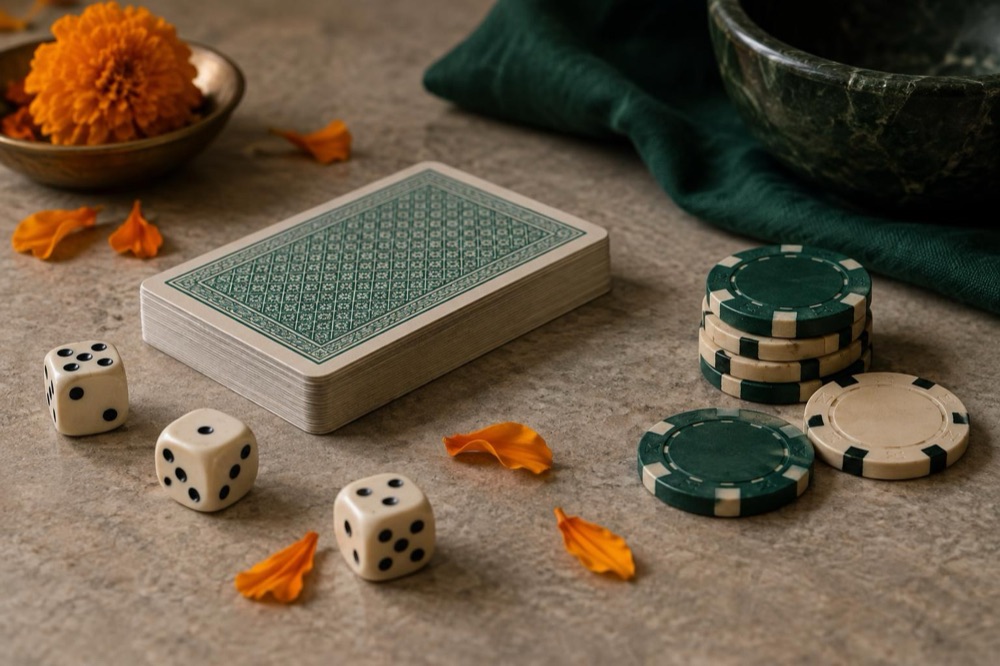
The three-card format is the same shape as Three Card Poker, which deals three cards to each player and the dealer, all face down3. The difference is what happens next. In Three Card Poker, the concept is simple: whoever has the higher three-card hand, dealer or player, wins3. In Teen Patti, there is no dealer hand to beat. You are comparing your three cards against the other players, and the betting is what decides who stays and who folds.
Because there are only three cards, the hand rankings are compressed. Pairs, flushes, straights and straight flushes all matter, and the strongest hands are rare. That rarity is what makes the side bets interesting, and it is also why the game moves quickly: with three cards each, there is not much to think about, so the action comes down to how much you are willing to put in.
If you want the full hand order before you sit down, the Teen Patti rules and hand rankings page walks through every combination from high card to straight flush.
The ante and boot: how a hand starts
Every hand begins with forced money on the table. In Teen Patti, an ante or boot amount is usually placed in a pot, and then betting begins with the player seated next to the dealer2. The ante is a forced bet where each player puts an equal amount or chips into the pot before the deal2. It is often one unit or a small amount, and a half or quarter of the minimum bet is also common2.
That structure will be familiar if you have played other ante games. In 7 Card Stud Hi/Lo, the game begins with each player placing an Ante bet to build up the pot before play begins10. The purpose is the same in both: the ante seeds the pot so there is something to play for, and it forces every player to have something at stake before any cards are turned over.
Once the boot is in, the player to the dealer's left acts first, and play moves around the table2. From there, each player takes one of the following actions:
- Put in a bet
- Call the current bet
- Raise
- Fold
The pot grows with each round until one player is left or the remaining players show their cards.
The ante also sets the scale for everything that follows. If the boot is small, the early bets are small, and the pot only gets serious once players start raising. If the boot is larger, the whole hand plays for more. Before you sit down, check what the table's boot amount is, because that number tells you what a typical hand will cost you.
Blind or seen: the two ways to bet
This is the part of Teen Patti that has no direct equivalent in most poker games, and it is the first thing a new player has to understand.
A blind player bets without looking at their three cards. They have no idea what they are holding, but they pay the smaller stake to stay in. A seen player has looked at their cards. They know what they have, but they must pay more to keep betting.
The trade-off is straightforward. Blind players risk less per bet but are betting in the dark. Seen players have information but pay a premium for it. In practice, most players stay blind for the first round or two, keeping the cost low while the pot builds, then look at their cards once the stakes get meaningful.
The blind and seen distinction also affects how others read you. A player who stays blind for a long time is either patient or holding a hand they do not need to see yet. A player who looks early and keeps raising is usually telling you something about their cards. Because the blind stake is cheaper, staying blind is a way to see more hands for less money, but you give up the chance to fold a bad hand early with full information.
If you have played Ultimate Texas Hold'em, you have seen a similar idea in a different form. There, the player makes two equal bets, the Ante and Blind5, and the blind bet pays according to the pay table if you beat the dealer with at least a straight, while with less than a straight the blind is a push10. Teen Patti's blind bet is not a side wager in the same way, but the name and the idea of betting before you have full information will feel familiar.
Minimum bets: blind stake vs 2x for seen players
The core betting rule in Teen Patti is that a seen player must put in at least double what a blind player puts in. If the current blind stake is one unit, a seen player betting in that round must put in at least two units. This is what keeps the game balanced: seen players have an edge in information, so they pay more for it.
The exact minimum is set by the table before the game starts, along with the boot amount. A table with a small boot will have small blind stakes and small seen minimums, which suits casual play. A table with a bigger boot raises everything proportionally.
For comparison, poker uses forced bets of a different shape. In Texas Hold'em, the small blind posts a bet equal to half the minimum bet, and the big blind posts a bet equal to the minimum bet11. Omaha works the same way: the small blind posts half the minimum bet and the big blind posts the full minimum bet12. Those blinds are posted once, before the cards, and then betting continues in rounds. Teen Patti's blind and seen stakes are not posted blinds in that sense; they are the minimum a player must put in based on whether they have looked at their cards.
When you announce a bet at a poker table, you say the amount plainly, for example "I bet $5"13. Teen Patti tables work the same way: you state your bet or push your chips forward, and the dealer or the table rules confirm the amount. If you are seen, make sure the amount you put in meets the double minimum, because a short bet will be corrected or treated as a call.
Side bets: Pair Plus and 6 Card Bonus with payouts up to 1000x
Teen Patti tables offer optional side bets alongside the main pot, and these are where the big payout numbers come from. The two named side bets are Pair Plus and 6 Card Bonus1. With the chance to win up to 1000x your side bets, the top of the pay table is the headline number1.
Pair Plus pays on the strength of your own three cards. The pay table for the equivalent Three Card Poker Pair Plus bet runs: straight flush 40 to 1, three of a kind 30 to 1, straight 6 to 1, flush 3 to 1, and pair 1 to 13. It is worth knowing that the Pair Plus bet is more likely to lose than win despite paying 40 to 1, and it is not a strategy for chasing losses3. Treat it as entertainment attached to the hand, not as a way to recover a bad session.
The 6 Card Bonus works differently. It pays based on the best five-card poker hand that can be made combining your hand and the dealer's three-card hand3. The pay table tops out at a royal flush paying 1,000 to 1, with other strong hands paying less3. In the Macau version of the same bet, the dealer combines five of the six cards, the dealer's three and the player's three, into the highest possible hand under the Six Card Bonus rankings and pays the corresponding odds14.
In the Macau Fortune 3 Card Poker rules, the Ante bet and the Pair Plus bet are the base bets, while the Six Card Bonus and the Progressive Jackpot are the side bets14. That is a useful way to think about any three-card table: the main bet is the game, and everything else is an optional extra with its own pay table.
| Bet | What it pays on | Top payout |
|---|---|---|
| Pair Plus | Your own three cards | 40 to 1 for a straight flush3 |
| 6 Card Bonus | Best five-card hand from your three plus the dealer's three | 1,000 to 1 for a royal flush3 |
| Teen Patti side bets | Side bet combinations | Up to 1000x1 |
Where you can play: Okada Manila and online apps
In the Philippines, Teen Patti runs at Okada Manila1. The game is part of the casino's table lineup, so you can walk in, find the table and buy in. Okada Manila sits in the Entertainment City district in Manila, which is where most of the city's large casino floors are.
If you want a poker room rather than a Teen Patti table, licensed operators in Manila include Poker Brothers at Ground Floor 1766 A. Mabini St., Zone 6, Barangay 699, Malate, Manila, 1004, Philippines, and Prime Poker Club Manila, which runs a poker room15. These are licensed poker venues, not Teen Patti tables, but they are useful if you want to compare the two games in person.
Age and access rules in the Philippines are strict. Persons under twenty-one years of age and students are not allowed to play, and government officials and employees connected directly with the operation of the Government, along with members of the Armed Forces of the Philippines including the PNP, are prohibited from entering, staying or playing4. Banning orders apply nationwide, and a ban may be a self-exclusion, a family exclusion or one issued by the licensee4. Bring photo ID, because you will be asked for it at the door.
Online, Teen Patti is widely available. Players worldwide can connect for real-time matches, use social game features and take part in tournaments on mobile applications and online platforms2. Live dealer versions also run under license, listed as Teen Patti Live8, and electronic versions appear in licensed casino game lists9. If you play on a mobile app, check who operates it and whether it holds a license in your jurisdiction before you deposit. The guide to playing Asian games online covers how apps, live dealer tables and legal risk fit together.
For a wider view of where the game sits alongside other regional games, see Asian gambling games and the comparison of where Asian games are legal.
Is Teen Patti a game of skill or chance?
Teen Patti sits in the same category as other card games where decisions matter but the deal decides a lot. The closest official comparison is Mississippi Stud, where some skill is involved in determining whether or not to bet or fold, but it is a game of chance based on the random distribution of cards16. Teen Patti has the same split: your betting decisions, when to look at your cards and when to fold are skill, but the three cards you are dealt are chance.
Poker as a whole is described as a skill-based game in which chance and strategy influence your outcome17. Teen Patti fits that description too, with one important difference: because there are only three cards and no community cards, there is less room for long-term strategy than in a game like Texas Hold'em. The skill is concentrated in the betting rounds, not in reading a board.
In India, this distinction matters legally. Teen Patti is widely treated as a game of skill, which is why it is played openly and why online versions have grown. Some operators still exclude it from certain promotions: one operator's terms state that it cannot be played on slot machines, poker and Indian Flush (Teen Patti)18. That is a promotion restriction, not a statement about legality, but it shows that operators treat the game separately from other card games.
If you are comparing the two games for a session, the practical summary is this: Teen Patti gives you a fast three-card game with player-versus-player betting, a blind and seen structure and side bets that can pay up to 1000x1. Casino poker gives you a hand to play against the dealer, with even-money main bets and pay-table side bets3. Both use the same hand rankings, so the skills transfer, but the betting rhythm and the person across the table from you are different.
Common Questions
What is the difference between blind and seen players in Teen Patti?
A blind player bets without looking at their three cards and pays the smaller stake. A seen player has looked at their hand and must bet at least twice what a blind player bets. Seen players have more information but pay more to stay in the hand.
How much do you have to bet as a seen player?
A seen player must put in at least double the current blind stake. If the blind stake is 10 chips, a seen player betting in that round puts in at least 20. The exact minimum is set by the table before the game starts.
What are Pair Plus and 6 Card Bonus side bets?
They are optional extra bets on the same deal. Pair Plus pays on the strength of your own three cards, such as a pair or a straight flush. The 6 Card Bonus combines your three cards with the dealer's three and pays on the best five-card hand.
What is the maximum side bet payout in Teen Patti?
Side bets can pay up to 1000x, which is the top of the pay table for the strongest possible hand. Most hands pay far less, and the lower tiers pay between 1 to 1 and 40 to 1 depending on the combination.
Where can I play Teen Patti in the Philippines?
Teen Patti is offered at Okada Manila in the Manila casino district. Licensed poker rooms such as Poker Brothers in Malate and Prime Poker Club Manila operate nearby. You must be 21 or older to enter and play.
Is Teen Patti legal in India?
Teen Patti is widely played in India and is generally treated as a game of skill, which places it outside the main gambling restrictions in most states. Rules vary by state, and some operators exclude it from certain promotions, so check locally before playing for money.
Can you play Teen Patti online on mobile apps?
Yes. Teen Patti is available on mobile apps and online platforms, where players connect for real-time matches, use social features and enter tournaments. Live dealer versions also run at licensed tables, so check the operator's license before depositing.
Sources18 sources
- Teen Patti, Okada Manila, 2026-05-21
- तीन पत्ती, Wikipedia, 2026
- Three Card Poker, PlaySmart, 2026-09-25
- Regulatory Framework for Gaming Venue Operations, PAGCOR, 2025-11-06
- Ultimate Texas Hold'em, PlaySmart, 2026-09-25
- Caribbean Stud Poker, PlaySmart, 2026-09-25
- How to Play Poker, PlaySmart, 2026-09-25
- PLAYTECH-LIVE, PAGCOR, 2026-07-16
- JILI, PAGCOR, 2026-05-19
- How to Play Ultimate Texas Hold'em Poker, GameSense, 2021
- Texas Hold'em, PlaySmart, 2026-09-25
- Omaha, PlaySmart, 2026-09-25
- How to Bet, PlaySmart, 2026-09-25
- Fortune 3 Card Poker, DICJ Macau, 2025-10-30
- List of Poker Operators with Issued Gaming License, PAGCOR, 2026-05-07
- Mississippi Stud, PlaySmart, 2026-09-25
- Poker Essentials, GameSense, 2020
- Terms and Conditions, Majestic Pride, 2026-09-26















