The tie bet: an 8 to 1 payout on a dead heat
Every baccarat table gives you three main boxes to bet on: Player, Banker and Tie. The tie bet wins only if the two hands finish with exactly the same point total. If they do, the standard payout is 8 to 11.
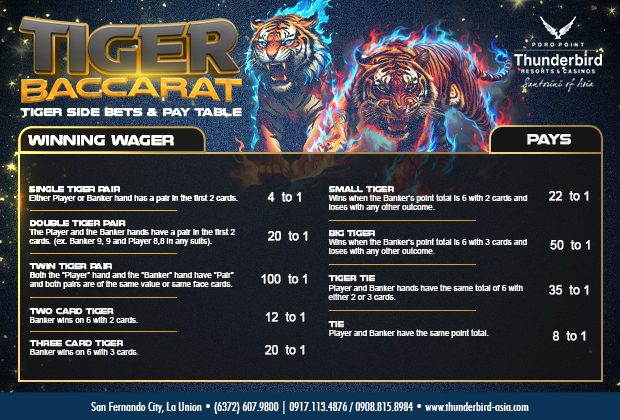
That 8 to 1 figure is remarkably consistent across Asia. Hoiana in Vietnam lists the Tie wager at 8 to 15. Tiger Baccarat side bet rules pay the Tie at 8 to 16. GG Poker's live casino rules state that a winning Tie Bet is paid at odds of 8 to 17. Paradise City in Incheon pays tie bettors eight times their bet and does not collect the original stake8. Baccarat 27 at City of Dreams Manila pays a winning Tie wager at 8 to 19. Even Lucky Three Card Baccarat, a compressed variant, keeps the same 8 to 1 tie payout10.
What does 8 to 1 mean in money? It means profit, not total return. A Taiwanese operator's worked example spells it out: on a 100 yuan tie bet that wins, you profit 800 yuan and receive 900 yuan back in total, stake included10. Compare that with the other two boxes: a winning Player bet on the same 100 yuan profits just 100 yuan, and a winning Banker bet profits 95 yuan after the usual 5% commission10. The tie pays eight times as much because it happens far less often.
One thing to check before you sit down: a few tables pay differently. Some operators offer either 8:1 or 9:1 on the tie depending on the table11, and the felt or the on-screen rules will say which. The difference matters more than you might think, and the house edge section below covers why.
How the three outcomes work in a coup
A game of baccarat has exactly three possible outcomes: Player wins, Banker wins, or Tie12. Each player at the table finds three bet boxes, one each for Player, Banker and Tie, above their number on the felt13. You can bet on Player or Banker, and you can add the Tie alongside or, at most tables, on its own.
A coup (one round of play) runs like this:
- All bets go down before any cards are dealt. Nothing can be wagered once the deal begins.
- Two cards are dealt to the Player hand and two to the Banker hand4.
- Depending on the totals, a third card may be drawn for one or both hands, following fixed rules the dealer applies. No player decides anything.
- The hand closest to 9 wins. If the totals are equal, the coup is a tie.
In Macau, the official rules add a detail about what a tie means for the flow of the game: when the coup ends with the Banker and Player holding the same points, it is scored as a draw, and a new coup decides the outcome14. The same rules confirm that a card exposed mid-coup does not void anything: the bets of that coup remain valid and the coup continues15.
So a tie is not a malfunction or a rare anomaly in the rules. It is one of the three designed outcomes of every coup, with its own betting box and its own price.
Card values and hand totals: why ties happen
To understand why ties occur, you need to know how hands are scored. Aces count as 1, cards 2 through 9 count at face value, and 10, jack, queen and king count as 016. The highest possible point total for a hand is nine, and the hand closest to 9 wins3.
If a hand's total exceeds 9, only the rightmost digit counts. A total of 12 becomes 2, and 25 becomes 517. This is why ties are possible at every total from 0 to 9: both hands can land on the same digit in many different ways.
The third card rules create further chances for the hands to converge. If either hand's first two cards total 8 or 9, that is a natural, no more cards are dealt and all bets are settled immediately3. Otherwise, the Player hand draws a third card on totals of 0 to 5 and stands on 6 or 75. The Banker's draw depends on its own total and the Player's third card, following a fixed tableau the dealer applies16. The maximum number of cards either hand can hold is three5.
Because the drawing rules are fixed and automatic, two hands frequently end on the same digit. A 4 versus a 4, a King-5 versus a 9-6: the paths differ but the destination is the same. That is the event your tie bet is riding on.
How often a tie actually happens
The tie bet wins about 9.52% of the time2. Put plainly: roughly one coup in ten ends in a tie, and the other nine do not.
That figure is consistent across sources. A Korean-language casino guide gives the tie win rate as 9.52%18, and an independent baccarat guide's odds table lists the tie at 9.52% with its 8 to 1 payout17.
The 9.52% figure is what makes the 8 to 1 payout feel generous and actually isn't. If a tie happened exactly one time in nine, an 8 to 1 payout would be a fair bet with no house edge at all. Because it happens slightly less often than that, the casino keeps a margin on every tie wager. The next section puts a number on that margin.
The house edge: why the tie costs more
The house edge is the share of everything wagered that the casino expects to keep over the long run. On the three main baccarat bets, the numbers are starkly different:
The 14.36% figure appears in operator rulebooks for Traditional Baccarat4, in independent game guides3, and in casino explainers across the region11. A research paper on Macao's gaming industry notes, for contrast, that the Banker bet carries a house edge of only about 1.06%19. In return-to-player terms, one operator spells out the same gap: Banker returns about 98.94%, Player about 98.76%, and the tie only about 85% to 86%20.
In practical terms, the gap shows up in the house edge figures the casinos publish. The Banker bet carries a house edge of about 1.06%, and the Player bet about 1.24%4. The tie bet's edge is far larger than either of those, which is why it costs so much more to play over a long session.
Tables that pay 9 to 1
A minority of tables pay the tie at 9 to 1 instead of 8 to 1, and that single point changes the math dramatically. At 9 to 1, the house edge on the tie drops to about 4.85%17. An archived analysis from Wizard of Odds breaks it down further by deck count: with eight decks and a 9 to 1 tie, the edge is 4.844%, while with a single deck it rises to 6.385%21. The same analysis notes that Binion's Horseshoe in Las Vegas used to pay 9 to 1, and that at the time the online casino Bodog still did22.
Historically, Macau's own regulations for the old Makccarat game offered casinos a choice: pay the tie at 14 to 1 under one alternative, or at 9 to 1 under another23. So the 9 to 1 tie is not a new invention; it is a long-standing alternative pricing that some tables still use. If you find one, the tie becomes a much more reasonable bet, though still several times more expensive than Banker.
What happens to your bet when the hands tie
This is the question that confuses new players most: if the hands tie and I bet Banker or Player, do I lose? No. On standard tables, when the result is a tie, neither hand wins or loses13, and the common rule is that your original stake on Banker or Player is returned, with that coup counted as neither a win nor a loss10. One operator's rulebook states it plainly for each side: if the round ends in a tie, the Banker bet is returned, and the Player bet is returned24.
So a tie is a push for Banker and Player bets, a win for tie bets, and a loss for everything else on the table.
A few variants handle ties differently, and it is worth knowing they exist:
- In Mahjong Baccarat, a Macau-approved game, if Banker and Player both hold a "tight ten", the banker wins regardless of tile size or combination25. There is no push.
- In Three Card Baccarat, another Macau game, the tie is a separate paid outcome at 1 to 20, and winning bets on the main options carry a 5% commission26.
- In Macau's standard baccarat rules, after a tie the existing bets may be canceled, maintained, or changed, with or without reducing the stake, or switched between Player and Banker before the new coup14.
That last point matters in Macau specifically: a tie there does not simply end the hand. A fresh coup is dealt to decide the outcome, and you have choices about what to do with your pushed chips.
Betting the tie on its own
Can you walk up to a table, put money on the tie and nothing else? At most tables, yes. Baccarat 27's rules state it directly: you may place a Tie or Pair or B-27 wager without having placed a wager on Player or Banker9. No Commission Baccarat rules say the same: players may place side wagers without a Player or Banker wager, and may place several wagers on the same hand27.
The general rule at most operators is that you may bet on either Banker or Player but not both, while you can bet on the tie outcome at any time, even with an existing bet on one of the sides28. The same rule appears in Thai-language versions of the same guidance29.
The one caveat: some tables classify the tie as a side bet and require a main bet first. Depending on the table, you may need to place the main bet before placing a side bet30. And whatever you bet, timing is fixed: all bets must be placed before the cards are dealt, before the dealer indicates no more bets and starts the round31.
Side bets and other wagers compared with the tie
The tie is not the only long-shot wager on a baccarat table. Here is how the common ones stack up:
| Wager | Winning condition | Payout | House edge |
|---|---|---|---|
| Tie | Player and Banker totals equal | 8 to 1 | 14.36%4 |
| Player Pair | Player's first two cards are a pair | 11 to 1 | varies by table5 |
| Banker Pair | Banker's first two cards are a pair | 11 to 1 | 10.36%4 |
| Lucky 6 | Banker wins on a total of 6 | 2 to 1 (two cards), 20 to 1 (three cards) | varies5 |
| Tiger Tie | Both hands tie on a total of 6 | 35 to 1 | varies6 |
Notice the Tiger Tie: it is a narrower version of the tie bet, winning only when both hands tie specifically at 6, and it pays 35 to 16. Hoiana's Tiger Baccarat also offers the standard Tie at 8 to 1 alongside pair bets32.
Baccarat 27 offers a Super Tie with a twist: it pays 10 to 1 if the hands tie on totals of 0 to 6, but only 5 to 1 if they tie on 7 to 9, and its house edge is 16.51%, worse than the standard tie33. At the other end of the scale, Okada Manila's Hi Tie Baccarat advertises side bets paying up to 210 times the amount wagered34.
The pattern across all of them: the bigger the payout, the bigger the house edge tends to be. The tie bet at 14.36% already sits near the expensive end of the main table, and the exotic variants around it are usually pricier still.
No strategy changes the tie
Baccarat is a game of chance. There are no skills you can develop to improve your odds of winning3. Once the cards are in the shoe and the rules are set, nothing you do at the table changes the probability of a tie: it is 9.52% on every coup regardless of what happened before.
Official game rules warn against the most common misuse of the tie bet: chasing losses with it because of the high payout. Higher payouts mean lower odds of winning, so placing tie bets to win back losses is not a winning strategy35. This is worth repeating in plain terms: the 8 to 1 payout is not a prize for cleverness. It is the price the casino pays for an event that happens less than one time in ten, priced so the house keeps 14.36% of everything wagered.
If you enjoy the long-shot nature of the bet, that is a perfectly good reason to place it occasionally at a size you are comfortable losing. Just go in knowing it is the worst-priced of the three main bets on the felt.
The tie bet online and at live dealer tables
The tie bet works identically online. Live dealer platforms in the region run large baccarat operations: one Vietnam-facing site advertises more than 50 live baccarat tables with real dealers and stakes from 10,000 dong36. The rules are the same as on the floor: all bets placed before the deal, three outcomes, tie paid at 8 to 1.
Baccarat, also known as punto banco, is one of the oldest and most popular casino games in the world, and it is especially popular among high-rollers and Asian gamblers37. Online versions typically play with eight decks, though six-deck and single-deck tables exist37. The deck count is worth a glance if you are hunting a 9 to 1 tie, because as noted above, the edge on that payout shifts with the number of decks21.
Before you place a tie bet
A quick rundown for a first visit to the tie box:
- Check the payout on the felt or in the game rules before you bet. It is 8 to 1 almost everywhere, but 9 to 1 tables exist and are much better value11.
- Know that roughly one coup in ten ties. Expect long losing runs between wins2.
- Size the bet for a 14.36% house edge, not for the 8 to 1 headline. It is the most expensive of the three main bets3.
- Remember your Banker and Player bets push on a tie: the stake comes back, the coup counts as neither win nor loss10.
- Place everything before the dealer calls no more bets. Nothing can be wagered once the deal starts31.
- Betting limits are displayed at the table; all wagers must sit within the table's minimum and maximum5.
- In Macau, a tie leads to a fresh coup, and you may cancel, keep, reduce or switch your pushed bet between Player and Banker14.
If you want the fuller picture of how the three bets compare across a whole session, see baccarat odds, and for the pairs and bonus wagers that sit alongside the tie, see baccarat side bets.
Common Questions
How much does a winning tie bet pay on a 100 yuan stake?
At the standard 8 to 1 payout, a 100 yuan tie bet returns a net profit of 800 yuan, or 900 yuan back in total once your original stake is included. Your stake is not collected on a winning tie bet.
Is the tie bet the same as 9 to 1?
No. The standard payout on Asian tables and most casinos worldwide is 8 to 1. A few tables and some online casinos pay 9 to 1, which cuts the house edge from 14.36% to about 4.85%. Always check the felt or the game rules before you bet.
Can I bet on a tie without betting on player or banker?
At most tables, yes. Many operators state plainly that you may place a Tie wager without having placed a wager on Player or Banker. Some tables do require a main bet before any side bet, so check the specific table rules.
Do banker and player bets get returned on a tie?
Yes, on standard tables. When the hands tie, Banker and Player bets are neither won nor lost: your original stake is returned and the hand does not count as a win or a loss. In Macau, a new coup then decides the outcome.
What is the house edge on the tie bet at tables that pay 9 to 1?
About 4.85% with eight decks, compared with 14.36% at the standard 8 to 1 payout. With a single deck the edge at 9 to 1 rises to about 6.385%. The number of decks in the shoe matters.
Is there any strategy that improves the tie bet's odds?
No. Baccarat is a game of chance with no decisions after the bet is placed, and no skill improves your odds. Chasing losses with tie bets because of the high payout is specifically warned against in official game rules.
Sources37 sources
- How to Play Baccarat, PlaySmart, 2026-09-25
- Baccarat, CoinPoker, 2026-08-23
- Baccarat, GameSense, 2025
- Traditional Baccarat gaming guide, City of Dreams Manila, 2026
- Baccarat, Hoiana, 2026
- Tiger Baccarat, Thunderbird Asia, 2026-03
- House Rules, GGPoker, 2026-03-27
- Casino game guide, Paradise City, 2026-09-26
- Baccarat 27 gaming guide, City of Dreams Manila, 2026-09-26
- Banker and player odds and rebates, GSBET88, 2026-08-22
- How to play baccarat with small capital and big profits at V9Bet, V9Bet, 2024-12-25
- Baccarat, NUSTAR Resort and Casino, 2026-06-25
- How to Play Baccarat, PlaySmart, 2026-09-25
- Baccarat rules, FB88, 2004-05-12
- Bacara rules, DICJ Macau, 2004-05-12
- Baccarat, Hoiana, 2026
- Baccarat, Natural8, 2026-09-26
- Baccarat guide, CoinPoker, 2025-10-10
- The Transformation of Macao's Gaming Industry, University of Macau, 2026-02
- Casino tra thuong nhu the nao, Casino Corona, 2026-09-11
- Baccarat basics, Wizard of Odds, 2017-02-23
- Baccarat, Wizard of Odds, 2011-03-01
- Despacho do Secretário-para-a-Segurança 67/2007, Boletim Oficial de Macau, 2007-07-03
- Baccarat Deluxe, Casino Plus, 2026-09-26
- Mahjong Bacara rules, DICJ Macau, 2026
- Three Card Bacara rules, DICJ Macau, 1996-02-12
- No Commission Baccarat, City of Dreams Manila, 2026-09-26
- Baccarat, Natural8, 2026-09-26
- Baccarat, Natural8, 2026-09-26
- Bai Cao, Casino Corona, 2026-09-25
- Hoiana Tiger Baccarat, Hoiana, 2026
- Baccarat 27, City of Dreams Manila, 2026-09-26
- Hi Tie Baccarat, Okada Manila, 2025-09-12
- How to Play Casino War, PlaySmart, 2026-09-25
- Max 88 Casino, Max88, 2026
- Baccarat, Wizard of Odds, 2026-09-27
- Baccarat, CoinPoker, 2026-05-25