How the rules differ from table to table
Two blackjack tables in the same casino can play like different games. The felt looks the same, the cards are the same, but the small print on the layout and the placard at the table tell you the real rules: how many decks are in the shoe, whether a natural pays 3:2 or 6:5, whether the dealer hits or stands on soft 17, and whether you can surrender or resplit. Many casinos offer variations on regular blackjack with different odds, different numbers of decks, or side bets that pay bonuses3.
The core game never changes. The object is to beat the dealer, not the other players, by a higher total up to 21 or by not busting before the dealer4. Cards 2 through 9 count at face value, 10s and face cards count ten, and the ace is worth either 1 or 11, your choice depending on the hand5. What changes from table to table is everything around that core: the payout on a natural, the dealer's drawing rules, and how much freedom you get with splits, doubles and surrenders.
Named variants push the rules further. Blackjack Switch lets you make the most of two hands by swapping out the second card dealt to each. Zappit follows standard blackjack rules with one major twist: under the right circumstances, your opening cards can be exchanged for new ones. War Blackjack lets you combine two bets, one on a hand of Casino War and another on a standard hand of blackjack6. Each of these twists is paid for somewhere else in the rules, usually a worse payout or a dealer advantage such as pushing on 22.
Unlike most table games, skill can improve your odds at blackjack, which is exactly why the rule variations matter so much: they set the ceiling on how well you can do7. A good chart for one rule set can be the wrong chart for another, as you will see below.
Number of decks: one to eight and why it matters
Blackjack runs on anywhere from one to eight decks1. The most common setups:
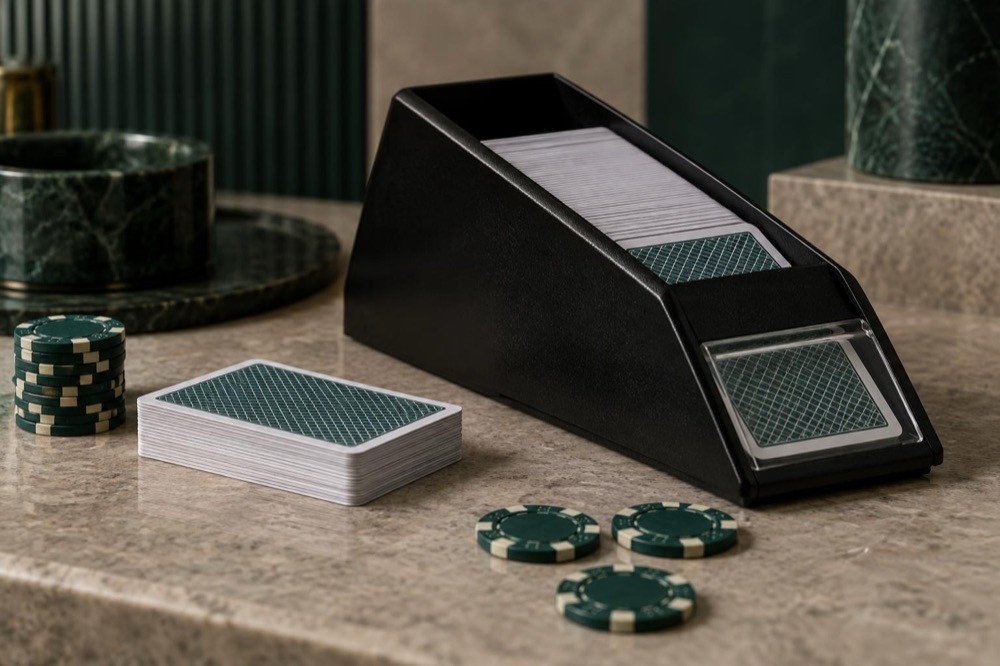
- Six to eight decks is the standard for American-style and live dealer games. American Blackjack is played with six to eight decks8, and one live dealer version uses eight decks9.
- Two decks is typical of European Blackjack10.
- Single deck games exist but are rare, and often come with other rules that claw the advantage back.
- Regulators sometimes fix the range: Japan's casino rules allow blackjack with 4 to 8 decks of identical size, back color and design, and Blackjack Switch with 6 to 8 decks11.
Why does the count matter? With fewer decks, each card dealt from the shoe tells you more about what remains, and the odds of drawing the card you need shift slightly. The effect shows up in strategy. In single-deck blackjack, the basic play with 12 against a dealer 4 is to stand, but if the 12 is composed of a 10 and a 2, the odds favor hitting instead, because the two cards already out of the deck change the math12. In a six- or eight-deck shoe, that composition effect is too small to act on, and the basic chart treats all 12s the same.
Deck count also changes the correct play in small ways. The standard four-to-eight-deck chart says to double hard 10 except against a dealer 10 or ace, and to split 7s against a dealer 2 through 713. Single-deck games have their own composition-dependent charts, with plays such as standing on a five-card 16 against a dealer 914. If you memorize one chart, the four-to-eight-deck version is the one you will use most often.
Soft 17: does the dealer hit or stand
A soft 17 is a hand of 17 that counts an ace as 11, such as an ace plus a 6. It is soft because you cannot bust by drawing: if the next card pushes you past 21, the ace simply counts as 1 instead.
The dealer has no choices, so this rule is printed on the table. Some tables have the dealer stand on all 17s; others have the dealer hit soft 17. A dealer who stands on soft 17 is slightly better for the player1. When the dealer hits soft 17, the table improves the dealer's average hand just enough to cost you over a session.
The rule also changes your own strategy chart. The standard four-to-eight-deck strategy assumes the dealer stands on soft 17, and it tells you to always hit your own soft 17 or less13. When the dealer hits soft 17, the chart shifts: you surrender 15, a pair of 8s, and 17 against a dealer ace, and you double soft 18 against a dealer 213. Mixing the two up is expensive. The cost in errors from playing a stand-on-soft-17 game with the hit-on-17 strategy is 2.3 times higher than the reverse, so if you play both kinds of tables, memorize the stand-on-soft-17 chart and adjust13.
Live dealer studios pick their own setting: one Playtech Blackjack Switch table hits soft 17, while a Concept Gaming European table stands on it13. Super Fun 21's dealer usually hits a soft 1715, and Spanish 21 tables may go either way16. Japan's rules let the operator choose: the dealer draws to 16 or less and stands on 17 or more, with an option to treat a soft 17 as a draw11. Always check the placard before you sit down.
3:2 vs 6:5: what the blackjack payout costs you
A blackjack, also called a natural, is an ace plus a 10-value card as your first two cards17. It traditionally pays 3:2 rather than 1:118. On a $10 bet, that is a $15 win.
Some tables pay 6:5 on blackjack instead1. That same $10 bet wins only $12, which meaningfully raises the house edge over a session1. The difference sounds small, but a natural comes up roughly once in 21 hands, so the shortfall compounds steadily. A 3:2 table is simply better than a 6:5 table, and there is no rule elsewhere in the game that makes up the gap2.
You can spot the rule before you sit down. Standard blackjack tables carry the layout inscription "Blackjack pays 3 to 2"19. If the felt says "Blackjack pays 6 to 5," you know what you are getting. Regulators treat the two as distinct products: New Jersey's rules for the 6 to 5 blackjack variation require all wagers in increments of $5.00 and cap the table at no more than six betting areas19. Japan's rules allow an operator to pay blackjack at 6 to 5 odds instead, in which case even money does not apply11.
The rest of the payout structure is standard almost everywhere: any other winning hand pays 1:1, insurance pays 2 to 1, and tied hands push20. Some variants keep the 3:2 natural as their headline: Zappit pays 3 to 2 for a blackjack as your initial hand6.
Peek, hole card and dealer natural rules
There are two ways casinos handle the dealer's second card, and it changes when you find out bad news.
The American style: hole card with peek. The dealer receives two cards, one face up and one face down, and checks for blackjack before players act if the upcard is an ace or a 10-value card8. If the dealer has a ten or an ace up, she checks whether the face-down card makes 21; if it does, the round is over and all players automatically lose, unless one of them also has blackjack, in which case they keep their original bet4. Partypoker's version works the same way: the dealer checks for blackjack before the player draws a third card21. This peek protects you from doubling or splitting into a dealer natural and losing the extra bets.
The European style: no hole card. The dealer's card is dealt face up and the second card is dealt only when all players have completed their hands22. If the dealer then gets a natural blackjack, the wagers of all players who do not have a natural are immediately collected22. The catch is that bets you have already doubled or split can be swept away by a dealer natural, which is why some no-hole-card games soften the rule: at Hoiana, if the dealer has blackjack, the player loses only the original bet23.
When both sides have a natural, it is a push. When a player has blackjack, the player is paid 3 to 2 and cannot lose; if the dealer also has one, it is a tie24. Insurance, offered when the dealer's up card is an ace, is a side bet that the dealer's hole card is valued at 10, treated independently of the main wager and paying 2:16. We cover it in more detail in blackjack insurance and even money.
Surrender: when you can fold half your bet
Surrender lets you give up a hopeless hand for half its cost. You forfeit half the bet and end your turn25. In its late form, it is allowed after the dealer has checked for blackjack: half of the bet is forfeited at that point21. At Hustler Casino, a player may surrender half of the original wager on the first two cards only26.
The most common restriction is the dealer's upcard. In Macau's statutory rules, if the dealer's face-up card is not an ace, a player may surrender and lose half the stake; the decision must be made before the dealer draws and cannot be changed27. The same condition appears in the alternate Macau rules and at Hoiana: if the dealer's card is not an ace, players may surrender and recover half their bet23. The logic is that against an ace you may be facing a natural, in which case half back would be too generous.
Not every table offers it. European Blackjack has no surrender option10. Spanish 21 does: you can surrender after the first two cards and get half your original bet back28. Paradise Casino's Korean-language manual lists surrender alongside hit and stay as a standard player option24.
When surrender is available, it has a place in basic strategy: surrender hard 16 (but not a pair of 8s) against a dealer 9, 10 or ace, and hard 15 against a dealer 1013. In games where the dealer hits soft 17, the list grows to include 15, a pair of 8s, and 17 against a dealer ace13. One quirk worth knowing from Macau's rules: surrendering also loses all streak bets you have on that hand27.
Splitting and doubling: limits on aces and extra bets
Splitting and doubling are where tables differ the most, because these are the rules that let you get more money out when you have the advantage.
Splitting. If you are dealt two cards of the same value, you may split them into two hands, and you must make another bet equal to the original22. The dealer gives the first hand a second card, which you may hit, stand or double, before moving to the second hand5. The signal is a splitting gesture with your index and ring finger5.
The limits vary:
- At Hoiana, players may split up to three times to form up to four hands23.
- American Blackjack lets players split up to three times, including resplitting aces8.
- Paradise City in Korea allows two splits for three hands total29.
- European Blackjack limits splitting to once per round8.
- Macau's rules let a player with a pair split into four or more equal bets, with aces split once or more receiving one card each, and non-ace pairs re-split once30.
Aces are special. When splitting aces, each ace gets only one card, and a ten plus ace after splitting counts as 21 points, not a blackjack, so it does not get the 3:2 payout4. Super Fun 21 is the exception: there you may hit and double down on split aces15.
Doubling down. You can only double down after your first two cards and before drawing another card: you double the initial bet in return for one, and only one, draw card5. At NUSTAR in Cebu, you double your initial bet, take one more card, and must stand regardless of its value22. Macau's rules allow doubling on the first two cards, on the first two cards after splitting any pair except split aces, or when the first two cards total 1132. Hoiana lets you add a bet equal to or lower than the original23.
Side bets and their payouts
Side bets are optional wagers alongside the main game, and they are where tables advertise their biggest payouts. Some casinos, both offline and online, offer side bets where you can win additional money based on the available multipliers18.
The main ones:
- Insurance. Offered when the dealer's up card is an ace, it is a side bet that the dealer has blackjack, treated independently of the main wager and paying 2:1, two dollars for every dollar bet6. You can stake up to half your original wager29.
- 21+3. Your first two cards plus the dealer's upcard form a poker hand. Each winning combination, a flush, straight, three of a kind or straight flush, is paid nine times the stake under Monaco's rules33. One live dealer table offers 21+3 alongside Crazy 7s34.
- Pair bets. Macau's rules let players bet on "any pair" in one or more boxes in addition to the original and insurance bets32. At Paradise City, a pair bet pays 11 times when your initial two cards are a pair29.
- Blazing 7s. A progressive side bet that pays out depending on how many 7s are in your hand and the dealer's hand6. One catch: splitting your hand may make you unable to win the progressive side bet in some casinos6.
- Streak bets. A New Jersey-approved layout pays 3 to 1 for two consecutive wins, 7 to 1 for three, 17 to 1 for four and 37 to 1 for five19.
- Special bonuses. Macau's rules pay three times the bet for a suited 6, 7 and 8 or three 7s, even if the dealer's face card is an ace30.
Side bets generally carry a much higher house edge than the main game, which is how the big multipliers are funded. We break down the individual bets and their odds in blackjack side bets.
House edge and RTP under different rule sets
This is where all the variations add up. Blackjack's house edge runs about 1 to 3 percent depending on the rules, drops to about 1 percent with basic strategy, and card counting can lower it a further 1 to 2 percent35. A well-run standard game sits lower still: standard blackjack's house edge is roughly 0.4 percent6, and with correct basic strategy it is under 1 percent, with RTP of 99 to 99.5 percent2. Play randomly instead of by the chart and RTP falls to 95 to 97 percent2.
Each rule moves the needle in a known direction:
- Fewer decks help you; single and double-deck games have a lower starting edge than eight-deck shoes.
- Dealer stands on soft 17 is slightly better for you than dealer hits1.
- 3:2 beats 6:5 by a wide margin; the 6:5 payout meaningfully raises the house edge over a session1.
- Surrender and liberal splitting and doubling rules shave the edge down; European Blackjack has no surrender and tighter splitting limits, yet its house edge is often slightly lower than American10.
- Side bets carry their own, much higher edge.
Variant games trade rules in both directions. European Blackjack often has a slightly lower house edge than American10, while novelty games vary their rules and pay tables by casino36. Spanish 21 removes the 10s from its six or eight Spanish decks but pays bonuses for 21s; some casinos allow redoubling up to three times16. Super Fun 21 lets you hit and double split aces but has the dealer usually hit soft 1715.
Knowing the dealer's bust rate helps you see why the upcard drives every decision.
| Dealer upcard | Bust rate |
|---|---|
| 2 | about 35.3 percent |
| 3 | about 37.6 percent |
| 4 | about 40.3 percent |
| 5 | about 42.9 percent |
| 6 | about 42.1 percent |
| 10 | about 21.2 percent31 |
That is why the chart tells you to stand on stiff hands against small cards and hit against big ones, and it is the foundation of the blackjack basic strategy chart.
The practical takeaway: before you sit down, read three things off the table. The payout on a natural (3:2 or 6:5), the soft 17 rule (stands on all 17s is better), and the number of decks. Those three lines tell you more about your expected results than anything else on the felt.
Common Questions
How many decks are used in standard casino blackjack?
It ranges from one to eight. Live dealer and American-style tables usually use six to eight decks, European blackjack often uses two, and single-deck games exist but are rarer. Fewer decks are slightly better for the player.
What is a soft 17?
A soft 17 is a hand totaling 17 that uses an ace counted as 11, such as an ace plus a 6. It is called soft because drawing another card cannot bust you; the ace simply drops to a value of 1 if needed.
Is 6:5 blackjack worse than 3:2?
Yes, noticeably. A $10 bet wins $15 on a natural at a 3:2 table but only $12 at 6:5. That difference meaningfully raises the house edge over a session, so a 3:2 table is always the better choice.
What does surrender mean in blackjack?
Surrender lets you fold a bad hand after the first two cards, give up half your bet and end your turn. It is usually only offered when the dealer's face-up card is not an ace, and the decision cannot be reversed.
Can you split aces more than once?
It depends on the table. Many games let you split aces only once, with one extra card dealt to each ace. Some American-style games allow resplitting aces, while European blackjack usually limits all splitting to once per round.
What are the odds of the dealer busting with a 5 upcard?
Around 42.9 percent, one of the highest bust rates of any upcard. A 6 is similar at about 42.1 percent, while a 10 upcard busts only about 21.2 percent of the time.
What happens if the dealer has blackjack and I do too?
It is a push. You keep your original bet rather than winning it. At tables where the dealer checks for blackjack before players act, the round ends immediately and everyone else loses their bets.
Sources36 sources
- How to Play Blackjack, Shuffle, August 20, 2026
- Casino Tra Thương Như Thế Nào, Casino Corona, September 11, 2026
- How to Play Blackjack, GameSense, 2020
- How to Play Blackjack, PlaySmart, September 25, 2026
- How to Play Blackjack Details, PlaySmart, September 25, 2026
- How to Play Blackjack Details, PlaySmart, September 25, 2026
- Table Games, PlaySmart, September 26, 2026
- How to Play Blackjack, Las Atlantis, September 26, 2026
- Live Blackjack, CoinPoker, June 16, 2026
- Blackjack, Stake, September 26, 2026
- Casino Regulatory Law, e-Gov Japan, 2021
- Composition Dependent Strategy, Wizard of Odds, August 3, 2026
- 4-Deck to 8-Deck Blackjack Basic Strategy, Wizard of Odds, August 3, 2026
- Composition Dependent Strategy for Single Deck, Wizard of Odds, August 3, 2026
- Super Fun 21, Wizard of Odds, August 3, 2026
- Spanish 21, Wizard of Odds, August 3, 2026
- Blackjack, Newport World Resorts, 2026
- Blackjack, Natural8, September 26, 2026
- Chapter 69E Regulations, New Jersey Division of Gaming Enforcement, 2016
- Blackjack Rules, FB88, September 26, 2026
- How to Play Blackjack, partypoker, September 26, 2026
- Blackjack, NUSTAR Resort Cebu, June 25, 2026
- Blackjack, Hoiana, 2026
- BlackJack Game Manual, Paradise Casino, September 26, 2026
- Blackjack, Natural8, September 26, 2026
- Hustler Casino Blackjack Rules, California Department of Justice, 2021
- Statutory Rules for Black Jack, Macau Official Gazette, March 30, 2009
- Spanish 21, PlaySmart, September 25, 2026
- Casino Game Guide, Paradise City, September 26, 2026
- Black Jack or Twenty-One Rules, DICJ Macau, May 12, 2004
- Blackjack Odds, CoinPoker, September 17, 2025
- Black Jack Alternate Rules, DICJ Macau, February 26, 2007
- Arrêté Ministériel, Monaco Legismonte, July 26, 1988
- Ethereum Blackjack, CoinPoker, August 23, 2026
- 控除率, Wikipedia, 2026
- Mississippi Stud, PlaySmart, September 25, 2026