What basic strategy actually is
Blackjack is a decision game. You are dealt two cards, the dealer shows one card face up, and you choose whether to hit, stand, double down, split or surrender. Unlike most table games, where you place a bet and watch, here your choices change your odds of winning4. Basic strategy is the complete set of those choices, worked out mathematically so that every hand is played the way that gives you the best expected result.
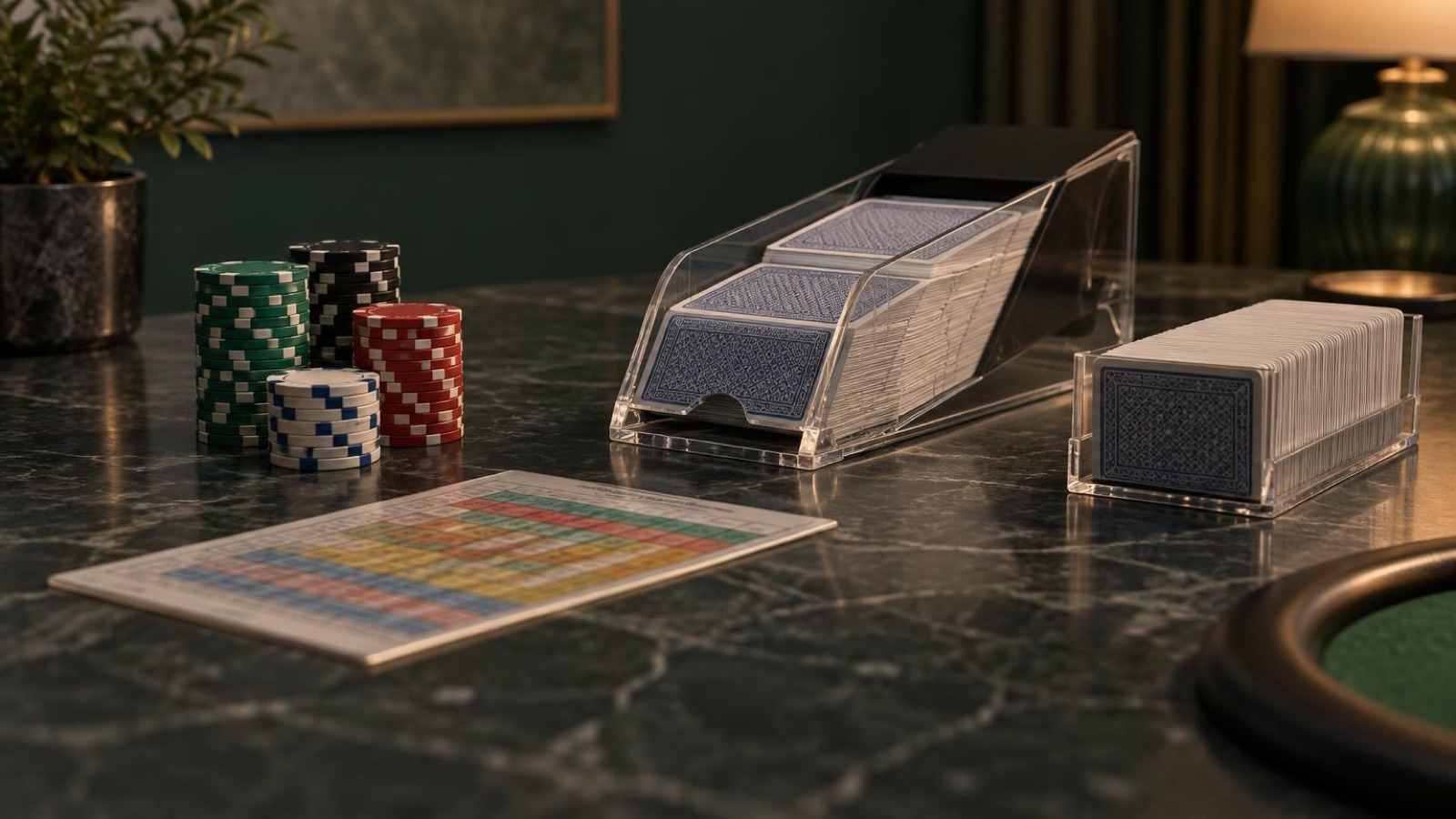
The chart itself is a grid. Down one side are the hands you can hold, split into three groups: hard totals (no ace, or an ace that must count as 1), soft totals (an ace counting as 11) and pairs. Across the top are the dealer's possible upcards, from 2 through ace. You find your hand, follow the row to the dealer's column, and the cell tells you the play1.
A few examples of what the chart says:
- Always stand on hard 17 or more1
- Never take insurance or "even money"1
- Split 2s and 3s against a dealer 4 through 7, and against a 2 or 3 if doubling after splitting is allowed1
- Double soft 15 or 16 against a dealer 4 through 61
- Surrender hard 16 (but not a pair of 8s) against a dealer 9, 10 or ace, and hard 15 against a dealer 10, where surrender is offered1
Two things basic strategy is not. It is not a betting system; it tells you how to play your cards, never how much to wager. And it is not a way to beat the game; even played perfectly, the house keeps a small edge. What it does is shrink that edge to the minimum the rules allow, which is why it is the baseline every serious player starts from2.
Where the chart comes from: the math behind it
The chart was not invented by trial and error. Every cell is the answer to a calculation: for each combination of your hand and the dealer's upcard, analysts computed the expected return of every legal play (hit, stand, double, split, surrender) and picked the best one. Because the dealer's behavior is fixed by rule, typically drawing to 16 and standing on 175, the only unknown is which cards come next, and the math can account for that using the full distribution of the remaining deck.
The result is that basic strategy is not a set of hunches or customs. Standing on 16 against a dealer 6 is on the chart because the numbers say it loses less money over thousands of hands than hitting does. The same analysis produces the payout structure you see at the table: a natural blackjack, an ace plus a 10-value card on the first two cards, pays 3 to 2, or 1.5 times your bet6, while an ordinary winning hand pays even money7.
The standard chart is calculated for a game with four to eight decks, where the dealer stands on all 17s, you may double on any two cards, and doubling after splitting is allowed. If your table differs, a small number of cells change, and the chart's author recommends memorizing the stands-on-soft-17 version if you mix games with both rules1. The cost of using the wrong one is real but modest: playing the hit-soft-17 strategy at a stand-on-soft-17 table produces 2.3 times more error cost than the reverse mistake1.
The dealer's upcard: why it drives every decision
Every round, the dealer gives each player two cards face up and takes two herself, one face up and one face down8. That single face-up card is the most important piece of information on the table, because the dealer has no choices. She must draw until she reaches 17 or more9. Her upcard therefore tells you, with fair precision, how likely she is to bust.
The pattern splits cleanly in the middle. Weak upcards (2 through 6) put the dealer in trouble; strong upcards (7 through ace) mean she usually makes a finishing hand. The bust rates make the point2:
| Dealer upcard | Chance dealer busts |
|---|---|
| 2 | ~35.3% |
| 4 | ~40.3% |
| 6 | ~42.1% |
| 10 | ~21.2% |
This is why the chart tells you to stand on stiff hands like 12 through 16 when the dealer shows 2 through 6. You are not standing because your hand is good; you are standing because the dealer is likely to break, and any card you draw to a 12 through 16 risks busting first. Against a dealer 7 through ace, the same hands should usually be hit, because the dealer is likely to finish on 17 or better and your weak total will simply lose1.
The upcard also drives the special situations. If the dealer shows an ace, insurance is offered before play continues4. If she shows a 10-value card or an ace, she checks her hole card for blackjack; if she has one, the round ends immediately and everyone loses unless they also hold a blackjack, in which case they keep their original bet8. Knowing that, the chart's aggressive doubling against weak upcards and its caution against strong ones follows directly from the numbers.
Basic strategy versus exact-card strategy
The standard chart treats your hand as a total. A hard 16 against a dealer 10 is played the same way whether your 16 is a king and a 6 or a 10, 4 and 2. That simplification costs almost nothing in multi-deck games, but analysts have gone further and computed strategy based on the exact cards in your hand, called composition-dependent strategy6.
The differences are small and mostly appear in single-deck games. A classic example: in single-deck blackjack the basic strategy chart calls for standing with 12 against a dealer 4, but when the 12 is made of a 10 and a 2 the odds shift and the chart's composition-dependent version switches to hitting7. Similarly, with multi-card hands the exact composition can change the call; a six-card 16 made of small cards is played as a stand against a dealer 8, where a two-card 16 would be hit or surrendered6.
For practical purposes the distinction matters little at the tables you will actually play. In games with four or more decks, composition-dependent play changes the house edge by only a tiny fraction, and for two-card hands the basic strategy changes are none at all6. Unless you are playing single deck, the standard chart is all you need.
House edge with basic strategy: about 0.5%
The headline number: played correctly at a standard table paying 3 to 2 on blackjacks, basic strategy brings the house edge down to about 0.5%, and the player wins about 42% of hands2. Some rule sets and game versions go lower still; published figures for specific live and software blackjack games range from 0.01% to 0.57%1, with several live tables and app versions quoting approximately 0.50%11.
The number moves with the rules. The biggest single factor is the blackjack payout: at a table paying only 6 to 5 on a natural instead of 3 to 2, the house edge jumps from about 0.5% to 2% even when you follow the chart perfectly2. A Vietnamese casino guide puts the same point in return terms: basic strategy yields a return to player of 99% to 99.5%, while random play drops it to 95% to 97%12.
What happens without the chart is worse. Ignoring basic strategy can push the house edge to 4%2, and live dealer guides put suboptimal play at 2% or higher3. A Japanese-language summary of the game gives the same range: the edge varies from about 1% to 3% depending on rules and play, with basic strategy bringing it to around 1% or below, and card counting able to shave a further 1 to 2%13. For comparison, video poker typically carries an edge above 1%2.
The practical takeaway is that basic strategy is worth roughly the difference between losing half a percent of your action and losing two to four percent of it. Over a long session, that is the difference between a slow bleed and a fast one. No level of skill eliminates the edge entirely14, but nothing else you can do at the table comes close to what the chart does.
What the chart does not cover: rule variations and side bets
Basic strategy assumes a standard game. Real tables vary, and the chart does not tell you how to handle the variations5:
- Payouts. Most tables pay 3 to 2 on a natural blackjack, but some pay 6 to 5, and approved layouts exist that pay only 1 to 115. The payout is printed on the felt; check it before you sit down.
- Dealer soft 17. Whether the dealer hits or stands on soft 17 changes a few chart cells, as covered above.
- Surrender. Where offered, surrender lets you give up a bad two-card hand for half your bet back16. The chart's surrender lines only apply where the option exists.
- Local rules. Macau's official blackjack rules, for example, allow a player holding five cards totaling 21 or less to claim a payout of half the bet when the dealer's upcard is not an ace, a rule no standard chart accounts for17.
Side bets sit outside the chart entirely. Insurance is the classic one: a side bet that the dealer's hole card is worth 10, offered when she shows an ace and settled independently of your main wager4. Others include Match the Dealer, which pays when your first two cards match the dealer's upcard, with rank-and-suit matches paying more than rank-only matches18, and pair bets, such as the one at Paradise City in South Korea that pays 11 times your stake when your first two cards are a pair19. Some games add structural twists, like Super Fun 21 where a player blackjack always wins20, or no-side-bet variants such as Neon Blackjack, which uses a basic set of blackjack rules with no side bets in play21. None of these are covered by basic strategy, and several have their own strategy considerations. We cover these separately on blackjack rule variations, blackjack insurance and blackjack side bets.
Card counting and why it is not basic strategy
Basic strategy and card counting are often confused. They are different things. Basic strategy is a fixed set of plays that does not change as cards leave the shoe; it is optimal for a fresh deck and near-optimal throughout. Card counting tracks which cards have already been dealt to estimate whether the remaining shoe favors the player, and then changes bet sizes and sometimes plays accordingly. It is the reason the house edge can be pushed a further 1 to 2% below the basic strategy figure13.
Counting is hard to apply in practice. At live dealer online tables you can attempt it just as in a physical casino, but operators shuffle more frequently and use multiple decks specifically to blunt it22. Some online terms prohibit it outright, with account suspension and withholding of funds as consequences21. And composition-dependent strategy, which looks at exact cards, is explicitly not counting: it uses no running numbers, just the cards in front of you6.
For a player learning the game, the order of operations is clear: basic strategy first, always. Counting is a separate skill with separate conditions, and at most Asian tables it is impractical. We cover it in detail on card counting in blackjack.
Using the chart at live tables in Asia
Almost every blackjack table you will encounter in Asia, live dealer or casino floor, uses the rules the standard chart was built for. Live dealer games typically run six to eight decks with the dealer standing on soft 17 and blackjacks paying 3 to 23. Deltin's tables in India use six pre-shuffled decks with seven boxes per table23. Hoiana in Vietnam has the dealer draw to 16 and stand on 1724, as do High1 in Korea25, Paradise Casino in Korea26, NUSTAR in Cebu27 and Newport World Resorts in Manila28. FB88's live tables use eight decks, pay 3 to 2 on blackjack and 2 to 1 on insurance, and push tied hands29.
A few practical points for using the chart in person:
- Memorize before you go. A printed chart at a physical table is generally not welcome. Online RNG games are different: some, like certain virtual American blackjack tables, even build a strategy chart into the interface30, and you can consult one freely while playing at your own pace.
- Learn the hand signals. At a physical table you do not say "hit"; you tap your finger on the felt behind your cards. To stand, wave your hand horizontally. To double, place a chip next to your original bet4. We cover the full set on casino table etiquette.
- Check the payout before sitting. The 3 to 2 versus 6 to 5 difference matters more than any single chart decision2.
- Watch for local quirks. Macau's five-card half-payout rule17 and its allowance for up to three players to bet on one spot, with the seated player making the decisions17, are the kind of details a generic chart will not mention.
- Live dealer play moves fast. Natural8's live blackjack runs on a standard table seating up to seven players with the cutting card placed four decks from the back of the shoe31, and GGPoker's live casino uses the same table specification32. If you are still learning the chart, an RNG table at your own speed is the easier place to practice; Japanese players, for instance, have access to live blackjack alongside baccarat, roulette, Dragon Tiger and Sic Bo at offshore live casinos33.
Common mistakes players make
The chart is simple to read but easy to deviate from. The most common errors, and what they cost:
- Taking insurance. The chart says never, at any table covered by the standard strategy1. Insurance is a separate bet on the dealer's hole card4, and the math does not favor it.
- Playing the wrong soft-17 chart. Using the hit-soft-17 strategy at a stands-on-soft-17 table costs 2.3 times more in errors than the reverse mistake1. Check the felt or the game rules before you play.
- Standing on 12 through 16 against a strong upcard. Fear of busting makes players stand on stiff hands against a dealer 7 through ace, when the chart says to hit because the dealer is unlikely to break2.
- Splitting tens or fives. The chart has no split row for these; you play them as hard totals of 20 and 101. Two 20s look tempting, but 20 is already a hand that wins about 92% of the time8.
- Misplaying a bust. In most rule sets, if you bust you lose immediately, even if the dealer later busts too17. This is why the chart is so conservative with hard hands above 12.
- Ignoring the payout. Sitting at a 6 to 5 table and playing the chart perfectly still leaves you a 2% edge to overcome2. No amount of correct play fixes a bad payout.
- Chasing losses with bigger bets. The chart covers cards, not stakes. Raising bets after losses does not change the house edge on the next hand; it only changes how much of it you pay.
None of these mistakes is dramatic on its own. Each just quietly raises the price of the game. Played correctly, blackjack with basic strategy remains one of the lowest-edge offerings in the casino14, and the chart is the single tool that gets you there. For how it stacks up against the other big decision game in Asian casinos, see baccarat vs blackjack.
Common Questions
Does basic strategy work with six or eight decks?
Yes. The standard chart is written for games using four to eight decks, which covers almost every casino and live dealer table you will find. One chart covers all of them, with a few small changes depending on whether the dealer hits or stands on soft 17.
What is the difference between a hard and a soft hand?
A soft hand contains an ace counted as 11, so it cannot bust with one more card. A hard hand has no ace, or an ace that must count as 1. Soft hands are played more aggressively because you can safely draw to improve them.
Why should you stand on 12-16 when the dealer shows 2-6?
Because the dealer must keep drawing until reaching 17, and weak upcards like 4, 5 and 6 make the dealer bust roughly 40% of the time. Standing lets the dealer break instead of risking your own stiff hand.
Is basic strategy the same at every casino?
The core chart is the same, but a few plays change with the rules. Whether the dealer hits or stands on soft 17, whether you can double after splitting, and whether surrender is offered all shift a handful of decisions.
Can you use a strategy chart at the table?
At online tables, yes. Many RNG blackjack games even build a chart into the interface. At a live casino floor table, printed charts are usually not welcome, so most players memorize the chart or check it between hands on their phone.
Does basic strategy guarantee you will win?
No. It is the mathematically best play for each hand, but blackjack still carries a house edge of about 0.5% even with perfect play. Basic strategy minimizes your losses over the long run; it does not turn the game in your favor.
Sources33 sources
- 4-Deck to 8-Deck Blackjack Basic Strategy, Wizard of Odds, 2026
- Blackjack odds, CoinPoker, 2025
- Live Casino Blackjack, Panas777, 2026
- How to play blackjack, PlaySmart, 2026
- How to play blackjack, GameSense, 2020
- Composition-dependent strategy for single deck, Wizard of Odds, 2026
- Composition dependent strategy example, Wizard of Odds, 2026
- How to play blackjack, Las Atlantis, 2026
- How to play blackjack, PlaySmart, 2026
- Stake Blackjack, Stake, 2026
- Mobile blackjack, CoinPoker, 2026
- Casino tra thưởng như thế nào?, Casino Corona, 2026
- 控除率, Wikipedia, 2026
- How to play blackjack, Shuffle, 2026
- Chapter 69E regulations, New Jersey Division of Gaming Enforcement, 2016
- Hustler Casino Blackjack rules, California Department of Justice, 2021
- Black Jack ou 21 rules, DICJ Macau, 2004
- Spanish 21, Wizard of Odds, 2026
- Casino game guide, Paradise City, 2026
- Super Fun 21, Wizard of Odds, 2026
- Terms and conditions, Rainbet, 2026
- Blackjack, Natural8, 2026
- Blackjack, Deltin, 2026
- Table games: blackjack, Hoiana, 2026
- Casino contents, High1, 2026
- Game manual, Paradise Casino, 2026
- Table games: blackjack, NUSTAR Resort Cebu, 2026
- Black jack, Newport World Resorts, 2026
- Live rules, FB88, 2026
- Dogecoin blackjack, CoinPoker, 2026
- House rules, Natural8, 2026
- House rules, GGPoker, 2026
- Best online casinos for players from Japan, Wizard of Odds, 2026