
What card counting is
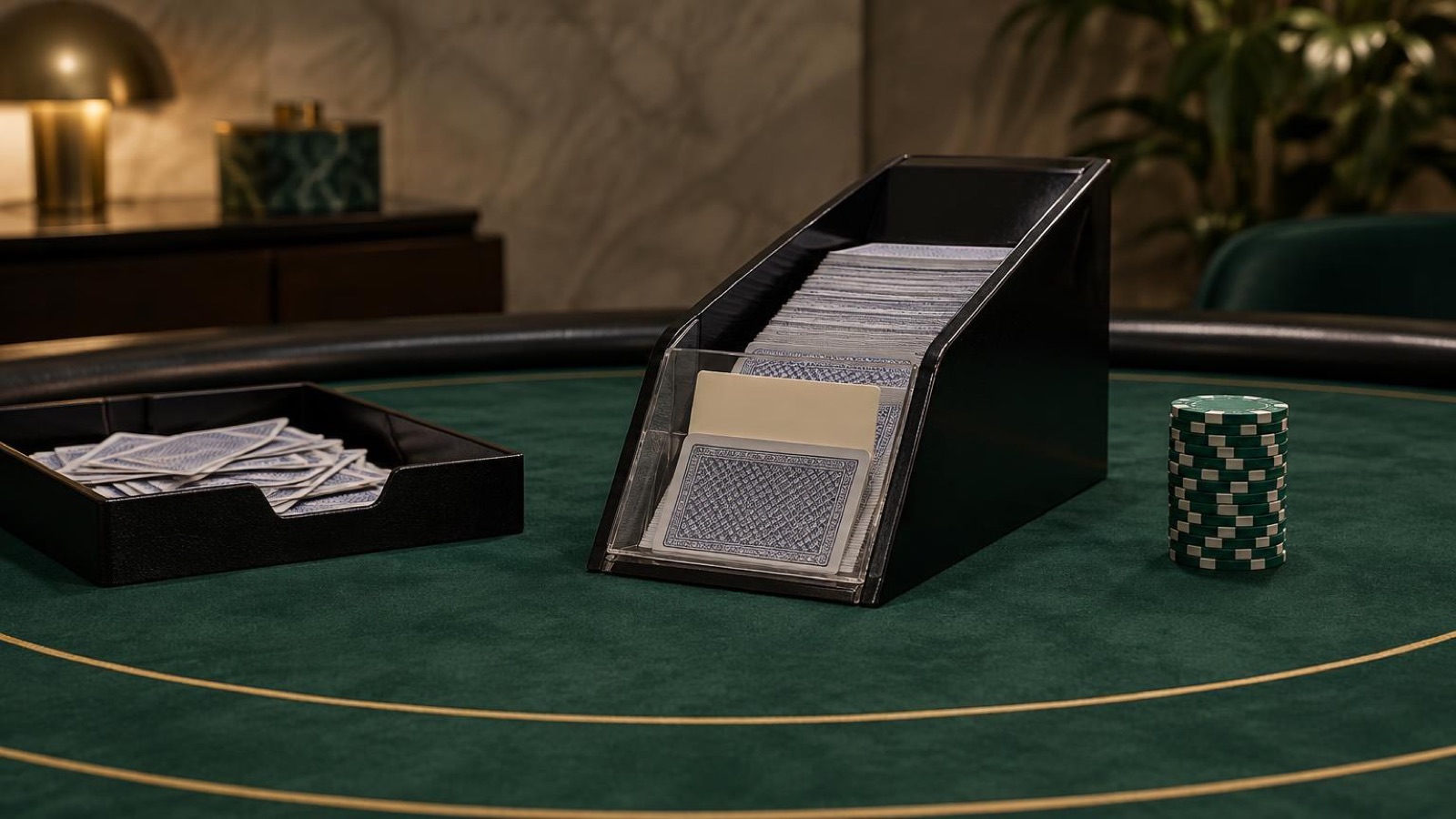
Card counting is nothing more mysterious than paying attention. In blackjack, the cards are dealt from a shoe and, round by round, they leave that shoe and do not come back until it is reshuffled. A counter watches the cards that have already appeared and uses that information to judge whether the cards still to come favor the player or the dealer.
The reason this matters is the structure of the game itself. Blackjack pays a premium, traditionally 3 to 2, on a natural: an ace plus a ten-value card in your first two cards3. Tens, jacks, queens and kings all count as 10, and an ace counts as 1 or 11 at your choice8. When the remaining shoe is rich in tens and aces, naturals are more likely for everyone, and the player benefits more than the house does, because the player's premium payout is bigger than the dealer's. A ten-heavy shoe also makes the dealer more likely to bust, since the dealer must keep drawing to 172.
It is worth being clear about what counting is not. It is not a way to know the next card. It is not a system of secret signals or hidden devices. Even detailed strategy work that looks card-by-card, such as composition-dependent play, is explicitly not counting: it is based on the exact cards you can see, with no running numbers involved9. Counting is simply arithmetic done in your head on public information.
Blackjack is unusual among table games in that skill genuinely changes your odds, which is why it attracts counters at all10. Compare baccarat, where the same idea has been studied and the conclusion is bleak: even a perfect count of the shoe shifts the best bet only at extreme counts, and the gain is tiny11. Blackjack is the one mainstream game where the deck's composition moves enough to be worth tracking.
How counting works in practice
The classic method is called a running count. You assign a value to every card as it appears: low cards (2 through 6) are +1, high cards (tens, faces and aces) are -1, and middle cards (7, 8, 9) are 0. You add these up as the cards come out. A count that climbs means low cards have gone and the shoe is getting rich in high cards, which is good for players. A count that falls means the opposite.
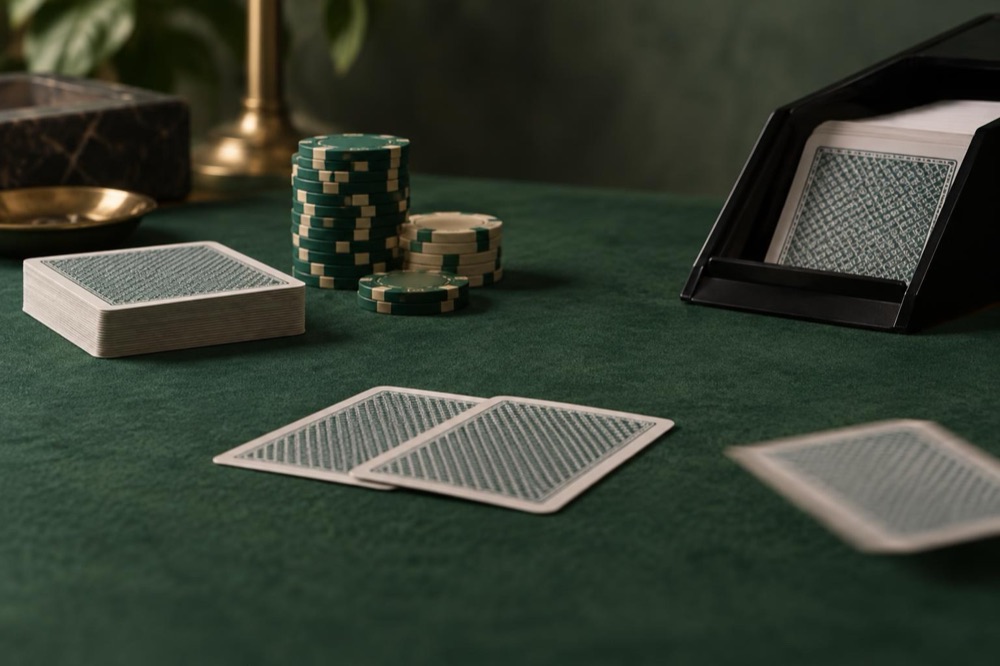
Because the dealer deals your cards face up and her own first card face up too12, everything you need to count is visible on the table. You watch the other players' hands as well, since their cards also leave the shoe.
Two practical details of shoe procedure matter to a counter:
- The cut card. After shuffling, a colored card is inserted into the shoe, and when it appears, the shoe is finished and the cards are reshuffled. In baccarat the equivalent white card is inserted at least about 12 cards from the end13, and in Three Card Baccarat a second white card goes between 30 and 40 cards from the end14. In live blackjack the cutting card is typically placed 4 decks from the back of an 8-deck shoe15. The deeper the cut card, the more rounds you can play into a favorable shoe.
- The burn. At the start of a new shoe, cards are burned before play begins. In baccarat the dealer turns one card and burns that many, with a 10 or face card meaning 10 burned16. Burned cards are counted as if seen only if you can see them.
With a running count in hand, the counter converts it to a "true count" by dividing by the estimated number of decks still in the shoe, then raises the bet when the true count is high and bets the table minimum when it is low. That bet spread is where the money is made: the edge from counting comes not from winning more hands, but from having more money out when the shoe is favorable.
Card counting is not illegal, but casinos can refuse you
Counting cards in your head is not cheating and it is not a crime. You are using only information the game freely shows you. No Asian jurisdiction treats it as an offense, and there is no law anywhere in the region that makes mental arithmetic at a blackjack table illegal.
What counters face instead is the casino's right, as a private business, to decide who plays. A casino can:
- refuse your bets at a table while accepting everyone else's,
- ask you to leave the property,
- bar you from its blackjack tables on future visits.
That is the practical risk in a sentence: you will not be arrested, but you can be shown the door and told not to come back. Some venues are blunt about their discretion. Hustler Casino in California, for example, takes its collection before cards are dealt and sets the terms of play at its own tables7. In Monaco, the game's rules are fixed by ministerial order, down to the dealer's obligation to stand on 17 or more17, but who may sit at the table remains the house's call everywhere.
So the honest framing is: legal, but unwelcome. Casinos invest in spotting counters, and the usual response is a quiet word, a lowered table limit, or early shuffling, not a police call.
Why multiple decks and frequent shuffling defeat counters
Counting depends on one thing: cards leaving the shoe and staying out. Everything a casino does to dilute that hurts the counter.
More decks. Blackjack runs on anywhere from one to eight decks1. A single deck is stripped of its good cards quickly, so the composition swings hard and a counter sees big advantages. An eight-deck shoe barely moves: the same six favorable cards that would transform a single deck are a rounding error among 416 cards. American Blackjack is typically dealt from six to eight decks18, and Deltin's blackjack tables use a shoe of six pre-shuffled decks2.
Frequent shuffles. Every shuffle resets the count to zero and wipes out whatever edge had built up. Casinos can call for a shuffle between rounds, or use a shuffling machine that continuously mixes the cards, so that no card ever really "leaves" the shoe. Against a continuous shuffling machine there is simply nothing to count, because the shoe's composition never drifts.
Shallow penetration. Even without extra shuffling, the cut card controls how deep into the shoe you play. If the cut card sits close to the front, the shoe ends before the count can go far. Live blackjack rules that place the cutting card 4 decks from the back of the shoe15 leave most of the shoe in play, but a casino that cuts thinner removes the counter's best rounds.
The net effect is that the theoretical edge of counting survives, but the number of rounds where it pays shrinks. A counter facing eight decks, a thin cut and a mid-shoe shuffle is working very hard for a very small return.
Counting is impossible against RNG games, possible against live dealer tables
Online blackjack comes in two forms, and they could not be more different for a counter.
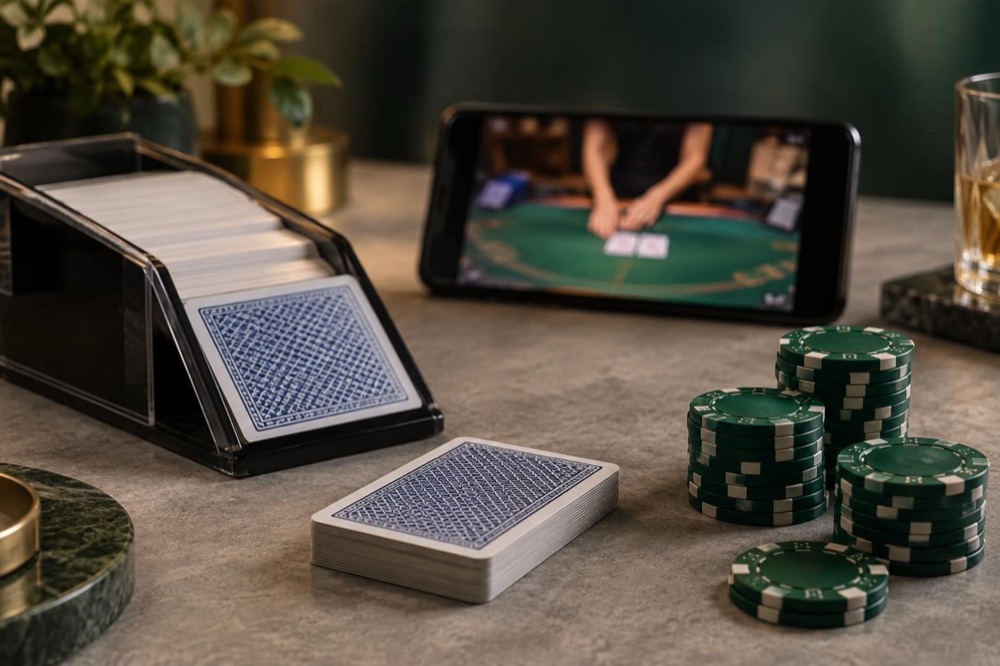
RNG (random number generator) games are software: the "shoe" is a mathematical draw, and the deck is reshuffled for every single hand. There is no memory between hands, so no count can build. It does not matter how good you are; against an RNG blackjack table, counting is impossible by design. These games, such as Stake's in-house blackjack with its stated 0.57 percent house edge6, are pure basic-strategy territory.
Live dealer tables stream a real dealer, a real table and a real shoe from a studio. Here the cards physically leave the shoe, so counting is possible in principle. PAGCOR's license register, for example, lists approved live blackjack titles such as Playtech's Live Unlimited Blackjack and standard Blackjack tables19. Some live variants use fewer decks than land-based casinos: one Concept Gaming single-hand live table is listed with 3 decks20, though it appears at only a handful of casinos.
In practice, live tables are still a hard place to count:
- the shoe is usually six or eight decks, as at fb88, which deals blackjack from 8 decks21;
- the cut card placement is fixed by the operator's rules15;
- the studio can shuffle whenever it likes, and many live games shuffle at or near the cut card without playing deep;
- table limits and the speed of play cap how much a favorable shoe can be worth.
So the honest answer to "does counting work online" is: RNG games, never; live dealer tables, technically yes, practically barely.
Basic strategy versus counting: what each is worth
These are two different tools, and it helps to keep them straight.
Basic strategy is the fixed chart of correct plays for every hand versus every dealer upcard. It is free, learnable in an afternoon, and it is what actually moves the house edge for almost everyone. Standard blackjack played with correct decisions carries roughly a 0.4 percent house edge4, and about 1 percent with basic strategy under typical Japanese-language rule summaries, which also note that counting can lower the edge a further 1 to 2 percent5. Using basic strategy reduces the house edge to about 0.5 percent, giving a long-term winning chance of roughly 49.5 percent3. Ignoring it can push the edge to 4 percent3.
Counting is a layer on top of basic strategy. It does not change how you play most hands; it changes how much you bet. Its value is real but narrow: a further 1 to 2 percent off the edge in theory5, realized only when the shoe actually goes favorable and the table lets you spread your bets.
Two refinements sit between the two:
- Composition-dependent strategy. In single-deck blackjack, basic strategy calls for standing with 12 against a dealer's 4, but when the 12 is composed of a 10 and a 2, the odds favor hitting instead. This is exact-card play, not counting22.
- Using the right chart. The cost of errors from playing the wrong strategy is 2.3 times higher when a hit-soft-17 chart is used at a stand-soft-17 table than the reverse, so the chart needs to match the table's rules20. Variant games need their own charts entirely: in Spanish 21, hitting 17 against an ace with three or more cards saves about 2.8 percent of the initial wager compared to standing23.
If you learn one thing, learn basic strategy. Counting without it is worthless; it with basic strategy is the complete package. Our page on blackjack basic strategy covers the chart in detail.
House edge and payouts: what the table rules give you
Whether you count or not, the table's rules set the price of the game. The headline items:
The natural payout. A blackjack, an ace plus a ten-value card in the first two cards, traditionally pays 3 to 2, so a $20 bet wins $303. Some casinos pay 6 to 5, so a $25 bet wins only $30, which meaningfully raises the house edge over a session1. At 6 to 5, the house's long-term take rises from 0.5 percent to 2 percent even with perfect basic strategy3. Variants can go lower still: in Super Fun 21, only a blackjack in diamonds pays 2 to 1, and all other blackjacks pay even money24. Check the felt before you sit.
Dealer rules. The dealer follows fixed rules, typically standing on 17 and drawing on 16 or lower18. At Paradise Casinos in Korea, if the dealer's first two cards total less than 16, the dealer must draw until reaching 17 or greater25. Whether the dealer stands on all 17s or hits soft 17 changes the edge and determines which basic strategy chart fits the table20.
Your options. You can double down, doubling your initial bet for exactly one more card; split pairs into two hands; and at some tables surrender, giving up half your wager to withdraw from a hand25. At NUSTAR in Cebu, doubling means taking one more card and then standing regardless of its value27. Split aces usually get one card each, and a ten plus ace after splitting counts as 21, not a blackjack8.
Insurance. When the dealer shows an ace, you are offered insurance, typically paying 2 to 126. It is a separate bet on whether the dealer has a ten underneath, and it is where a counter's information is most directly usable, since a ten-rich shoe makes insurance genuinely attractive. Our page on blackjack insurance works through the odds.
Pushes and dealer naturals. If the dealer has a natural, everyone loses unless they also have a natural, in which case the bet is returned8. Tied hands push: at Paradise Casinos a player blackjack cannot lose, and a dealer blackjack against it is a push25.
Hand strength. For a sense of the numbers: a hand of 20 wins about 92 percent of the time, 19 about 85 percent, 18 about 77 percent, and 16 only about 60 percent with a 1.5 percent house edge on the hand18.
Where the shoe matters: deck counts at Asian casinos
If you are going to count, or just want the best game, the shoe is the first thing to look at. Across the region:
| Venue or operator | Game | Decks | Notes |
|---|---|---|---|
| Deltin (India) | Blackjack | 6 pre-shuffled decks | Seven boxes per table2 |
| fb88 (live) | Blackjack | 8 decks | Dealer draws to 16, stands on 1721 |
| American Blackjack (typical) | Blackjack | 6 to 8 decks | Dealer checks for blackjack on ace or 10 up18 |
| Concept Gaming (live) | Single-hand blackjack | 3 decks | Rare, few casinos20 |
| Macau casinos | Black Jack (Twenty-One) | Multi-deck shoe | Rules set by dispatch29 |
Macau is a special case worth a note. Blackjack there is governed by official rules published by the regulator: the card values are fixed (ace 1 or 11 at the player's choice, face cards 10, others face value)30, each table has six or more betting boxes as shown on the table sign, and the house may limit how many boxes one player may bet31. The hole-card procedure even allows a player to split a pair up to four times into five hands28. The rules are stable and public, which is good news for anyone comparing tables, but the shoes are multi-deck and the tables are busy, which is bad news for counting.
Elsewhere in Asia, the pattern repeats: Manila's Newport World Resorts and Cebu's NUSTAR deal standard blackjack with the dealer's second card coming only after all players finish26, Korean casino floors run the same core game25, and Japan's legal casino rules define the game's card values in the same way32. The old British regulations even fixed the same values, with the first ace counting 11 unless that would bust33, and Macau's own 2004 dispatch set them identically in Portuguese34. Wherever you play, the game is recognizable; what changes, and what a counter must check, is the deck count, the cut card depth and the natural payout.
For most players the takeaway is simple: the shoe matters less than the payout and the chart. A 3 to 2 table with six decks and basic strategy is a better deal than a 6 to 5 single-deck game, count or no count. If you want to compare the rule variations in one place, see our page on blackjack rule variations, and for how the house edge is built into every bet, see true odds vs casino payouts.
Common Questions
Is card counting cheating?
No. Counting uses only information that is publicly on the table: the cards you can see dealt. You mark no cards, touch nothing you should not, and change no equipment. It is a mental skill, which is why it is not treated as cheating, even though casinos dislike it.
Can you be arrested for counting cards?
No. Counting cards in your head breaks no law, and no jurisdiction in Asia treats it as a criminal offense. The practical risk is different: a casino can refuse your action, ask you to leave, or bar you from its blackjack tables, and that is the end of the matter.
Does card counting work at online casinos?
Not against standard RNG games, which shuffle every hand, so there is nothing to track. Live dealer tables streamed from a studio use a real shoe, so counting is possible in principle, but frequent shuffling, cut cards placed deep in the shoe, and bet limits make it hard to profit.
How many decks do casinos use in blackjack?
Anywhere from one to eight. American Blackjack typically uses six to eight decks, many live dealer studios use six or eight, and a few live tables use as few as three. Macau blackjack rules cover multi-deck shoes, and single-deck games are rare.
What is the payout for a natural blackjack?
Traditionally 3 to 2, so a $20 bet wins $30. Some tables pay only 6 to 5, so a $25 bet wins $30, which meaningfully raises the house edge. Always check the felt before you sit down, because the payout is printed on the table sign.
Why do casinos shuffle more often?
Because shuffling resets the deck. A counter needs cards to be removed from play without returning, so the composition of the shoe can drift. Frequent shuffles, more decks, and cut cards placed close to the end of the shoe all shrink the edge a counter can capture.
What is the house edge in blackjack with basic strategy?
Roughly 0.4 to 0.5 percent with correct basic strategy, giving you a long-term winning chance of about 49.5 percent. Careless play can push the edge to 4 percent, and 6 to 5 blackjack payouts raise it to about 2 percent even with perfect strategy.
Sources34 sources
- How to play blackjack, Shuffle.com, 2026-08-20
- Blackjack, Deltin, 2026-09-26
- Blackjack odds, CoinPoker, 2025-09-17
- How to play blackjack, details, PlaySmart, 2026-09-25
- 控除率, Wikipedia, 2026
- Blackjack, Stake, 2026-09-26
- Hustler Casino blackjack rules, California Department of Justice, 2021
- How to play blackjack, PlaySmart, 2026-09-25
- Composition-dependent strategy for single deck, Wizard of Odds, 2026-08-03
- Table games, PlaySmart, 2026-09-26
- Card counting in baccarat, Wizard of Odds, 2026-08-03
- How to play blackjack, PlaySmart, 2026-09-25
- Baccarat rules, DICJ Macau, 2004-05-12
- Three Card Baccarat rules, DICJ Macau, 1996-02-12
- House rules, Natural8, 2026-09-26
- Baccarat basics, Wizard of Odds, 2017-02-23
- Arrêté ministériel 88-384, Monaco, 1988-07-26
- How to play blackjack, Las Atlantis, 2026-09-26
- Playtech live games license, PAGCOR, 2026-07-16
- 4-deck to 8-deck blackjack basic strategy, Wizard of Odds, 2026-08-03
- Live game rules, fb88, 2026-09-26
- Composition-dependent strategy, Wizard of Odds, 2026-08-03
- Spanish 21, Wizard of Odds, 2026-08-03
- Super Fun 21, Wizard of Odds, 2026-08-03
- BlackJack game manual, Paradise Casino, 2026-09-26
- Black jack, Newport World Resorts, 2026
- Blackjack, NUSTAR Resort Cebu, 2026-06-25
- Black Jack (Twenty-One) rules, hole-card procedure, DICJ Macau, 2009-03-30
- Statutory Rules for Black Jack (Twenty-One), Macau Official Gazette, 2009-03-30
- Black Jack (二十一點) rules, DICJ Macau, 2004-05-12
- Statutory Rules of Black Jack or Twenty-One, Macau Official Gazette, 2009-04-06
- Casino regulatory law, Japan e-Gov, 2021
- Gaming board regulations 1994, UK, 1994-11-13
- Despacho normativo 56/2004, Macau Official Gazette, 2004-05-12















